• Skip to primary navigation
  • Skip to main content
  • Skip to primary sidebar
  • Texas A&M Forest Service
  • Texas A&M Veterinary Medical Diagnostics Laboratory
  • Texas A&M AgriLife Extension Service
  • Texas A&M AgriLife Research
  • Texas A&M College of Agrculture and Life Sciences
West Texas Rangelands
West Texas RangelandsWe hope to provide a variety of science-based rangeland information and current research on prescribed fire, wildfires, brush management, and grazing management!
  • Menu
  • Home
  • About & Contact
  • Publications
    • Extension Publications
    • Refereed Journal Articles
    • Program Summaries
  • Events
  • Lunch N’ Learn
  • Infographics
    • Drought
    • Grazing
    • Herbicide
    • Prescribed Fire
    • Rangeland Plants
    • Wildfire
  • Range Resources
    • Published to Pasture
    • Range Concepts
  • Fire Resources
  • Sponsors
  • AgriLife Learn Online Courses

Advancing Wildland Fire Science: Inside the USDA Forest Service Fire Lab

March 25, 2026 by kara.matheney

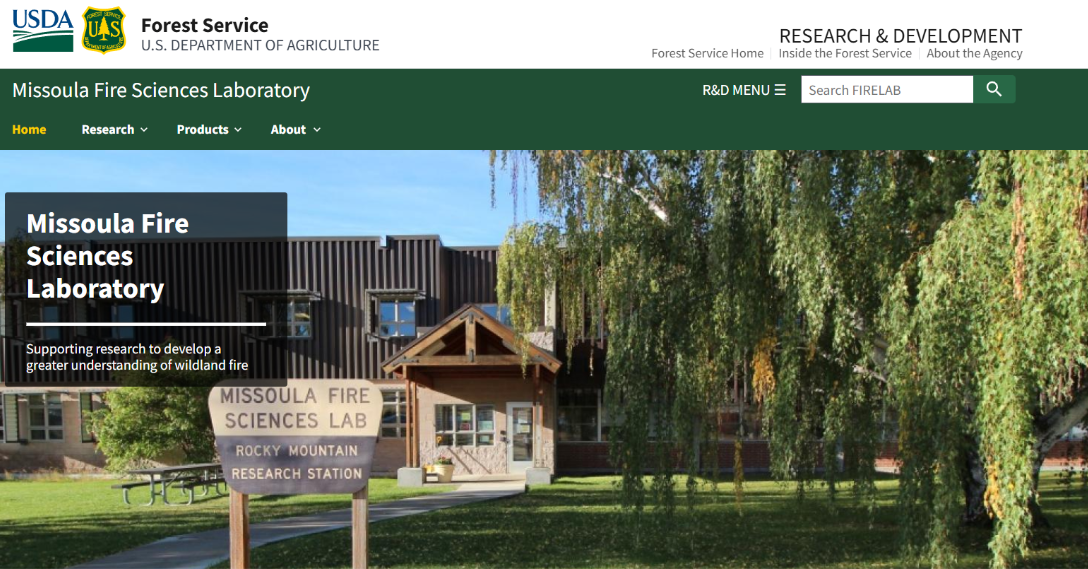
Wildland fire is one of the most complex and consequential natural forces shaping landscapes across the United States. At the center of national efforts to better understand and manage fire is the Missoula Fire Sciences Laboratory, commonly known as the Fire Lab, part of the USDA Forest Service’s Research and Development program.

A Legacy of Fire Research
Dedicated in 1960, the Fire Lab has a long-standing history of supporting scientific research focused on wildland fire. Over the decades, it has grown into a state-of-the-art research facility, reflecting the Forest Service’s ongoing commitment to improving how fire is understood, predicted, and managed across diverse ecosystems.

What Is the Fire Lab?
The Fire Lab’s mission centers on developing a greater understanding of wildland fire through rigorous science. Researchers study fire from multiple angles, recognizing that effective fire management requires insight into fuels, fire behavior, smoke, and decision-making systems. This broad scope allows the Fire Lab to address both the ecological role of fire and the practical challenges faced by land managers.

Research That Informs Real-World Decisions
Research conducted at the Fire Lab spans all aspects of wildland fire, from the characteristics of fuels to fire management systems. This work helps inform how fires behave, how they can be managed more safely, and how landscapes respond before, during, and after fire events. By grounding management strategies in science, the Fire Lab helps bridge the gap between research and on-the-ground application.

Tools, Products, and Practical Support
Beyond research, the Fire Lab develops datasets, tools, and products designed to directly support wildland fire management. These resources are intended for use across the full fire timeline from planning and mitigation before a fire, to decision support during incidents, and evaluation and recovery afterward. The emphasis is on making science accessible and usable for practitioners working in complex and high-stakes environments.

Resources for Land Managers
To further extend its impact, Fire Lab research is synthesized into research summaries and fact sheets that focus on topics especially relevant to land managers. These resources help translate scientific findings into clear, actionable information, supporting informed decision-making across agencies and disciplines.

Why the Fire Lab Matters
As wildland fire continues to shape forests, rangelands, and communities, the work of the Fire Lab remains critically important. By combining long-term research, modern facilities, and practical tools, the Missoula Fire Sciences Laboratory plays a key role in advancing fire science and supporting those tasked with managing fire in an ever-changing landscape.

Filed Under: Prescribed Burn Associations, Prescribed Burning, Wildfire Tagged With: #AgriLifeExtension, #Network, #Resources, #WestTexasRangelands

Spring Weather Outlook By Luke Drosche – Texas A&M AgriLife Extension DAR Specialist

March 18, 2026 by kara.matheney

West Texas Rangelands would like to extend our gratitude to Mr. Luke Drosche for collaborating with us and providing this weather update for our readers.  We thank him for sharing his time, talents, and knowledge with us as a guest contributor.  Luke serves with Texas A&M AgriLife Extension Service as a Disaster Assessment and Recovery Specialist.     

3-Month Precipitation Outlook:
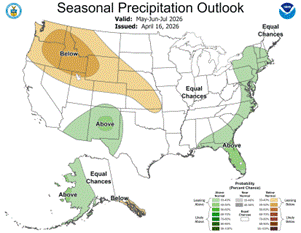
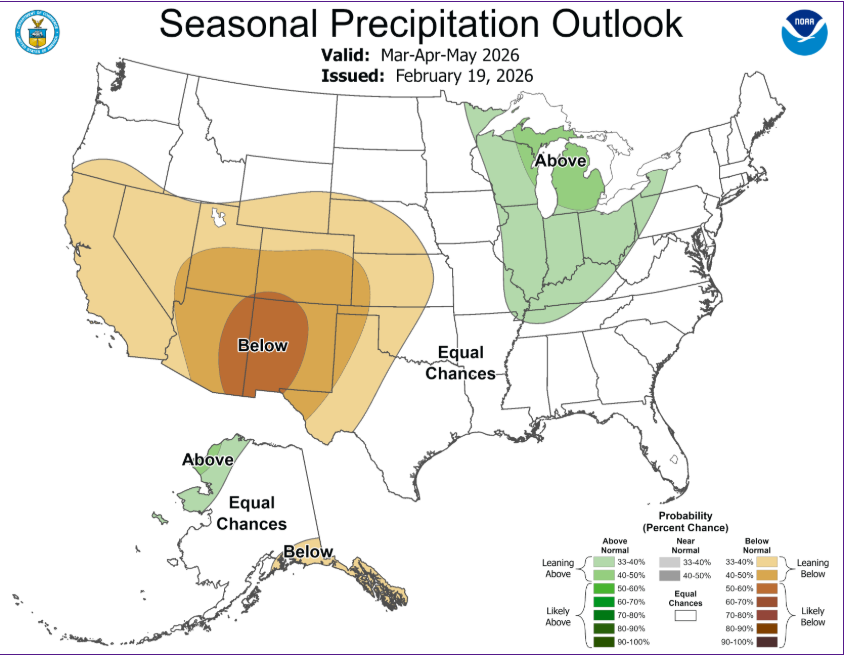
The first few days of March have brought areas of rain and severe storms to a large portion of the State. Those across the Coastal Plains have enjoyed some much-needed precipitation, while our areas in the Panhandle and out west have continue to be mostly dry with the exception of a few supercell thunderstorms. The month of March should continue to bolster higher rain chances before tapering back off closer to May. The 3-month outlook has shown that a majority of the state is in an “Equal Chances” Category for rain. Meaning that we are most likely to mark near normal on our rain gauges.  NOAA has predicated the month of March to be potentially wetter than average for the Northeastern part of the State before marking close to normal through April and May. While the far western and Northwestern areas are forecasted to be drier. This is the time of year we need to make sure we always have a way to receive weather warnings. Severe Weather in Texas is year-round but increases dramatically in the springtime. For anywhere you are in the State of Texas, all modes of Severe weather are possible. It is important to have a plan for you, your family, and your property should severe weather impact you. Know how to communicate, plan to live a few days without power or water, and who to contact if you are affected by severe weather.  Keep an eye to the sky.

3-Month Temperature Outlook:
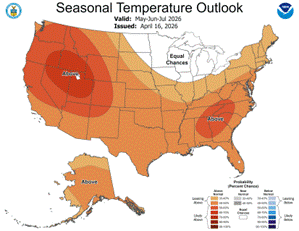
Rinse and Repeat from our winter months is predicted as we remain warmer than average. March has a high likelihood of marking above normal temperature with higher-than-normal temperatures likely through at least May, areas out west have higher potential to be warmer than average.  The entire state is under this prediction due to our current La Nina Conditions. These bring warmer temperatures to our area. However, we are seeing a transition out of La Nina into ENSO Neutral Conditions. This transition will happen over the next few months. Later in the year we look to potentially move into an El Nino weather pattern closer to next Fall. We will take this as a hope for more beneficial rain as 19.2 million of us in the State of Texas are in a Drought Designation.


Drought Update:
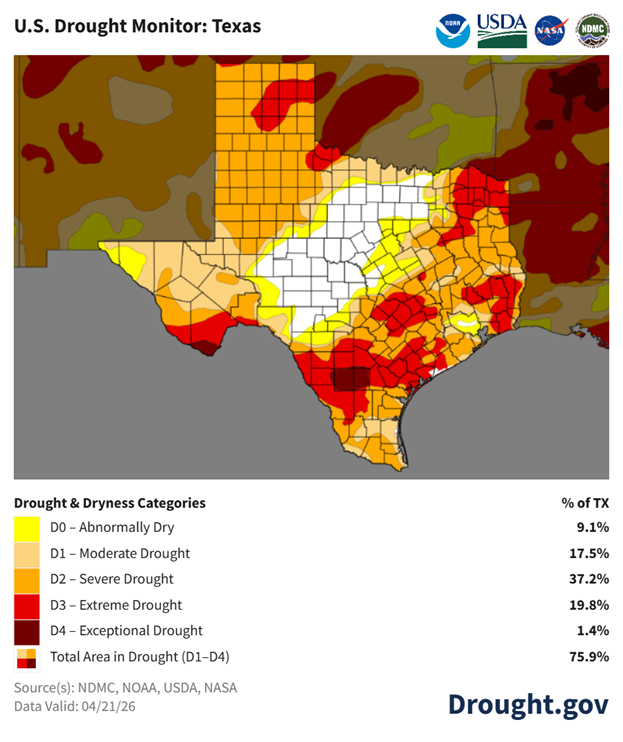
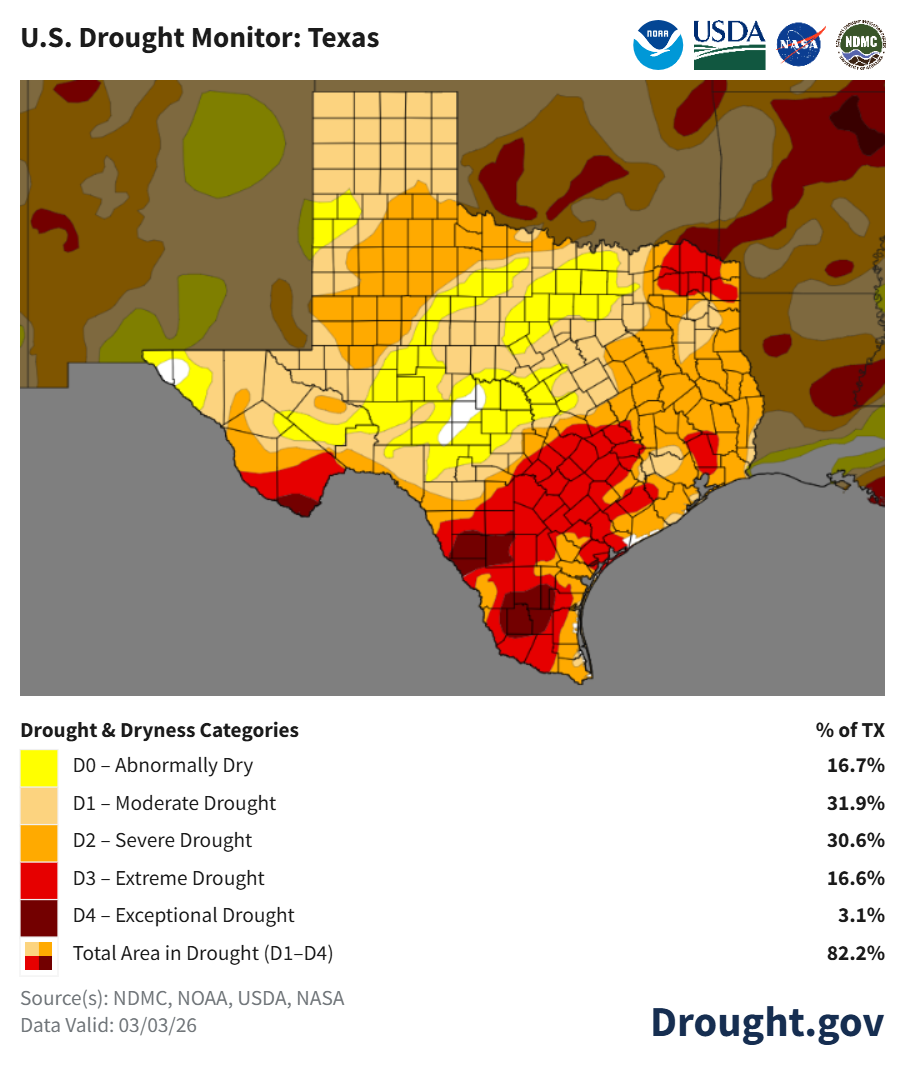
Extreme Drought Conditions persist in Central and South Texas with nearly the entire state in some dryness/drought category.  Panhandle regions remain in Moderate Drought and areas slightly south of there creep into the Severe Drought Designation. Early March’s rain will provide some relief to the Coastal Plains and parts of Central Texas when the next Drought updates come in roughly a month from now. More rainy days are predicted through March and will hopefully continue to improve conditions.  The next few months, March, April, and May typically bring weather systems across much of the state.  These systems pack a punch with severe storms and high rainfall rates.  We always prefer longer, drawn out rainfall events that allow the rainfall to soak into the soil, rather than run off the dry, packed ground. However, once the soil is primed with some moisture from whatever form of rain we get, we benefit more.  With the transition predicted us of La Nina and into ENSO Neutral conditions, we are hopeful for some improvement in overall drought conditions across the State.  Over many months in recent history, we have been in a La Nina designation, which is what has continued to push our drought conditions.  As we transition into Neutral Conditions in the short term, we will see more weather patterns indicative of repeated rainfall come into play.  No doubt we will still see long periods of dry weather, but let’s keep a hopeful eye on next fall as we should move into El Nino Conditions.


References and Resources: https://www.cpc.ncep.noaa.gov/, https://www.drought.gov/states/texas

Filed Under: Conservation, El Niño, La Niña, Uncategorized, Water, Weather Tagged With: #AgrliLifeExtension, #ClimateVariability, #ConservationConversations, #Weather, #WestTexasRangelands, drought

Using Birds to Read Rangeland Health

March 11, 2026 by kara.matheney

Birds are more than just a welcome sight on Texas rangelands. They can also tell us a great deal about the condition of our land. Because birds respond quickly to changes in vegetation, water availability, and management practices, they are valuable indicators of overall land health.

Texas A&M AgriLife Extension Service recently released A Texas Landowner’s Guide to Conducting a Bird Survey, a research-based publication designed to help landowners better understand the bird species using their property and what those observations can reveal about habitat conditions.

Why Conduct a Bird Survey?

Bird surveys give landowners a practical way to “check the pulse” of their property. The presence or absence of certain bird species can reflect changes in plant diversity, forage structure, and wildlife habitat. Rather than focusing on a single species, a general bird survey looks at the broader bird community and how it relates to current land management.

Over time, repeated observations can help landowners track trends, document stewardship efforts, and evaluate whether management goals are being met.

Designed with Landowners in Mind

This AgriLife Extension guide is written specifically for Texas landowners, not professional bird biologists. It introduces bird surveys in a practical, approachable way that fits working ranches and rural properties.

The publication explains the basics of conducting a general bird survey, why bird data are useful for land management, and where to find birding resources and equipment. It is especially helpful for landowners who are new to bird surveys or looking to incorporate wildlife monitoring into an existing management plan.

Turning Observations into Action

Collecting information is only useful if it can inform decisions. Bird survey data can help landowners evaluate habitat conditions, identify areas for improvement, and better understand how wildlife responds to management practices.

While bird surveys are not regulatory requirements, they offer a voluntary, science-based tool that complements broader rangeland and wildlife management strategies. They can also help landowners better communicate their stewardship efforts with partners, agencies, or the community.

Building Skills Over Time

The guide recognizes that bird identification can feel intimidating at first. However, bird surveying is a skill that improves with practice. By using available resources and learning over time, landowners can gain confidence and make bird surveys a meaningful part of their land management toolbox.

Learn More

A Texas Landowner’s Guide to Conducting a Bird Survey is available through Texas A&M AgriLife Extension Service. For more information or assistance, contact your local AgriLife Extension office and explore additional wildlife and rangeland management resources.

Filed Under: Conservation, Conservation Practices, Land, Publications Tagged With: #AgriLifeExtension, #BirdSurvey, #RangelandHealth, #RangelandManagement, #TexasLandowners, #WestTexasRangelands, #WildlifeStewardship

  • « Go to Previous Page
  • Page 1
  • Page 2

Recent Posts

  • Summer Weather Outlook
  • Burn Smarter, Not Just Hotter: Timing Fire for Plant Response in the Edwards Plateau
  • Know Your Stocking Rate Like You Know Your Bank Balance
  • Does Prescribed Fire Ever Cross Your Mind? Join the Prescribed Burn School in Gatesville Next Month!
  • Adaptability Is Key as Drought Persists Across Texas Rangelands

Categories

  • 4-H Range Contests
  • Beef Cattle
  • Brush Management
  • Carbon Credits
  • Carbon Markets
  • Conservation
  • Conservation Practices
  • Drought Management
  • El Niño
  • Events
  • Goats
  • Grazing Management
  • La Niña
  • Land
  • Lessons Learned
  • Meet A County Extension Agent
  • Plant ID
  • Podcast
  • Prescribed Burn Associations
  • Prescribed Burning
  • Publications
  • Range Concepts
  • RAP
  • Sheep
  • Society for Range Management
  • Soil
  • Staff
  • Targeted Grazing
  • Uncategorized
  • Water
  • Weather
  • Why I Ranch
  • Wild Pigs
  • Wildfire
  • Wildfires
  • Wind
  • Woody Encroachment
  • Youth Range Workshop

Archives

Texas A&M AgriLife Extension Service
Texas A&M University System Member
  • Compact with Texans
  • Privacy and Security
  • Accessibility Policy
  • State Link Policy
  • Statewide Search
  • Veterans Benefits
  • Military Families
  • Risk, Fraud & Misconduct Hotline
  • Texas Homeland Security
  • Texas Veteran's Portal
  • Equal Opportunity
  • Open Records/Public Information