• Skip to primary navigation
  • Skip to main content
  • Skip to primary sidebar
  • Texas A&M Forest Service
  • Texas A&M Veterinary Medical Diagnostics Laboratory
  • Texas A&M AgriLife Extension Service
  • Texas A&M AgriLife Research
  • Texas A&M College of Agrculture and Life Sciences
West Texas Rangelands
West Texas RangelandsWe hope to provide a variety of science-based rangeland information and current research on prescribed fire, wildfires, brush management, and grazing management!
  • Menu
  • Home
  • About & Contact
  • Publications
    • Extension Publications
    • Refereed Journal Articles
    • Program Summaries
  • Events
  • Lunch N’ Learn
  • Infographics
    • Drought
    • Grazing
    • Herbicide
    • Prescribed Fire
    • Rangeland Plants
    • Wildfire
  • Range Resources
    • Published to Pasture
    • Range Concepts
  • Fire Resources
  • Sponsors
  • AgriLife Learn Online Courses

A Tale of Two Texas Landscapes: Drought Conditions and the Road Ahead

April 29, 2026 by kara.matheney

West Texas Rangelands would like to extend our gratitude to Mr. Luke Drosche for collaborating with us and providing this weather update for our readers.  We thank him for sharing his time, talents, and knowledge with us as a guest contributor.  Luke serves with Texas A&M AgriLife Extension Service as a Disaster Assessment and Recovery Specialist.     

3-Month Precipitation Outlook
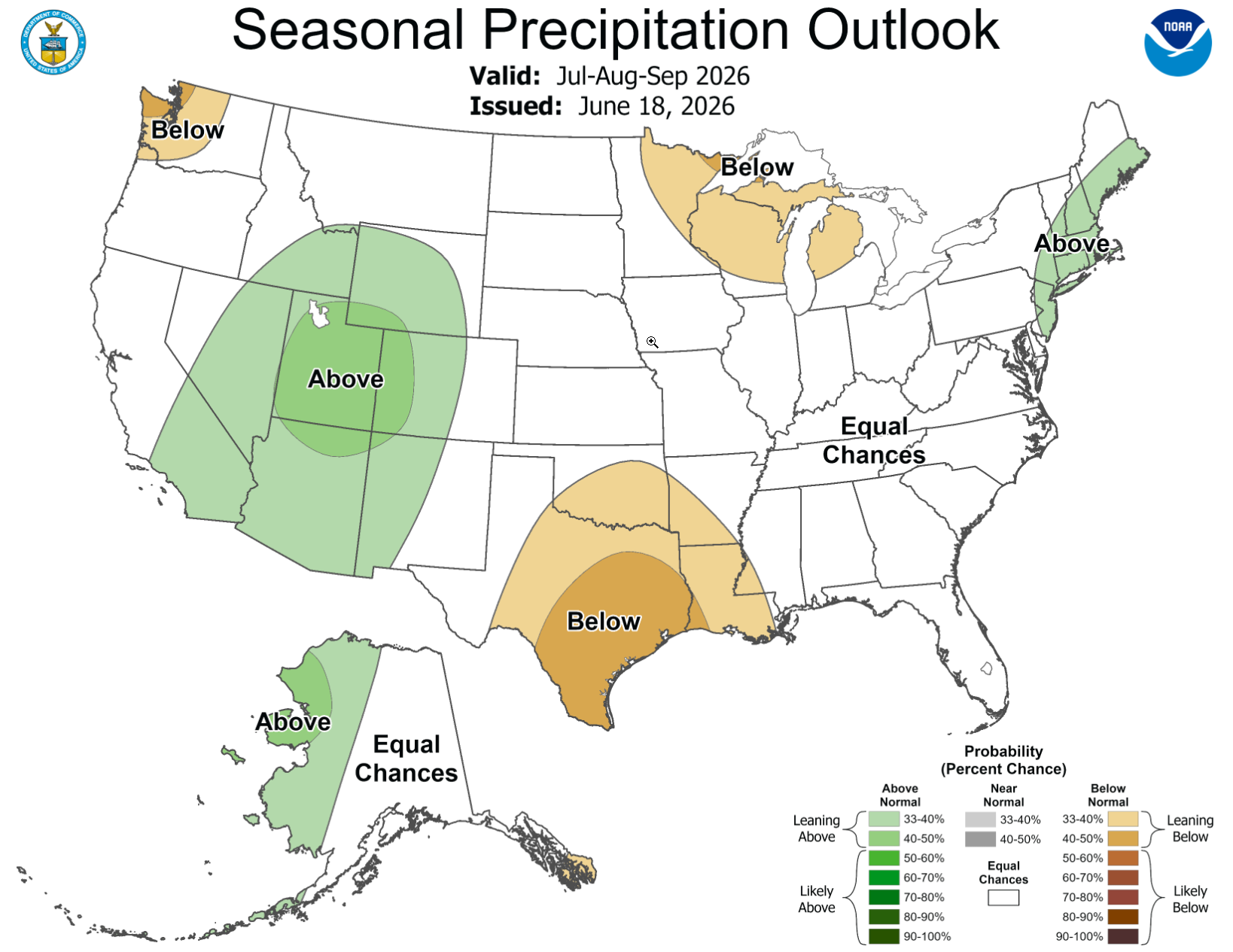
The end of April has brought heavy rainfall to a good 70% of the State. Springtime months are typically beneficial for Texas, bringing in showers that, unfortunately, pack a punch with severe weather attached.  Large Hail, Damaging Winds, Flash Flooding, and even Tornados are more common in March, April, and May, and will continue while our summertime heat and Hurricane season kick off.  More of this can be expected through May and stretching into the Mid-Summer months, according to NOAA’s 3-month outlook. This forecast keeps Texas in an Equal Chances Category through the early summer for marking near average on our rain gauges.  The forecast specifically mentions areas that have received rainfall in April, having better chances of finding more rain through early June due to the moistened topsoil.
Areas in far West Texas and far west of the Panhandle are in a slightly above-average chances category.  These equal and above probabilities are following our large-scale weather pattern, working to make a major shift.  Currently, we are in an ENSO Neutral period, meaning we are not in either La Niña or El Niño.  But as we move through May and June, we are expecting to move into the El Niño phase.  This will prompt better rain chances for all of the State, and typically reduces our likelihood of seeing hurricane impacts, although hurricanes in the Gulf and hitting Texas are still possible.

3-Month Temperature Outlook
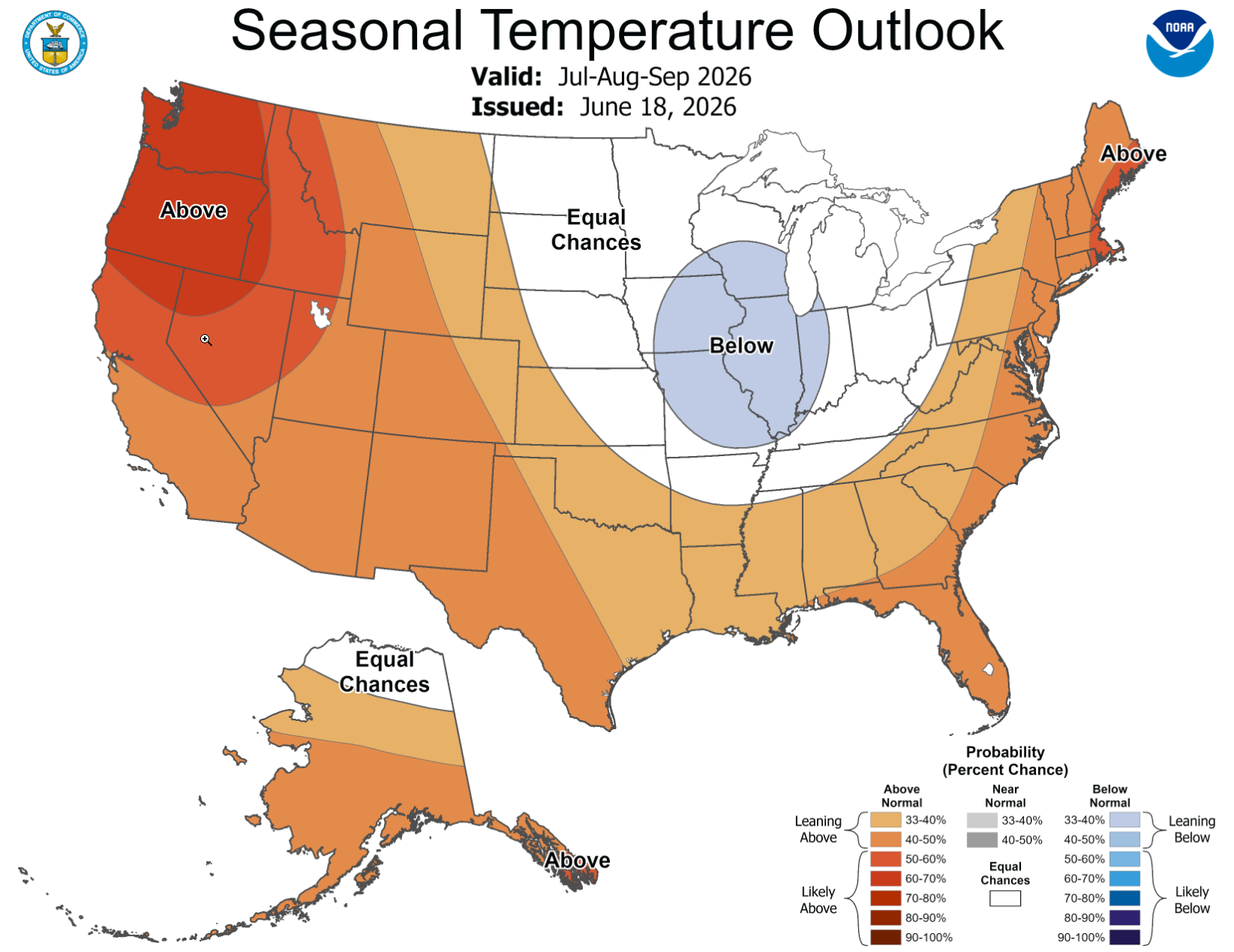
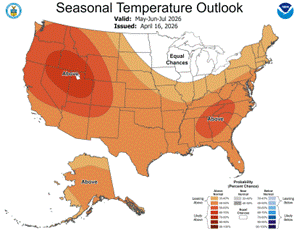
Summertime is here early.  All of Texas has a “Leaning Above” designation for hitting warmer-than-average temperatures through July.  Parts of Texas have already seen these warm summer temperatures and even heat advisories/warnings. With our increased moisture over the State, these warmer temperatures will feel more stifling.  It is important to remember to stay hydrated, take breaks in the shade, and make sure our livestock and pets have access to drinking water.  Practice summer weather-resistant strategies now; these warm temperatures are not going anywhere anytime soon.

Drought Update
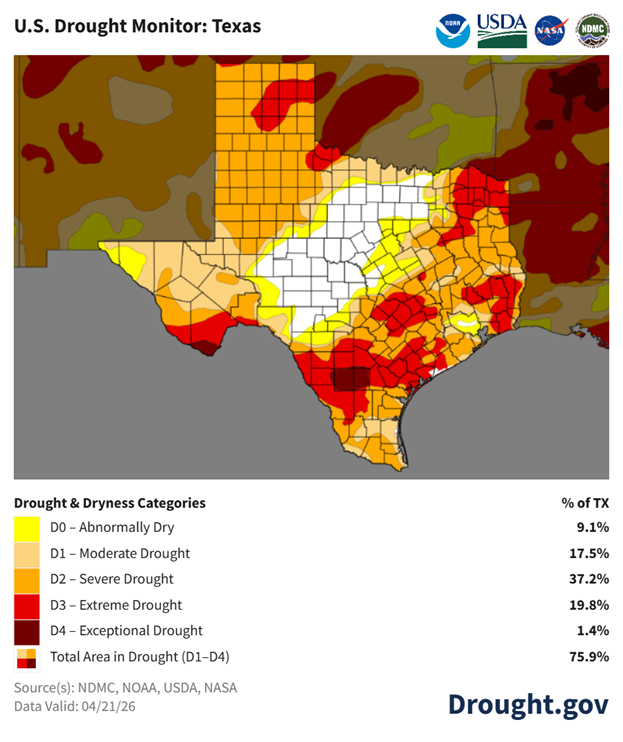
There is a tale of two stories this month since I last discussed drought with you all.  The Panhandle and Eastern parts of Texas have found drying, worsening conditions, and are currently under Severe and Extreme Drought. In the Northern Hill County, up through the DFW Metroplex, we have seen massive steps in a positive direction, as these areas are in no drought designation. This area is roughly 25% of the State of Texas and had been in the Dry to Severe Categories prior to this update. As of April 21st, around 60% of the State is in worse, Severe to Exceptional Drought categories.   Due to heavy rain since this map’s last update, 2-4 inches in the last 2 weeks, I expect to see areas around San Antonio and East along I-10 to North Houston get bumped down a drought category, and the total Severe to Exceptional percentage to go down. Far South Texas into the Valley should also see some lessening of the current extreme conditions they are in from rainfall in the last two weeks, 0.5-3 inches.

Recent forecasts and news calling for the early transition into a strong El Niño Pattern makes me believe that we will find some drought relief across much of the State over the next few months.  Strong El Niño patterns have previously provided heavy rainfall events that have helped to boost our water storage and ease drought conditions overall, but not totally erase them.  Along with higher chances of rain, stronger chances of severe weather and flash flooding will persist. Now is the time to make sure you and your operation are ready for adverse conditions.  Always have a way to receive weather warnings, have a plan, and practice that plan.  Let’s hope for beneficial rain without any of its rude partners, stay safe my friends.

References:
https://www.cpc.ncep.noaa.gov/
https://www.drought.gov/states/texas
Filed Under: El Niño, La Niña, Weather Tagged With: #Weather, drought, Drought Management, El Niño, La Nina

Spring Weather Outlook By Luke Drosche – Texas A&M AgriLife Extension DAR Specialist

March 18, 2026 by kara.matheney

West Texas Rangelands would like to extend our gratitude to Mr. Luke Drosche for collaborating with us and providing this weather update for our readers.  We thank him for sharing his time, talents, and knowledge with us as a guest contributor.  Luke serves with Texas A&M AgriLife Extension Service as a Disaster Assessment and Recovery Specialist.     

3-Month Precipitation Outlook:
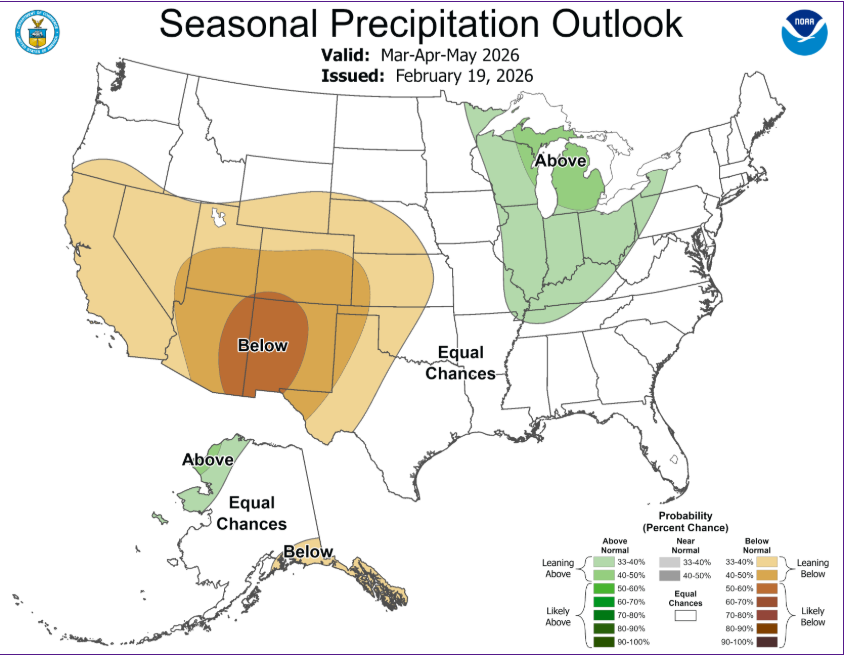
The first few days of March have brought areas of rain and severe storms to a large portion of the State. Those across the Coastal Plains have enjoyed some much-needed precipitation, while our areas in the Panhandle and out west have continue to be mostly dry with the exception of a few supercell thunderstorms. The month of March should continue to bolster higher rain chances before tapering back off closer to May. The 3-month outlook has shown that a majority of the state is in an “Equal Chances” Category for rain. Meaning that we are most likely to mark near normal on our rain gauges.  NOAA has predicated the month of March to be potentially wetter than average for the Northeastern part of the State before marking close to normal through April and May. While the far western and Northwestern areas are forecasted to be drier. This is the time of year we need to make sure we always have a way to receive weather warnings. Severe Weather in Texas is year-round but increases dramatically in the springtime. For anywhere you are in the State of Texas, all modes of Severe weather are possible. It is important to have a plan for you, your family, and your property should severe weather impact you. Know how to communicate, plan to live a few days without power or water, and who to contact if you are affected by severe weather.  Keep an eye to the sky.

3-Month Temperature Outlook:
Rinse and Repeat from our winter months is predicted as we remain warmer than average. March has a high likelihood of marking above normal temperature with higher-than-normal temperatures likely through at least May, areas out west have higher potential to be warmer than average.  The entire state is under this prediction due to our current La Nina Conditions. These bring warmer temperatures to our area. However, we are seeing a transition out of La Nina into ENSO Neutral Conditions. This transition will happen over the next few months. Later in the year we look to potentially move into an El Nino weather pattern closer to next Fall. We will take this as a hope for more beneficial rain as 19.2 million of us in the State of Texas are in a Drought Designation.


Drought Update:
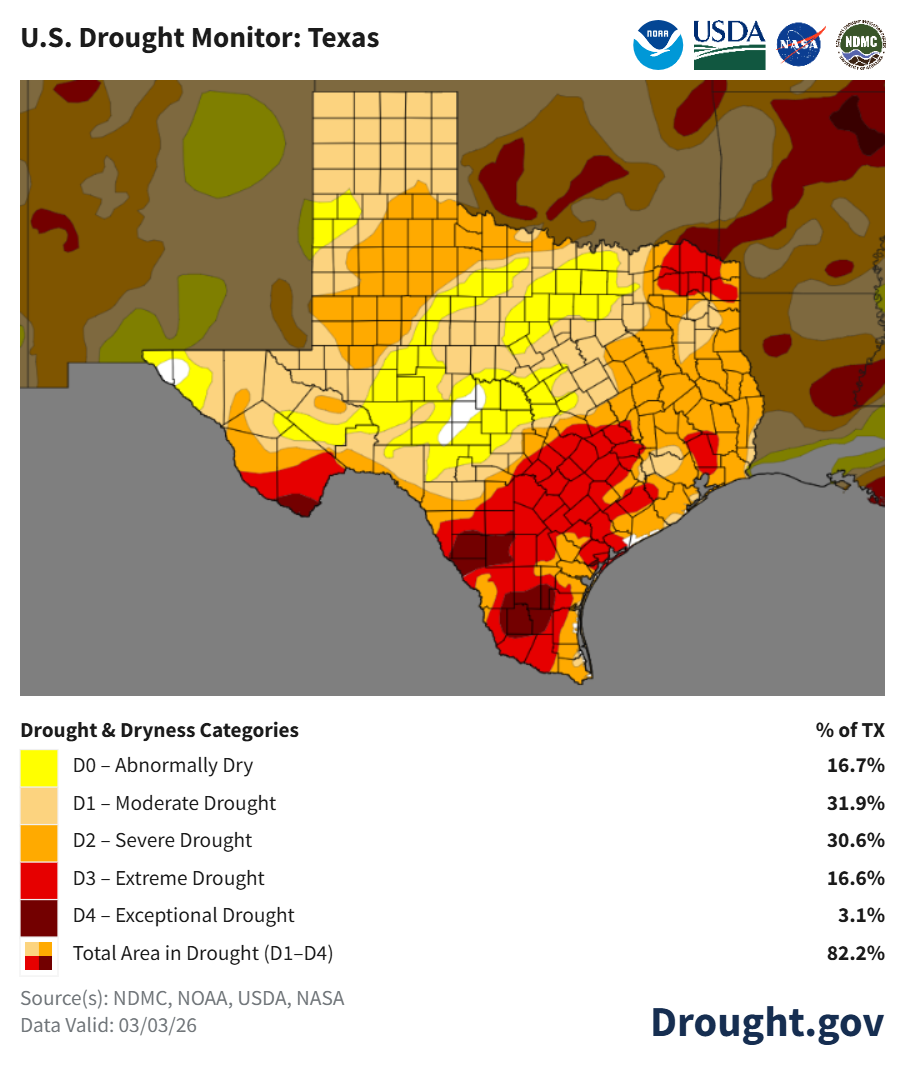
Extreme Drought Conditions persist in Central and South Texas with nearly the entire state in some dryness/drought category.  Panhandle regions remain in Moderate Drought and areas slightly south of there creep into the Severe Drought Designation. Early March’s rain will provide some relief to the Coastal Plains and parts of Central Texas when the next Drought updates come in roughly a month from now. More rainy days are predicted through March and will hopefully continue to improve conditions.  The next few months, March, April, and May typically bring weather systems across much of the state.  These systems pack a punch with severe storms and high rainfall rates.  We always prefer longer, drawn out rainfall events that allow the rainfall to soak into the soil, rather than run off the dry, packed ground. However, once the soil is primed with some moisture from whatever form of rain we get, we benefit more.  With the transition predicted us of La Nina and into ENSO Neutral conditions, we are hopeful for some improvement in overall drought conditions across the State.  Over many months in recent history, we have been in a La Nina designation, which is what has continued to push our drought conditions.  As we transition into Neutral Conditions in the short term, we will see more weather patterns indicative of repeated rainfall come into play.  No doubt we will still see long periods of dry weather, but let’s keep a hopeful eye on next fall as we should move into El Nino Conditions.


References and Resources: https://www.cpc.ncep.noaa.gov/, https://www.drought.gov/states/texas
Filed Under: Conservation, El Niño, La Niña, Uncategorized, Water, Weather Tagged With: #AgrliLifeExtension, #ClimateVariability, #ConservationConversations, #Weather, #WestTexasRangelands, drought

Recent Posts

  • A Tale of Two Texas Landscapes: Drought Conditions and the Road Ahead
  • The Hidden Cost of Overgrazing: How It Drains Your Watershed, Your Rainfall, and Your Bottom Line
  • Economic Incentives for Reducing Wildfire Risk
  • Building Knowledge and Confidence with the Updated Online Prescribed Burn School
  • The Cost of Prolonged Overgrazing: Ripple Effects on Watershed Health, Rainfall Infiltration, and Ranch Production

Categories

  • 4-H Range Contests
  • Beef Cattle
  • Brush Management
  • Carbon Credits
  • Carbon Markets
  • Conservation
  • Conservation Practices
  • Drought Management
  • El Niño
  • Events
  • Goats
  • Grazing Management
  • La Niña
  • Land
  • Lessons Learned
  • Meet A County Extension Agent
  • Plant ID
  • Podcast
  • Prescribed Burn Associations
  • Prescribed Burning
  • Publications
  • Range Concepts
  • RAP
  • Sheep
  • Society for Range Management
  • Soil
  • Staff
  • Targeted Grazing
  • Uncategorized
  • Water
  • Weather
  • Why I Ranch
  • Wild Pigs
  • Wildfire
  • Wildfires
  • Wind
  • Woody Encroachment
  • Youth Range Workshop

Archives

Texas A&M AgriLife Extension Service
Texas A&M University System Member
  • Compact with Texans
  • Privacy and Security
  • Accessibility Policy
  • State Link Policy
  • Statewide Search
  • Veterans Benefits
  • Military Families
  • Risk, Fraud & Misconduct Hotline
  • Texas Homeland Security
  • Texas Veteran's Portal
  • Equal Opportunity
  • Open Records/Public Information