Article written by Hayden Webb
West Texas Rangelands Intern
Graduate Student – Texas A&M University
It is no mystery that honey mesquite is one of the most difficult brush species for West Texas landowners to manage. Its ability to resprout and its deep root system make it one of the most resilient plants on Texas rangelands. Because of these traits, long-term control often requires herbicide treatment.
Prescribed fire is the most cost-effective brush management tool available to landowners (Van Liew et al. 2012), but it often struggles to overcome mesquite’s well-protected bud bank—the source of its ability to resprout. Research has shown that while fire is effective at top-killing mesquite, its ability to achieve true mortality, or root kill, is much lower than desired. In a 2022 Texas A&M study, high-intensity fires top-killed 100% of mesquite trees, but only 29% of those trees failed to resprout (Starns et al. 2022). Although this was the highest mortality rate achieved by fire in recent mesquite studies, researchers had to add extra fuel around the base of each tree to create fire intensities that would be difficult to achieve under natural conditions.
While this study demonstrated that fire can kill mesquite roots even outside drought conditions, these mortality rates still do not compare to those achieved with herbicides such as Sendero or Remedy.
All is not lost for landowners hoping to reduce mesquite recruitment with prescribed fire. A North Texas study published this year by Ansley et al. provides new insight into the vulnerability of mesquite seedlings to fire and identifies the factors that most influence seedling mortality.
Fire Temperature Duration
Laboratory studies have long suggested that plant tissue dies when exposed to temperatures of at least 140°F for one minute or longer (Van Wagner, 1973). However, it has remained unclear whether these findings apply to woody resprouting species in field conditions.
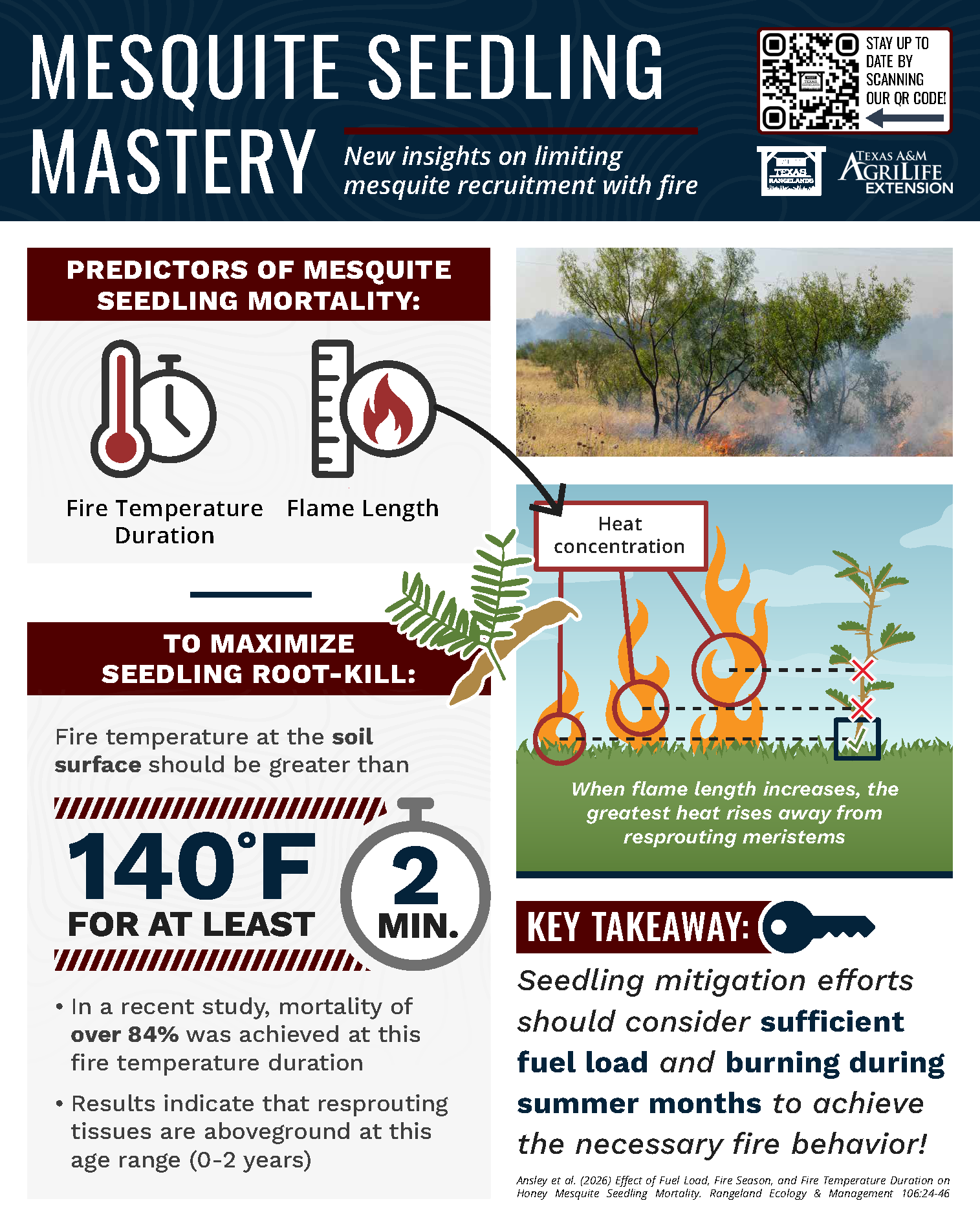
Ansley et al. found that to maximize root kill in mesquite seedlings between 0 and 2 years old, temperatures at the soil surface must remain at or above 140°F for at least two minutes. Under these conditions, summer fires achieved mortality rates greater than 84%, regardless of fuel type.
The fact that these mortality rates were only achieved when heat remained at the soil surface for a sufficient amount of time suggests that the tissues responsible for resprouting are still located above ground in very young seedlings. Because soil is an excellent insulator, fire-induced mortality may only be possible until those resprouting tissues move below the soil surface as the plant matures.
Predictors of Seedling Mortality
The strongest predictor of mesquite seedling mortality was flame length, followed by fire temperature duration. As flame lengths increase, the hottest part of the fire moves farther away from the soil surface. As a result, longer flames may actually reduce the likelihood of root kill because less heat is concentrated where it is needed most.
Wind is a major factor that increases flame length, but it also speeds up the movement of the fire front. Landowners hoping to maximize mesquite seedling mortality should recognize that summer burns and headfires may produce taller flames and faster-moving fires. In some cases, the fire may not remain over a seedling long enough to maintain the recommended two-minute heating period at the soil surface.
Importance of Fire Season and Fuel Load
Both fire season and fuel load play important roles in producing the fire behavior needed to kill mesquite seedlings. The highest temperatures and longest heating durations occurred during summer burns, and the greatest mortality rates were also achieved during the summer.
Conditions common during summer burns, including high temperatures, low fuel moisture, stronger winds, and rainfall deficits, help create more intense fires. High fuel loads, especially in tallgrass prairie ecosystems, further increase fire intensity and improve the chances of achieving seedling mortality.
Because the study found lower mortality rates during winter burns and in mixed-grass systems with lower fuel loads, landowners should consider taking advantage of summer burn opportunities whenever possible.
The Big Takeaway
Managing woody resprouting plants remains one of the greatest challenges facing Texas landowners and rangeland managers. Honey mesquite is especially difficult to control because its belowground bud bank allows it to survive drought, disturbance, and even fire.
However, prescribed fire can help limit future mesquite recruitment by killing seedlings between 0 and 2 years of age. To achieve mortality, temperatures at the soil surface must reach at least 140°F and remain there for a minimum of two minutes. Landowners can improve their chances of meeting these conditions by burning during summer windows and allowing fine fuels to accumulate before a prescribed burn.
Citations:
Ansley, R. J. et al. (2026) Effect of Fuel Load, Fire Season, and Fire Temperature Duration on Honey Mesquite Seedling Mortality. Rangeland Ecology & Management 106:24-46
Van Liew, D. et al. (2012) An economic comparison of prescribed extreme fire and alternative methods for managing invasive brush species in Texas: a modeling approach. The Open Agricultural Journal 6.1
Starns, Heath, et al. “Prosopis glandulosa persistence is facilitated by differential protection of buds during low-and high-energy fires.” Journal of Environmental Management 303(2022) 114141
Van Wagner, C. E. (1973) Height of Crown Scorch in Forest Fires.Canadian Journal for Restoration. 3: 373-378.