• Skip to primary navigation
  • Skip to main content
  • Skip to primary sidebar
  • Texas A&M Forest Service
  • Texas A&M Veterinary Medical Diagnostics Laboratory
  • Texas A&M AgriLife Extension Service
  • Texas A&M AgriLife Research
  • Texas A&M College of Agrculture and Life Sciences
West Texas Rangelands
West Texas RangelandsWe hope to provide a variety of science-based rangeland information and current research on prescribed fire, wildfires, brush management, and grazing management!
  • Menu
  • Home
  • About & Contact
  • Publications
    • Extension Publications
    • Refereed Journal Articles
    • Program Summaries
  • Events
  • Lunch N’ Learn
  • Infographics
    • Drought
    • Grazing
    • Herbicide
    • Prescribed Fire
    • Rangeland Plants
    • Wildfire
  • Range Resources
    • Published to Pasture
    • Range Concepts
  • Fire Resources
  • Sponsors
  • AgriLife Learn Online Courses

Economic Incentives for Reducing Wildfire Risk

April 15, 2026 by kara.matheney

What Landowners, Educators, and Technical Assistance Providers Should Know
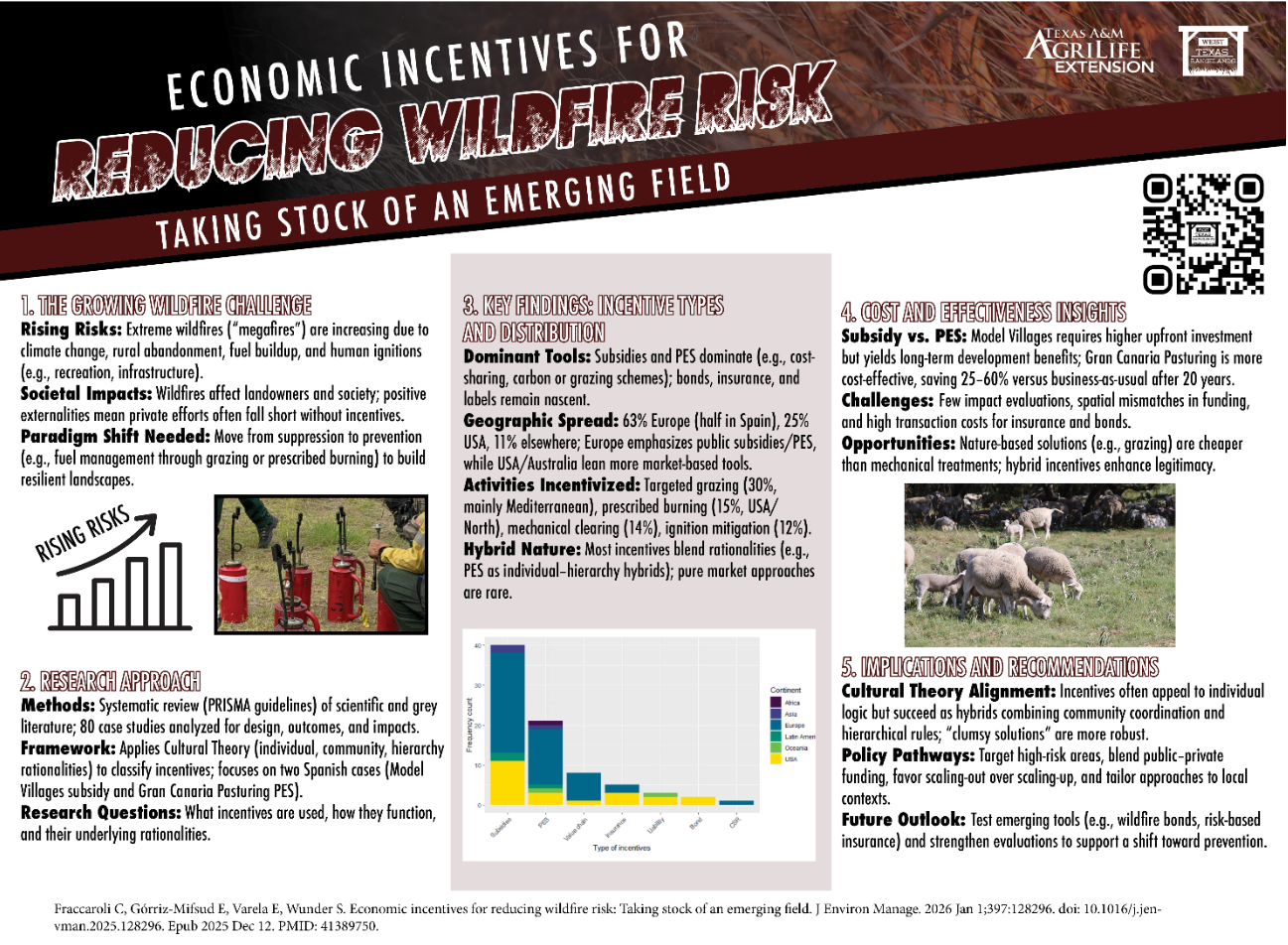
Wildfire risk across Texas rangelands and working lands continues to rise. Larger fires, longer fire seasons, and increased exposure at the wildland–urban interface are no longer isolated concerns, they are becoming part of routine land management decisions. While traditional wildfire response has focused heavily on suppression, growing attention is being given to prevention and risk reduction, particularly through economic incentives that encourage proactive land stewardship.  Recent research examining economic incentives for reducing wildfire risk highlights both opportunities and challenges for landowners and those who support them through education and technical assistance.

Why Wildfire Risk Is Increasing
Several interacting forces are driving higher wildfire risk on rangelands:

  • Climate and weather variability, including hotter temperatures and more frequent droughts
  • Fuel buildup from invasive grasses, brush encroachment, and reduced disturbance
  • Land use change and fragmentation, which complicates coordinated fire management

The social and economic impacts extend beyond burned acres. Wildfires affect ranch operations, infrastructure, natural resources, insurance markets, and community safety. As a result, there is growing interest in tools that shift investments from post-fire response to pre-fire prevention.

What Are Economic Incentives for Wildfire Risk Reduction?
Economic incentives are mechanisms designed to lower the financial barriers to adopting wildfire-mitigating practices or to reward landowners for reducing risk on their properties. The research summarized in the infographic identifies four broad categories of incentives:

  1. Command-and-Control Policies – These include regulations such as burn bans, fuel treatment requirements, or zoning rules. While they can be effective in certain contexts, they often face resistance if they limit landowner flexibility or fail to account for local conditions.
  2. Information-Based Incentives – Programs such as cost-share education, outreach campaigns, and technical guidance aim to increase awareness and capacity. These approaches are common in Extension programming and are most effective when paired with financial or operational support.
  3. Market-Based Incentives
    • Cost-share programs for prescribed burning, brush management, or grazing infrastructure
    • Payments for ecosystem services
    • Insurance premium adjustments tied to risk reduction
    • Research shows that direct subsidies and cost-share programs are among the most frequently used and most studied incentive types for wildfire risk reduction.
  4. Hybrid Incentives – Hybrid approaches combine regulatory frameworks with market or informational tools. For example, insurance programs that reward compliance with fuel management standards.

Cost, Effectiveness, and Tradeoffs
One of the most important takeaways for landowners and advisors is that upfront investment matters, but long-term savings can be substantial.

  • Prescribed burning, targeted grazing, and mechanical treatments require planning and initial costs.
  • Over time, these practices can reduce wildfire suppression costs, limit infrastructure damage, and improve ecological resilience.
  • Studies summarized in the research indicate that prevention investments can yield significant cost savings compared to repeated emergency response and recovery.

However, challenges remain:

  • Incentive programs are often short-term, while wildfire risk reduction requires sustained management.
  • Programs may not align well with local ecological conditions or landowner objectives.
  • Participation can be limited by administrative burden or lack of technical support.

Implications for Extension and Technical Assistance
For Extension educators and technical assistance providers, the findings reinforce several key points:

  • Cultural context matters. Landowners are more likely to engage when incentives align with local norms, production goals, and stewardship values.
  • One-size-fits-all approaches rarely work. Flexible, locally adapted programs outperform rigid designs.
  • Education alone is not enough. Information is most effective when paired with financial or operational incentives that reduce risk and uncertainty for landowners.

Extension’s trusted role positions educators to:

  • Translate incentive opportunities into practical decision tools
  • Facilitate cooperative approaches across fence lines
  • Support landowners in navigating cost-share, insurance, and hybrid programs

Looking Ahead
As wildfire risk continues to shape rangeland management, future incentive programs are likely to place greater emphasis on:

  • Long-term contracts and sustained funding
  • Risk-based insurance models
  • Integrated approaches that combine grazing management, prescribed fire, and fuel reduction

For landowners, proactive participation in wildfire risk reduction can protect livelihoods, landscapes, and communities. For educators and technical assistance providers, aligning economic incentives with sound land management remains a powerful strategy for building more fire-resilient rangelands.

Learn More and Stay Connected
For additional resources on rangeland fire management, prescribed burning, and incentive programs, contact your local Extension office or rangeland specialist.

Filed Under: Brush Management, Conservation Practices, Prescribed Burn Associations, Prescribed Burning, Range Concepts, Wildfire, Wildfires, Woody Encroachment Tagged With: #AgriLifeExtension, #FireResilientLandscapes, #PrescribedFire, #RangelandManagement, #TargetedGrazing, #WestTexasRangelands, #WildfireRisk, #WorkingLands

Advancing Wildland Fire Science: Inside the USDA Forest Service Fire Lab

March 25, 2026 by kara.matheney

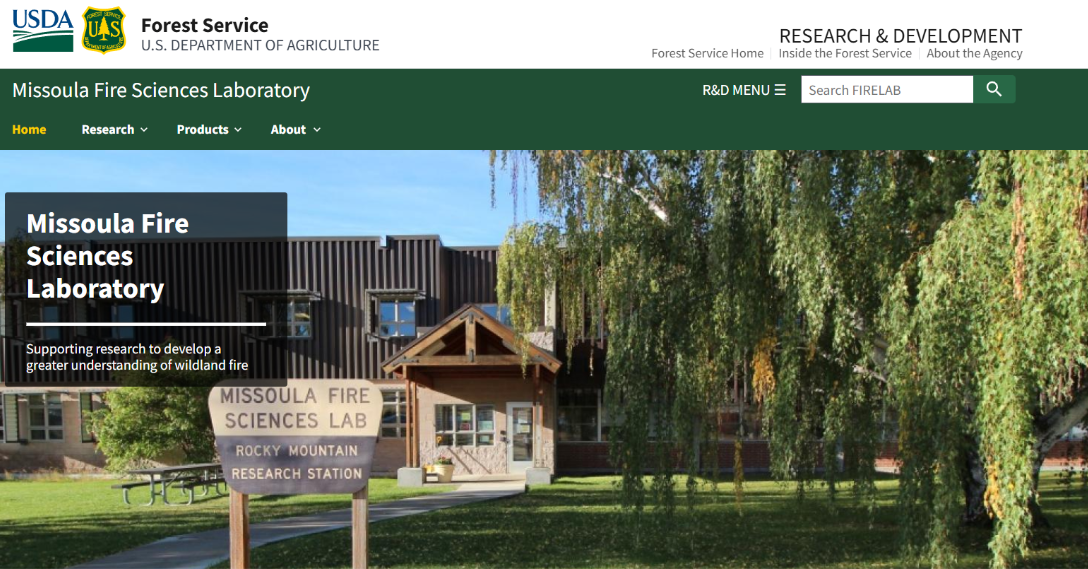
Wildland fire is one of the most complex and consequential natural forces shaping landscapes across the United States. At the center of national efforts to better understand and manage fire is the Missoula Fire Sciences Laboratory, commonly known as the Fire Lab, part of the USDA Forest Service’s Research and Development program.

A Legacy of Fire Research
Dedicated in 1960, the Fire Lab has a long-standing history of supporting scientific research focused on wildland fire. Over the decades, it has grown into a state-of-the-art research facility, reflecting the Forest Service’s ongoing commitment to improving how fire is understood, predicted, and managed across diverse ecosystems.

What Is the Fire Lab?
The Fire Lab’s mission centers on developing a greater understanding of wildland fire through rigorous science. Researchers study fire from multiple angles, recognizing that effective fire management requires insight into fuels, fire behavior, smoke, and decision-making systems. This broad scope allows the Fire Lab to address both the ecological role of fire and the practical challenges faced by land managers.

Research That Informs Real-World Decisions
Research conducted at the Fire Lab spans all aspects of wildland fire, from the characteristics of fuels to fire management systems. This work helps inform how fires behave, how they can be managed more safely, and how landscapes respond before, during, and after fire events. By grounding management strategies in science, the Fire Lab helps bridge the gap between research and on-the-ground application.

Tools, Products, and Practical Support
Beyond research, the Fire Lab develops datasets, tools, and products designed to directly support wildland fire management. These resources are intended for use across the full fire timeline from planning and mitigation before a fire, to decision support during incidents, and evaluation and recovery afterward. The emphasis is on making science accessible and usable for practitioners working in complex and high-stakes environments.

Resources for Land Managers
To further extend its impact, Fire Lab research is synthesized into research summaries and fact sheets that focus on topics especially relevant to land managers. These resources help translate scientific findings into clear, actionable information, supporting informed decision-making across agencies and disciplines.

Why the Fire Lab Matters
As wildland fire continues to shape forests, rangelands, and communities, the work of the Fire Lab remains critically important. By combining long-term research, modern facilities, and practical tools, the Missoula Fire Sciences Laboratory plays a key role in advancing fire science and supporting those tasked with managing fire in an ever-changing landscape.

Filed Under: Prescribed Burn Associations, Prescribed Burning, Wildfire Tagged With: #AgriLifeExtension, #Network, #Resources, #WestTexasRangelands

Fire Field Day – Mason, Tx: A Hands-On Learning Experience for Landowners

March 4, 2026 by morgan.treadwell

Landowners, ranchers, and natural resource managers across the region are invited to take part in an exciting and educational Fire Field Day.  The event is slated for March 21, 2026, at the scenic White Ranch in Mason, Texas. This in-person workshop offers a unique opportunity to learn directly from prescribed fire experts and the Central Basin Prescribed Burn Association (PBA).

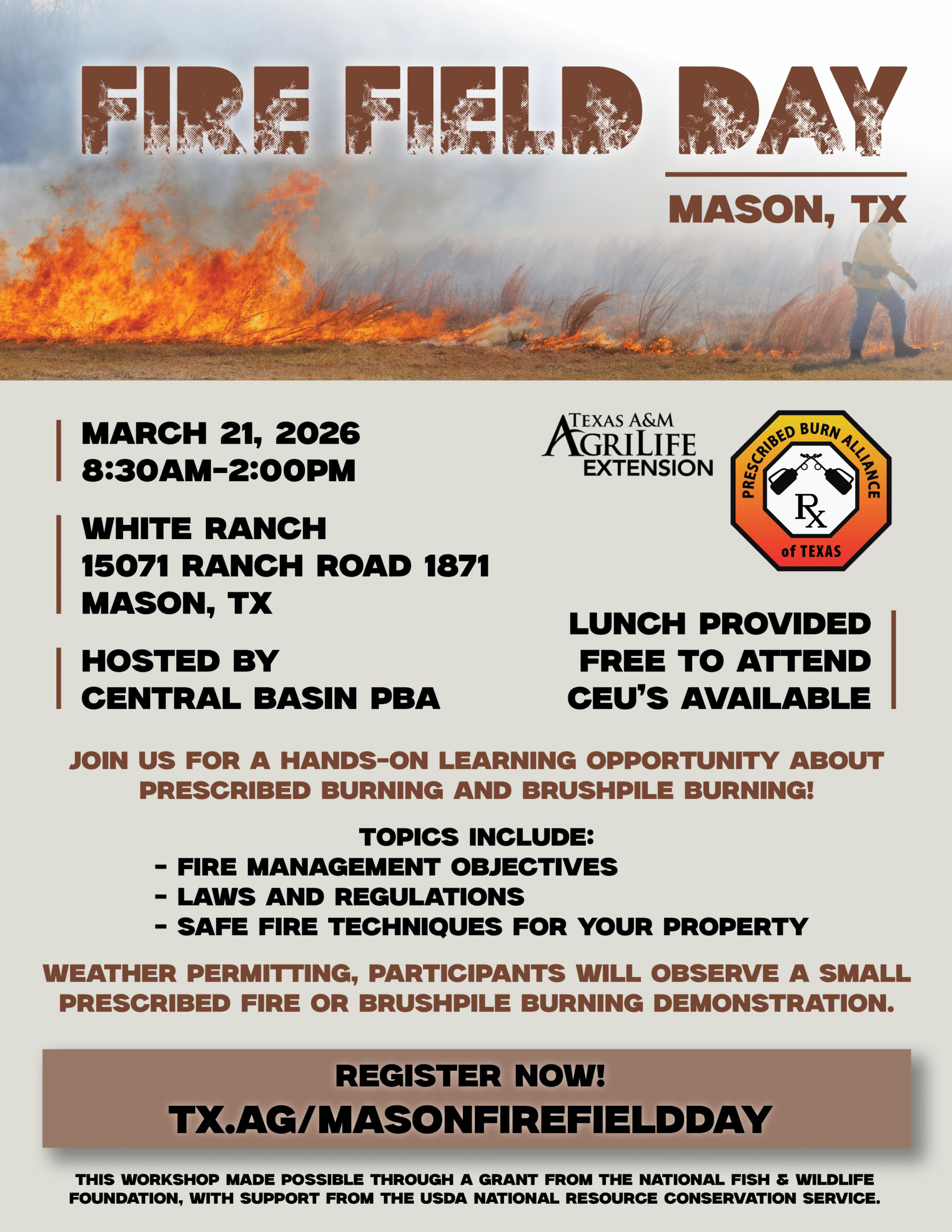
With growiA promotional flyer for a “Fire Field Day” event in Mason, Texas, featuring a background photo of an active grass fire with flames and smoke. Event details include date, time, location at White Ranch, and host information. The flyer highlights topics such as prescribed burning, brushpile burning, fire management objectives, regulations, and safe techniques. It notes lunch is provided, the event is free, CEUs are available, and participants may observe a live demonstration. A registration link is included at the bottom.ng interest in safe and effective rangeland management practices, prescribed fire has become an essential tool for improving rangeland health, reducing wildfire risk, and managing brush and tree encroachment. This event is designed to equip participants with both foundational knowledge and practical, hands-on experience.

What to Expect at Fire Field Day
The workshop runs from 8:30am to 2:00pm, and lunch will be provided at no cost to attendees. The day includes expert-led discussions and demonstrations focusing on:

⭐ Fire Management Objectives
Learn why fire is such an effective ecological tool, how it benefits rangelands, and what outcomes you can expect when applying prescribed burning on your property.

⭐ Laws and Regulations
Prescribed fire is a powerful tool that comes with responsibilities. Attendees will gain clarity on Texas laws governing burn plans, permitting, liability, and proper safety protocols.

⭐ Safe Fire Techniques for Your Property
From ignition methods to firebreak preparation, participants will walk away with practical strategies they can apply at home.

Weather permitting, the event will also feature a live prescribed fire or brushpile burn demonstration, giving attendees a chance to observe fire behavior and management techniques in real time.

This Fire Field Day is proudly hosted by the Central Basin Prescribed Burn Association, with support from Texas A&M AgriLife Extension and the Prescribed Burn Alliance of Texas. These organizations are committed to helping landowners apply safe, science-based fire practices to improve their rangeland and encourage healthier ecosystems across the region.

Why Prescribed Fire Matters
Prescribed burning is one of the most cost-effective and natural methods for managing unwanted brush and trees, improving wildlife habitat, stimulating new plant growth, and reducing the intensity of future wildfires. For many Texas landowners, gaining confidence and practical knowledge is the key first step toward implementing burns on their own property.

This workshop is an ideal starting point, whether you are brand new to prescribed fire or looking to expand your experience with support from certified professionals.

We hope you will mark your calendar and JOIN US!
📍 Location: White Ranch – 15071 Ranch Road 1871, Mason, TX
📅 Date: March 21, 2026
⏰ Time: 8:30 AM–2:00 PM
💲 Cost: FREE
🍽️ Lunch Included
📜 CEU’s Available

For more information and to register please visit: TX.AG/MASONFIREFIELDDAY
Spaces often fill quickly for hands-on burn workshops so don’t miss this chance to learn from experts and connect with landowners across the region.

Stay Connected with Us!
Follow along for more land management events, educational workshops, and updates across the region.

Filed Under: Brush Management, Conservation, Conservation Practices, Prescribed Burn Associations, Prescribed Burning, Range Concepts, Wildfire Tagged With: #BrushManagement, #CentralBasinPBA, #FireEcology, #FireFieldDay, #PrescribedBurn, #RanchManagement, #SustainableLandManagement, #TexasAgriLifeExtension, #TexasLandowners, #TexasRangeManagement, #WildfirePrevention

Prepared Today, Resilient Tomorrow: Making Wildfire Preparedness Part of Rangeland Stewardship

January 28, 2026 by morgan.treadwell

Wildfire risk is a natural part of West Texas rangelands, but preparedness is most effective when it is part of ongoing land stewardship. Managing rangelands with long-term resilience in mind not only protects property and resources, but also supports ecosystem health and sustainable operations. 

Integrating Preparedness into Stewardship Practices 
Preparedness begins with everyday land management decisions. Practices such as targeted grazing, rotational grazing, and selective vegetation management help reduce fuel loads while maintaining healthy grass and brush cover. These strategies are not one-time solutions—they are ongoing practices that strengthen the landscape over years. 

Infrastructure and Access as a Stewardship Tool 
Maintaining roads, fence lines, water sources, and access points is a long-term investment in rangeland resilience. Clear access allows for safe movement of equipment and personnel if wildfire conditions arise. Roads and defensible corridors also serve as strategic breaks in fuel, reducing potential fire spread while supporting everyday operations. 

Monitoring Conditions Over Time 
Ongoing observation of vegetation, fuel, and weather trends is central to long-term preparedness. Tools like the Jornada Rangeland Analysis Platform provide historical and current data on vegetation growth and drought patterns. Combining this data with on-the-ground monitoring helps landowners make adaptive decisions, such as adjusting grazing or vegetation treatments, in a way that supports both land health and wildfire preparedness. 

Preparedness as a Continuous Practice
Long-term wildfire preparedness is not about expecting a fire every year. It is about creating a resilient, well-managed landscape that can better withstand unpredictable events. Maintaining native grasses, managing fuel continuity, and planning infrastructure improvements over time ensures the land remains productive and safer under a variety of conditions. 

Building Resilient Rangelands
By treating preparedness as part of overall stewardship, landowners reinforce their long-term investment in rangeland health. The combined effect of fuel management, infrastructure planning, monitoring, and adaptive management reduces potential wildfire impact while sustaining the ecological and economic productivity of West Texas rangelands. 

Filed Under: Conservation, Conservation Practices, Grazing Management, Targeted Grazing, Water, Weather, Wildfire, Wildfires Tagged With: Conservation Practices, grazing management, range management, wildfire, Wildfires

Fuel, Weather, and Risk: Monitoring Wildfire Conditions on Your Land

January 21, 2026 by morgan.treadwell

Wildfire risk on rangelands is influenced by changing conditions rather than a fixed season. Weather patterns, vegetation growth, and fuel dryness all vary throughout the year. Monitoring these conditions helps landowners and managers understand when wildfire risk may increase and supports better decision-making. 

Tracking Fuel Conditions
One of the most important factors to watch is fuel condition. Grasses and other fine fuels dry at different rates depending on temperature, wind, and recent precipitation. After periods of rainfall, rangelands may produce increased vegetation that later becomes dry fuel. Observing changes in fuel amount and dryness over time provides valuable context for management activities. 

Watching Weather Patterns
Weather conditions also play a key role. Low humidity, strong winds, and extended dry periods can increase fire potential. Monitoring forecasts and short-term weather trends helps identify periods when caution may be needed. These conditions can occur at any time of year in West Texas, including winter months. 

Using Regional Data Tools
In addition to on-the-ground observations, land managers can use online tools to track broader trends. The Rangeland Analysis Platform (RAP) provides data and visual tools that help users assess vegetation productivity, drought patterns, and long-term rangeland conditions. This platform allows landowners to view changes across large areas and compare current conditions to historical averages. 

Connecting Data with Local Knowledge
Using tools like RAP alongside local knowledge creates a clearer picture of rangeland conditions. While no single dataset can predict wildfire, combining field observations with regional data improves awareness and supports informed planning. 

Applying What You Observe
Monitoring conditions also helps guide everyday decisions. Timing of equipment use, grazing rotations, or vegetation treatments can be adjusted based on current fuel and weather conditions. This approach reduces unnecessary risk while maintaining normal land management operations. 

Staying Aware Over Time
Monitoring is not about expecting wildfire to occur. Instead, it is a way to stay informed and adaptable. Conditions change, and understanding those changes helps landowners respond thoughtfully rather than reactively. 

Filed Under: Conservation, Conservation Practices, Land, Wildfire, Wildfires Tagged With: #grazing #ranchmanagement #brush #grasslands, Conservation Management, wildfire, wildfire prevention, Wildfires

Roads, Buffers, and Water: Preparing Your Ranch for Wildfire

January 14, 2026 by morgan.treadwell

Wildfire is one of several natural disturbances that can affect West Texas rangelands under certain conditions. While wildfire does not occur every year or on every property, periods of dry weather, low humidity, and strong winds can increase risk. January provides a useful time to evaluate infrastructure and address potential vulnerabilities ahead of higher-risk periods. 

Infrastructure influences both wildfire prevention and response. Roads, fences, water sources, and access points affect how fire may move across a landscape and how landowners or responders may access an area if a wildfire occurs. Maintaining these systems can reduce potential impacts and improve safety. 

Roads and Access Points 

Well-maintained roads improve access for routine management and can be important if emergency access is needed. Roads also create breaks in vegetation that may slow fire spread under certain conditions. Keeping roads passable and managing vegetation along road edges helps maintain these benefits. 

Fence Lines and Corridors 

Fence lines, pipelines, and utility corridors often accumulate grasses and debris. These areas can create continuous fuel pathways if ignited. Managing vegetation along these corridors helps reduce fuel continuity and may limit fire movement between pastures. 

Water Availability

Water infrastructure can support wildfire response if needed. Stock tanks, ponds, and troughs should be accessible and free of excessive vegetation. Clearly identifying water access points ahead of time improves readiness without assuming they will be needed. 

Structures and High-Use Areas 

Barns, sheds, working pens, and equipment areas are commonly used spaces where ignition sources may be present during dry and windy conditions. Reducing fine fuels around these areas helps lower the chance that a fire could spread to structures. Maintaining open space around buildings also improves visibility and access. 

Planning and Timing 

Infrastructure preparation is most effective when addressed well before high-risk conditions develop. Reviewing access routes, identifying areas with heavy fuel accumulation, and making gradual improvements allows flexibility in management decisions. 

Wildfire is not guaranteed, but preparation supports resilience. Maintaining functional infrastructure improves overall land management and ensures that, if wildfire conditions develop, landowners are better positioned to respond safely and effectively. 

Visit our site to learn more about wildfire risk.

Filed Under: Water, Wildfire, Wildfires Tagged With: wildfire, Wildfires

Fuel on the Ground: Managing Vegetation to Reduce Wildfire Risk 

January 8, 2026 by morgan.treadwell

In West Texas, wildfire risk does not wait for summer. By January, grasses are dry, humidity is low, and wind events are common across open rangelands. These conditions make early preparation important. Taking steps now to manage fuel helps reduce how fast fire can move and improves safety when wildfire season approaches. 

What Are Fuel Loads? 

Fuel loads are the amount and arrangement of vegetation available to burn. Heavy fuel loads include thick grasses, dense brush, and dead plant material. These fuels dry out easily during drought or winter, making them more flammable. Reducing fuel loads helps slow fire spread and gives firefighters better chances to contain fires.  

Targeted Grazing to Reduce Fuel 

Targeted grazing uses livestock to reduce fine fuels like grasses and forbs. Cattle, goats, or sheep can be placed in specific areas to eat vegetation before wildfire season. This process lowers grass height and reduces the total fuel available. Research shows that targeted grazing can reduce flame height and fuel continuity, especially where herbaceous fuels are high and woody cover is low.  

Targeted grazing can also be used to form fuel breaks—strips of land with reduced vegetation. Fuel breaks slow fire spread and help protect key areas such as roads, fences, or infrastructure. Placing livestock to graze along these strips before fire season can improve their effectiveness.  

Infrastructure and Access 

Good infrastructure supports fuel management and wildfire response. Well-maintained roads and access points allow managers and fire crews to reach critical areas quickly. Roads also act as breaks in fuel continuity. Regularly clearing vegetation along fence lines, around water sources, and near buildings reduces fuel near structures and allows safer movement of equipment and personnel during a fire event.  

Integrated Fuel Management Fuel reduction works best when multiple tools are used together. In addition to targeted grazing, mechanical treatments, mowing, and prescribed burns may be appropriate on certain sites. Planning fuel management before wildfire season improves its success. Collaboration with local Extension services and wildfire professionals can help tailor strategies to specific rangeland conditions. 

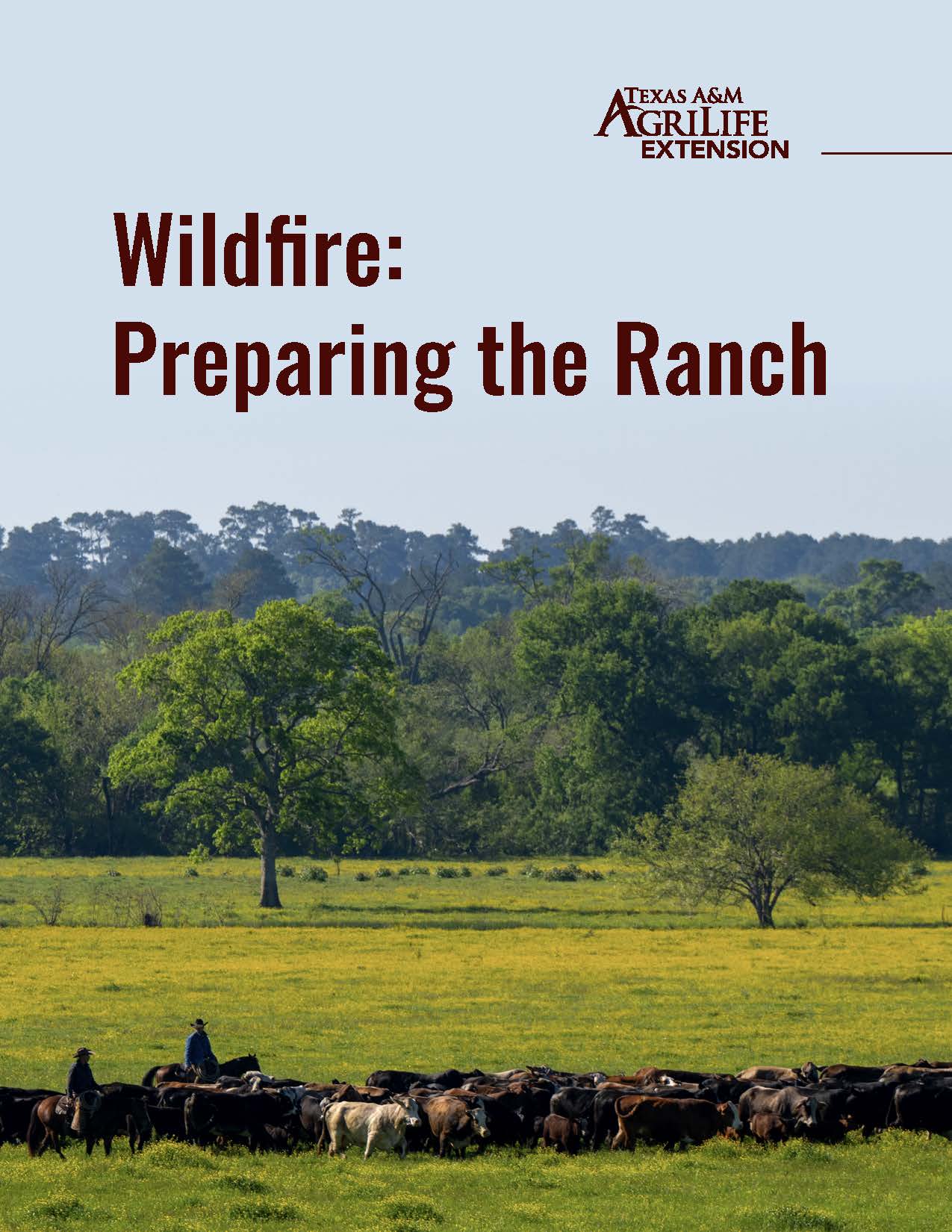
For more information, please download Wildfire…Preparing the Ranch!

Filed Under: La Niña, Wildfire Tagged With: fuel mitigation, Rangeland, wildfire

Dry, Warm, Windy, and Fuel.

November 19, 2025 by morgan.treadwell

  • Drought conditions (D1–D4) increased to 33% of the state, up from 24% four weeks ago; statewide reservoir storage decreased to 73.9% full, down from 75.6% four weeks ago, about 6 percentage points below normal for this time of year.
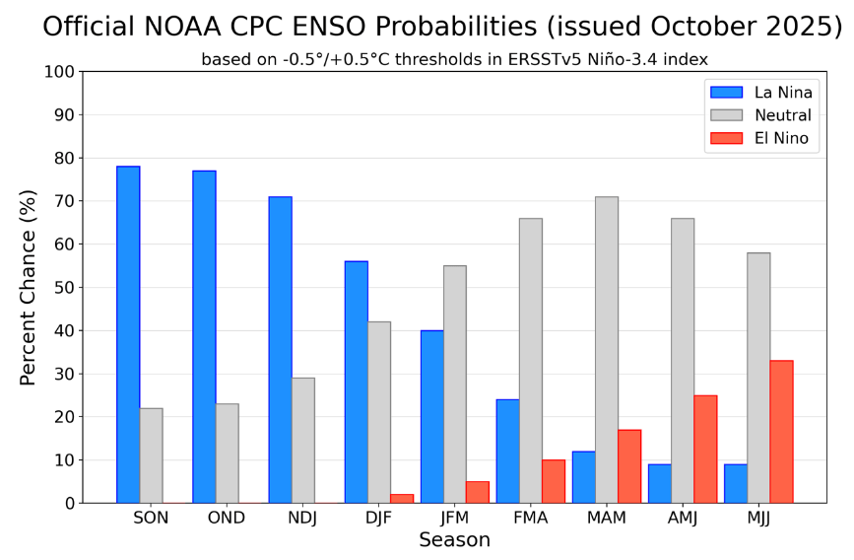
  • We are now a La Niña Advisory with a 55% chance of La Niña conditions continuing into the January-March season.
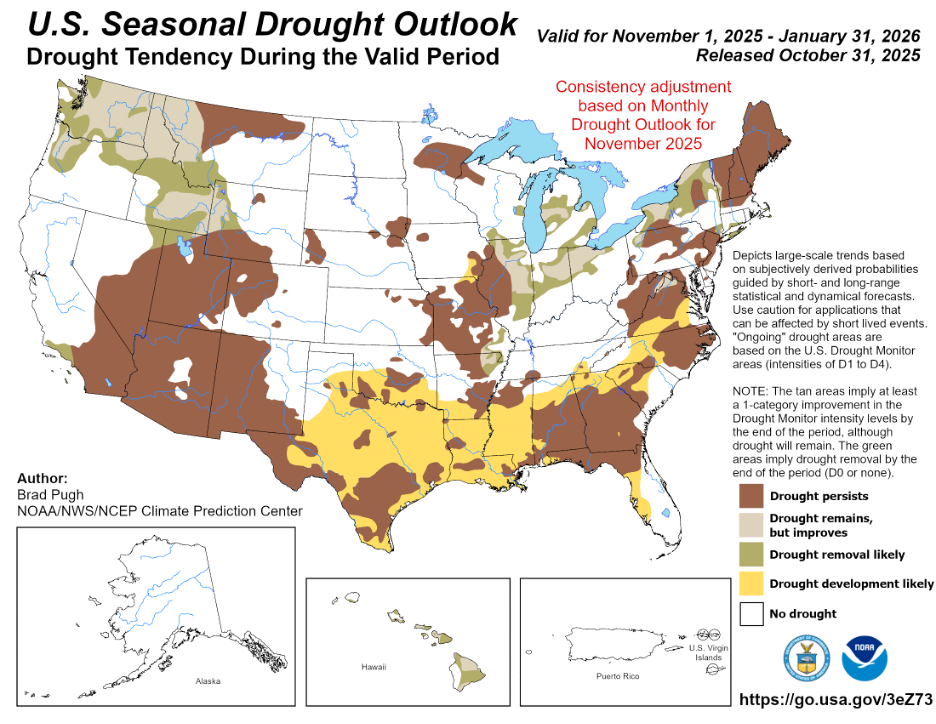
  • Most of the state is projected to be in drought over the next three months.

Isn’t it ironic that this last summer presented us with more than above average rainfall, yet not only is 33% of Texas in D1-D4 status, but our statewide reservoir storage is currently at 73.9%.  This becomes increasingly concerning as we watch La Niña take a firm hold with a 55% chance of La Niña conditions continuing into the January-March season.  Not only does this present challenging dormant season grazing management conditions, but wildfire will be at the top of rangeland manager’s concerns.

Bottom line, this winter will suck.  Get your game face on, dust off your drought plan, budget your numbers to see how late into winter/early spring your forage base can survive.  We will always remain optimistic, but we will also plan and prepare.  And with any rangeland management, we will remain adaptive holding strong to the grazing management and soil health principles guiding our practices and decisions.  For a comprehensive Wildfire Ready checklist, please click here and for our Preparing the Ranch publication click here.

Much appreciation to Robert Mace for his insight and wisdom in his outlook + water November 3, 2025 article found at: https://texaspluswater.wp.txstate.edu/.


Filed Under: Grazing Management, La Niña, Wildfire Tagged With: drought, Rangeland, wildfire

The New Wildfire Season

April 30, 2025 by jaime.sanford

Wildfires have become a significant concern in the United States, causing substantial economic, environmental, and agricultural losses. The financial burden, regional impact, and seasonal length of wildfires have increased in recent decades, raising national and global concerns. In fact, since 2015, three of the five largest wildfire years for acreage burned in the United States have occurred.  [Read more…] about The New Wildfire Season

Filed Under: Wildfire, Wildfires

Wildfire Preparedness: Protecting Your Ranch

January 22, 2025 by jaime.sanford

Texas A&M AgriLife has released a new publication in preparing the ranch for wildfire! 

Wildfire: Preparing the Ranch is an online educational resource debuting at Texas Panhandle wildfire preparedness educational meetings in Pampa and Canadian. The resource is designed to equip Texas agricultural producers with educational information and tools to prepare for wildfires. 

[Read more…] about Wildfire Preparedness: Protecting Your Ranch

Filed Under: Wildfire, Wildfires

  • Page 1
  • Page 2
  • Go to Next Page »

Recent Posts

  • Economic Incentives for Reducing Wildfire Risk
  • Building Knowledge and Confidence with the Updated Online Prescribed Burn School
  • The Cost of Prolonged Overgrazing: Ripple Effects on Watershed Health, Rainfall Infiltration, and Ranch Production
  • Advancing Wildland Fire Science: Inside the USDA Forest Service Fire Lab
  • Spring Weather Outlook By Luke Drosche – Texas A&M AgriLife Extension DAR Specialist

Categories

  • 4-H Range Contests
  • Beef Cattle
  • Brush Management
  • Carbon Credits
  • Carbon Markets
  • Conservation
  • Conservation Practices
  • Drought Management
  • El Niño
  • Events
  • Goats
  • Grazing Management
  • La Niña
  • Land
  • Lessons Learned
  • Meet A County Extension Agent
  • Plant ID
  • Podcast
  • Prescribed Burn Associations
  • Prescribed Burning
  • Publications
  • Range Concepts
  • RAP
  • Sheep
  • Society for Range Management
  • Soil
  • Staff
  • Targeted Grazing
  • Uncategorized
  • Water
  • Weather
  • Why I Ranch
  • Wild Pigs
  • Wildfire
  • Wildfires
  • Wind
  • Woody Encroachment
  • Youth Range Workshop

Archives

Texas A&M AgriLife Extension Service
Texas A&M University System Member
  • Compact with Texans
  • Privacy and Security
  • Accessibility Policy
  • State Link Policy
  • Statewide Search
  • Veterans Benefits
  • Military Families
  • Risk, Fraud & Misconduct Hotline
  • Texas Homeland Security
  • Texas Veteran's Portal
  • Equal Opportunity
  • Open Records/Public Information