• Skip to primary navigation
  • Skip to main content
  • Skip to primary sidebar
  • Texas A&M Forest Service
  • Texas A&M Veterinary Medical Diagnostics Laboratory
  • Texas A&M AgriLife Extension Service
  • Texas A&M AgriLife Research
  • Texas A&M College of Agrculture and Life Sciences
West Texas Rangelands
West Texas RangelandsWe hope to provide a variety of science-based rangeland information and current research on prescribed fire, wildfires, brush management, and grazing management!
  • Menu
  • Home
  • About & Contact
  • Publications
    • Extension Publications
    • Refereed Journal Articles
    • Program Summaries
  • Events
  • Lunch N’ Learn
  • Infographics
    • Drought
    • Grazing
    • Herbicide
    • Prescribed Fire
    • Rangeland Plants
    • Wildfire
  • Range Resources
    • Published to Pasture
    • Range Concepts
  • Fire Resources
  • Sponsors
  • AgriLife Learn Online Courses

2025 Region 3 Texas Land Value Trends: What Stability Means for West Texas Producers

May 6, 2026 by kara.matheney

West Texas Rangelands sourced this information from the Texas Agriculture Law Blog authored by Tiffany Dowell Lashmet, Professor & Extension Ag Law Specialist with Texas A&M AgriLife Extension Service.  To view the full report, please visit: https://agrilife.org/texasaglaw/2026/04/13/2025-rural-land-value-trends-report-released/.   

Land values influence nearly every management decision on a West Texas ranch, from leasing and grazing strategies to succession planning and long‑term investment. The 2025 Texas Land Value Trends for Region 3 offer an important takeaway for producers across North, Central, and South Central Texas: stability remains the dominant theme.

While individual properties differ, overall rangeland values and rental rates across Region 3 have remained steady going into 2025. For producers, this consistency provides a clearer planning window during a time when many costs and inputs remain unpredictable.

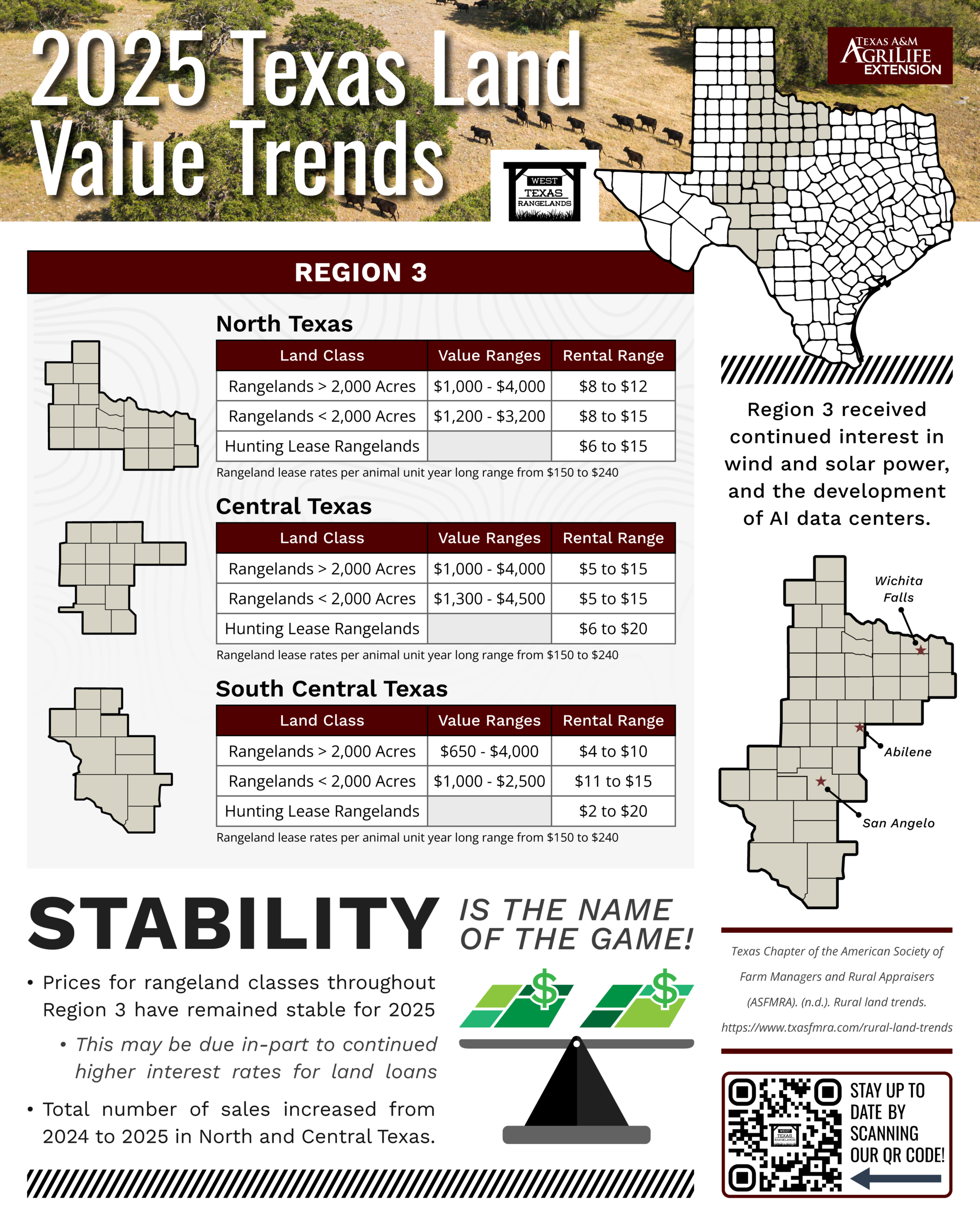
Infographic detailing 2025 Texas Land Value Trends for Region 3, presenting data for North, Central, and South Central Texas, including land classes, value ranges, and rental ranges. The infographic highlights regional stability and increased sales, with a map illustrating key cities and areas within Region 3.

A Stable Market Across Region 3
According to the Texas Chapter of the American Society of Farm Managers and Rural Appraisers, rangeland prices throughout Region 3 have largely held steady from 2024 to 2025. This includes large tracts greater than 2,000 acres as well as smaller ranches under 2,000 acres.

In North and Central Texas, total land sales increased from 2024 to 2025, even as interest rates for land loans remained higher than many producers have been accustomed to in recent years. This suggests that demand for rangeland remains strong, particularly for properties that support livestock production, hunting leases, or long‑term land investments.

For South Central Texas, values have remained stable as well, though rental ranges and entry prices continue to vary based on acreage size, location, and land condition.

What the Numbers Say About Rangeland Values
Across Region 3, rangelands larger than 2,000 acres generally continue to carry lower per‑acre values than smaller properties, reflecting typical economies of scale. Smaller tracts often command higher per‑acre prices due to accessibility, limited supply, or diversification opportunities.

Rental rates for rangeland grazing remain within consistent ranges across the region. Long‑term rangeland lease rates per animal unit year continue to fall within established norms, giving producers some predictability when budgeting for leased ground or negotiating renewals.

Hunting leases remain an important supplemental income source for many ranches. Although rates vary widely depending on habitat, access, and wildlife management, the continued presence of hunting lease value reinforces the importance of multispecies land stewardship in West Texas.

Development Pressure and Emerging Interests
There continues to be interest in wind and solar development, as well as AI data centers, within Region 3. While these developments are not evenly distributed, they are increasingly part of landowner conversations across nearly every region of Texas.

For producers, this does not necessarily mean a shift away from agriculture. Instead, it reinforces the need to understand how surface use agreements, water access, and infrastructure placement may affect long‑term ranch operations. Evaluating these opportunities through the lens of working lands remains critical.

What Stability Means for Ranch Management Decisions
Stable land values can be both reassuring and strategic for producers. When markets are not rapidly escalating or declining, decisions can be made with greater confidence and less pressure to react quickly.
For some operations, this may be an opportunity to:

  • Re-evaluate grazing or hunting lease terms
  • Invest in land improvements such as water infrastructure or brush management
  • Plan transitions within family operations
  • Reassess insurance, taxes, and long‑term budgets

Stable markets do not remove risk, but they do reduce uncertainty when compared to periods of rapid appreciation or correction.

Keeping Land Productive in a Stable Market
While land values matter, long‑term ranch success still depends on land conditions. Soil health, forage productivity, water availability, and flexibility during drought remain foundational to property value over time.

Markets reflect what land can produce. Producers who focus on sustainable grazing management, adaptive stocking strategies, and thoughtful use of tools such as prescribed fire are better positioned regardless of short‑term market shifts.

Staying Informed
Land value trends are one piece of the broader picture producers must consider. Staying informed through credible sources allows landowners to separate short‑term headlines from long‑term patterns.

The West Texas Rangelands program will continue sharing producer‑focused information that supports informed decision-making across working landscapes.

Filed Under: Conservation, Land Tagged With: #AgEconomics, #AgriLifeExtension, #LandValues, #RangelandManagement, #RuralLand, #TexasRanching, #WestTexasRangelands, #WorkingLands

Using Birds to Read Rangeland Health

March 11, 2026 by kara.matheney

Birds are more than just a welcome sight on Texas rangelands. They can also tell us a great deal about the condition of our land. Because birds respond quickly to changes in vegetation, water availability, and management practices, they are valuable indicators of overall land health.

Texas A&M AgriLife Extension Service recently released A Texas Landowner’s Guide to Conducting a Bird Survey, a research-based publication designed to help landowners better understand the bird species using their property and what those observations can reveal about habitat conditions.

Why Conduct a Bird Survey?

Bird surveys give landowners a practical way to “check the pulse” of their property. The presence or absence of certain bird species can reflect changes in plant diversity, forage structure, and wildlife habitat. Rather than focusing on a single species, a general bird survey looks at the broader bird community and how it relates to current land management.

Over time, repeated observations can help landowners track trends, document stewardship efforts, and evaluate whether management goals are being met.

Designed with Landowners in Mind

This AgriLife Extension guide is written specifically for Texas landowners, not professional bird biologists. It introduces bird surveys in a practical, approachable way that fits working ranches and rural properties.

The publication explains the basics of conducting a general bird survey, why bird data are useful for land management, and where to find birding resources and equipment. It is especially helpful for landowners who are new to bird surveys or looking to incorporate wildlife monitoring into an existing management plan.

Turning Observations into Action

Collecting information is only useful if it can inform decisions. Bird survey data can help landowners evaluate habitat conditions, identify areas for improvement, and better understand how wildlife responds to management practices.

While bird surveys are not regulatory requirements, they offer a voluntary, science-based tool that complements broader rangeland and wildlife management strategies. They can also help landowners better communicate their stewardship efforts with partners, agencies, or the community.

Building Skills Over Time

The guide recognizes that bird identification can feel intimidating at first. However, bird surveying is a skill that improves with practice. By using available resources and learning over time, landowners can gain confidence and make bird surveys a meaningful part of their land management toolbox.

Learn More

A Texas Landowner’s Guide to Conducting a Bird Survey is available through Texas A&M AgriLife Extension Service. For more information or assistance, contact your local AgriLife Extension office and explore additional wildlife and rangeland management resources.

Filed Under: Conservation, Conservation Practices, Land, Publications Tagged With: #AgriLifeExtension, #BirdSurvey, #RangelandHealth, #RangelandManagement, #TexasLandowners, #WestTexasRangelands, #WildlifeStewardship

Fuel, Weather, and Risk: Monitoring Wildfire Conditions on Your Land

January 21, 2026 by morgan.treadwell

Wildfire risk on rangelands is influenced by changing conditions rather than a fixed season. Weather patterns, vegetation growth, and fuel dryness all vary throughout the year. Monitoring these conditions helps landowners and managers understand when wildfire risk may increase and supports better decision-making. 

Tracking Fuel Conditions
One of the most important factors to watch is fuel condition. Grasses and other fine fuels dry at different rates depending on temperature, wind, and recent precipitation. After periods of rainfall, rangelands may produce increased vegetation that later becomes dry fuel. Observing changes in fuel amount and dryness over time provides valuable context for management activities. 

Watching Weather Patterns
Weather conditions also play a key role. Low humidity, strong winds, and extended dry periods can increase fire potential. Monitoring forecasts and short-term weather trends helps identify periods when caution may be needed. These conditions can occur at any time of year in West Texas, including winter months. 

Using Regional Data Tools
In addition to on-the-ground observations, land managers can use online tools to track broader trends. The Rangeland Analysis Platform (RAP) provides data and visual tools that help users assess vegetation productivity, drought patterns, and long-term rangeland conditions. This platform allows landowners to view changes across large areas and compare current conditions to historical averages. 

Connecting Data with Local Knowledge
Using tools like RAP alongside local knowledge creates a clearer picture of rangeland conditions. While no single dataset can predict wildfire, combining field observations with regional data improves awareness and supports informed planning. 

Applying What You Observe
Monitoring conditions also helps guide everyday decisions. Timing of equipment use, grazing rotations, or vegetation treatments can be adjusted based on current fuel and weather conditions. This approach reduces unnecessary risk while maintaining normal land management operations. 

Staying Aware Over Time
Monitoring is not about expecting wildfire to occur. Instead, it is a way to stay informed and adaptable. Conditions change, and understanding those changes helps landowners respond thoughtfully rather than reactively. 

Filed Under: Conservation, Conservation Practices, Land, Wildfire, Wildfires Tagged With: #grazing #ranchmanagement #brush #grasslands, Conservation Management, wildfire, wildfire prevention, Wildfires

Texas Land Trends: A Shifting Landscape

May 14, 2025 by jaime.sanford

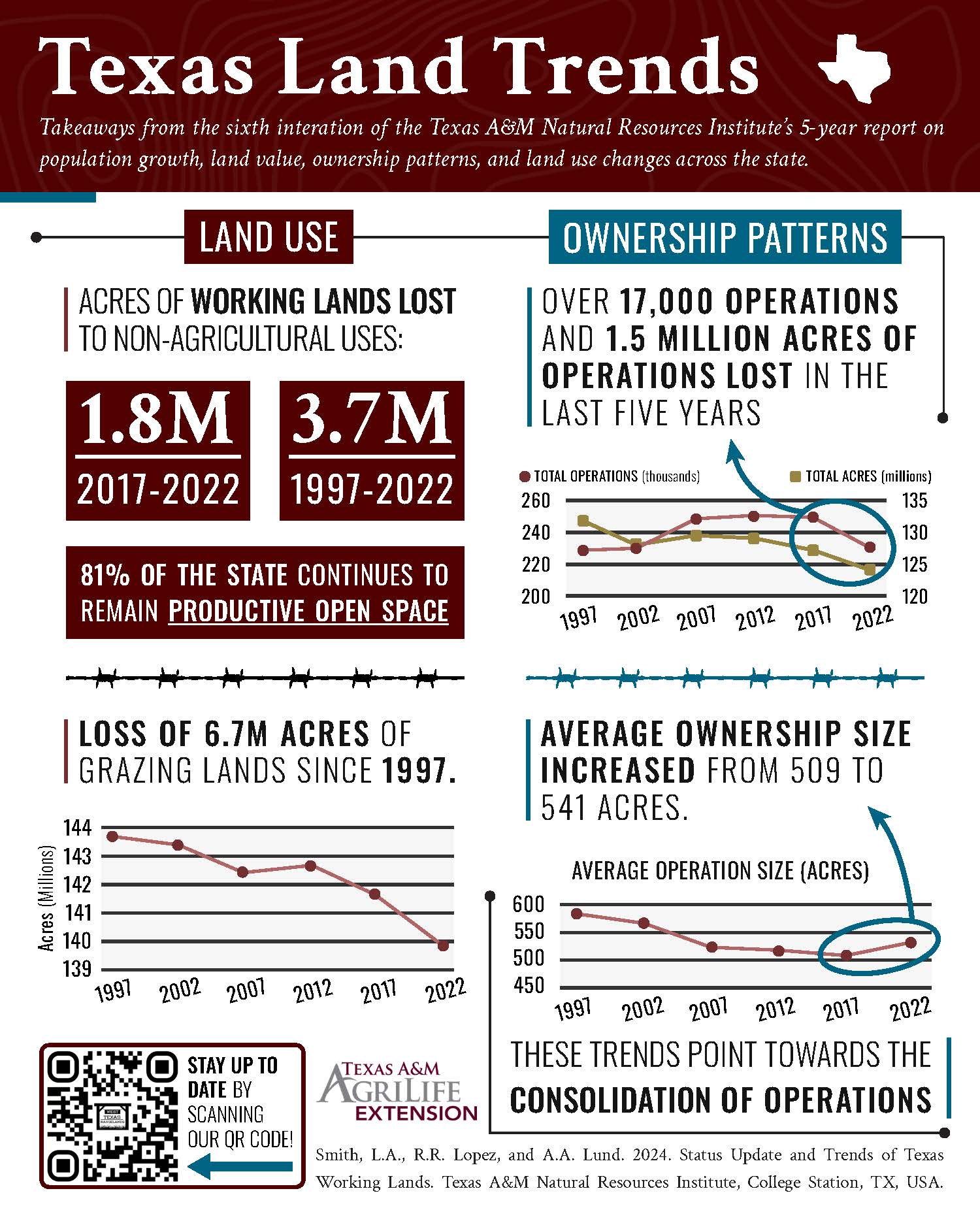
A fascinating new report from the amazing team at Texas A&M Natural Resources Institute sheds light on the changing landscape of Texas. Their sixth edition of a five-year study dives deep into population growth, land values, ownership patterns, and how land use is changing across Texas. The takeaways, reveal some significant trends that paint a picture of a state undergoing considerable transformation.

[Read more…] about Texas Land Trends: A Shifting Landscape

Filed Under: Conservation, Land

A Comparison of the 2017 & 2022 USDA Ag Census Data for West Texas Counties

February 12, 2025 by jaime.sanford

The U.S. Department of Agriculture’s National Agricultural Statistics Service (NASS) has released 2022 Census of Agriculture data. The graphic presents a fascinating snapshot of the ranching landscape impacting four West Texas counties: Tom Green, Schleicher, Crockett, and Menard. Using data from the 2017 and 2022 USDA Agricultural Census, we can glean valuable insights into trends and shifts within this vital sector of Texas’s economy and heritage.

[Read more…] about A Comparison of the 2017 & 2022 USDA Ag Census Data for West Texas Counties

Filed Under: Beef Cattle, Land, Range Concepts, Sheep

Texas Producer Average Age Increases 1.2% to 59.9

October 2, 2024 by jaime.sanford

Every 5 years the USDA’s National Agricultural Statistics Service’s Census of Agriculture publishes and provides data at the U.S., state, and county levels. One of the metrics that is tracked in this census is the average age of agricultural producers. 

[Read more…] about Texas Producer Average Age Increases 1.2% to 59.9

Filed Under: Conservation, Land

2023 Rural Land Value Trends Report

June 5, 2024 by jaime.sanford

Check out the 2023 Rural Land Value Trends Report from Texas Agriculture Law Blog by Tiffany Lashmet! https://agrilife.org/texasaglaw/2024/05/06/2023-rural-land-value-trends-report-is-here/

West Texas:

Strong demand for quality tracts continues to hold up prices in the region. At $2,410 per acre, prices rose 8.02 percent YOY. Tract size has also decreased from highs in 2021 and 2022, coming in at 385 acres this quarter, 10.65 percent below one year ago. Annualized sales volume declined 50.97 percent to 431 sales. Total dollar volume at $155.54 million decreased by 72.39 percent. At 64,540 acres, though a slight increase from last quarter, total acreage declined 74.44 percent YOY. Fourth quarter only sales volume fell 26.09 percent below that of fourth quarter 2022, a much less drastic drop compared to YOY.

Region 3 Take Homes:

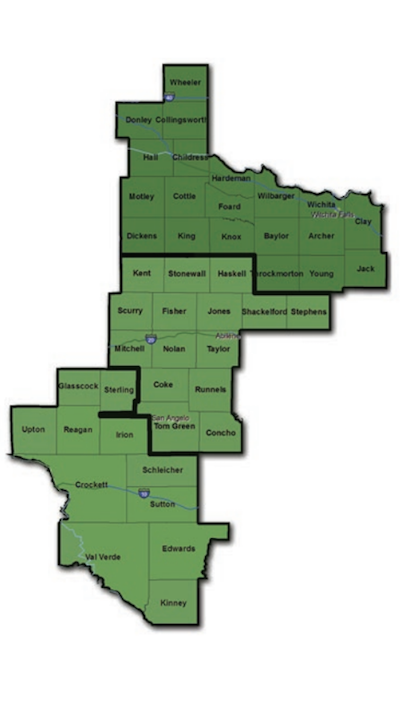
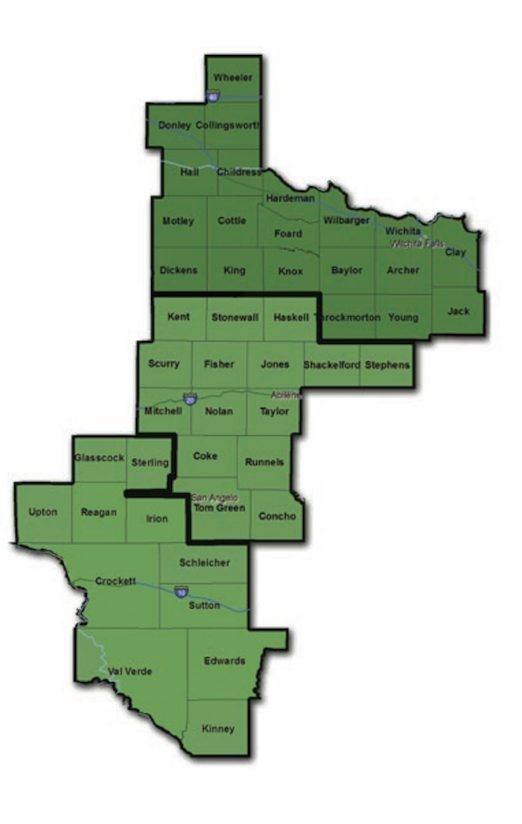
Counties included: Archer, Baylor, Childress, Clay, Coke, Collingsworth, Concho, Cottle, Crockett, Dickens, Donley, Edwards, Fisher, Foard, Glasscock, Hall, Hardeman, Haskell, Irion, Jack, Jones, Kent, King, Kinney, Knox, Mitchell, Motley, Nolan, Reagan, Runnels, Schleicher, Scurry, Shackelford, Stephens, Sterling, Stonewall, Sutton, Taylor, Throckmorton, Tom Green, Upton, Val Verde, Wheeler, Wichita, Wilbarger, and Young.

  • In discussions with an attorney in San Angelo, he stated that he had worked on 10 to 15 wind and solar leases in 2023, with 8 to 10 of those signed. Several of the companies decided they were no longer interested before the lease was signed.
  • According to the attorney, this was due to a number of factors including poor due diligence on the part of the company or ERCOT West not having enough transmission lines. These wind leases come in blocks where the attorney may represent one to a dozen landowners at a time.
  • As mentioned in the 2022 discussion, a solar farm in San Angelo area was expanding. This expansion has been completed from one to two sections.  There has not been any construction in the immediate San Angelo area since 2022 of any new solar farms.  This could be a result of the increased cost due to higher interest rates, cost of materials and construction costs.
  • Purchases by developers dropped significantly in 2023. This is due primarily to the increased interest rates and the fact the end users for these properties are no longer in the market due to the higher interest rates.
  • There continues to be an increase in residential development in the immediate area of the larger trade areas, specifically Wichita Falls, Abilene and San Angelo. It appears that residential buyers continue to move to areas with smaller schools, which are considered to be above average for educational opportunities.


For the 2023 and previous years report, be sure to download it here – https://www.txasfmra.com/rural-land-trends

Rural Land Trends – Texas Chapter ASFMRA. (2024, March 29). Texas Chapter ASFMRA. https://www.txasfmra.com/rural-land-trends

Filed Under: Beef Cattle, Carbon Credits, Carbon Markets, Conservation, Land

2022 Texas Land Market Developments

February 7, 2024 by jaime.sanford

The reported demand for land by rural brokers has slowed down compared to the contest for land in 2021. However, at the end of 2022, prices had increased by 12.44 percent to $4,446 per acre statewide. By the end of 2022, a total of 719,738 acres had changed hands, down 14.96 percent from 2021. This suggests that market activity has fallen to a more normal level at high prices. The rising prices coupled with the diminished activity suggests that current buyers are focusing on higher quality properties.

In West Texas strong demand drove up prices in the region. At $2,231 per acre, prices rose 14.59 percent year over year. However, the annualized sales volume declined 22.35 percent to 879 sales. Typical size of acreage remained nearly the same, dropping 0.33 percent to 431 acres. The total dollar volume spent at $563.4 million increased by 25.71 percent compared to 2021. At 252,510 acres, total acreage sold rose 9.71 percent. Fourth quarter only sales volume fell 9.80 percent short of fourth quarter 2021 totals, 49.08 percent short of 2020 totals, but 14.05 percent above the 2019 fourth quarter sales total.

Region 3 is made up of counties located in North Texas all the way through South Central Texas.


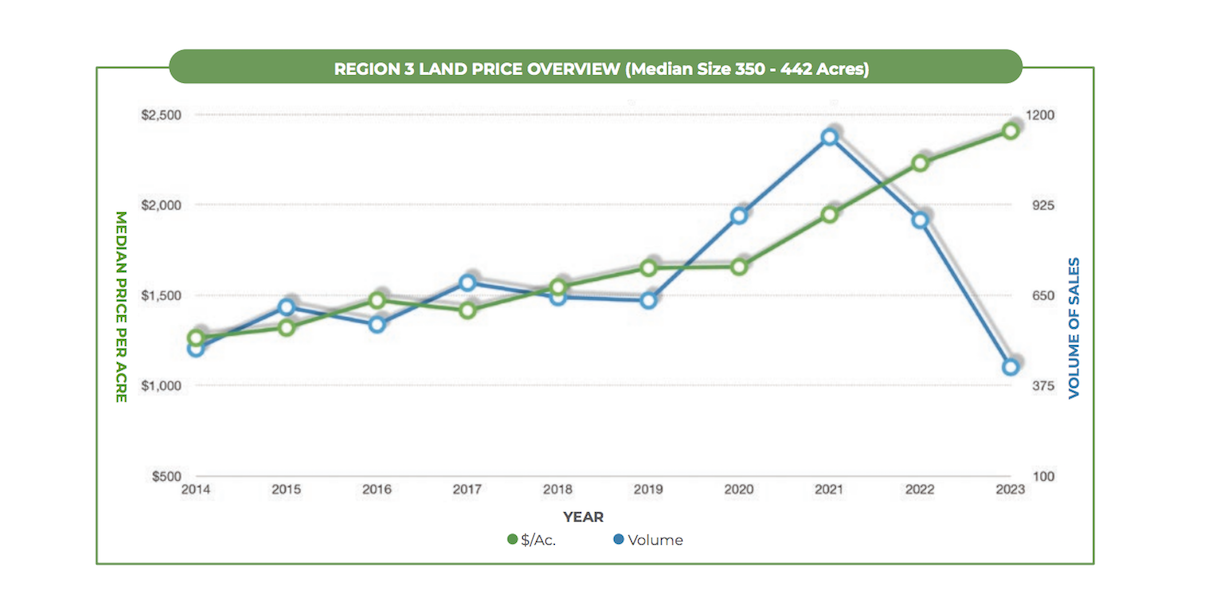
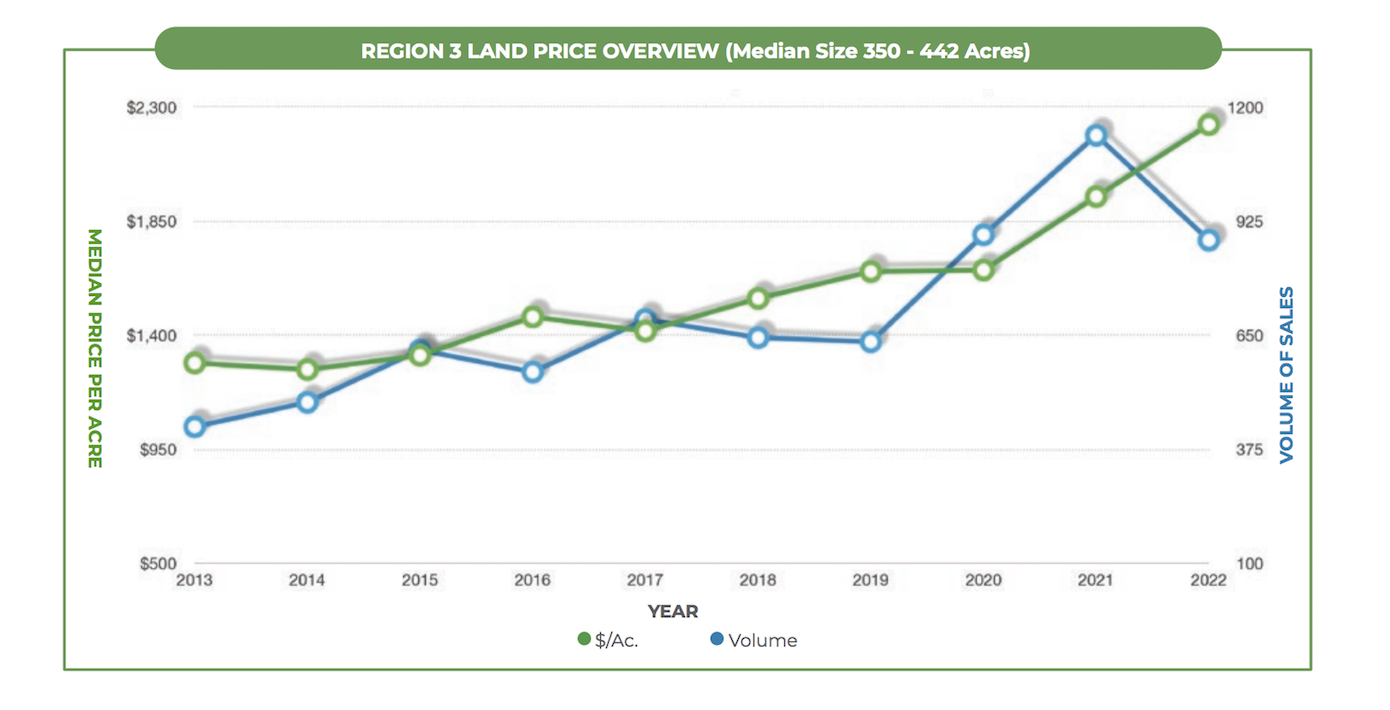
In looking at the region as a whole, while the volume of sales has declined, the price per acreage has increased. As you can see in the graph below, the price per acre has continued to steadily increase since 2020. 


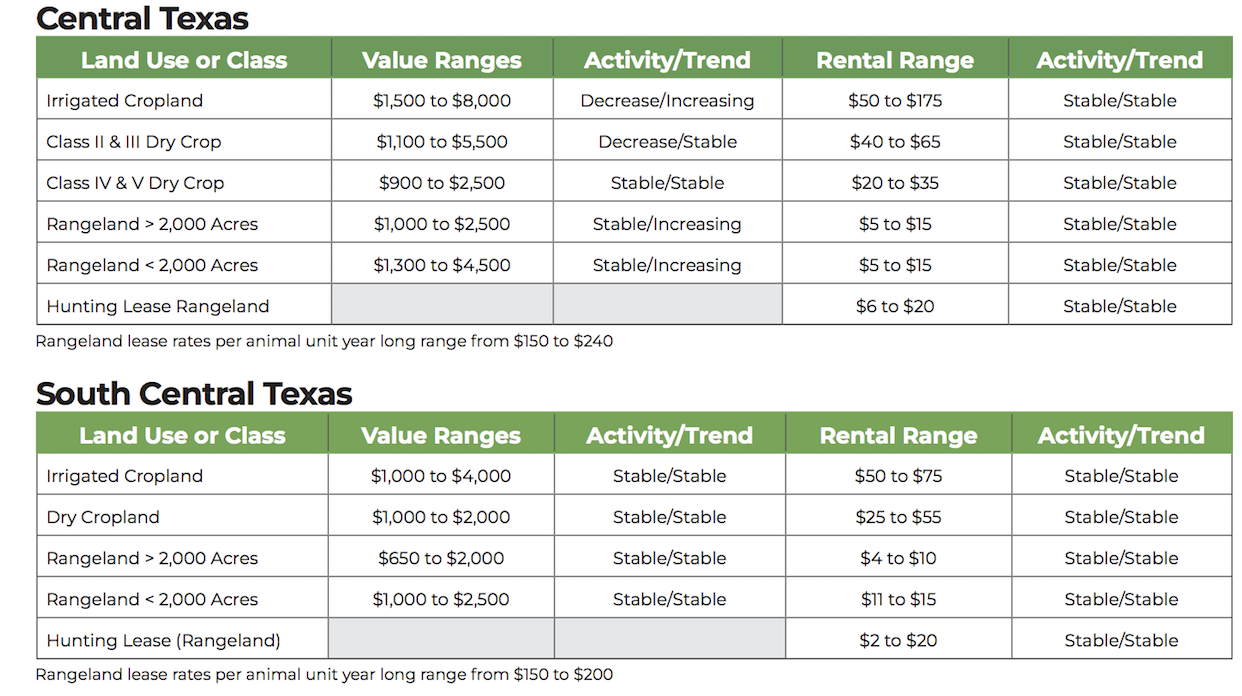
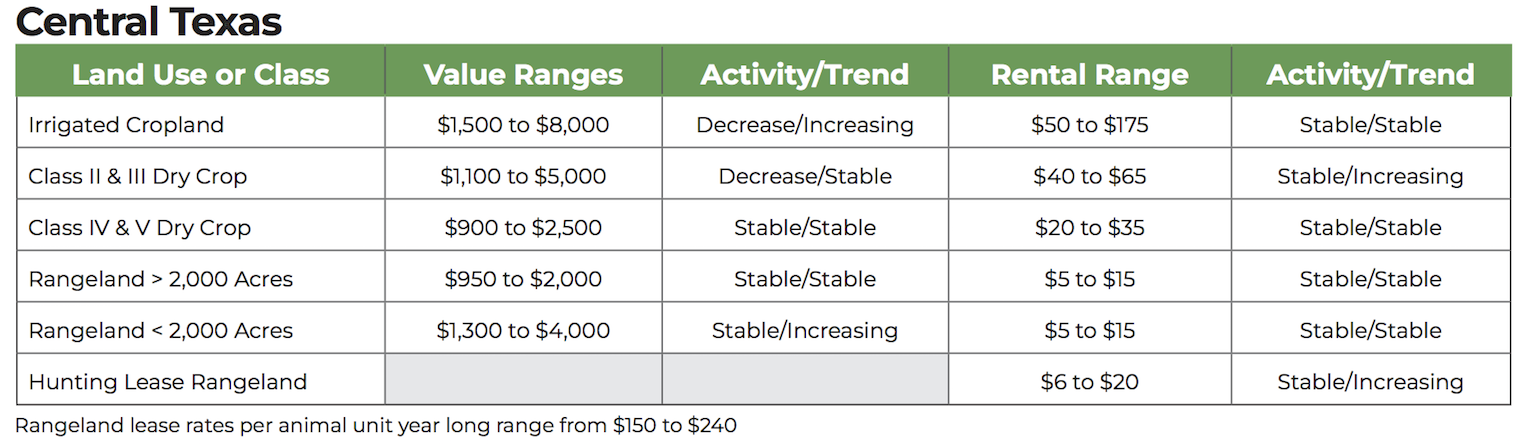
Below Central Texas is broken down by cropland, rangeland and hunting lease rangeland. If you are thinking about leasing land compared to buying, be sure to check out some of the prices and how they are trending.


For more information and the full report, be sure to check it out here!

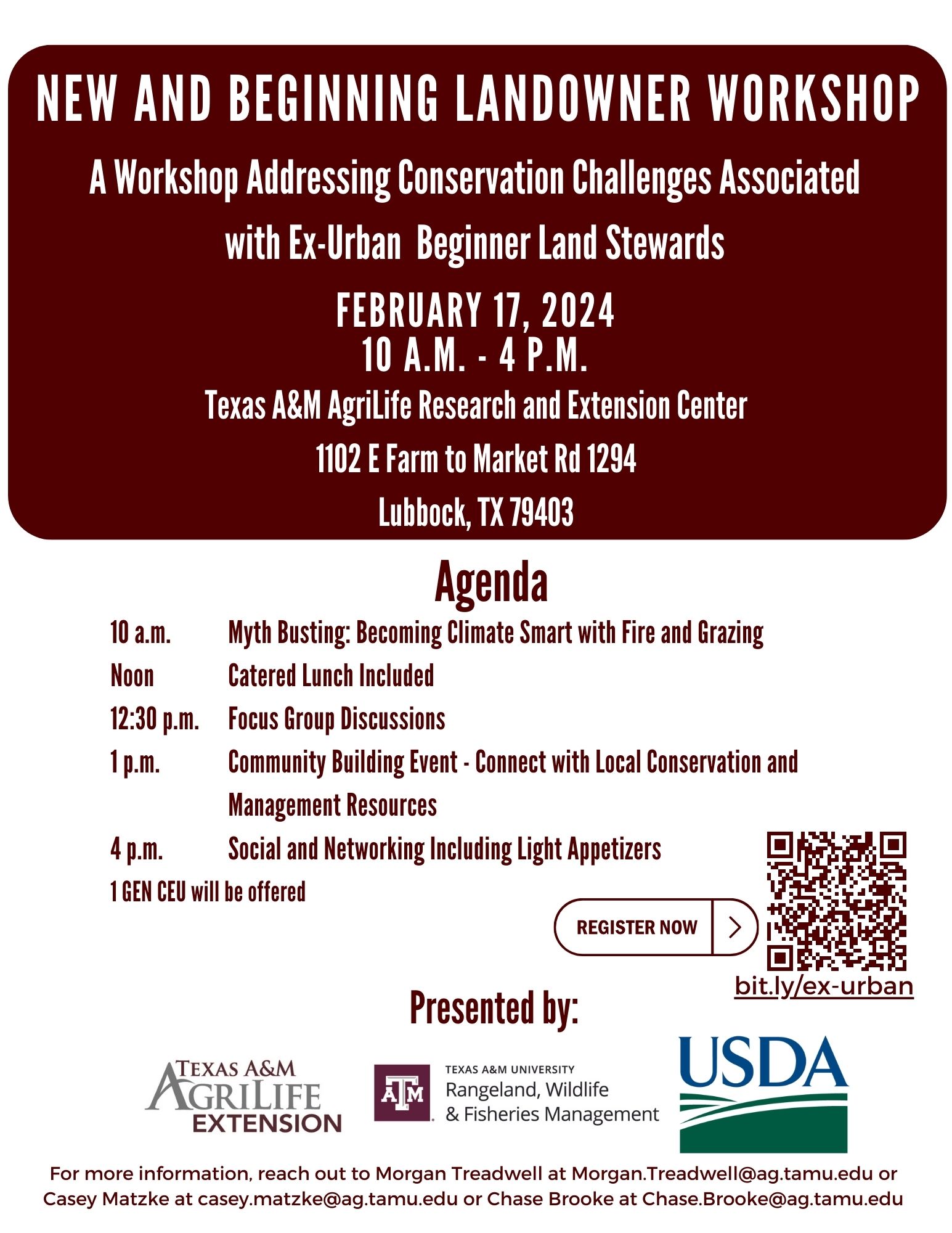
Are you a new landowner in Texas? We are bringing a series of workshops around Texas to help new landowners get involved in their communities! Our first stop is in Lubbock, followed by Corpus Christi, San Angelo, College Station, and Stephenville, Texas. For more information reach out to casey.matzke@ag.tamu.edu. Interested in registering for this free event? Click here! 

Filed Under: Land

Recent Posts

  • What the National CPBM Report Means for Producers Using Prescribed Fire
  • 2025 Region 3 Texas Land Value Trends: What Stability Means for West Texas Producers
  • A Tale of Two Texas Landscapes: Drought Conditions and the Road Ahead
  • The Hidden Cost of Overgrazing: How It Drains Your Watershed, Your Rainfall, and Your Bottom Line
  • Economic Incentives for Reducing Wildfire Risk

Categories

  • 4-H Range Contests
  • Beef Cattle
  • Brush Management
  • Carbon Credits
  • Carbon Markets
  • Conservation
  • Conservation Practices
  • Drought Management
  • El Niño
  • Events
  • Goats
  • Grazing Management
  • La Niña
  • Land
  • Lessons Learned
  • Meet A County Extension Agent
  • Plant ID
  • Podcast
  • Prescribed Burn Associations
  • Prescribed Burning
  • Publications
  • Range Concepts
  • RAP
  • Sheep
  • Society for Range Management
  • Soil
  • Staff
  • Targeted Grazing
  • Uncategorized
  • Water
  • Weather
  • Why I Ranch
  • Wild Pigs
  • Wildfire
  • Wildfires
  • Wind
  • Woody Encroachment
  • Youth Range Workshop

Archives

Texas A&M AgriLife Extension Service
Texas A&M University System Member
  • Compact with Texans
  • Privacy and Security
  • Accessibility Policy
  • State Link Policy
  • Statewide Search
  • Veterans Benefits
  • Military Families
  • Risk, Fraud & Misconduct Hotline
  • Texas Homeland Security
  • Texas Veteran's Portal
  • Equal Opportunity
  • Open Records/Public Information