• Skip to primary navigation
  • Skip to main content
  • Skip to primary sidebar
  • Texas A&M Forest Service
  • Texas A&M Veterinary Medical Diagnostics Laboratory
  • Texas A&M AgriLife Extension Service
  • Texas A&M AgriLife Research
  • Texas A&M College of Agrculture and Life Sciences
West Texas Rangelands
West Texas RangelandsWe hope to provide a variety of science-based rangeland information and current research on prescribed fire, wildfires, brush management, and grazing management!
  • Menu
  • Home
  • About & Contact
  • Publications
    • Extension Publications
    • Refereed Journal Articles
    • Program Summaries
  • Events
  • Lunch N’ Learn
  • Infographics
    • Drought
    • Grazing
    • Herbicide
    • Prescribed Fire
    • Rangeland Plants
    • Wildfire
  • Range Resources
    • Published to Pasture
    • Range Concepts
  • Fire Resources
  • Sponsors
  • AgriLife Learn Online Courses

Adaptability Is Key as Drought Persists Across Texas Rangelands

May 20, 2026 by kara.matheney

Across much of Texas, drought remains a defining challenge for rangeland managers. A recent AgriLife Today article highlights an important reality for producers: while some areas have seen timely rainfall, much of the state is still managing through ongoing drought conditions, and adaptability remains critical for long-term rangeland resilience.

👉 Read the full AgriLife Today article: https://agrilifetoday.tamu.edu/2026/05/19/adaptability-and-managing-for-rangeland-resilience-remain-key-as-drought-covers-much-of-the-state/

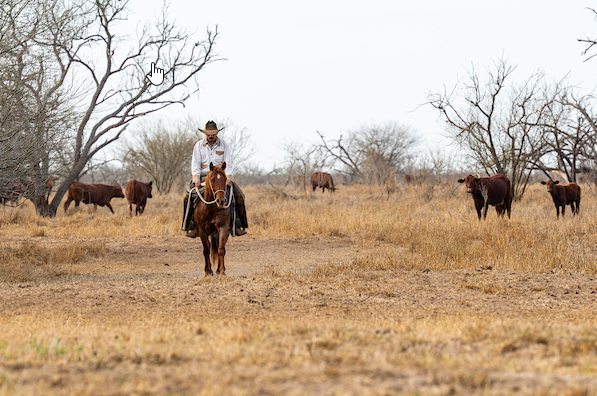
A cowboy on horseback rides through a dry, grassy field with cattle grazing in the background under a pale sky.A Mixed Picture Across the State
Texas rangelands are experiencing a wide range of conditions this year. Some regions, including parts of the Cross Timbers, Concho Valley, and Hill Country, are seeing improved forage production due to spring rainfall. These areas present an opportunity for producers to allow pastures time to recover after extended drought conditions.

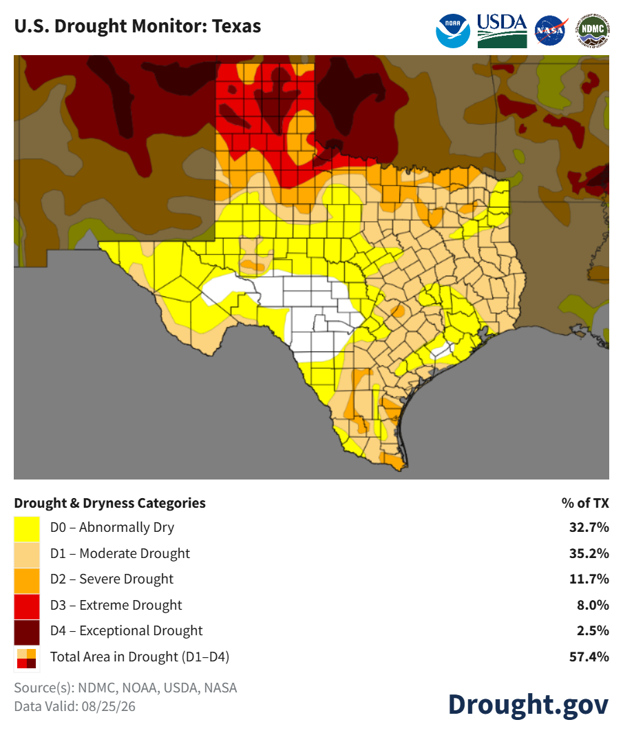
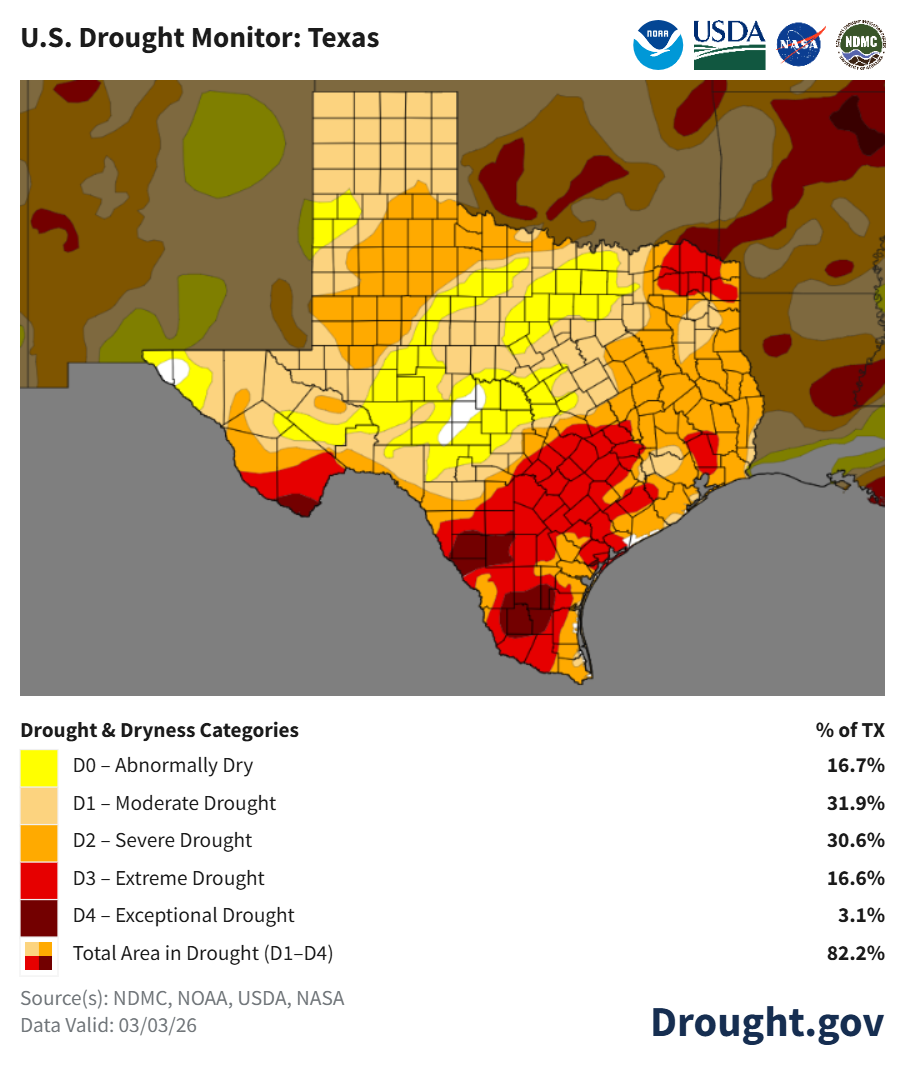
At the same time, much of the state remains in drought. According to the U.S. Drought Monitor cited in the article, 81 percent of Texas is experiencing some level of drought. While fewer areas are in the most extreme categories compared to last year, drought is still widespread and continues to impact forage availability and management decisions.

For producers in the Panhandle, South Texas, and other regions facing more severe conditions, the message is clear: careful evaluation and planning are still essential.

Recovery Starts with Rest
One of the most important takeaways from the article is the value of rest during periods of active plant growth. When moisture is available, and grasses begin to respond, reducing grazing pressure allows plants to rebuild energy reserves.
This recovery period helps promote:

  • Root development
  • Leaf growth
  • Improved plant vigor

Allowing plants time to recover can have long-term benefits for both forage production and overall rangeland health. Resilient rangelands depend on maintaining this balance between use and recovery.

Managing for Resilience, Not Just Production
Producers are not just managing livestock. They are managing ecosystems. The article emphasizes that stewardship of rangeland resources includes maintaining ground cover and building organic matter in the soil.

These practices support essential ecosystem services, including:

  • Forage production for livestock
  • Habitat for wildlife, especially during critical periods
  • Soil health and water infiltration

A focus on resilience helps ensure that rangelands can continue to function through both wet and dry periods.

Drought Planning Still Matters
Even in areas that have received rain, it is important not to assume the drought is over. Conditions can change quickly, and the forage available now may need to carry operations through the remainder of the growing season.

Producers are encouraged to continually evaluate forage availability and compare it to expected needs. This is a key part of any drought contingency plan and helps guide decisions about stocking rates and grazing pressure.

In areas still experiencing severe drought, proactive steps such as adjusting stocking rates or reassessing grazing strategies may be necessary to avoid long-term damage to the land.

A Practical Takeaway for West Texas
For West Texas producers, where variability is the norm and drought cycles are familiar, this message reinforces what many already know. Flexibility is not optional. It is essential.
Whether your operation has received recent rain or is still waiting for relief, the same principles apply:

  • Take advantage of good conditions to build recovery
  • Protect plant health through strategic grazing decisions
  • Monitor forage conditions closely
  • Be prepared to adjust as conditions change

Looking Ahead
Drought will continue to be part of managing rangelands in Texas. While rainfall patterns and seasonal conditions are beyond our control, management decisions are not.

By focusing on adaptability and resilience, landowners and managers can position their operations to better withstand drought and recover more quickly when conditions improve.

Resilient rangelands are built over time with careful management, timely decisions, and a long-term perspective.

Filed Under: Conservation, Drought Management, Grazing Management, Range Concepts, Weather

A Tale of Two Texas Landscapes: Drought Conditions and the Road Ahead

April 29, 2026 by kara.matheney

West Texas Rangelands would like to extend our gratitude to Mr. Luke Drosche for collaborating with us and providing this weather update for our readers.  We thank him for sharing his time, talents, and knowledge with us as a guest contributor.  Luke serves with Texas A&M AgriLife Extension Service as a Disaster Assessment and Recovery Specialist.     
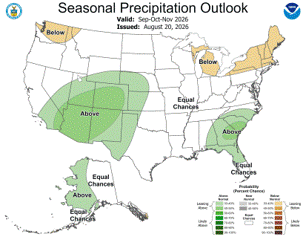
3-Month Precipitation Outlook
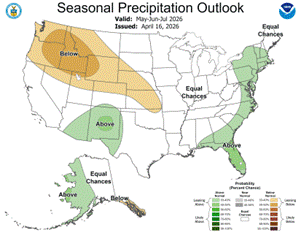
The end of April has brought heavy rainfall to a good 70% of the State. Springtime months are typically beneficial for Texas, bringing in showers that, unfortunately, pack a punch with severe weather attached.  Large Hail, Damaging Winds, Flash Flooding, and even Tornados are more common in March, April, and May, and will continue while our summertime heat and Hurricane season kick off.  More of this can be expected through May and stretching into the Mid-Summer months, according to NOAA’s 3-month outlook. This forecast keeps Texas in an Equal Chances Category through the early summer for marking near average on our rain gauges.  The forecast specifically mentions areas that have received rainfall in April, having better chances of finding more rain through early June due to the moistened topsoil.
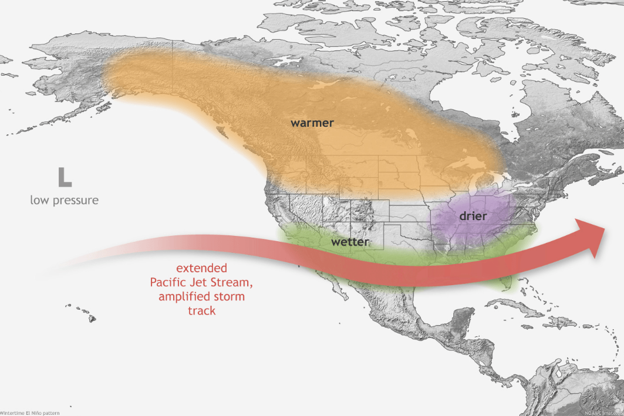
Areas in far West Texas and far west of the Panhandle are in a slightly above-average chances category.  These equal and above probabilities are following our large-scale weather pattern, working to make a major shift.  Currently, we are in an ENSO Neutral period, meaning we are not in either La Niña or El Niño.  But as we move through May and June, we are expecting to move into the El Niño phase.  This will prompt better rain chances for all of the State, and typically reduces our likelihood of seeing hurricane impacts, although hurricanes in the Gulf and hitting Texas are still possible.

3-Month Temperature Outlook
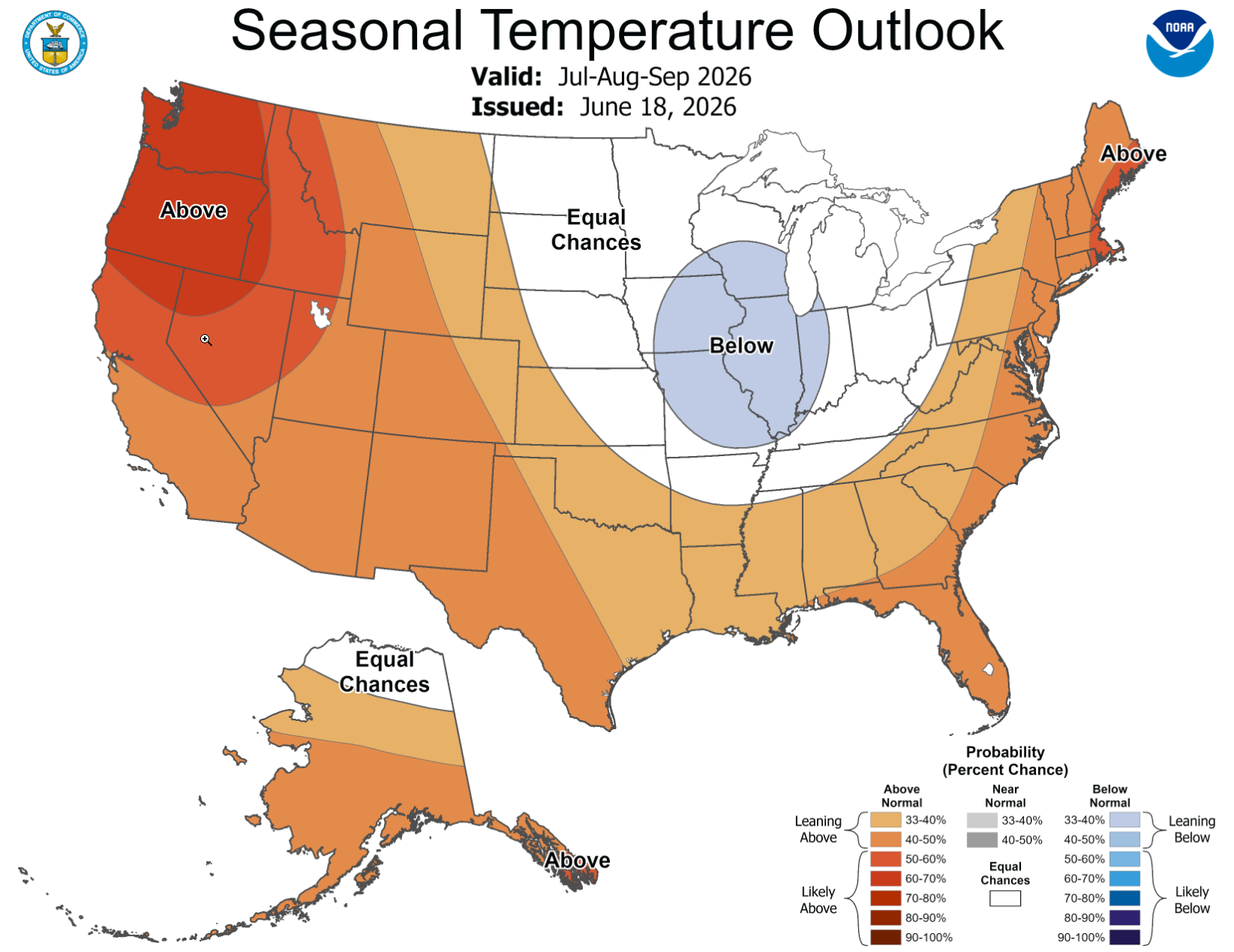
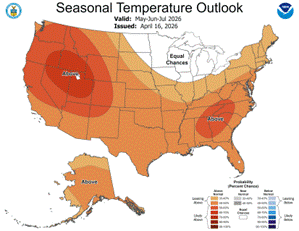
Summertime is here early.  All of Texas has a “Leaning Above” designation for hitting warmer-than-average temperatures through July.  Parts of Texas have already seen these warm summer temperatures and even heat advisories/warnings. With our increased moisture over the State, these warmer temperatures will feel more stifling.  It is important to remember to stay hydrated, take breaks in the shade, and make sure our livestock and pets have access to drinking water.  Practice summer weather-resistant strategies now; these warm temperatures are not going anywhere anytime soon.

Drought Update
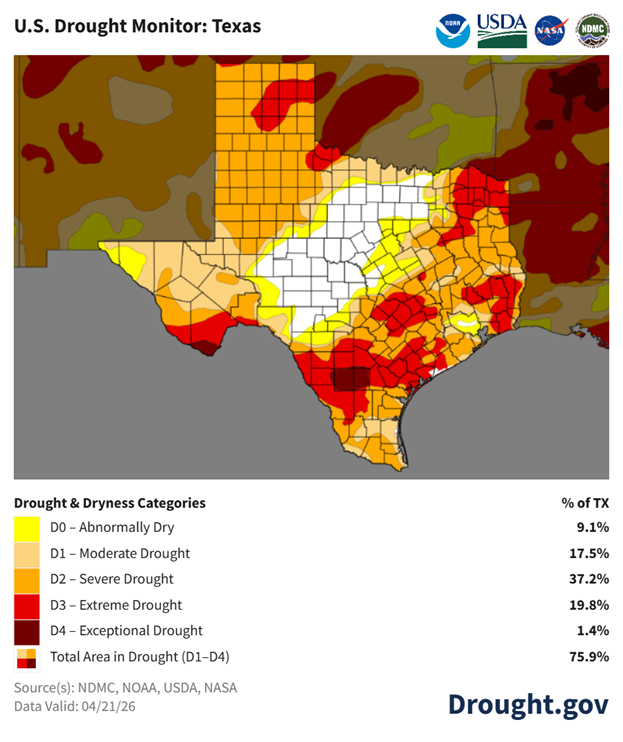
There is a tale of two stories this month since I last discussed drought with you all.  The Panhandle and Eastern parts of Texas have found drying, worsening conditions, and are currently under Severe and Extreme Drought. In the Northern Hill County, up through the DFW Metroplex, we have seen massive steps in a positive direction, as these areas are in no drought designation. This area is roughly 25% of the State of Texas and had been in the Dry to Severe Categories prior to this update. As of April 21st, around 60% of the State is in worse, Severe to Exceptional Drought categories.   Due to heavy rain since this map’s last update, 2-4 inches in the last 2 weeks, I expect to see areas around San Antonio and East along I-10 to North Houston get bumped down a drought category, and the total Severe to Exceptional percentage to go down. Far South Texas into the Valley should also see some lessening of the current extreme conditions they are in from rainfall in the last two weeks, 0.5-3 inches.

Recent forecasts and news calling for the early transition into a strong El Niño Pattern makes me believe that we will find some drought relief across much of the State over the next few months.  Strong El Niño patterns have previously provided heavy rainfall events that have helped to boost our water storage and ease drought conditions overall, but not totally erase them.  Along with higher chances of rain, stronger chances of severe weather and flash flooding will persist. Now is the time to make sure you and your operation are ready for adverse conditions.  Always have a way to receive weather warnings, have a plan, and practice that plan.  Let’s hope for beneficial rain without any of its rude partners, stay safe my friends.

References:
https://www.cpc.ncep.noaa.gov/
https://www.drought.gov/states/texas

Filed Under: El Niño, La Niña, Weather Tagged With: #Weather, drought, Drought Management, El Niño, La Nina

Spring Weather Outlook By Luke Drosche – Texas A&M AgriLife Extension DAR Specialist

March 18, 2026 by kara.matheney

West Texas Rangelands would like to extend our gratitude to Mr. Luke Drosche for collaborating with us and providing this weather update for our readers.  We thank him for sharing his time, talents, and knowledge with us as a guest contributor.  Luke serves with Texas A&M AgriLife Extension Service as a Disaster Assessment and Recovery Specialist.     
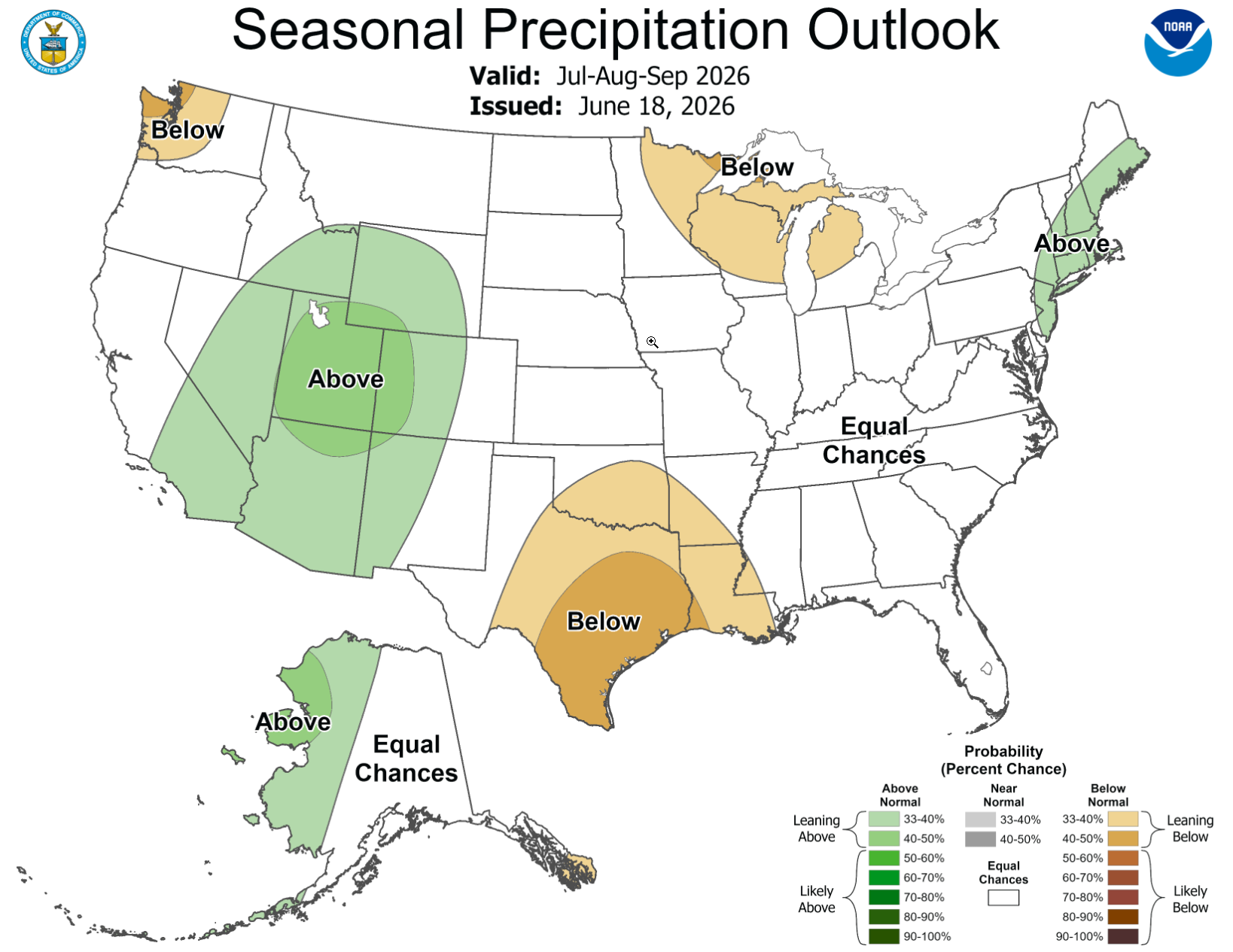
3-Month Precipitation Outlook:
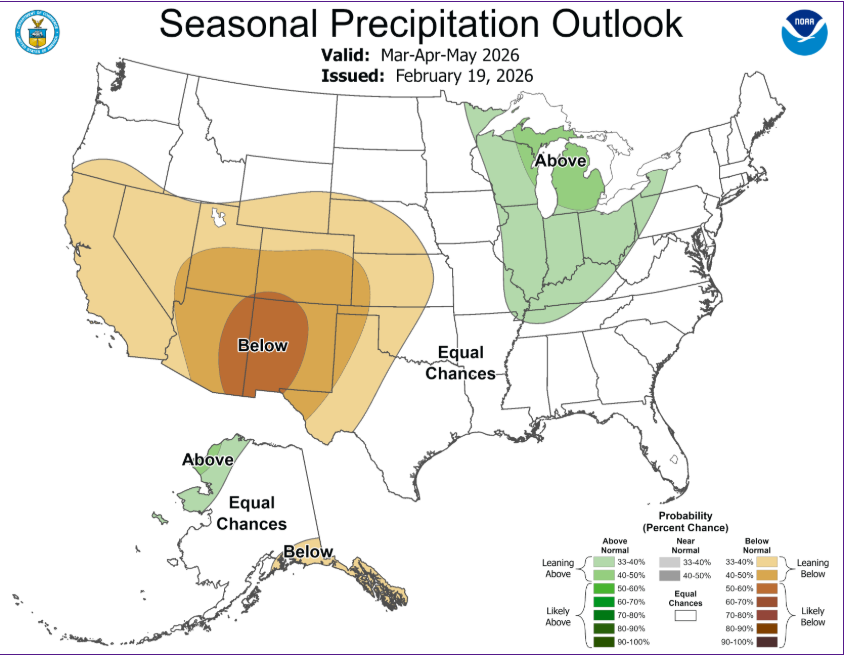
The first few days of March have brought areas of rain and severe storms to a large portion of the State. Those across the Coastal Plains have enjoyed some much-needed precipitation, while our areas in the Panhandle and out west have continue to be mostly dry with the exception of a few supercell thunderstorms. The month of March should continue to bolster higher rain chances before tapering back off closer to May. The 3-month outlook has shown that a majority of the state is in an “Equal Chances” Category for rain. Meaning that we are most likely to mark near normal on our rain gauges.  NOAA has predicated the month of March to be potentially wetter than average for the Northeastern part of the State before marking close to normal through April and May. While the far western and Northwestern areas are forecasted to be drier. This is the time of year we need to make sure we always have a way to receive weather warnings. Severe Weather in Texas is year-round but increases dramatically in the springtime. For anywhere you are in the State of Texas, all modes of Severe weather are possible. It is important to have a plan for you, your family, and your property should severe weather impact you. Know how to communicate, plan to live a few days without power or water, and who to contact if you are affected by severe weather.  Keep an eye to the sky.

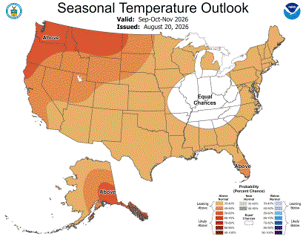
3-Month Temperature Outlook:
Rinse and Repeat from our winter months is predicted as we remain warmer than average. March has a high likelihood of marking above normal temperature with higher-than-normal temperatures likely through at least May, areas out west have higher potential to be warmer than average.  The entire state is under this prediction due to our current La Nina Conditions. These bring warmer temperatures to our area. However, we are seeing a transition out of La Nina into ENSO Neutral Conditions. This transition will happen over the next few months. Later in the year we look to potentially move into an El Nino weather pattern closer to next Fall. We will take this as a hope for more beneficial rain as 19.2 million of us in the State of Texas are in a Drought Designation.


Drought Update:
Extreme Drought Conditions persist in Central and South Texas with nearly the entire state in some dryness/drought category.  Panhandle regions remain in Moderate Drought and areas slightly south of there creep into the Severe Drought Designation. Early March’s rain will provide some relief to the Coastal Plains and parts of Central Texas when the next Drought updates come in roughly a month from now. More rainy days are predicted through March and will hopefully continue to improve conditions.  The next few months, March, April, and May typically bring weather systems across much of the state.  These systems pack a punch with severe storms and high rainfall rates.  We always prefer longer, drawn out rainfall events that allow the rainfall to soak into the soil, rather than run off the dry, packed ground. However, once the soil is primed with some moisture from whatever form of rain we get, we benefit more.  With the transition predicted us of La Nina and into ENSO Neutral conditions, we are hopeful for some improvement in overall drought conditions across the State.  Over many months in recent history, we have been in a La Nina designation, which is what has continued to push our drought conditions.  As we transition into Neutral Conditions in the short term, we will see more weather patterns indicative of repeated rainfall come into play.  No doubt we will still see long periods of dry weather, but let’s keep a hopeful eye on next fall as we should move into El Nino Conditions.


References and Resources: https://www.cpc.ncep.noaa.gov/, https://www.drought.gov/states/texas
Filed Under: Conservation, El Niño, La Niña, Uncategorized, Water, Weather Tagged With: #AgrliLifeExtension, #ClimateVariability, #ConservationConversations, #Weather, #WestTexasRangelands, drought

Prepared Today, Resilient Tomorrow: Making Wildfire Preparedness Part of Rangeland Stewardship

January 28, 2026 by morgan.treadwell

Wildfire risk is a natural part of West Texas rangelands, but preparedness is most effective when it is part of ongoing land stewardship. Managing rangelands with long-term resilience in mind not only protects property and resources, but also supports ecosystem health and sustainable operations. 

Integrating Preparedness into Stewardship Practices 
Preparedness begins with everyday land management decisions. Practices such as targeted grazing, rotational grazing, and selective vegetation management help reduce fuel loads while maintaining healthy grass and brush cover. These strategies are not one-time solutions—they are ongoing practices that strengthen the landscape over years. 

Infrastructure and Access as a Stewardship Tool 
Maintaining roads, fence lines, water sources, and access points is a long-term investment in rangeland resilience. Clear access allows for safe movement of equipment and personnel if wildfire conditions arise. Roads and defensible corridors also serve as strategic breaks in fuel, reducing potential fire spread while supporting everyday operations. 

Monitoring Conditions Over Time 
Ongoing observation of vegetation, fuel, and weather trends is central to long-term preparedness. Tools like the Jornada Rangeland Analysis Platform provide historical and current data on vegetation growth and drought patterns. Combining this data with on-the-ground monitoring helps landowners make adaptive decisions, such as adjusting grazing or vegetation treatments, in a way that supports both land health and wildfire preparedness. 

Preparedness as a Continuous Practice
Long-term wildfire preparedness is not about expecting a fire every year. It is about creating a resilient, well-managed landscape that can better withstand unpredictable events. Maintaining native grasses, managing fuel continuity, and planning infrastructure improvements over time ensures the land remains productive and safer under a variety of conditions. 

Building Resilient Rangelands
By treating preparedness as part of overall stewardship, landowners reinforce their long-term investment in rangeland health. The combined effect of fuel management, infrastructure planning, monitoring, and adaptive management reduces potential wildfire impact while sustaining the ecological and economic productivity of West Texas rangelands. 

Filed Under: Conservation, Conservation Practices, Grazing Management, Targeted Grazing, Water, Weather, Wildfire, Wildfires Tagged With: Conservation Practices, grazing management, range management, wildfire, Wildfires

A Flood of Change: What July’s Historic Rains Mean for Texas’ Drought Outlook

August 27, 2025 by jaime.sanford

Texas endured a dramatic climatic shift in July—one that’s already rewriting the story of our drought and breaking 131 year records. But even as optimism swells, persistent vulnerabilities remind us the path to recovery is far from over.

[Read more…] about A Flood of Change: What July’s Historic Rains Mean for Texas’ Drought Outlook

Filed Under: Drought Management, El Niño, Weather

Hot and Dry. And, it’s only April.

April 16, 2025 by jaime.sanford

Hel-loooooo La Niña. Until June-July-August (hopefully). 

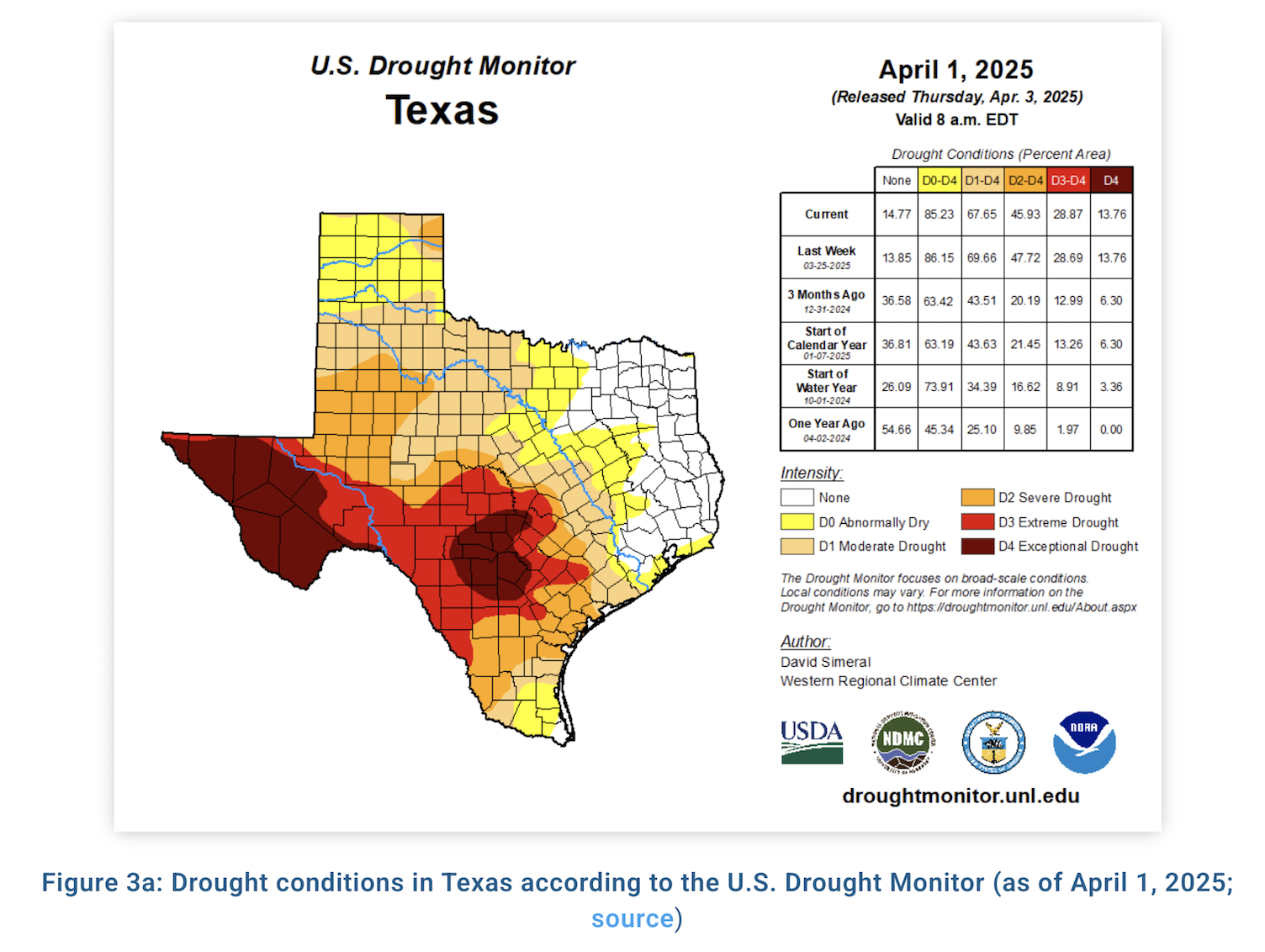
The percentage of the state under drought conditions (D1-D4) has alarmingly increased from 49% to 68% in just four weeks. Extreme drought or worse has jumped from 17% to 29% during the same period, and exceptional drought has more than doubled from 6.3% to 14%. Overall, a staggering 85% of the state is now abnormally dry or worse (D0-D4).

While the eastern parts of Texas saw typical March precipitation patterns, a significant portion of West and Far West Texas received less than 0.01 inches of rainfall. Consequently, despite the localized flooding in the Lower Rio Grande Valley,, almost the entire state experienced substantially less than normal rainfall for March 2025. 

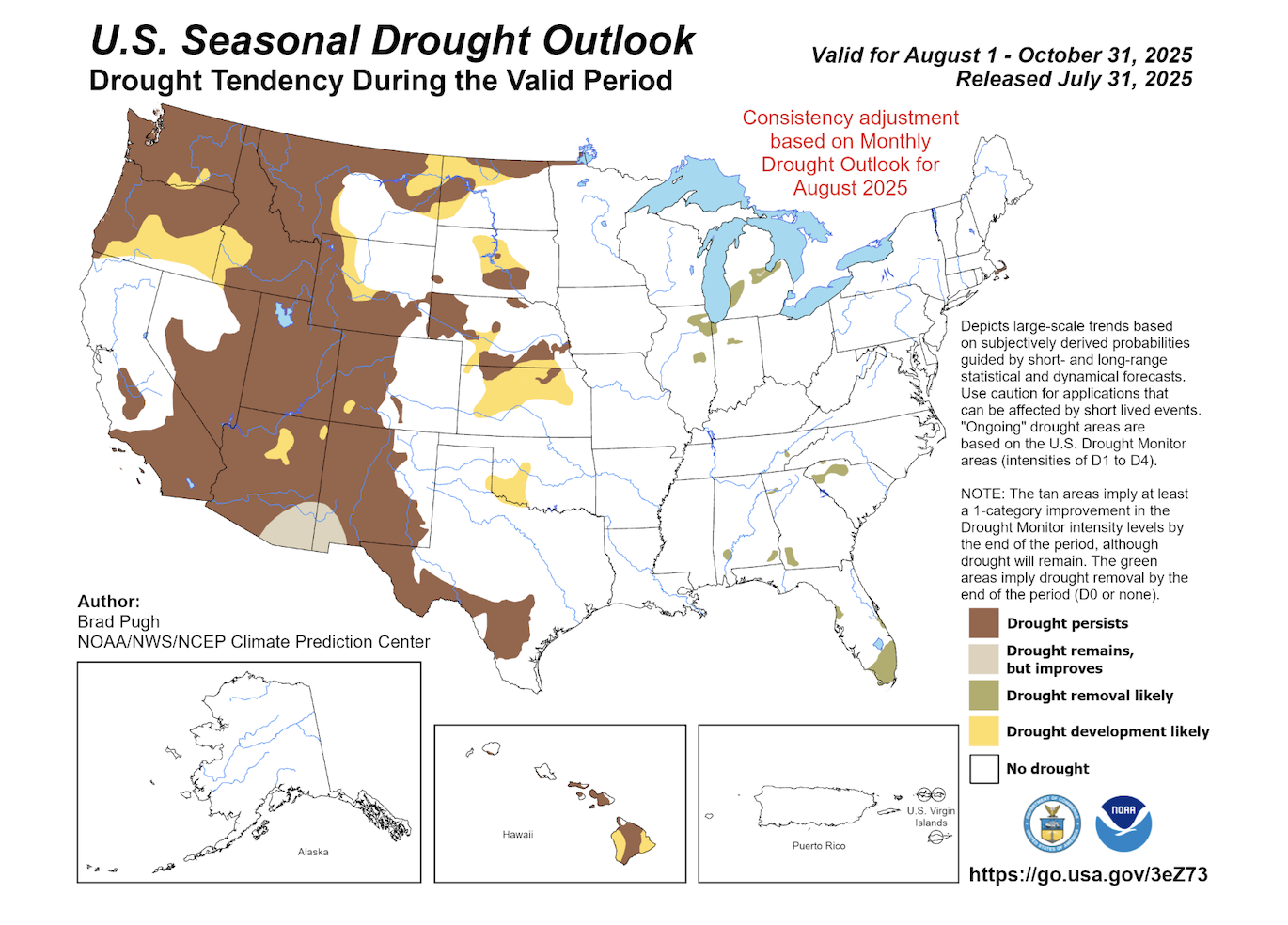
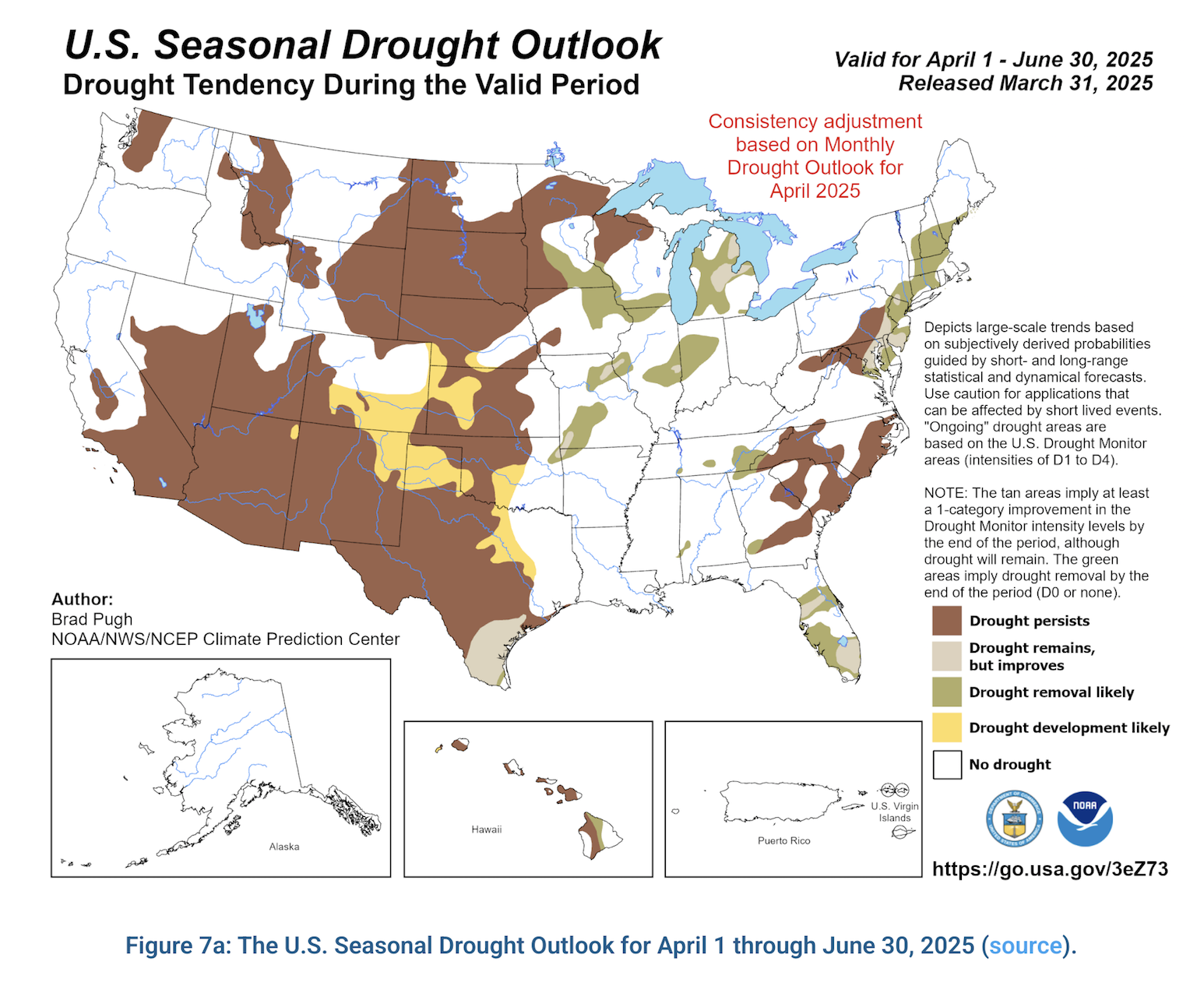
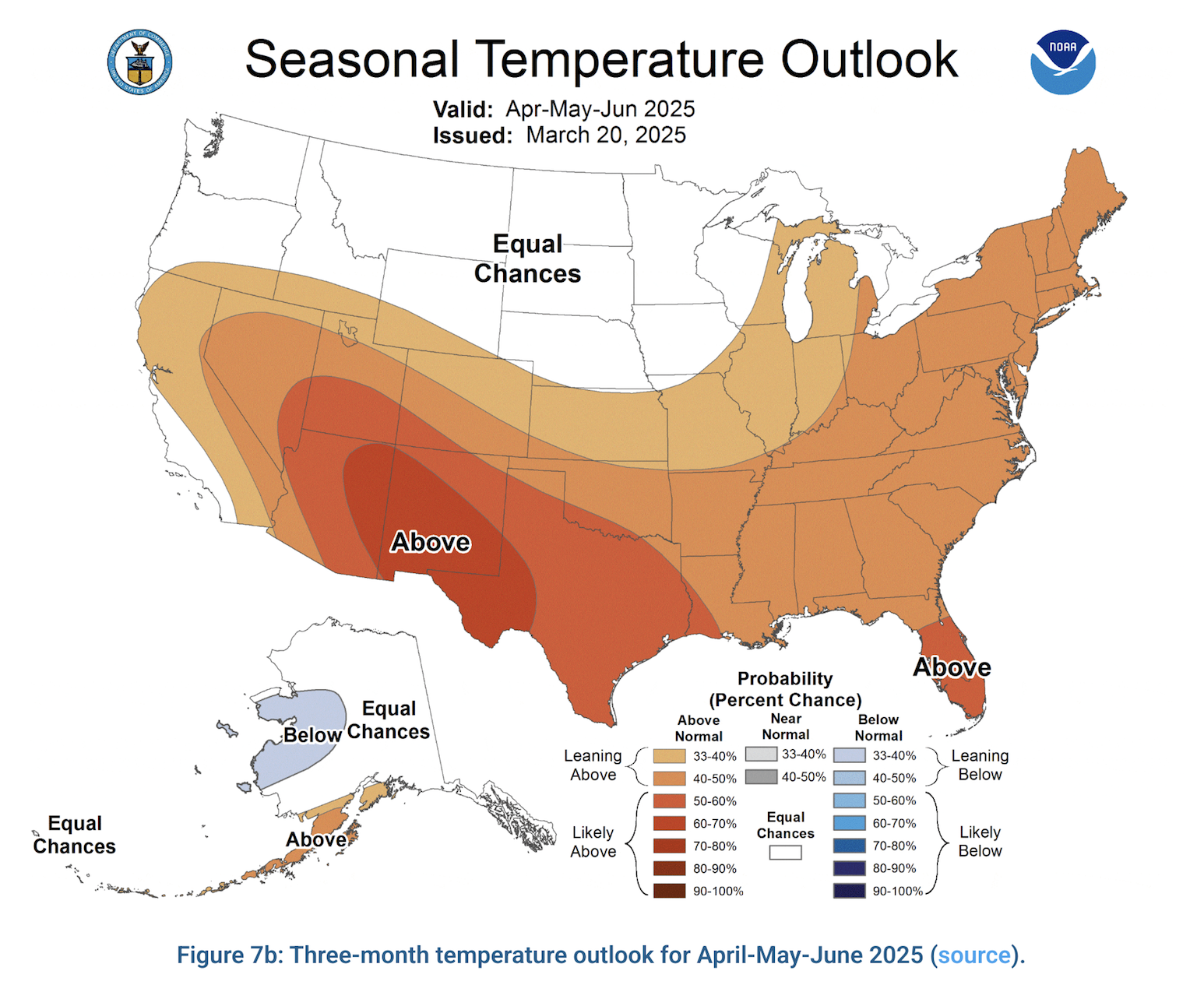
The current La Niña Advisory, is expected to be short-lived, with a high probability (62%) of transitioning to neutral conditions by late summer. The U.S. Seasonal Drought Outlook through May predicts continued drought or drought development for most of Texas, excluding the far east. Furthermore, the three-month temperature outlook favors above-average temperatures, while the precipitation outlook leans towards rainfall deficits for the majority of the state.


It’s going to get worse before it gets better.  

This is growing season drought.

For the full article, check it out here! 

Filed Under: Drought Management, La Niña, Weather

Get Ready: Hot. Dry. And More Dry.

February 19, 2025 by jaime.sanford

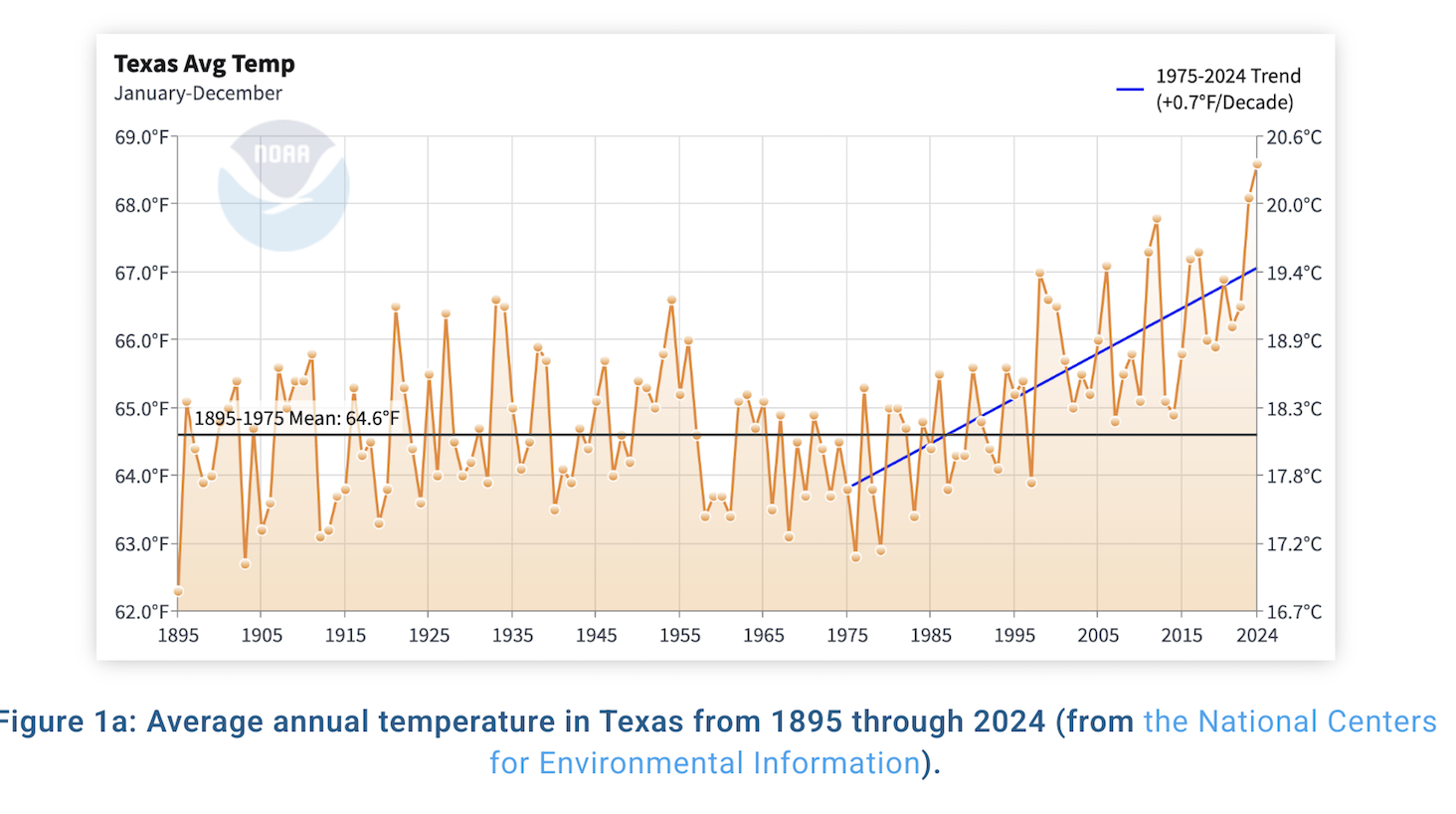
If you felt like 2024 was a scorcher, you weren’t wrong. Texas experienced its warmest year in 130 years, mirroring a global trend that likely marks the hottest year in nearly 100,000 years. That’s not just hot; it’s historically significant (Figure 1a courtesy of Texas + Water)!

[Read more…] about Get Ready: Hot. Dry. And More Dry.

Filed Under: La Niña, Weather

Is it Summer? Weather and Drought Update

November 13, 2024 by jaime.sanford

October was the warmest and driest October on record across the state of Texas. We are also tracking to have the warmest year on record, which would replace 2023 as the warmest. While some of the state saw some rain over the last week, in other areas of the state the predictions for rain did not pan out. According to the figure below, for the month of October, the entire state saw less than 25% of the normal amount of rain.

[Read more…] about Is it Summer? Weather and Drought Update

Filed Under: La Niña, Weather

Fire Weather Alert System and Wildfire Risk to Communities Resources from the U.S. Forest Service

October 30, 2024 by jaime.sanford

The Fire Weather Alert System (FWAS) is a vital tool designed to support firefighters on the front lines by providing timely and critical weather information. This app is specifically designed to provide wildland firefighters alerts and notifications for changing weather conditions based on user-set thresholds. The app also provides convenient access to RAWS data, Zone Fire Weather Forecasts, and other important fire weather information.

[Read more…] about Fire Weather Alert System and Wildfire Risk to Communities Resources from the U.S. Forest Service

Filed Under: Weather

Drought and La Niña Update

September 18, 2024 by jaime.sanford

Even with recent rains in the central part of Texas, drought conditions have, unfortunately, increased. There are moderate to severe droughts along the Northern border between Texas and Oklahoma and in the far West Texas region, drought conditions are extreme and in some areas have increased to exceptional drought. Central Texas, along the Gulf Coast, and parts of East Texas are looking above average showing no drought indicators.

[Read more…] about Drought and La Niña Update

Filed Under: La Niña, Weather

  • Page 1
  • Page 2
  • Go to Next Page »

Recent Posts

  • Adaptability Is Key as Drought Persists Across Texas Rangelands
  • What the National CPBM Report Means for Producers Using Prescribed Fire
  • 2025 Region 3 Texas Land Value Trends: What Stability Means for West Texas Producers
  • A Tale of Two Texas Landscapes: Drought Conditions and the Road Ahead
  • The Hidden Cost of Overgrazing: How It Drains Your Watershed, Your Rainfall, and Your Bottom Line

Categories

  • 4-H Range Contests
  • Beef Cattle
  • Brush Management
  • Carbon Credits
  • Carbon Markets
  • Conservation
  • Conservation Practices
  • Drought Management
  • El Niño
  • Events
  • Goats
  • Grazing Management
  • La Niña
  • Land
  • Lessons Learned
  • Meet A County Extension Agent
  • Plant ID
  • Podcast
  • Prescribed Burn Associations
  • Prescribed Burning
  • Publications
  • Range Concepts
  • RAP
  • Sheep
  • Society for Range Management
  • Soil
  • Staff
  • Targeted Grazing
  • Uncategorized
  • Water
  • Weather
  • Why I Ranch
  • Wild Pigs
  • Wildfire
  • Wildfires
  • Wind
  • Woody Encroachment
  • Youth Range Workshop

Archives

Texas A&M AgriLife Extension Service
Texas A&M University System Member
  • Compact with Texans
  • Privacy and Security
  • Accessibility Policy
  • State Link Policy
  • Statewide Search
  • Veterans Benefits
  • Military Families
  • Risk, Fraud & Misconduct Hotline
  • Texas Homeland Security
  • Texas Veteran's Portal
  • Equal Opportunity
  • Open Records/Public Information