• Skip to primary navigation
  • Skip to main content
  • Skip to primary sidebar
  • Texas A&M Forest Service
  • Texas A&M Veterinary Medical Diagnostics Laboratory
  • Texas A&M AgriLife Extension Service
  • Texas A&M AgriLife Research
  • Texas A&M College of Agrculture and Life Sciences
West Texas Rangelands
West Texas RangelandsWe hope to provide a variety of science-based rangeland information and current research on prescribed fire, wildfires, brush management, and grazing management!
  • Menu
  • Home
  • About & Contact
  • Publications
    • Extension Publications
    • Refereed Journal Articles
    • Program Summaries
  • Events
  • Lunch N’ Learn
  • Infographics
    • Drought
    • Grazing
    • Herbicide
    • Prescribed Fire
    • Rangeland Plants
    • Wildfire
  • Range Resources
    • Published to Pasture
    • Range Concepts
  • Fire Resources
  • Sponsors
  • AgriLife Learn Online Courses

The Hidden Cost of Overgrazing: How It Drains Your Watershed, Your Rainfall, and Your Bottom Line

April 22, 2026 by kara.matheney

The Hidden Cost of Overgrazing: How It Drains Your Watershed, Your Rainfall, and Your Bottom Line

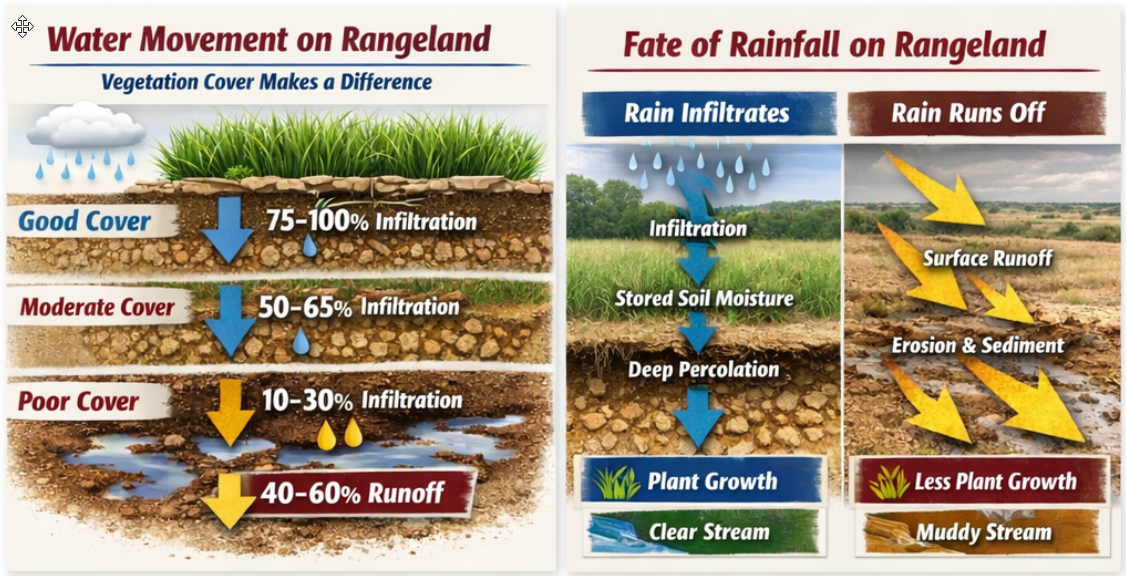
Across Texas, every drop of rain is precious. On healthy rangeland, most of that rainfall enters the soil (infiltration), is stored in the profile, and then drives forage production. Under prolonged overgrazing, however, plant vigor declines, roots shrink, litter disappears, and soils compact, reducing infiltration, increasing runoff and erosion, and shrinking the water available for grass growth. Over time, that damages both watershed function and ranch profitability. 

What overgrazing does to water

  • Less plant cover → less infiltration. Texas A&M Extension work shows that rangeland sites with robust bunchgrass or oak-understory cover retain more rainfall and lose less to runoff than sites dominated by sodgrasses or bare ground. Heavily grazed watersheds at the Sonora Station have shown runoff approaching 10% of annual precipitation, water that could have been growing grass. 
  • More bare ground and compaction → more runoff and sediment. Vegetation and ground cover are the two attributes managers can influence most to control raindrop impact, maintain soil structure, and limit concentrated flow erosion; when cover is lost, rills and sheet flow move soil, nutrients, and carbon off the pasture and downstream. 
  • Hydrologic decline scales from paddock to watershed. AgriLife Research modeling in northwest Texas found heavy continuous grazing increased bare ground and reduced infiltration, elevating surface runoff, soil erosion, and carbon export to streams, while adaptive multi-paddock (AMP) grazing reduced those losses at both ranch and watershed scales. 
  • Stream water quality takes a hit. Edge-of-field monitoring in Northeast Texas showed continuously grazed sites produced >24% more runoff than pastures under prescribed grazing and had significantly higher loads of nitrate/nitrite and total suspended solids, reflecting the combined effects of reduced infiltration and increased overland flow. Diagram illustrating how vegetation cover on rangeland affects water movement, showing infiltration rates and runoff under good, moderate, and poor cover, and the subsequent impact on soil moisture, plant growth, and stream clarity.

[Read more…] about The Hidden Cost of Overgrazing: How It Drains Your Watershed, Your Rainfall, and Your Bottom Line

Filed Under: Conservation, Grazing Management, Range Concepts Tagged With: #AgriLifeExtension, #WestTexasRangelands, grass production, grazing management, range management

The Long-Term Cost of Overgrazing—and How to Avoid It

February 25, 2026 by morgan.treadwell

Rangeland health is shaped by cumulative management decisions rather than single events. Grazing practices that consider timing, recovery, and monitoring support long-term productivity and resilience.

Avoiding overgrazing requires consistency, observation, and flexibility. Just as our environmental conditions change (whiplash drought), so must our grazing strategies.

Connecting the Pieces

Understanding overgrazing, reading rangeland condition, and applying recovery-based grazing strategies work together. Each piece informs the next, creating a management approach that responds to what rangeland needs.

When these elements are aligned, rangelands are better equipped to handle drought, variable weather, fires, woody plant encroachment, and changing conditions.

Long-Term Benefits of Intentional Grazing

Over time, well-managed grazing supports stronger plant communities, improved soil cover, and greater forage stability. These benefits accumulate gradually, reinforcing the importance of patience and long-term thinking.

Stewardship Over Short-Term Gains

Successful rangeland management prioritizes sustainability over short-term use. Grazing decisions made with long-term outcomes in mind help ensure rangelands remain productive and functional for future generations. These strategies also create more flexibility across the operation because pastures are kept productive, healthy, and ready for the next grazing rotation despite challenging environmental conditions.

What Long-Term Success Looks Like on Rangeland

Long-term rangeland success is not defined by a single good year, but by consistent patterns over time. Healthy rangelands tend to show stable plant communities, adequate ground cover, and the ability to recover after grazing or environmental stress.

Successful grazing systems remain flexible. Stocking rates, timing, and pasture use are adjusted based on current conditions rather than fixed plans or continuous use. Monitoring becomes a regular habit, allowing managers to respond early instead of reacting after damage has occurred.

Over time, this approach supports more reliable forage production, improved soil protection, and greater resilience during drought and variable weather. Long-term success is built through intentional decisions made season after season, with the rangeland guiding every single management choice.

Filed Under: Brush Management, Conservation, Conservation Practices, Grazing Management Tagged With: #grazing #ranchmanagement #brush #grasslands, brush management, Conservation Practices, Grazing, grazing management, range management

Grazing Isn’t the Problem. Unmanaged Pressure Is.

February 18, 2026 by morgan.treadwell

Grazing is often viewed as a disturbance or impediment to rangeland health, but it is just the opposite! When applied intentionally, it can support plant diversity and ecosystem function. The key is managing pressure, timing, and recovery rather than applying constant use in a continuous grazing system.  Even if managers are conservatively or low-stocked, continuous grazing is a recipe for poor rangeland condition.  

Grazing strategies that prioritize rest allow plants to recover and strengthen root systems. 

Rest and Recovery Matter 

Plants need time after grazing to regrow leaves and rebuild energy reserves that sustains populations during drought and dormancy. Without sufficient recovery, repeated grazing weakens native perennial grasses and reduces long-term productivity and diversity. 

Planned grazing systems incorporate rest periods that match plant growth patterns and environmental conditions. 

Managing Pressure, Not Just Numbers 

Stocking rate alone does not determine grazing success. Duration and distribution of grazing pressure often have a greater impact on plant health than animal numbers. 

Adjusting pasture size, rotation timing, and water placement can help distribute grazing pressure more evenly across the landscape. 

Grazing as a Management Tool 

When managed properly, grazing can reduce excess vegetation, promote plant diversity, and support soil health. Used intentionally, livestock become a win-win synergistic balance that contributes to rangeland resilience rather than degradation. 

Filed Under: Brush Management, Conservation, Grazing Management, Range Concepts Tagged With: #grazing #ranchmanagement #brush #grasslands, Grazing, grazing management, rangelands

What Your Rangeland Is Telling You: If You Know How to Look

February 11, 2026 by morgan.treadwell

The condition of your rangeland shows how management decisions are affecting it. By paying attention to plant communities, soil cover, and overall structure, land managers can identify potential issues early and respond effectively. Regular observation is one of the most important tools in long-term rangeland stewardship. 

Key Indicators to Watch 

Plant diversity is a strong indicator of rangeland health. A mix of grasses, forbs, cool and warm season species, and varying plant heights often signals a functioning system. Uniform vegetation or dominance by a single species may indicate stress or management imbalance. Think monocultures of Purple Threeawn or Texas Wintergrass.  

Soil surface condition is equally important. Adequate litter and ground cover protect soil from erosion, temperatures, and help retain moisture. Increasing bare ground can signal declining rangeland condition.  Bare ground between bunchgrasses of plants will slowly start to expand, increasing soil movement and soil loss.  

Monitoring Beyond the Growing Season 

Rangeland monitoring does not stop when plants are dormant! Winter and early spring observations can reveal grazing patterns, hoof impact, and areas where pressure may be too concentrated.  Monitoring native perennial grasses during the winter is just as important as monitoring during the growing season, because what you protect in the winter is what jumpstarts new growth this spring.   

Tracking changes season-to-season rather than reacting to a single observation provides a clearer picture of trends and management outcomes.  

Using Monitoring to Guide Decisions 

Monitoring allows managers to make informed adjustments to grazing timing, duration, and intensity. When rangeland conditions are regularly evaluated, management becomes proactive rather than reactive setting pastures off to a great start this spring.  

Filed Under: Conservation, Grazing Management, Range Concepts, Woody Encroachment Tagged With: #grazing #ranchmanagement #brush #grasslands, Conservation, Conservation Practices, grazing management

Prepared Today, Resilient Tomorrow: Making Wildfire Preparedness Part of Rangeland Stewardship

January 28, 2026 by morgan.treadwell

Wildfire risk is a natural part of West Texas rangelands, but preparedness is most effective when it is part of ongoing land stewardship. Managing rangelands with long-term resilience in mind not only protects property and resources, but also supports ecosystem health and sustainable operations. 

Integrating Preparedness into Stewardship Practices 
Preparedness begins with everyday land management decisions. Practices such as targeted grazing, rotational grazing, and selective vegetation management help reduce fuel loads while maintaining healthy grass and brush cover. These strategies are not one-time solutions—they are ongoing practices that strengthen the landscape over years. 

Infrastructure and Access as a Stewardship Tool 
Maintaining roads, fence lines, water sources, and access points is a long-term investment in rangeland resilience. Clear access allows for safe movement of equipment and personnel if wildfire conditions arise. Roads and defensible corridors also serve as strategic breaks in fuel, reducing potential fire spread while supporting everyday operations. 

Monitoring Conditions Over Time 
Ongoing observation of vegetation, fuel, and weather trends is central to long-term preparedness. Tools like the Jornada Rangeland Analysis Platform provide historical and current data on vegetation growth and drought patterns. Combining this data with on-the-ground monitoring helps landowners make adaptive decisions, such as adjusting grazing or vegetation treatments, in a way that supports both land health and wildfire preparedness. 

Preparedness as a Continuous Practice
Long-term wildfire preparedness is not about expecting a fire every year. It is about creating a resilient, well-managed landscape that can better withstand unpredictable events. Maintaining native grasses, managing fuel continuity, and planning infrastructure improvements over time ensures the land remains productive and safer under a variety of conditions. 

Building Resilient Rangelands
By treating preparedness as part of overall stewardship, landowners reinforce their long-term investment in rangeland health. The combined effect of fuel management, infrastructure planning, monitoring, and adaptive management reduces potential wildfire impact while sustaining the ecological and economic productivity of West Texas rangelands. 

Filed Under: Conservation, Conservation Practices, Grazing Management, Targeted Grazing, Water, Weather, Wildfire, Wildfires Tagged With: Conservation Practices, grazing management, range management, wildfire, Wildfires

100 Years of Data to Identify the Right Time to Regenerate Perennial Grasses

September 13, 2023 by jaime.sanford

In a recent study, the Army Research Laboratory in N.M. and the USDA ARS’s Jornada Experimental Range, used 100 years of measurements of perennial grass growth to identify how climate controls changes in grass cover. 

[Read more…] about 100 Years of Data to Identify the Right Time to Regenerate Perennial Grasses

Filed Under: Conservation, Grazing Management, Woody Encroachment Tagged With: grazing management, woody encroachment

Remove, Reduce, or Manipulate? Best Practices for Brush Management Conservation Standards in Great Plains Grasslands

August 9, 2023 by jaime.sanford

One of the biggest confusion points in brush management is the decision between removing, reducing, or manipulating woody plants. Past management decisions have addressed the symptoms of woody encroachment but not the root cause of the problem. To contribute to the efforts to confront the loss of grasslands at county and state, clarity is needed on which woody species need complete removal versus species who can be reduced or manipulated  without the threat of grassland loss.

[Read more…] about Remove, Reduce, or Manipulate? Best Practices for Brush Management Conservation Standards in Great Plains Grasslands

Filed Under: Brush Management, Grazing Management, Publications, Range Concepts, Woody Encroachment Tagged With: brush management, grazing management, woody encroachment

NIFA Invests $9 million in Extension, Education and USDA Climate Hubs Partnership

July 19, 2023 by jaime.sanford

We are excited to announce that Drs. Morgan Treadwell, Melissa Shehane, and Ben Wu will be continuing education and extension Prairie Project efforts after receiving a $1.5 million grant from the USDA-NIFA Extension, Education and USDA Climate Hubs Partnership program area priority within AFRI’s Foundational and Applied Science Program  to support a project titled, “Promoting Climate-Smart Agricultural Practice to Reduce Risk and Impacts of Drought, Wildfire and Woody Encroachment on Livestock Production.”

[Read more…] about NIFA Invests $9 million in Extension, Education and USDA Climate Hubs Partnership

Filed Under: Drought Management, Grazing Management, Prescribed Burning, Targeted Grazing, Woody Encroachment Tagged With: Drought Management, grazing management, Prescribed Burn, woody encroachment

Statewide Texas Landowner Survey Results

May 10, 2023 by jaime.sanford

Did you know that Texas Landowner demographics are surveyed by the Texas A&M Natural Resources Institute (NRI)? This type of information is incredibly valuable and insightful to the changing demographic occurring across Texas working landscapes. 

[Read more…] about Statewide Texas Landowner Survey Results

Filed Under: Beef Cattle, Conservation, Grazing Management, Why I Ranch Tagged With: Conservation, grazing management, grazingland, Landowner

Rangeland Analysis Platform Virtual Training

May 3, 2023 by jaime.sanford

Rangeland Analysis Platform, also known as RAP, have you heard of it? It is a platform that was created with a partnership between the University of Montana (UM), the United States Department of Agriculture (USDA), and the U.S. Department of Interior (DOI).

[Read more…] about Rangeland Analysis Platform Virtual Training

Filed Under: Brush Management, Conservation Practices, Grazing Management, Range Concepts, RAP Tagged With: brush management, Conservation Practices, grazing management, Range Concepts, RAP

  • Page 1
  • Page 2
  • Go to Next Page »

Recent Posts

  • What the National CPBM Report Means for Producers Using Prescribed Fire
  • 2025 Region 3 Texas Land Value Trends: What Stability Means for West Texas Producers
  • A Tale of Two Texas Landscapes: Drought Conditions and the Road Ahead
  • The Hidden Cost of Overgrazing: How It Drains Your Watershed, Your Rainfall, and Your Bottom Line
  • Economic Incentives for Reducing Wildfire Risk

Categories

  • 4-H Range Contests
  • Beef Cattle
  • Brush Management
  • Carbon Credits
  • Carbon Markets
  • Conservation
  • Conservation Practices
  • Drought Management
  • El Niño
  • Events
  • Goats
  • Grazing Management
  • La Niña
  • Land
  • Lessons Learned
  • Meet A County Extension Agent
  • Plant ID
  • Podcast
  • Prescribed Burn Associations
  • Prescribed Burning
  • Publications
  • Range Concepts
  • RAP
  • Sheep
  • Society for Range Management
  • Soil
  • Staff
  • Targeted Grazing
  • Uncategorized
  • Water
  • Weather
  • Why I Ranch
  • Wild Pigs
  • Wildfire
  • Wildfires
  • Wind
  • Woody Encroachment
  • Youth Range Workshop

Archives

Texas A&M AgriLife Extension Service
Texas A&M University System Member
  • Compact with Texans
  • Privacy and Security
  • Accessibility Policy
  • State Link Policy
  • Statewide Search
  • Veterans Benefits
  • Military Families
  • Risk, Fraud & Misconduct Hotline
  • Texas Homeland Security
  • Texas Veteran's Portal
  • Equal Opportunity
  • Open Records/Public Information