• Skip to primary navigation
  • Skip to main content
  • Skip to primary sidebar
  • Texas A&M Forest Service
  • Texas A&M Veterinary Medical Diagnostics Laboratory
  • Texas A&M AgriLife Extension Service
  • Texas A&M AgriLife Research
  • Texas A&M College of Agrculture and Life Sciences
West Texas Rangelands
West Texas RangelandsWe hope to provide a variety of science-based rangeland information and current research on prescribed fire, wildfires, brush management, and grazing management!
  • Menu
  • Home
  • About & Contact
  • Publications
    • Extension Publications
    • Refereed Journal Articles
    • Program Summaries
  • Events
  • Lunch N’ Learn
  • Infographics
    • Drought
    • Grazing
    • Herbicide
    • Prescribed Fire
    • Rangeland Plants
    • Wildfire
  • Range Resources
    • Published to Pasture
    • Range Concepts
  • Fire Resources
  • Sponsors
  • AgriLife Learn Online Courses

The Hidden Cost of Overgrazing: How It Drains Your Watershed, Your Rainfall, and Your Bottom Line

April 22, 2026 by kara.matheney

The Hidden Cost of Overgrazing: How It Drains Your Watershed, Your Rainfall, and Your Bottom Line

Across Texas, every drop of rain is precious. On healthy rangeland, most of that rainfall enters the soil (infiltration), is stored in the profile, and then drives forage production. Under prolonged overgrazing, however, plant vigor declines, roots shrink, litter disappears, and soils compact, reducing infiltration, increasing runoff and erosion, and shrinking the water available for grass growth. Over time, that damages both watershed function and ranch profitability. 

What overgrazing does to water

  • Less plant cover → less infiltration. Texas A&M Extension work shows that rangeland sites with robust bunchgrass or oak-understory cover retain more rainfall and lose less to runoff than sites dominated by sodgrasses or bare ground. Heavily grazed watersheds at the Sonora Station have shown runoff approaching 10% of annual precipitation, water that could have been growing grass. 
  • More bare ground and compaction → more runoff and sediment. Vegetation and ground cover are the two attributes managers can influence most to control raindrop impact, maintain soil structure, and limit concentrated flow erosion; when cover is lost, rills and sheet flow move soil, nutrients, and carbon off the pasture and downstream. 
  • Hydrologic decline scales from paddock to watershed. AgriLife Research modeling in northwest Texas found heavy continuous grazing increased bare ground and reduced infiltration, elevating surface runoff, soil erosion, and carbon export to streams, while adaptive multi-paddock (AMP) grazing reduced those losses at both ranch and watershed scales. 
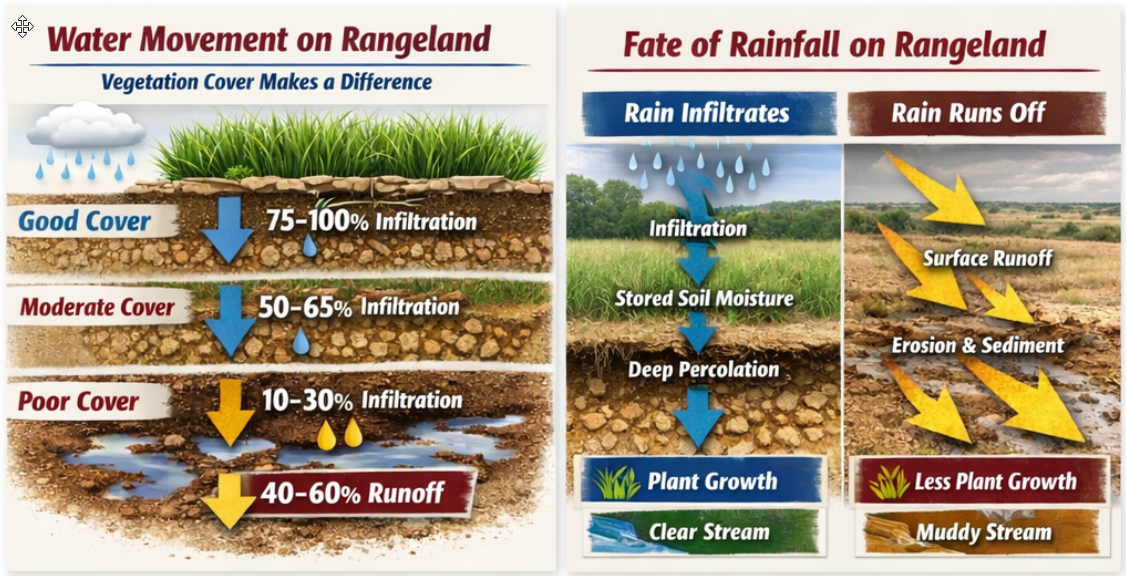
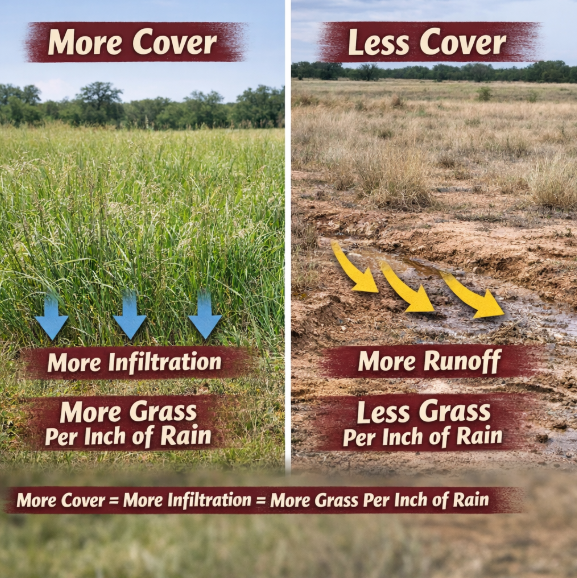
  • Stream water quality takes a hit. Edge-of-field monitoring in Northeast Texas showed continuously grazed sites produced >24% more runoff than pastures under prescribed grazing and had significantly higher loads of nitrate/nitrite and total suspended solids, reflecting the combined effects of reduced infiltration and increased overland flow. Diagram illustrating how vegetation cover on rangeland affects water movement, showing infiltration rates and runoff under good, moderate, and poor cover, and the subsequent impact on soil moisture, plant growth, and stream clarity.

Why infiltration matters for production

Every inch of rainfall that infiltrates instead of running off becomes soil moisture for roots, cooler soil temperatures, and more days of active growth. Texas A&M’s classic Improving Rainfall Effectiveness on Rangeland illustrates how management that maintains cover and litter can shift water fate toward infiltration and storage, improving rain-use efficiency which translates to more grass per inch of rain. 

From a forage and cattle performance standpoint, prolonged overgrazing repeatedly removes leaf area and growing points, which reduces photosynthesis, root mass, and regrowth capacity resulting in the plant having fewer “tools” to capture and use the water that does infiltrate. Texas A&M AgriLife’s grazing series details how timing, intensity, and recovery periods govern these plant responses. 

The compounding costs you can’t see (at first)

  • Reduced carrying capacity & higher feed costs. Lower infiltration and more runoff → less forage → lower stocking potential or higher reliance on hay and supplements. Over time, repeatedly “mining” residual cover shrinks both grass base and soil function. 
  • More erosion & infrastructure risk. Concentrated flow cuts rills and gullies, damages roads and water gaps, and fills stock ponds with sediment and these are costs that show up as repairs and lost storage. (NRCS hydrology guidance emphasizes cover as the first line of defense.) 
  • Water quality liabilities. TWRI studies link poor grazing in creek pastures to higher bacteria and sediment delivery during runoff events; rotational/prescribed grazing and keeping livestock out of wet creek pastures during stormy periods reduce those loads dramatically. 
  • Ecological drift. Overgrazed, drought-stressed sites can shift toward weedy/invasive species that livestock avoid, creating a feedback loop of selective overuse on the remaining palatable plants. 

What to do instead: Practical fixes that pay

  1. Match stocking to forage and recovery. Stocking rate is the “gatekeeper” decision; nothing else works if it’s wrong. Build flexibility to reduce numbers when growth slows, and plan for adequate post-graze recovery that changes with rainfall. 
  2. Manage timing, duration, and distribution. Shorter grazing periods, longer rest, and strategic water/mineral placement prevent chronic re-grazing of regrowth and spread hoof impact—core principles in the AgriLife Adaptive Multi-Paddock guidance. 
  3. Monitor cover, litter, and bare ground. Simple photo points and transects documenting bare ground and litter depth are sensitive early-warning indicators of hydrologic decline; adjust grazing before the problem is expensive (AgriLife’s West Texas Rangelands site offers practical monitoring how-tos and also check out the Rangeland Analysis Platform for current production estimates). 
  4. Invest where infiltration starts: the soil surface. Where chronic traffic has sealed the surface, recovery requires rest + cover, not more grazing. NRCS and AgriLife hydrology guidance are clear: vegetation cover is the most manager-controllable driver of infiltration, compaction, and erosion resistance on rangeland.

Bottom line

Prolonged overgrazing is more than a forage or drought problem, it’s a management problem that creates water scarcity. It trades infiltration for runoff, soil for loose dirt, and carrying capacity for input costs. The fixes are well-known: destock, shorten grazing bouts, lengthen recovery, and monitor cover and bare ground. Those steps rebuild infiltration, stabilize soils, and turn the same rainfall into more grass and healthier soils. 

References and Additional Readings

  • AgriLife Extension West Texas Rangelands — applied posts on overgrazing, monitoring, and reading your range. 
  • Texas A&M AgriLife Extension – Improving Rainfall Effectiveness on Rangeland (L-5029). 
  • Texas A&M AgriLife Research & Extension – Grazing Principles series (ERM-056 to ERM-060): plant competition, grazing effects, stocking rate, AMP principles. 
  • Texas A&M AgriLife Research – AMP vs. continuous grazing effects on bare ground, infiltration/runoff, and watershed carbon losses. 
  • Texas Water Resources Institute (TWRI) – Edge-of-field runoff under prescribed vs. continuous grazing in Northeast Texas; Lone Star Healthy Streams BMP evaluations. 
  • USDA-NRCS Rangeland Hydrology & Soil Erosion Handbook – vegetation cover as the lever for infiltration/erosion processes on rangelands.


Filed Under: Conservation, Grazing Management, Range Concepts Tagged With: #AgriLifeExtension, #WestTexasRangelands, grass production, grazing management, range management

Economic Incentives for Reducing Wildfire Risk

April 15, 2026 by kara.matheney

What Landowners, Educators, and Technical Assistance Providers Should Know
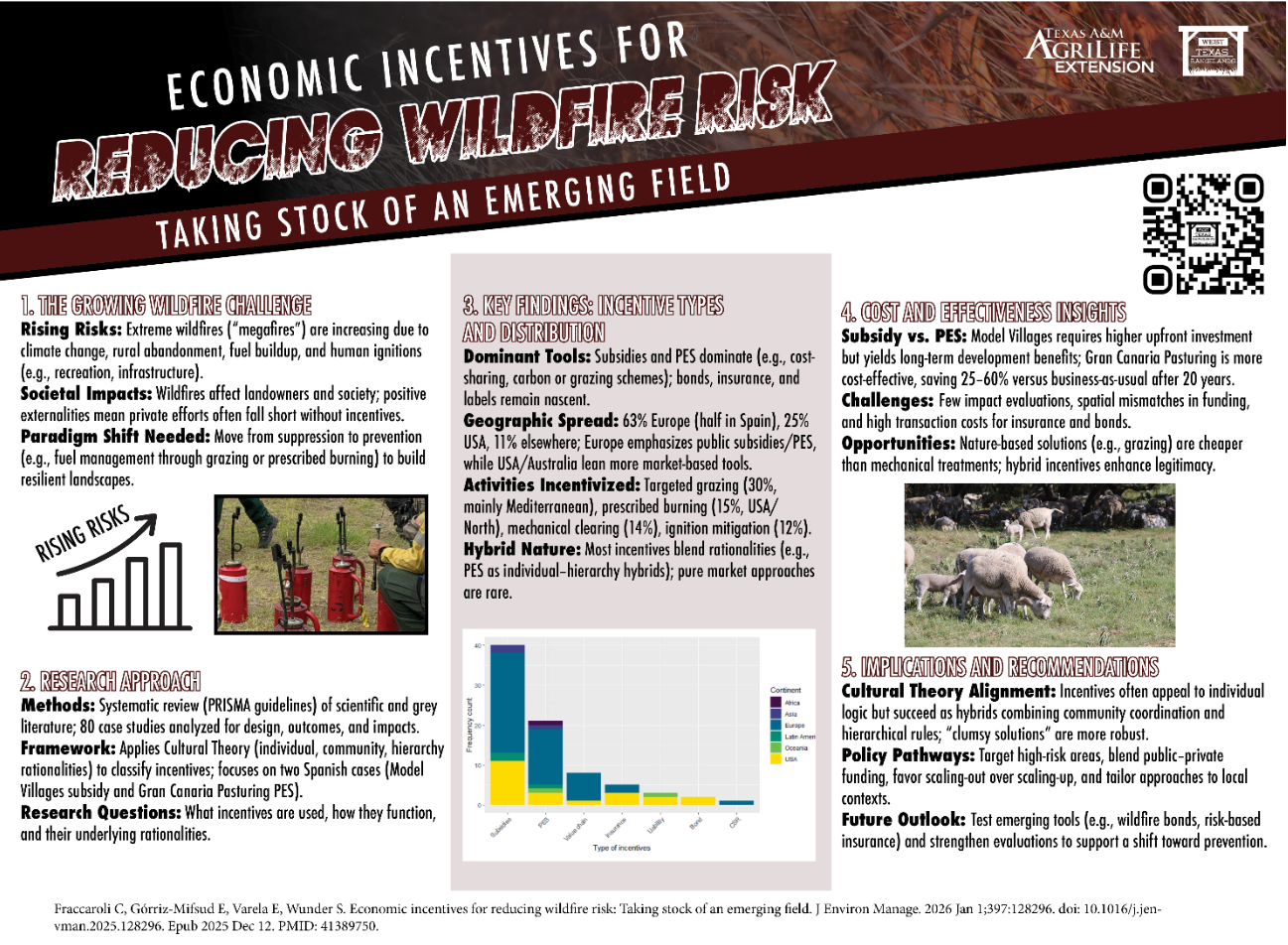
Wildfire risk across Texas rangelands and working lands continues to rise. Larger fires, longer fire seasons, and increased exposure at the wildland–urban interface are no longer isolated concerns, they are becoming part of routine land management decisions. While traditional wildfire response has focused heavily on suppression, growing attention is being given to prevention and risk reduction, particularly through economic incentives that encourage proactive land stewardship.  Recent research examining economic incentives for reducing wildfire risk highlights both opportunities and challenges for landowners and those who support them through education and technical assistance.

Why Wildfire Risk Is Increasing
Several interacting forces are driving higher wildfire risk on rangelands:

  • Climate and weather variability, including hotter temperatures and more frequent droughts
  • Fuel buildup from invasive grasses, brush encroachment, and reduced disturbance
  • Land use change and fragmentation, which complicates coordinated fire management

The social and economic impacts extend beyond burned acres. Wildfires affect ranch operations, infrastructure, natural resources, insurance markets, and community safety. As a result, there is growing interest in tools that shift investments from post-fire response to pre-fire prevention.

What Are Economic Incentives for Wildfire Risk Reduction?
Economic incentives are mechanisms designed to lower the financial barriers to adopting wildfire-mitigating practices or to reward landowners for reducing risk on their properties. The research summarized in the infographic identifies four broad categories of incentives:

  1. Command-and-Control Policies – These include regulations such as burn bans, fuel treatment requirements, or zoning rules. While they can be effective in certain contexts, they often face resistance if they limit landowner flexibility or fail to account for local conditions.
  2. Information-Based Incentives – Programs such as cost-share education, outreach campaigns, and technical guidance aim to increase awareness and capacity. These approaches are common in Extension programming and are most effective when paired with financial or operational support.
  3. Market-Based Incentives
    • Cost-share programs for prescribed burning, brush management, or grazing infrastructure
    • Payments for ecosystem services
    • Insurance premium adjustments tied to risk reduction
    • Research shows that direct subsidies and cost-share programs are among the most frequently used and most studied incentive types for wildfire risk reduction.
  4. Hybrid Incentives – Hybrid approaches combine regulatory frameworks with market or informational tools. For example, insurance programs that reward compliance with fuel management standards.

Cost, Effectiveness, and Tradeoffs
One of the most important takeaways for landowners and advisors is that upfront investment matters, but long-term savings can be substantial.

  • Prescribed burning, targeted grazing, and mechanical treatments require planning and initial costs.
  • Over time, these practices can reduce wildfire suppression costs, limit infrastructure damage, and improve ecological resilience.
  • Studies summarized in the research indicate that prevention investments can yield significant cost savings compared to repeated emergency response and recovery.

However, challenges remain:

  • Incentive programs are often short-term, while wildfire risk reduction requires sustained management.
  • Programs may not align well with local ecological conditions or landowner objectives.
  • Participation can be limited by administrative burden or lack of technical support.

Implications for Extension and Technical Assistance
For Extension educators and technical assistance providers, the findings reinforce several key points:

  • Cultural context matters. Landowners are more likely to engage when incentives align with local norms, production goals, and stewardship values.
  • One-size-fits-all approaches rarely work. Flexible, locally adapted programs outperform rigid designs.
  • Education alone is not enough. Information is most effective when paired with financial or operational incentives that reduce risk and uncertainty for landowners.

Extension’s trusted role positions educators to:

  • Translate incentive opportunities into practical decision tools
  • Facilitate cooperative approaches across fence lines
  • Support landowners in navigating cost-share, insurance, and hybrid programs

Looking Ahead
As wildfire risk continues to shape rangeland management, future incentive programs are likely to place greater emphasis on:

  • Long-term contracts and sustained funding
  • Risk-based insurance models
  • Integrated approaches that combine grazing management, prescribed fire, and fuel reduction

For landowners, proactive participation in wildfire risk reduction can protect livelihoods, landscapes, and communities. For educators and technical assistance providers, aligning economic incentives with sound land management remains a powerful strategy for building more fire-resilient rangelands.

Learn More and Stay Connected
For additional resources on rangeland fire management, prescribed burning, and incentive programs, contact your local Extension office or rangeland specialist.

Filed Under: Brush Management, Conservation Practices, Prescribed Burn Associations, Prescribed Burning, Range Concepts, Wildfire, Wildfires, Woody Encroachment Tagged With: #AgriLifeExtension, #FireResilientLandscapes, #PrescribedFire, #RangelandManagement, #TargetedGrazing, #WestTexasRangelands, #WildfireRisk, #WorkingLands

The Cost of Prolonged Overgrazing: Ripple Effects on Watershed Health, Rainfall Infiltration, and Ranch Production

April 1, 2026 by morgan.treadwell

Producers often face tough choices when managing rangeland, especially during drought or market fluctuations. While maximizing livestock numbers might bring short-term profit, prolonged overgrazing can deal lasting damage to the overall health and productivity of the land. One of the most critical, but sometimes overlooked, impacts is how overgrazing disrupts the watershed and reduces rainfall infiltration, setting off a chain reaction that threatens both present and future production.

What Is Overgrazing?

Overgrazing happens when livestock remove more plant material than the land can regenerate, reducing vegetative cover. Without sufficient rest and recovery for grasses and forbs, root systems shrink, soil structure declines, and bare ground increases.

Watershed Function and Why It Matters

A healthy watershed collects, stores, and distributes water efficiently across the landscape. Vegetation intercepts rainfall, slows surface runoff, and helps water infiltrate into the soil, replenishing aquifers and supporting plant growth during dry periods. When this function is degraded, so is the life of a ranch.

The Impact of Overgrazing on Rainfall Infiltration

Intact vegetation and litter (dead plant material) act as a sponge, allowing more rainfall to soak in rather than run off. Texas A&M research consistently shows that overgrazed pastures lose this critical function (Briske et al., 2011).   The results:

  • Increased Bare Soil – without enough cover, droplets hit bare soil directly, compacting it and reducing pore spaces.
  • More Runoff – compacted, crusted soils shed water, sending it downhill rather than storing it for plant growth.
  • Erosion – runoff carries away topsoil, further reducing the land’s ability to support vegetation.

Effects on Production and Range Health

  • Lower Forage Yields – less water stored means less forage growth through the season. Productivity drops, resulting in further pressure to overstock in a vicious cycle.
  • Reliance on Supplemental Feed – with reduced native forage, producers must purchase feed or de-stock, both of which cut into profits.
  • Increased Weed Invasion – bare patches and disturbed soil invite invasive species, which further outcompete desirable native plants.
  • Reduced Drought Resilience – healthy rangeland can buffer drought impacts; degraded rangeland cannot.

Economic and Environmental Tradeoff

“A pound of prevention is worth a ton of cure,” says Dr. Larry Redmon, Professor & Extension Forage Specialist at Texas A&M. Repairing watershed function, restoring infiltration, and rebuilding soil health can take years and significant expense.

Key findings from Texas A&M’s “Rangeland Watershed Management” (B-6136) highlight how managed grazing increases infiltration by 12–60% compared to overgrazed sites.   

Steps for Ranchers

  1. Monitor Utilization – Leave adequate stubble height and ground cover after grazing.
  2. Rest Pastures – Allow for seasonal or rotational rest to restore plant and root health.
  3. Observe Hydrology – Monitor for runoff, erosion, and infiltration after rains.
  4. Consult Local Extension – Texas A&M AgriLife can provide technical assistance and region-specific recommendations.

Conclusion

The hidden cost of overgrazing is the undermining of the ranch’s very foundation which starts and ends with the soil and water resources. By prioritizing range health and managing for watershed function, producers secure not only the current year’s paycheck but the resilience and productivity of their land for years to come.

References

  1. Briske, D.D., et al. (2011). [Rangeland Watershed Management – B-6136] (https://agrilife.org/texasrangelands/files/2011/02/B-6136.pdf), Texas A&M AgriLife Extension.
  2. What Is a Watershed? (https://wrri.tamu.edu/watersheds/what-is-a-watershed/), Texas Water Resources Institute.

For more infographics and resources, visit AgriLife Extension’s West Texas Rangelands https://agrilife.org/westtexasrangelands/extension-publications/

Are you seeing signs of overgrazing, runoff, or diminished production on your ranch? Contact your county’s AgriLife Extension Office for a site assessment and recommendations today.

Filed Under: Conservation, Conservation Practices, Grazing Management, Range Concepts Tagged With: #AgriLifeExtension, #RanchManagement, #WestTexasRangelands, Conservation, Conservation Practices, soil, water

Fire Field Day – Mason, Tx: A Hands-On Learning Experience for Landowners

March 4, 2026 by morgan.treadwell

Landowners, ranchers, and natural resource managers across the region are invited to take part in an exciting and educational Fire Field Day.  The event is slated for March 21, 2026, at the scenic White Ranch in Mason, Texas. This in-person workshop offers a unique opportunity to learn directly from prescribed fire experts and the Central Basin Prescribed Burn Association (PBA).

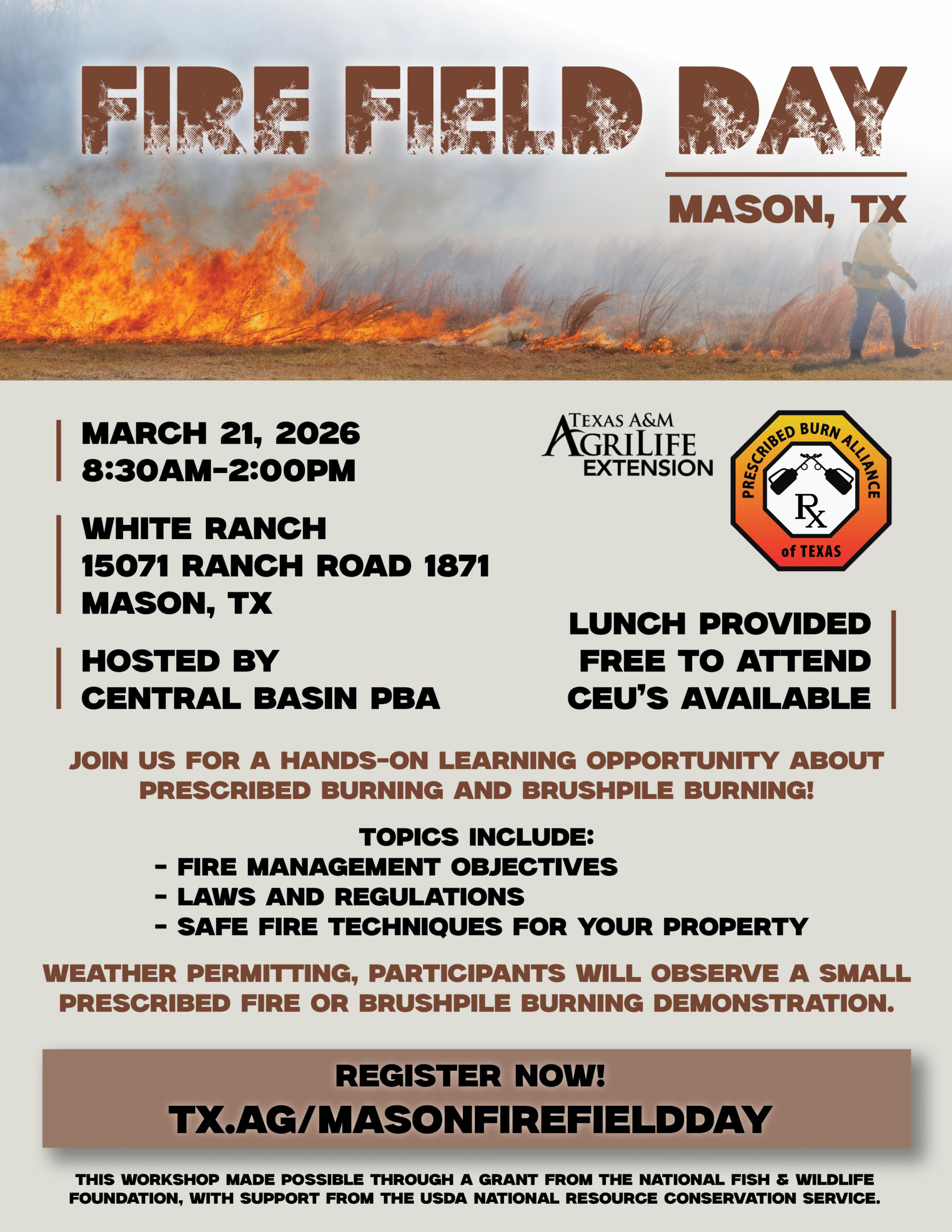
With growiA promotional flyer for a “Fire Field Day” event in Mason, Texas, featuring a background photo of an active grass fire with flames and smoke. Event details include date, time, location at White Ranch, and host information. The flyer highlights topics such as prescribed burning, brushpile burning, fire management objectives, regulations, and safe techniques. It notes lunch is provided, the event is free, CEUs are available, and participants may observe a live demonstration. A registration link is included at the bottom.ng interest in safe and effective rangeland management practices, prescribed fire has become an essential tool for improving rangeland health, reducing wildfire risk, and managing brush and tree encroachment. This event is designed to equip participants with both foundational knowledge and practical, hands-on experience.

What to Expect at Fire Field Day
The workshop runs from 8:30am to 2:00pm, and lunch will be provided at no cost to attendees. The day includes expert-led discussions and demonstrations focusing on:

⭐ Fire Management Objectives
Learn why fire is such an effective ecological tool, how it benefits rangelands, and what outcomes you can expect when applying prescribed burning on your property.

⭐ Laws and Regulations
Prescribed fire is a powerful tool that comes with responsibilities. Attendees will gain clarity on Texas laws governing burn plans, permitting, liability, and proper safety protocols.

⭐ Safe Fire Techniques for Your Property
From ignition methods to firebreak preparation, participants will walk away with practical strategies they can apply at home.

Weather permitting, the event will also feature a live prescribed fire or brushpile burn demonstration, giving attendees a chance to observe fire behavior and management techniques in real time.

This Fire Field Day is proudly hosted by the Central Basin Prescribed Burn Association, with support from Texas A&M AgriLife Extension and the Prescribed Burn Alliance of Texas. These organizations are committed to helping landowners apply safe, science-based fire practices to improve their rangeland and encourage healthier ecosystems across the region.

Why Prescribed Fire Matters
Prescribed burning is one of the most cost-effective and natural methods for managing unwanted brush and trees, improving wildlife habitat, stimulating new plant growth, and reducing the intensity of future wildfires. For many Texas landowners, gaining confidence and practical knowledge is the key first step toward implementing burns on their own property.

This workshop is an ideal starting point, whether you are brand new to prescribed fire or looking to expand your experience with support from certified professionals.

We hope you will mark your calendar and JOIN US!
📍 Location: White Ranch – 15071 Ranch Road 1871, Mason, TX
📅 Date: March 21, 2026
⏰ Time: 8:30 AM–2:00 PM
💲 Cost: FREE
🍽️ Lunch Included
📜 CEU’s Available

For more information and to register please visit: TX.AG/MASONFIREFIELDDAY
Spaces often fill quickly for hands-on burn workshops so don’t miss this chance to learn from experts and connect with landowners across the region.

Stay Connected with Us!
Follow along for more land management events, educational workshops, and updates across the region.

Filed Under: Brush Management, Conservation, Conservation Practices, Prescribed Burn Associations, Prescribed Burning, Range Concepts, Wildfire Tagged With: #BrushManagement, #CentralBasinPBA, #FireEcology, #FireFieldDay, #PrescribedBurn, #RanchManagement, #SustainableLandManagement, #TexasAgriLifeExtension, #TexasLandowners, #TexasRangeManagement, #WildfirePrevention

Grazing Isn’t the Problem. Unmanaged Pressure Is.

February 18, 2026 by morgan.treadwell

Grazing is often viewed as a disturbance or impediment to rangeland health, but it is just the opposite! When applied intentionally, it can support plant diversity and ecosystem function. The key is managing pressure, timing, and recovery rather than applying constant use in a continuous grazing system.  Even if managers are conservatively or low-stocked, continuous grazing is a recipe for poor rangeland condition.  

Grazing strategies that prioritize rest allow plants to recover and strengthen root systems. 

Rest and Recovery Matter 

Plants need time after grazing to regrow leaves and rebuild energy reserves that sustains populations during drought and dormancy. Without sufficient recovery, repeated grazing weakens native perennial grasses and reduces long-term productivity and diversity. 

Planned grazing systems incorporate rest periods that match plant growth patterns and environmental conditions. 

Managing Pressure, Not Just Numbers 

Stocking rate alone does not determine grazing success. Duration and distribution of grazing pressure often have a greater impact on plant health than animal numbers. 

Adjusting pasture size, rotation timing, and water placement can help distribute grazing pressure more evenly across the landscape. 

Grazing as a Management Tool 

When managed properly, grazing can reduce excess vegetation, promote plant diversity, and support soil health. Used intentionally, livestock become a win-win synergistic balance that contributes to rangeland resilience rather than degradation. 

Filed Under: Brush Management, Conservation, Grazing Management, Range Concepts Tagged With: #grazing #ranchmanagement #brush #grasslands, Grazing, grazing management, rangelands

What Your Rangeland Is Telling You: If You Know How to Look

February 11, 2026 by morgan.treadwell

The condition of your rangeland shows how management decisions are affecting it. By paying attention to plant communities, soil cover, and overall structure, land managers can identify potential issues early and respond effectively. Regular observation is one of the most important tools in long-term rangeland stewardship. 

Key Indicators to Watch 

Plant diversity is a strong indicator of rangeland health. A mix of grasses, forbs, cool and warm season species, and varying plant heights often signals a functioning system. Uniform vegetation or dominance by a single species may indicate stress or management imbalance. Think monocultures of Purple Threeawn or Texas Wintergrass.  

Soil surface condition is equally important. Adequate litter and ground cover protect soil from erosion, temperatures, and help retain moisture. Increasing bare ground can signal declining rangeland condition.  Bare ground between bunchgrasses of plants will slowly start to expand, increasing soil movement and soil loss.  

Monitoring Beyond the Growing Season 

Rangeland monitoring does not stop when plants are dormant! Winter and early spring observations can reveal grazing patterns, hoof impact, and areas where pressure may be too concentrated.  Monitoring native perennial grasses during the winter is just as important as monitoring during the growing season, because what you protect in the winter is what jumpstarts new growth this spring.   

Tracking changes season-to-season rather than reacting to a single observation provides a clearer picture of trends and management outcomes.  

Using Monitoring to Guide Decisions 

Monitoring allows managers to make informed adjustments to grazing timing, duration, and intensity. When rangeland conditions are regularly evaluated, management becomes proactive rather than reactive setting pastures off to a great start this spring.  

Filed Under: Conservation, Grazing Management, Range Concepts, Woody Encroachment Tagged With: #grazing #ranchmanagement #brush #grasslands, Conservation, Conservation Practices, grazing management

Prickly Pear and the South American Cactus Moth

March 19, 2025 by jaime.sanford

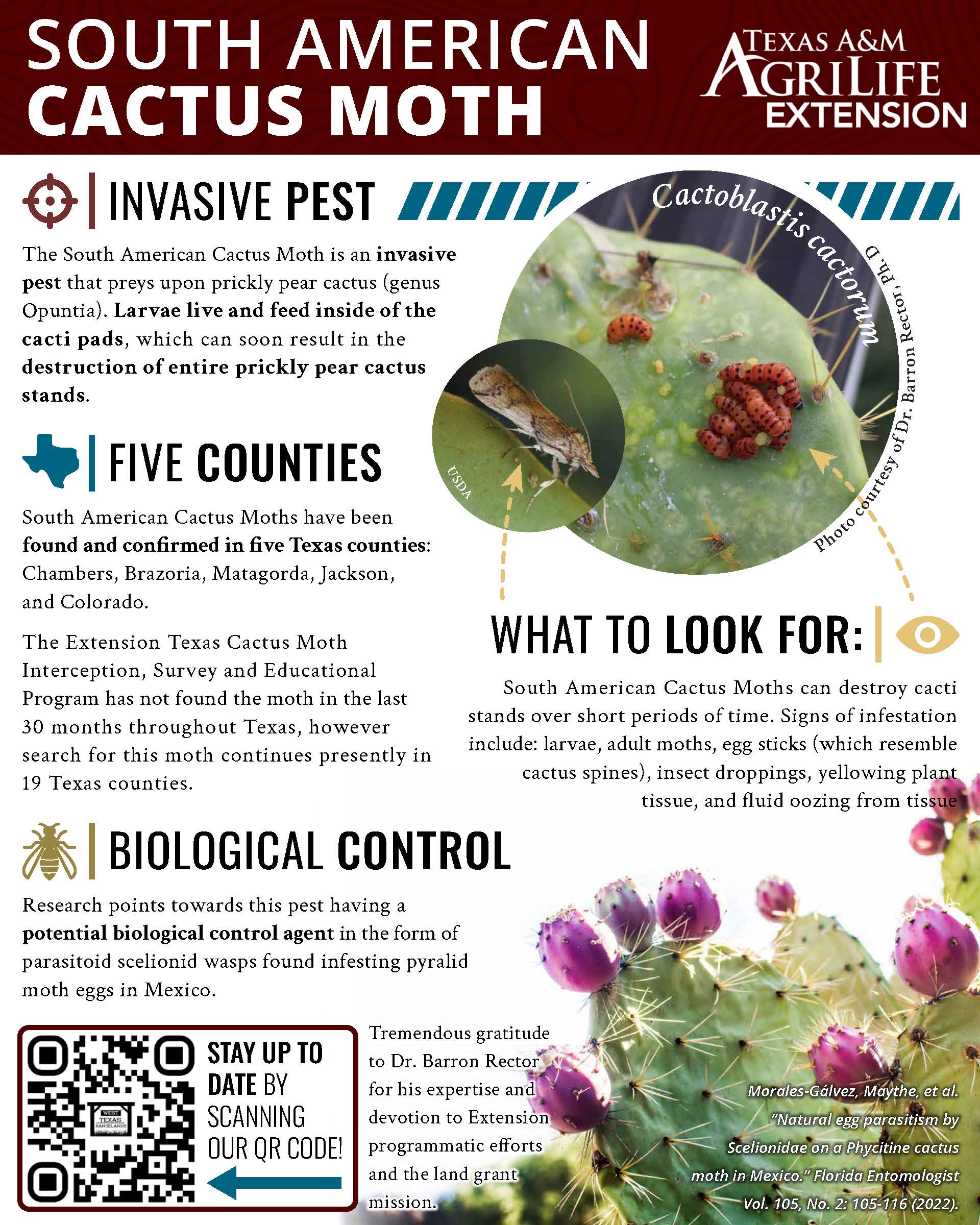
Cactus Moth InfographicTexas is known for its rugged landscapes and iconic, opportunistic, and problematic prickly pear. While these plants readily provide headaches to the grazing manager, oftentimes pear also serves as food and habitat for wildlife and is a native species on Texas rangelands. However, the South American Cactus Moth has been found and confirmed in five Texas counties. 

[Read more…] about Prickly Pear and the South American Cactus Moth

Filed Under: Brush Management, Grazing Management, Plant ID, Range Concepts

A Comparison of the 2017 & 2022 USDA Ag Census Data for West Texas Counties

February 12, 2025 by jaime.sanford

The U.S. Department of Agriculture’s National Agricultural Statistics Service (NASS) has released 2022 Census of Agriculture data. The graphic presents a fascinating snapshot of the ranching landscape impacting four West Texas counties: Tom Green, Schleicher, Crockett, and Menard. Using data from the 2017 and 2022 USDA Agricultural Census, we can glean valuable insights into trends and shifts within this vital sector of Texas’s economy and heritage.

[Read more…] about A Comparison of the 2017 & 2022 USDA Ag Census Data for West Texas Counties

Filed Under: Beef Cattle, Land, Range Concepts, Sheep

Gone With the Wind: Examining the Impact of Windfarms on Property Value

January 15, 2025 by jaime.sanford

Solar and wind energy development on rangeland is everywhere. They accounted for a whopping 40% and 18% of new electricity generation capacity in the United States in 2019, respectively. Inevitably, these projects often lead to habitat fragmentation, soil disturbance, and changes in hydrology, which can negatively impact native vegetation and wildlife species reliant on these landscapes. However, few ecological studies exist documenting plant community impacts, soil health dynamics, and wildlife habitat alterations, however, some studies conducted on wind and solar development have shown that proximity to wind farms can often reduce overall property values. This reduction is more significant when the wind turbines are visible from the property. The visual impact of wind turbines is a major factor in overall property value depreciation. Research suggests that the visibility radius for wind turbines can extend up to 8.7 miles.

[Read more…] about Gone With the Wind: Examining the Impact of Windfarms on Property Value

Filed Under: Conservation, Range Concepts

Blue Grama (Bouteloua gracilis)

December 18, 2024 by jaime.sanford

As stewards, let’s all just take a Christmas moment reflection and a deep breath of blue grama.  Did you know that blue grama is the most common plant found throughout the mixed prairie? Even more impressively, blue grama possesses the most general distribution thriving as far north as Canada and as far south as Mexico. 

[Read more…] about Blue Grama (Bouteloua gracilis)

Filed Under: Conservation, Grazing Management, Plant ID, Range Concepts

  • Page 1
  • Page 2
  • Page 3
  • Go to Next Page »

Recent Posts

  • The Hidden Cost of Overgrazing: How It Drains Your Watershed, Your Rainfall, and Your Bottom Line
  • Economic Incentives for Reducing Wildfire Risk
  • Building Knowledge and Confidence with the Updated Online Prescribed Burn School
  • The Cost of Prolonged Overgrazing: Ripple Effects on Watershed Health, Rainfall Infiltration, and Ranch Production
  • Advancing Wildland Fire Science: Inside the USDA Forest Service Fire Lab

Categories

  • 4-H Range Contests
  • Beef Cattle
  • Brush Management
  • Carbon Credits
  • Carbon Markets
  • Conservation
  • Conservation Practices
  • Drought Management
  • El Niño
  • Events
  • Goats
  • Grazing Management
  • La Niña
  • Land
  • Lessons Learned
  • Meet A County Extension Agent
  • Plant ID
  • Podcast
  • Prescribed Burn Associations
  • Prescribed Burning
  • Publications
  • Range Concepts
  • RAP
  • Sheep
  • Society for Range Management
  • Soil
  • Staff
  • Targeted Grazing
  • Uncategorized
  • Water
  • Weather
  • Why I Ranch
  • Wild Pigs
  • Wildfire
  • Wildfires
  • Wind
  • Woody Encroachment
  • Youth Range Workshop

Archives

Texas A&M AgriLife Extension Service
Texas A&M University System Member
  • Compact with Texans
  • Privacy and Security
  • Accessibility Policy
  • State Link Policy
  • Statewide Search
  • Veterans Benefits
  • Military Families
  • Risk, Fraud & Misconduct Hotline
  • Texas Homeland Security
  • Texas Veteran's Portal
  • Equal Opportunity
  • Open Records/Public Information