West Texas Rangelands sourced this information from the Texas Agriculture Law Blog authored by Tiffany Dowell Lashmet, Professor & Extension Ag Law Specialist with Texas A&M AgriLife Extension Service. To view the full report, please visit: https://agrilife.org/texasaglaw/2026/04/13/2025-rural-land-value-trends-report-released/.
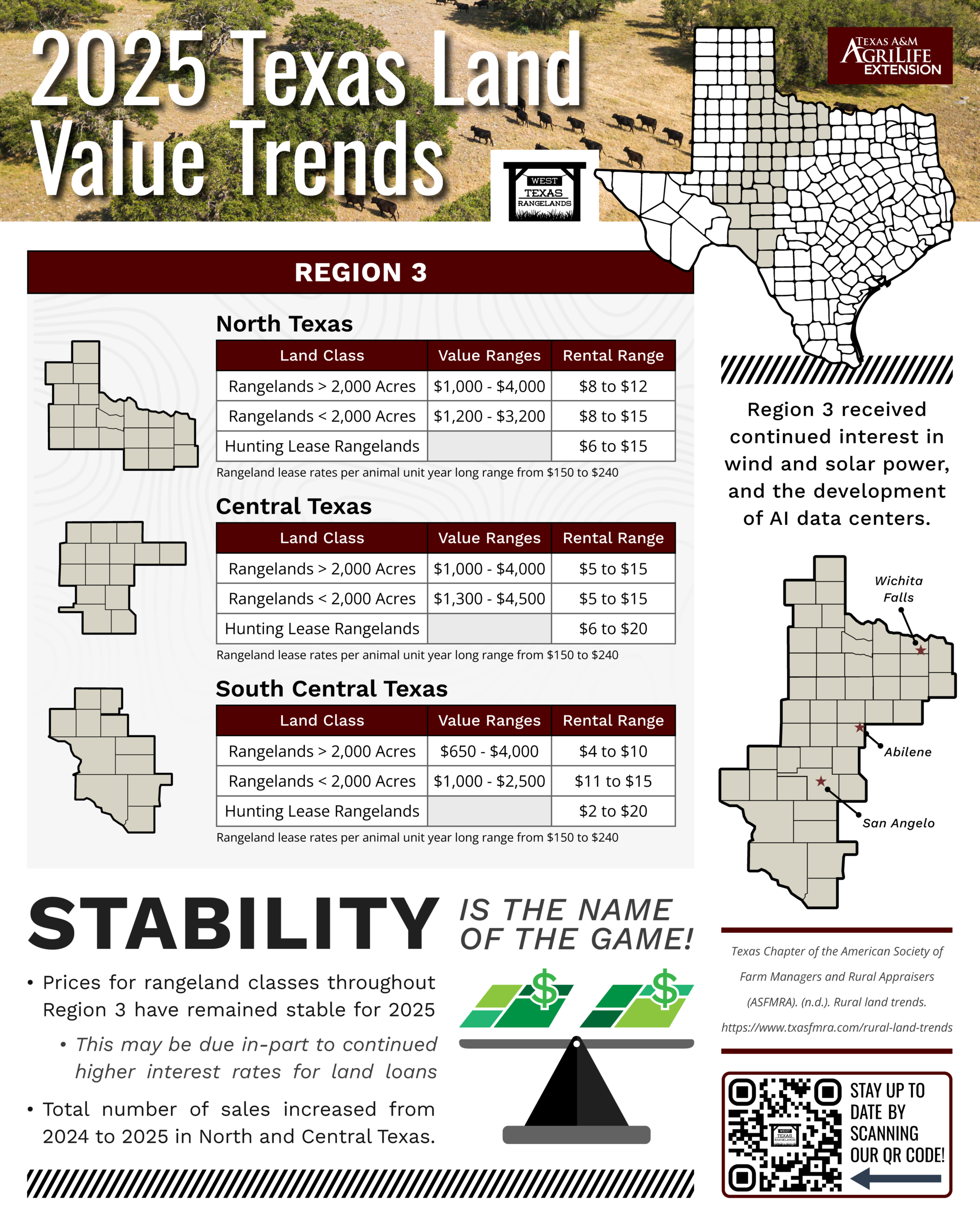
Land values influence nearly every management decision on a West Texas ranch, from leasing and grazing strategies to succession planning and long‑term investment. The 2025 Texas Land Value Trends for Region 3 offer an important takeaway for producers across North, Central, and South Central Texas: stability remains the dominant theme.
While individual properties differ, overall rangeland values and rental rates across Region 3 have remained steady going into 2025. For producers, this consistency provides a clearer planning window during a time when many costs and inputs remain unpredictable.
A Stable Market Across Region 3
According to the Texas Chapter of the American Society of Farm Managers and Rural Appraisers, rangeland prices throughout Region 3 have largely held steady from 2024 to 2025. This includes large tracts greater than 2,000 acres as well as smaller ranches under 2,000 acres.
In North and Central Texas, total land sales increased from 2024 to 2025, even as interest rates for land loans remained higher than many producers have been accustomed to in recent years. This suggests that demand for rangeland remains strong, particularly for properties that support livestock production, hunting leases, or long‑term land investments.
For South Central Texas, values have remained stable as well, though rental ranges and entry prices continue to vary based on acreage size, location, and land condition.
What the Numbers Say About Rangeland Values
Across Region 3, rangelands larger than 2,000 acres generally continue to carry lower per‑acre values than smaller properties, reflecting typical economies of scale. Smaller tracts often command higher per‑acre prices due to accessibility, limited supply, or diversification opportunities.
Rental rates for rangeland grazing remain within consistent ranges across the region. Long‑term rangeland lease rates per animal unit year continue to fall within established norms, giving producers some predictability when budgeting for leased ground or negotiating renewals.
Hunting leases remain an important supplemental income source for many ranches. Although rates vary widely depending on habitat, access, and wildlife management, the continued presence of hunting lease value reinforces the importance of multispecies land stewardship in West Texas.
Development Pressure and Emerging Interests
There continues to be interest in wind and solar development, as well as AI data centers, within Region 3. While these developments are not evenly distributed, they are increasingly part of landowner conversations across nearly every region of Texas.
For producers, this does not necessarily mean a shift away from agriculture. Instead, it reinforces the need to understand how surface use agreements, water access, and infrastructure placement may affect long‑term ranch operations. Evaluating these opportunities through the lens of working lands remains critical.
What Stability Means for Ranch Management Decisions
Stable land values can be both reassuring and strategic for producers. When markets are not rapidly escalating or declining, decisions can be made with greater confidence and less pressure to react quickly.
For some operations, this may be an opportunity to:
- Re-evaluate grazing or hunting lease terms
- Invest in land improvements such as water infrastructure or brush management
- Plan transitions within family operations
- Reassess insurance, taxes, and long‑term budgets
Stable markets do not remove risk, but they do reduce uncertainty when compared to periods of rapid appreciation or correction.
Keeping Land Productive in a Stable Market
While land values matter, long‑term ranch success still depends on land conditions. Soil health, forage productivity, water availability, and flexibility during drought remain foundational to property value over time.
Markets reflect what land can produce. Producers who focus on sustainable grazing management, adaptive stocking strategies, and thoughtful use of tools such as prescribed fire are better positioned regardless of short‑term market shifts.
Staying Informed
Land value trends are one piece of the broader picture producers must consider. Staying informed through credible sources allows landowners to separate short‑term headlines from long‑term patterns.
The West Texas Rangelands program will continue sharing producer‑focused information that supports informed decision-making across working landscapes.
