What Landowners, Educators, and Technical Assistance Providers Should Know
Wildfire risk across Texas rangelands and working lands continues to rise. Larger fires, longer fire seasons, and increased exposure at the wildland–urban interface are no longer isolated concerns, they are becoming part of routine land management decisions. While traditional wildfire response has focused heavily on suppression, growing attention is being given to prevention and risk reduction, particularly through economic incentives that encourage proactive land stewardship. Recent research examining economic incentives for reducing wildfire risk highlights both opportunities and challenges for landowners and those who support them through education and technical assistance.
Why Wildfire Risk Is Increasing
Several interacting forces are driving higher wildfire risk on rangelands:
- Climate and weather variability, including hotter temperatures and more frequent droughts
- Fuel buildup from invasive grasses, brush encroachment, and reduced disturbance
- Land use change and fragmentation, which complicates coordinated fire management
The social and economic impacts extend beyond burned acres. Wildfires affect ranch operations, infrastructure, natural resources, insurance markets, and community safety. As a result, there is growing interest in tools that shift investments from post-fire response to pre-fire prevention.
What Are Economic Incentives for Wildfire Risk Reduction?
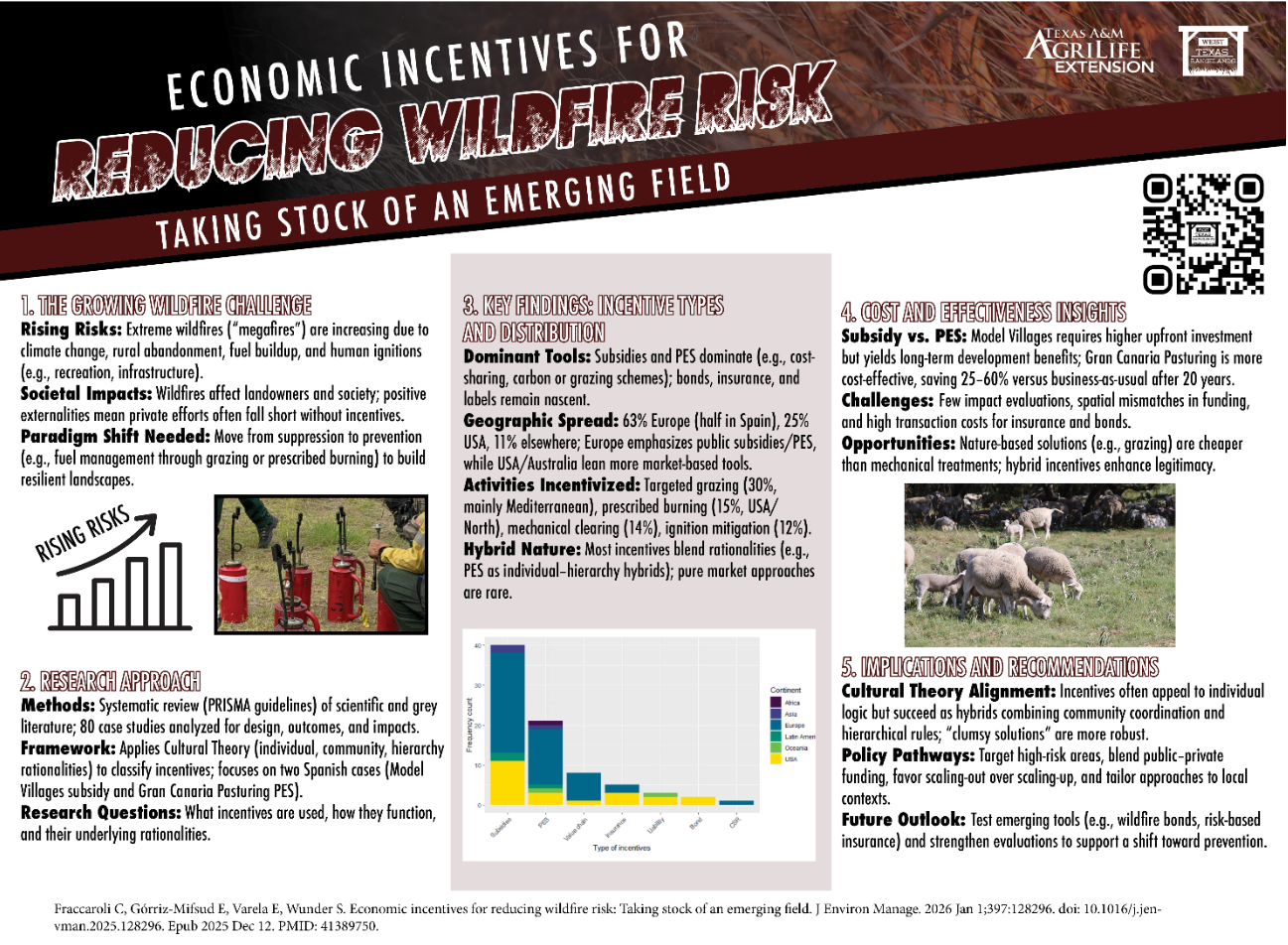
Economic incentives are mechanisms designed to lower the financial barriers to adopting wildfire-mitigating practices or to reward landowners for reducing risk on their properties. The research summarized in the infographic identifies four broad categories of incentives:
- Command-and-Control Policies – These include regulations such as burn bans, fuel treatment requirements, or zoning rules. While they can be effective in certain contexts, they often face resistance if they limit landowner flexibility or fail to account for local conditions.
- Information-Based Incentives – Programs such as cost-share education, outreach campaigns, and technical guidance aim to increase awareness and capacity. These approaches are common in Extension programming and are most effective when paired with financial or operational support.
- Market-Based Incentives
- Cost-share programs for prescribed burning, brush management, or grazing infrastructure
- Payments for ecosystem services
- Insurance premium adjustments tied to risk reduction
- Research shows that direct subsidies and cost-share programs are among the most frequently used and most studied incentive types for wildfire risk reduction.
- Hybrid Incentives – Hybrid approaches combine regulatory frameworks with market or informational tools. For example, insurance programs that reward compliance with fuel management standards.
Cost, Effectiveness, and Tradeoffs
One of the most important takeaways for landowners and advisors is that upfront investment matters, but long-term savings can be substantial.
- Prescribed burning, targeted grazing, and mechanical treatments require planning and initial costs.
- Over time, these practices can reduce wildfire suppression costs, limit infrastructure damage, and improve ecological resilience.
- Studies summarized in the research indicate that prevention investments can yield significant cost savings compared to repeated emergency response and recovery.
However, challenges remain:
- Incentive programs are often short-term, while wildfire risk reduction requires sustained management.
- Programs may not align well with local ecological conditions or landowner objectives.
- Participation can be limited by administrative burden or lack of technical support.
Implications for Extension and Technical Assistance
For Extension educators and technical assistance providers, the findings reinforce several key points:
- Cultural context matters. Landowners are more likely to engage when incentives align with local norms, production goals, and stewardship values.
- One-size-fits-all approaches rarely work. Flexible, locally adapted programs outperform rigid designs.
- Education alone is not enough. Information is most effective when paired with financial or operational incentives that reduce risk and uncertainty for landowners.
Extension’s trusted role positions educators to:
- Translate incentive opportunities into practical decision tools
- Facilitate cooperative approaches across fence lines
- Support landowners in navigating cost-share, insurance, and hybrid programs
Looking Ahead
As wildfire risk continues to shape rangeland management, future incentive programs are likely to place greater emphasis on:
- Long-term contracts and sustained funding
- Risk-based insurance models
- Integrated approaches that combine grazing management, prescribed fire, and fuel reduction
For landowners, proactive participation in wildfire risk reduction can protect livelihoods, landscapes, and communities. For educators and technical assistance providers, aligning economic incentives with sound land management remains a powerful strategy for building more fire-resilient rangelands.
Learn More and Stay Connected
For additional resources on rangeland fire management, prescribed burning, and incentive programs, contact your local Extension office or rangeland specialist.