Prescribed fire has long been one of the most effective tools for managing woody plant encroachment, improving wildlife habitat, enhancing forage production, and reducing wildfire risk. Yet for many landowners, implementing prescribed fire can seem out of reach due to concerns about labor, equipment, experience, liability, and planning requirements.
Across the Great Plains, Prescribed Burn Associations (PBAs) are helping overcome those barriers through a simple but powerful concept: neighbors helping neighbors. New research published in the International Journal of Wildland Fire demonstrates that these landowner-led organizations are expanding access to prescribed fire, building local capacity, and making meaningful contributions to rangeland stewardship across the United States.
A Movement Built by Landowners
Prescribed Burn Associations first emerged in the Great Plains in the 1990s to help ranchers gain the education, equipment, training, and support needed to safely implement prescribed fire on private lands. Since then, the model has spread nationwide, with more than 140 PBAs now operating across the country.
Unlike traditional top-down approaches, PBAs are community-led organizations that bring together landowners, volunteers, and natural resource professionals to share knowledge, labor, equipment, and experience. These local networks help reduce costs, increase confidence, and provide opportunities for people to gain hands-on experience using prescribed fire.
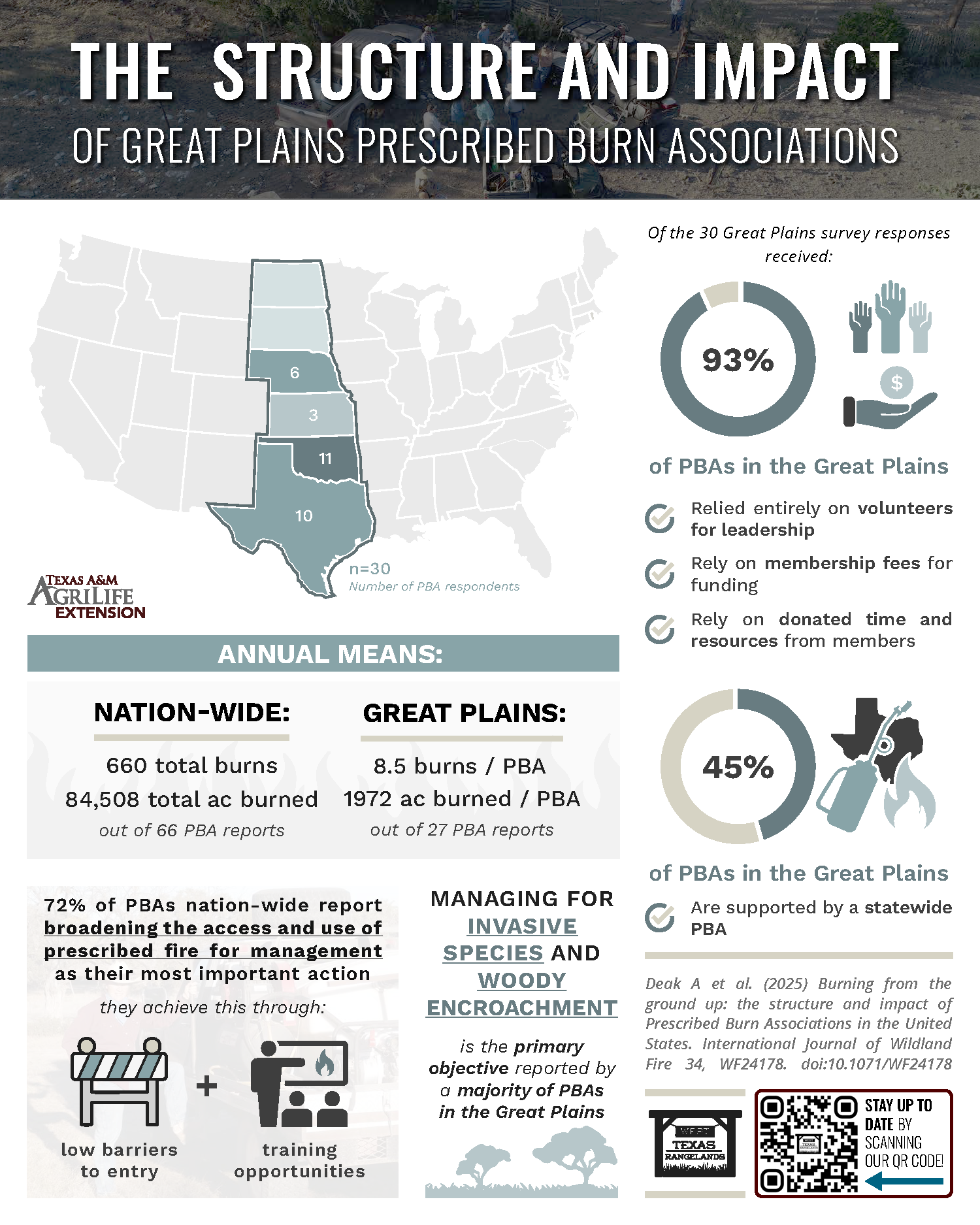
The impact of these organizations continues to grow. Survey responses from PBAs across the United States showed that associations collectively conduct an average of 660 prescribed burns across 84,508 acres annually, mobilizing thousands of volunteers to restore fire to ecosystems where it has historically been excluded.
Expanding Access to Prescribed Fire
One of the most significant findings from the study was the role PBAs play in making prescribed fire more accessible.
Nationwide, 72% of respondents identified broadening access to prescribed fire as a management tool as one of the three most important actions performed by their association. Respondents also emphasized field-based training, increasing public understanding of prescribed fire, and providing tools and equipment needed to conduct burns.
PBAs have been particularly successful because they intentionally maintain low barriers to participation. The research found that many associations welcome community members into training events, volunteer opportunities, and educational burns. More than half of surveyed PBAs reported opening burns to community participants through “learn and burn” or other educational programs. Additionally, 77% reported conducting at least one training opportunity annually.
This approach helps create new prescribed fire practitioners while strengthening local support for the use of prescribed fire.
Addressing Woody Encroachment in the Great Plains
Across much of Texas and the Great Plains, woody plant encroachment remains one of the greatest challenges facing rangeland managers. Eastern redcedar, juniper, mesquite, and other woody species continue to expand into grasslands, affecting forage production, wildlife habitat, water resources, and wildfire behavior.
The study found that management of invasive species and woody plant encroachment was the primary objective reported by 93% of Great Plains PBAs, making it the most common management goal among respondents in the region. Rangeland and forage enhancement ranked second, followed by wildlife habitat improvement.
These findings reinforce the importance of prescribed fire as a practical, cost-effective management tool. For many landowners, prescribed fire remains one of the few approaches that can address woody encroachment at the scale needed to maintain productive grasslands.
The Power of Volunteers
Perhaps one of the most remarkable findings from the research is the extent to which PBAs rely on volunteer leadership and community support.
Among Great Plains respondents:
- 93% relied entirely on volunteers for leadership.
- 93% relied on membership fees for funding.
- 93% relied on donated time and resources from members.
- 45% received support from a statewide PBA organization.
These numbers illustrate how strongly PBAs depend on local commitment and cooperation. Landowners are not simply members of these organizations. They are the trainers, burn crew members, equipment operators, mentors, and leaders that make prescribed fire possible within their communities.
The success of PBAs demonstrates that effective conservation often begins at the local level, where people with shared goals work together to solve common challenges.
More Than Acres Burned
While acres treated and burns conducted are important measures of success, the benefits of PBAs extend far beyond those numbers.
By providing real-world experience and mentorship opportunities, PBAs are helping train the next generation of prescribed fire practitioners. They are creating networks of landowners who understand fire behavior, weather, planning, and risk management. These organizations also foster trust among neighbors, strengthen community resilience, and increase public understanding of the role fire plays in maintaining healthy rangelands.
The study’s authors concluded that PBAs are successfully reducing barriers to prescribed burning while expanding access to beneficial fire through a community-based model that pools resources, provides training, and lowers implementation costs.
Looking Ahead
As woody encroachment, invasive species, and wildfire risk continue to challenge rangeland managers across Texas and the Great Plains, Prescribed Burn Associations are helping demonstrate what is possible when communities work together.
The research confirms what many Texas landowners already know: prescribed fire is not just a management tool. It is a tool that becomes even more effective when supported by strong partnerships, local leadership, and a shared commitment to healthy rangelands.
By expanding access to prescribed fire, training new practitioners, and supporting landowners in the field, PBAs are helping ensure that fire remains part of the rangeland management toolbox for generations to come.
Source
Deak, A., Fawcett, J. E., Quinn-Davidson, L., Adlam, C., Weir, J. R., and Stackhouse, J. (2025). Burning from the ground up: the structure and impact of Prescribed Burn Associations in the United States. International Journal of Wildland Fire, 34(3), WF24178. DOI: 10.1071/WF24178.