• Skip to primary navigation
  • Skip to main content
  • Skip to primary sidebar
  • Texas A&M Forest Service
  • Texas A&M Veterinary Medical Diagnostics Laboratory
  • Texas A&M AgriLife Extension Service
  • Texas A&M AgriLife Research
  • Texas A&M College of Agrculture and Life Sciences
West Texas Rangelands
West Texas RangelandsWe hope to provide a variety of science-based rangeland information and current research on prescribed fire, wildfires, brush management, and grazing management!
  • Menu
  • Home
  • About & Contact
  • Publications
    • Extension Publications
    • Refereed Journal Articles
    • Program Summaries
  • Events
  • Lunch N’ Learn
  • Infographics
    • Drought
    • Grazing
    • Herbicide
    • Prescribed Fire
    • Rangeland Plants
    • Wildfire
  • Range Resources
    • Published to Pasture
    • Range Concepts
  • Fire Resources
  • Sponsors
  • AgriLife Learn Online Courses

Burn Smarter, Not Just Hotter: Timing Fire for Plant Response in the Edwards Plateau

June 11, 2026 by kara.matheney

Article written by Kathryn O’Daniel
West Texas Rangelands Intern and Senior, Texas A&M University

The hottest fire is not always the best fire for meeting your management goals. In many cases, a fire applied at the right time is more effective than one with the highest intensity. Choosing when to burn is one of the most powerful tools land managers can use to guide rangelands toward a desired plant community.

Before striking a match, take time to evaluate what plants are currently present and what you want the landscape to look like in five or ten years. The timing of a prescribed burn can shift the ecological balance and help promote more productive, diverse, and resilient rangelands.

How Season Affects Fire Behavior
Fire behavior changes across the year due to variations in fuel type and moisture. Burns conducted during the growing season, typically late spring through summer and in some cases early fall, include more live plant material and higher fuel moisture. These conditions often result in variable fire behavior and patchier burns compared to dormant season fires.

Dormant season burns, commonly conducted in late fall and winter, rely primarily on dry, cured grasses. These fires are often more uniform in coverage due to consistent fuel conditions.

Understanding these differences allows managers to better match fire behavior with their objectives.

Managing Warm-Season Grasses
Warm-season grasses dominate much of West Texas rangeland and reach peak productivity during the summer. These grasses are generally well-adapted to fire.

Growing season burns can help favor warm-season native grasses, increase their competitiveness, and reduce accumulated plant litter. When combined with proper grazing management, these burns may also help suppress certain invasive species.

However, outcomes are influenced by factors such as rainfall, grazing pressure, and existing plant composition, so results may vary year to year.

Managing Cool-Season Grasses
Cool-season grasses grow earlier in the year and can provide valuable forage when warm-season grasses are dormant. Fire timing plays an important role in managing their abundance.

Burning during the active growth period of cool-season grasses, typically in the spring, can reduce their presence since plants are more susceptible to heat damage. In contrast, burning outside their growing season, such as in the summer, can favor cool-season species by reducing competition from warm-season grasses.

Because cool-season grasses extend the grazing season, managers should consider their goals carefully before altering their abundance.

Influencing Forb Diversity
Forbs are often among the first plants to respond after a prescribed burn. They provide important forage for livestock and wildlife, especially in terms of protein.

Fire timing can influence forb populations. Summer burns often promote greater forb diversity, while earlier-season burns may reduce forb abundance. Including forbs in the plant community can improve overall ecosystem function and wildlife habitat, so their role should be considered in burn planning.

Brush Management Considerations
Prescribed fire is a valuable tool for managing woody plants, but its effectiveness depends on the type of shrub present.

Resprouting species, such as mesquite and huisache, are highly adapted to fire. In these cases, prescribed fire alone is often not enough to achieve significant mortality. Instead, fire is more effective when combined with other management practices, such as mechanical or chemical control, to target seedlings and limit regrowth.

Non-resprouting species, on the other hand, are more susceptible to fire since their buds are located above ground. These plants can experience higher mortality from well-timed burns. Fire applied in the spring or winter can be used to reduce these species while retaining desirable vegetation.

Putting It All Together
Plant communities are shaped by many interacting factors, including weather, precipitation, grazing management, fuel conditions, and soil characteristics. Prescribed fire timing is just one piece of the puzzle, but it is a tool managers can actively control.

Whether your goal is improving forage production, enhancing wildlife habitat, or maintaining healthy rangeland, strategic fire timing can help move the landscape in the desired direction. Well-planned burns allow land managers to influence grasses, forbs, and woody plants simultaneously.

Plan Ahead and Burn with Purpose
Ready to burn smarter? Look beyond the hottest day and consider the season; your land will thank you. Work with local professionals, develop a burn plan, and consider how the timing of fire fits into your long-term management goals. With thoughtful planning, prescribed fire can help transform West Texas rangelands into more productive and resilient ecosystems.

Filed Under: Prescribed Burning Tagged With: #AgriLifeExtension, #BrushManagement, #FireEcology, #LandStewardship, #PlantCommunities, #PrescribedFire, #RangelandManagement, #TexasLandowners, #TexasRangelands, #WestTexasRangelands, #WorkingLands

Does Prescribed Fire Ever Cross Your Mind? Join the Prescribed Burn School in Gatesville Next Month!

May 27, 2026 by morgan.treadwell

For many Texas landowners and managers, prescribed fire is one of the most effective tools available for improving rangeland health, managing brush, supporting wildlife habitat, and reducing fuel loads. Still, knowing when to burn, how to plan, and what it takes to do it safely can feel overwhelming without the right training.

That is exactly where the Prescribed Burn School in Gatesville comes in.

Hosted by Dr. Morgan Treadwell, West Texas Rangelands, and Texas A&M AgriLife Extension Service, this comprehensive three-day training will be held Monday, June 15, through Wednesday, June 17, 2026, at the Gatesville Civic Center in Gatesville, Texas. Designed for landowners, fire professionals, and agency personnel, this course offers a practical learning experience that connects classroom instruction with real-world application.

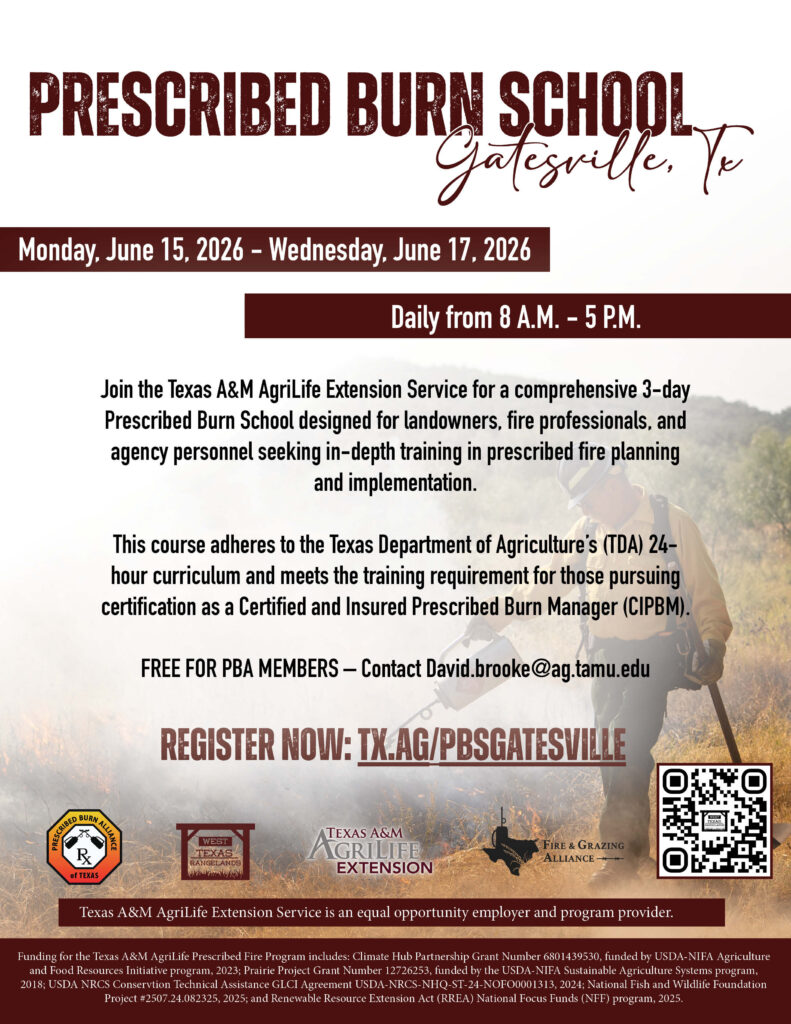
Whether prescribed fire is already part of your management plan or it is something you have considered but never pursued, this course provides a strong foundation in the principles and practice of prescribed burning in Texas.Prescribed Burn School in Gatesville, Texas, June 15-17, 2026, daily from 8 AM to 5 PM. Hosted by Texas A&M AgriLife Extension, this 3-day course provides in-depth training for landowners, fire professionals, and agency personnel seeking certification as a Certified and Insured Prescribed Burn Manager. Registration is open at TX.AG/PBSGATESVILLE

Why Prescribed Fire Still Matters
Across Texas rangelands, prescribed fire remains one of the most valuable tools for restoring and maintaining healthy landscapes. Fire can help reduce woody plant encroachment, improve forage production, recycle nutrients, and create better conditions for native plant communities and wildlife.

Prescribed fire is more than just lighting a match under the right weather conditions. Effective burning requires planning, situational awareness, and an understanding of fire behavior, fuel conditions, smoke management, and post-burn evaluation. Training matters, especially for producers who want to use fire with confidence and responsibility.

What Participants Can Expect
The Gatesville Prescribed Burn School follows the Texas Department of Agriculture’s 24-hour curriculum and meets the training requirement for those pursuing certification as a Certified and Insured Prescribed Burn Manager (CIPBM).

Participants will receive in-depth instruction in areas including fire behavior, weather interpretation, prescribed burn planning, ignition techniques, and post-burn evaluation.

When conditions allow, the course will also include multiple prescribed burns, allowing participants to gain valuable field experience alongside experienced instructors and burn professionals.

That hands-on component is especially important. For producers, there is real value in seeing how planning decisions translate to field conditions and how burn objectives, weather, fuels, and crew coordination come together on the ground.

Who Should Attend?
This training is a great opportunity for a wide range of participants, including:

  • Landowners and land managers interested in using prescribed fire as a management tool
  • Fire department personnel and emergency responders
  • Municipal, county, and agency staff involved in land or resource management
  • Anyone wanting to build a deeper understanding of prescribed fire in Texas ecosystems

For producers specifically, this course offers a chance to better understand how prescribed fire may fit into a broader management strategy that includes grazing, brush control, drought planning, and long-term stewardship.

A Practical Opportunity for Producers
One of the most valuable parts of this training is that it is designed to be practical. This is not simply a classroom discussion about fire ecology. It is an opportunity to learn how prescribed fire is planned and implemented in real-world conditions.

For producers who want to incorporate prescribed fire into their operation, this course can help answer important questions:

  • What makes a burn plan workable?
  • How do weather and fuel conditions affect success?
  • What equipment and personnel are needed?
  • How do you evaluate a burn after it is complete?

These are the kinds of questions that matter when fire becomes part of a rangeland management plan.

Registration and Event Details for the Prescribed Burn School:

Dates: Monday, June 15, 2026 through Wednesday, June 17, 2026
Time: 8 a.m. to 5 p.m. daily
Location: Gatesville Civic Center, 301 Veterans Mem Lp, Gatesville, Texas 76528

Registration: tx.ag/PBSGatesville

Free registration is available for Prescribed Burn Association members, with membership verification required to confirm eligibility.

For additional information, contact David Brooke at David.brooke@ag.tamu.edu.

Building Fire Knowledge That Supports Better Stewardship
At West Texas Rangelands, we know prescribed fire is not just a tool for specialists. It is a land management practice that can play a meaningful role on working ranches and private lands when backed by training, planning, and sound decision-making.

If prescribed fire has ever crossed your mind, this course offers a valuable opportunity to build the knowledge and field skills needed to better understand its role on Texas landscapes.

Filed Under: Events, Prescribed Burn Associations, Prescribed Burning Tagged With: #AgriLifeExtension, #BrushManagement, #FireEcology, #LandStewardship, #PrescribedBurnAssociation, #PrescribedBurnSchool, #PrescribedFire, #RangelandManagement, #TexasLandowners, #TexasRangelands, #WestTexasRangelands, #WorkingLands

Recent Posts

  • Burn Smarter, Not Just Hotter: Timing Fire for Plant Response in the Edwards Plateau
  • Know Your Stocking Rate Like You Know Your Bank Balance
  • Does Prescribed Fire Ever Cross Your Mind? Join the Prescribed Burn School in Gatesville Next Month!
  • Adaptability Is Key as Drought Persists Across Texas Rangelands
  • What the National CPBM Report Means for Producers Using Prescribed Fire

Categories

  • 4-H Range Contests
  • Beef Cattle
  • Brush Management
  • Carbon Credits
  • Carbon Markets
  • Conservation
  • Conservation Practices
  • Drought Management
  • El Niño
  • Events
  • Goats
  • Grazing Management
  • La Niña
  • Land
  • Lessons Learned
  • Meet A County Extension Agent
  • Plant ID
  • Podcast
  • Prescribed Burn Associations
  • Prescribed Burning
  • Publications
  • Range Concepts
  • RAP
  • Sheep
  • Society for Range Management
  • Soil
  • Staff
  • Targeted Grazing
  • Uncategorized
  • Water
  • Weather
  • Why I Ranch
  • Wild Pigs
  • Wildfire
  • Wildfires
  • Wind
  • Woody Encroachment
  • Youth Range Workshop

Archives

Texas A&M AgriLife Extension Service
Texas A&M University System Member
  • Compact with Texans
  • Privacy and Security
  • Accessibility Policy
  • State Link Policy
  • Statewide Search
  • Veterans Benefits
  • Military Families
  • Risk, Fraud & Misconduct Hotline
  • Texas Homeland Security
  • Texas Veteran's Portal
  • Equal Opportunity
  • Open Records/Public Information