• Skip to primary navigation
  • Skip to main content
  • Skip to primary sidebar
  • Texas A&M Forest Service
  • Texas A&M Veterinary Medical Diagnostics Laboratory
  • Texas A&M AgriLife Extension Service
  • Texas A&M AgriLife Research
  • Texas A&M College of Agrculture and Life Sciences
West Texas Rangelands
West Texas RangelandsWe hope to provide a variety of science-based rangeland information and current research on prescribed fire, wildfires, brush management, and grazing management!
  • Menu
  • Home
  • About & Contact
  • Publications
    • Extension Publications
    • Refereed Journal Articles
    • Program Summaries
  • Events
  • Lunch N’ Learn
  • Infographics
    • Drought
    • Grazing
    • Herbicide
    • Prescribed Fire
    • Rangeland Plants
    • Wildfire
  • Range Resources
    • Published to Pasture
    • Range Concepts
  • Fire Resources
  • Sponsors
  • AgriLife Learn Online Courses

Burning From the Ground Up: How Prescribed Burn Associations Are Expanding Fire Across the Great Plains

October 1, 2026 by kara.matheney

Prescribed fire has long been one of the most effective tools for managing woody plant encroachment, improving wildlife habitat, enhancing forage production, and reducing wildfire risk. Yet for many landowners, implementing prescribed fire can seem out of reach due to concerns about labor, equipment, experience, liability, and planning requirements.

Across the Great Plains, Prescribed Burn Associations (PBAs) are helping overcome those barriers through a simple but powerful concept: neighbors helping neighbors. New research published in the International Journal of Wildland Fire demonstrates that these landowner-led organizations are expanding access to prescribed fire, building local capacity, and making meaningful contributions to rangeland stewardship across the United States.

A Movement Built by Landowners
Prescribed Burn Associations first emerged in the Great Plains in the 1990s to help ranchers gain the education, equipment, training, and support needed to safely implement prescribed fire on private lands. Since then, the model has spread nationwide, with more than 140 PBAs now operating across the country.

Unlike traditional top-down approaches, PBAs are community-led organizations that bring together landowners, volunteers, and natural resource professionals to share knowledge, labor, equipment, and experience. These local networks help reduce costs, increase confidence, and provide opportunities for people to gain hands-on experience using prescribed fire.

The impact of these organizations continues to grow. Survey responses from PBAs across the United States showed that associations collectively conduct an average of 660 prescribed burns across 84,508 acres annually, mobilizing thousands of volunteers to restore fire to ecosystems where it has historically been excluded.
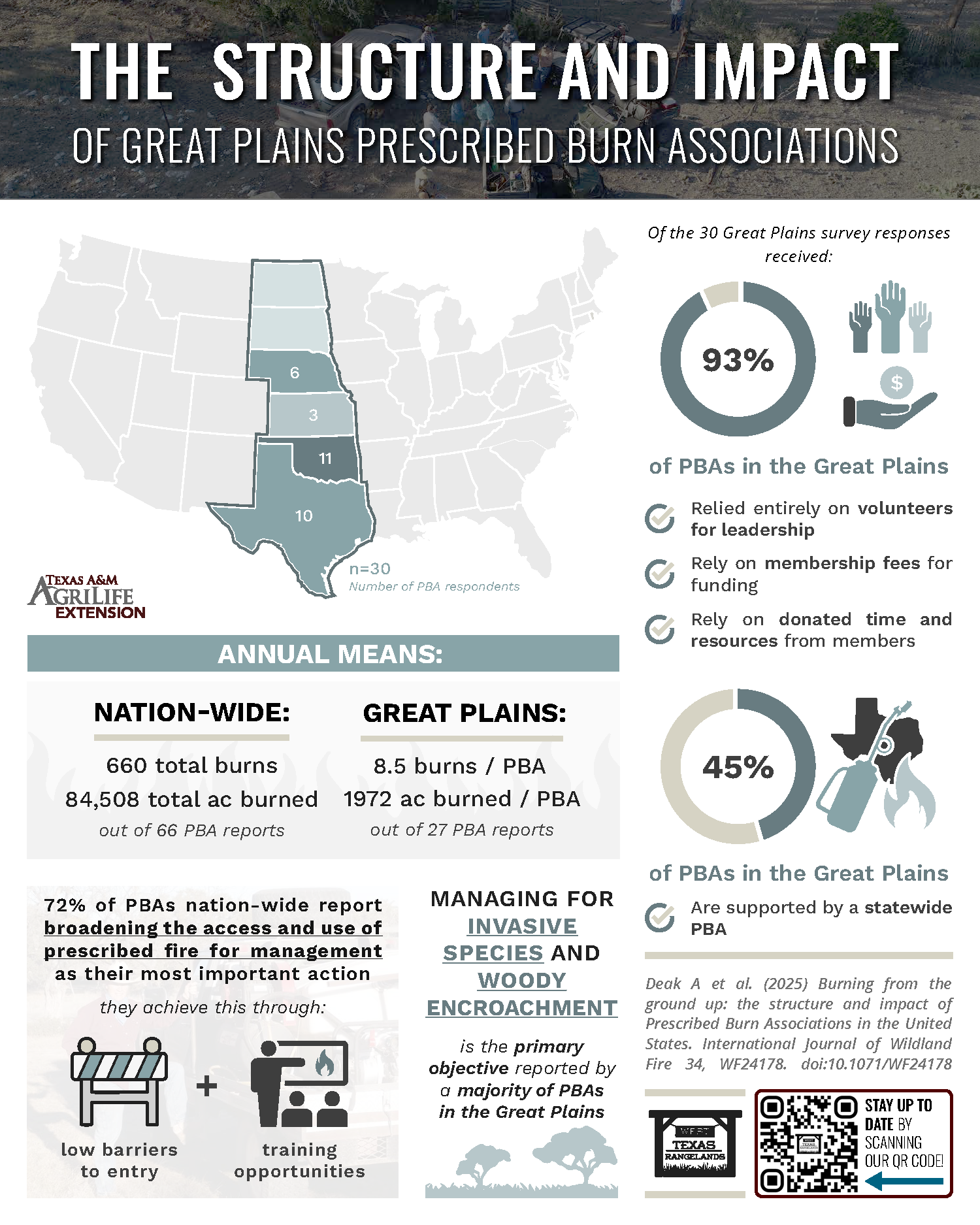
Infographic titled "The Structure and Impact of Great Plains Prescribed Burn Associations" showing survey results, statistics on prescribed burns, and information on managing invasive species. [Read more…] about Burning From the Ground Up: How Prescribed Burn Associations Are Expanding Fire Across the Great Plains

Filed Under: Prescribed Burn Associations, Prescribed Burning, Woody Encroachment Tagged With: #AgriLifeExtension, #FireAndGrazing, #FireEcology, #GrasslandConservation, #LandStewardship, #PrescribedBurnAssociation, #PrescribedFire, #RangelandManagement, #ResilientRangelands, #TexasRangelands, #WestTexasRangelands, #WildfireMitigation, #WoodyEncroachment, #WorkingLands

Juniper Management on Texas Rangelands

September 24, 2026 by kara.matheney

Article written by Jacob Court
West Texas Rangelands Intern
Graduate Student – Texas A&M University

With the widespread issue of woody encroachment on the Texas rangelands, the proper management of juniper is crucial. Unfortunately, due to overgrazing and poor land management, much of our rangelands have already been taken over by large juniper trees.

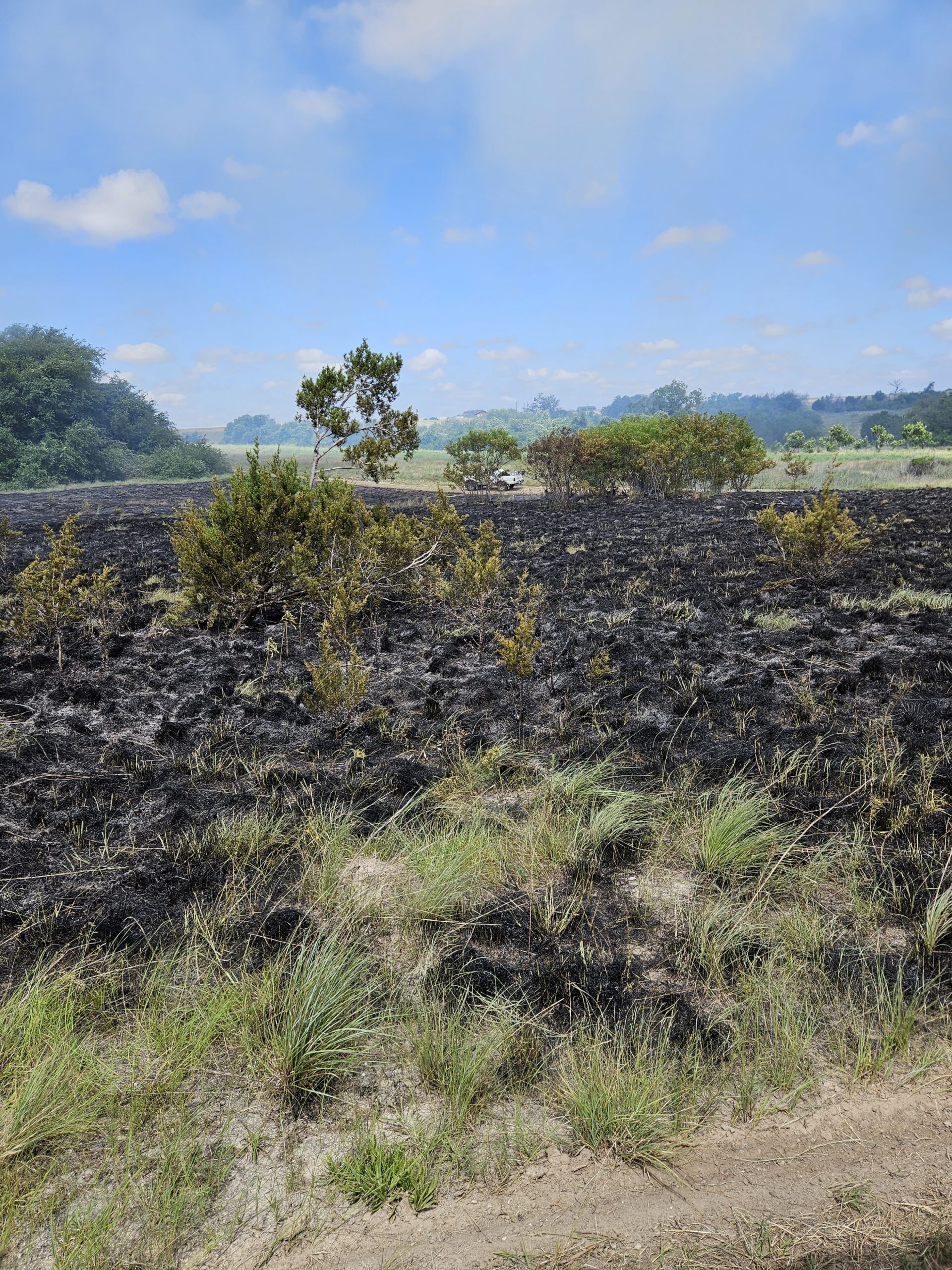
Prescribed fire is a great method to manage juniper when it is utilized correctly. One thing to note is that some juniper like Alligator Juniper (J. deppeana) and Redberry Juniper (J. pinchottii) can resprout from a bud bank beneath the surface. These bud banks make plants more resilient to the effects of burning; although fire can help to kill smaller trees, higher-intensity fires can work to kill larger trees. Even so, other management methods may be more effectively used to try and kill these resprouters. For non-resprouting trees, fire is an effective method throughout the early life cycles. Often, conducting growing season fires will help kill seedlings, preventing more growth while also helping to kill any larger trees. Like with the resprouting trees, more intense fire might be necessary for the removal of any larger non-sprouting trees, and the concern of them recovering from that damage is much less.

A great way to create these high-intensity fires is with the cut-and-stuff method. The idea behind this method is to cut branches off (or gather other fuels) and pile them underneath large juniper trees. This creates a continuous ladder of fuel all the way up the tree. Utilizing this method solves both of the two main issues when trying to burn larger trees: a lack of fuel to catch the tree on fire and not having flames long enough to burn the branches. By letting the flames climb this fuel ladder, we can successfully ignite the entire tree, greatly increasing the effectiveness of our prescribed fire. Some more things to consider when trying to burn juniper are waiting for the fuel beneath the tree to dry out so that it ignites and burns more effectively. It’s also important to put the fuel beneath the upwind side of the tree as this allows the majority of the fire to be blown into the main part of the tree instead of away from it.

While prescribed fire is a great method of juniper control, the implementation of grazing alongside burning can increase the overall effectiveness. Goats are especially good in this sense, as they will target the high-quality new growth from these juniper trees post-fire. The idea behind this method is to have fires in an area to kill off large swaths of juniper and then have the goats graze it afterward. Fire will kill the aboveground sections, allowing for new plants to sprout. Then the goats can target these sprouts, preventing any large-scale regrowth from happening. The utilization of pyric herbivory in this manner is cost-effective and will work for a variety of situations. One issue is still the management of the larger and more developed juniper trees. In these cases, chemical or mechanical methods may be the best strategy.

References
Texas A&M AgriLife Extension – Managing Texas Juniper with Prescribed Burning
Texas A&M AgriLife Extension – Managing Juniper (Cedar) with Goats
Oklahoma Cooperative Extension Service- Cut and Stuff Practices for Enhancing Cedar Control with Prescribed Fire

Filed Under: Brush Management, Grazing Management, Prescribed Burning, Woody Encroachment Tagged With: #PrescribedFire, #ResilientRangelends, #WestTexasRangelands, #WoodyEncroachment

Recent Posts

  • Winter Weather Outlook, Drought Update, and Looking Forward
  • A Year Worth Celebrating – Texas Section Society for Range Management
  • Fire and Wildlife: Building Better Habitat on Texas Rangelands
  • Data Centers and Rural Landscapes: What Landowners and Communities Should Consider
  • Building Fire Capacity Before the Next Burn: New Continuing Fire Training Course Supports Prescribed Fire Practitioners

Categories

  • 4-H Range Contests
  • Beef Cattle
  • Brush Management
  • Carbon Credits
  • Carbon Markets
  • Conservation
  • Conservation Practices
  • Drought Management
  • El Niño
  • Events
  • Forage
  • Goats
  • Grazing Management
  • La Niña
  • Land
  • Lessons Learned
  • Meet A County Extension Agent
  • Plant ID
  • Podcast
  • Prescribed Burn Associations
  • Prescribed Burning
  • Publications
  • Range Concepts
  • RAP
  • Sheep
  • Society for Range Management
  • Soil
  • Staff
  • Targeted Grazing
  • TSSRM
  • Uncategorized
  • Water
  • Weather
  • Why I Ranch
  • Wild Pigs
  • Wildfire
  • Wildfires
  • Wind
  • Woody Encroachment
  • Youth Range Workshop

Archives

Texas A&M AgriLife Extension Service
Texas A&M University System Member
  • Compact with Texans
  • Privacy and Security
  • Accessibility Policy
  • State Link Policy
  • Statewide Search
  • Veterans Benefits
  • Military Families
  • Risk, Fraud & Misconduct Hotline
  • Texas Homeland Security
  • Texas Veteran's Portal
  • Equal Opportunity
  • Open Records/Public Information