• Skip to primary navigation
  • Skip to main content
  • Skip to primary sidebar
  • Texas A&M Forest Service
  • Texas A&M Veterinary Medical Diagnostics Laboratory
  • Texas A&M AgriLife Extension Service
  • Texas A&M AgriLife Research
  • Texas A&M College of Agrculture and Life Sciences
West Texas Rangelands
West Texas RangelandsWe hope to provide a variety of science-based rangeland information and current research on prescribed fire, wildfires, brush management, and grazing management!
  • Menu
  • Home
  • About & Contact
  • Publications
    • Extension Publications
    • Refereed Journal Articles
    • Program Summaries
  • Events
  • Lunch N’ Learn
  • Infographics
    • Drought
    • Grazing
    • Herbicide
    • Prescribed Fire
    • Rangeland Plants
    • Wildfire
  • Range Resources
    • Published to Pasture
    • Range Concepts
  • Fire Resources
  • Sponsors
  • AgriLife Learn Online Courses

Prepared Today, Resilient Tomorrow: Making Wildfire Preparedness Part of Rangeland Stewardship

January 28, 2026 by morgan.treadwell

Wildfire risk is a natural part of West Texas rangelands, but preparedness is most effective when it is part of ongoing land stewardship. Managing rangelands with long-term resilience in mind not only protects property and resources, but also supports ecosystem health and sustainable operations. 

Integrating Preparedness into Stewardship Practices 
Preparedness begins with everyday land management decisions. Practices such as targeted grazing, rotational grazing, and selective vegetation management help reduce fuel loads while maintaining healthy grass and brush cover. These strategies are not one-time solutions—they are ongoing practices that strengthen the landscape over years. 

Infrastructure and Access as a Stewardship Tool 
Maintaining roads, fence lines, water sources, and access points is a long-term investment in rangeland resilience. Clear access allows for safe movement of equipment and personnel if wildfire conditions arise. Roads and defensible corridors also serve as strategic breaks in fuel, reducing potential fire spread while supporting everyday operations. 

Monitoring Conditions Over Time 
Ongoing observation of vegetation, fuel, and weather trends is central to long-term preparedness. Tools like the Jornada Rangeland Analysis Platform provide historical and current data on vegetation growth and drought patterns. Combining this data with on-the-ground monitoring helps landowners make adaptive decisions, such as adjusting grazing or vegetation treatments, in a way that supports both land health and wildfire preparedness. 

Preparedness as a Continuous Practice
Long-term wildfire preparedness is not about expecting a fire every year. It is about creating a resilient, well-managed landscape that can better withstand unpredictable events. Maintaining native grasses, managing fuel continuity, and planning infrastructure improvements over time ensures the land remains productive and safer under a variety of conditions. 

Building Resilient Rangelands
By treating preparedness as part of overall stewardship, landowners reinforce their long-term investment in rangeland health. The combined effect of fuel management, infrastructure planning, monitoring, and adaptive management reduces potential wildfire impact while sustaining the ecological and economic productivity of West Texas rangelands. 

Filed Under: Conservation, Conservation Practices, Grazing Management, Targeted Grazing, Water, Weather, Wildfire, Wildfires Tagged With: Conservation Practices, grazing management, range management, wildfire, Wildfires

Fuel, Weather, and Risk: Monitoring Wildfire Conditions on Your Land

January 21, 2026 by morgan.treadwell

Wildfire risk on rangelands is influenced by changing conditions rather than a fixed season. Weather patterns, vegetation growth, and fuel dryness all vary throughout the year. Monitoring these conditions helps landowners and managers understand when wildfire risk may increase and supports better decision-making. 

Tracking Fuel Conditions
One of the most important factors to watch is fuel condition. Grasses and other fine fuels dry at different rates depending on temperature, wind, and recent precipitation. After periods of rainfall, rangelands may produce increased vegetation that later becomes dry fuel. Observing changes in fuel amount and dryness over time provides valuable context for management activities. 

Watching Weather Patterns
Weather conditions also play a key role. Low humidity, strong winds, and extended dry periods can increase fire potential. Monitoring forecasts and short-term weather trends helps identify periods when caution may be needed. These conditions can occur at any time of year in West Texas, including winter months. 

Using Regional Data Tools
In addition to on-the-ground observations, land managers can use online tools to track broader trends. The Rangeland Analysis Platform (RAP) provides data and visual tools that help users assess vegetation productivity, drought patterns, and long-term rangeland conditions. This platform allows landowners to view changes across large areas and compare current conditions to historical averages. 

Connecting Data with Local Knowledge
Using tools like RAP alongside local knowledge creates a clearer picture of rangeland conditions. While no single dataset can predict wildfire, combining field observations with regional data improves awareness and supports informed planning. 

Applying What You Observe
Monitoring conditions also helps guide everyday decisions. Timing of equipment use, grazing rotations, or vegetation treatments can be adjusted based on current fuel and weather conditions. This approach reduces unnecessary risk while maintaining normal land management operations. 

Staying Aware Over Time
Monitoring is not about expecting wildfire to occur. Instead, it is a way to stay informed and adaptable. Conditions change, and understanding those changes helps landowners respond thoughtfully rather than reactively. 

Filed Under: Conservation, Conservation Practices, Land, Wildfire, Wildfires Tagged With: #grazing #ranchmanagement #brush #grasslands, Conservation Management, wildfire, wildfire prevention, Wildfires

Roads, Buffers, and Water: Preparing Your Ranch for Wildfire

January 14, 2026 by morgan.treadwell

Wildfire is one of several natural disturbances that can affect West Texas rangelands under certain conditions. While wildfire does not occur every year or on every property, periods of dry weather, low humidity, and strong winds can increase risk. January provides a useful time to evaluate infrastructure and address potential vulnerabilities ahead of higher-risk periods. 

Infrastructure influences both wildfire prevention and response. Roads, fences, water sources, and access points affect how fire may move across a landscape and how landowners or responders may access an area if a wildfire occurs. Maintaining these systems can reduce potential impacts and improve safety. 

Roads and Access Points 

Well-maintained roads improve access for routine management and can be important if emergency access is needed. Roads also create breaks in vegetation that may slow fire spread under certain conditions. Keeping roads passable and managing vegetation along road edges helps maintain these benefits. 

Fence Lines and Corridors 

Fence lines, pipelines, and utility corridors often accumulate grasses and debris. These areas can create continuous fuel pathways if ignited. Managing vegetation along these corridors helps reduce fuel continuity and may limit fire movement between pastures. 

Water Availability

Water infrastructure can support wildfire response if needed. Stock tanks, ponds, and troughs should be accessible and free of excessive vegetation. Clearly identifying water access points ahead of time improves readiness without assuming they will be needed. 

Structures and High-Use Areas 

Barns, sheds, working pens, and equipment areas are commonly used spaces where ignition sources may be present during dry and windy conditions. Reducing fine fuels around these areas helps lower the chance that a fire could spread to structures. Maintaining open space around buildings also improves visibility and access. 

Planning and Timing 

Infrastructure preparation is most effective when addressed well before high-risk conditions develop. Reviewing access routes, identifying areas with heavy fuel accumulation, and making gradual improvements allows flexibility in management decisions. 

Wildfire is not guaranteed, but preparation supports resilience. Maintaining functional infrastructure improves overall land management and ensures that, if wildfire conditions develop, landowners are better positioned to respond safely and effectively. 

Visit our site to learn more about wildfire risk.

Filed Under: Water, Wildfire, Wildfires Tagged With: wildfire, Wildfires

Fuel on the Ground: Managing Vegetation to Reduce Wildfire Risk 

January 8, 2026 by morgan.treadwell

In West Texas, wildfire risk does not wait for summer. By January, grasses are dry, humidity is low, and wind events are common across open rangelands. These conditions make early preparation important. Taking steps now to manage fuel helps reduce how fast fire can move and improves safety when wildfire season approaches. 

What Are Fuel Loads? 

Fuel loads are the amount and arrangement of vegetation available to burn. Heavy fuel loads include thick grasses, dense brush, and dead plant material. These fuels dry out easily during drought or winter, making them more flammable. Reducing fuel loads helps slow fire spread and gives firefighters better chances to contain fires.  

Targeted Grazing to Reduce Fuel 

Targeted grazing uses livestock to reduce fine fuels like grasses and forbs. Cattle, goats, or sheep can be placed in specific areas to eat vegetation before wildfire season. This process lowers grass height and reduces the total fuel available. Research shows that targeted grazing can reduce flame height and fuel continuity, especially where herbaceous fuels are high and woody cover is low.  

Targeted grazing can also be used to form fuel breaks—strips of land with reduced vegetation. Fuel breaks slow fire spread and help protect key areas such as roads, fences, or infrastructure. Placing livestock to graze along these strips before fire season can improve their effectiveness.  

Infrastructure and Access 

Good infrastructure supports fuel management and wildfire response. Well-maintained roads and access points allow managers and fire crews to reach critical areas quickly. Roads also act as breaks in fuel continuity. Regularly clearing vegetation along fence lines, around water sources, and near buildings reduces fuel near structures and allows safer movement of equipment and personnel during a fire event.  

Integrated Fuel Management Fuel reduction works best when multiple tools are used together. In addition to targeted grazing, mechanical treatments, mowing, and prescribed burns may be appropriate on certain sites. Planning fuel management before wildfire season improves its success. Collaboration with local Extension services and wildfire professionals can help tailor strategies to specific rangeland conditions. 

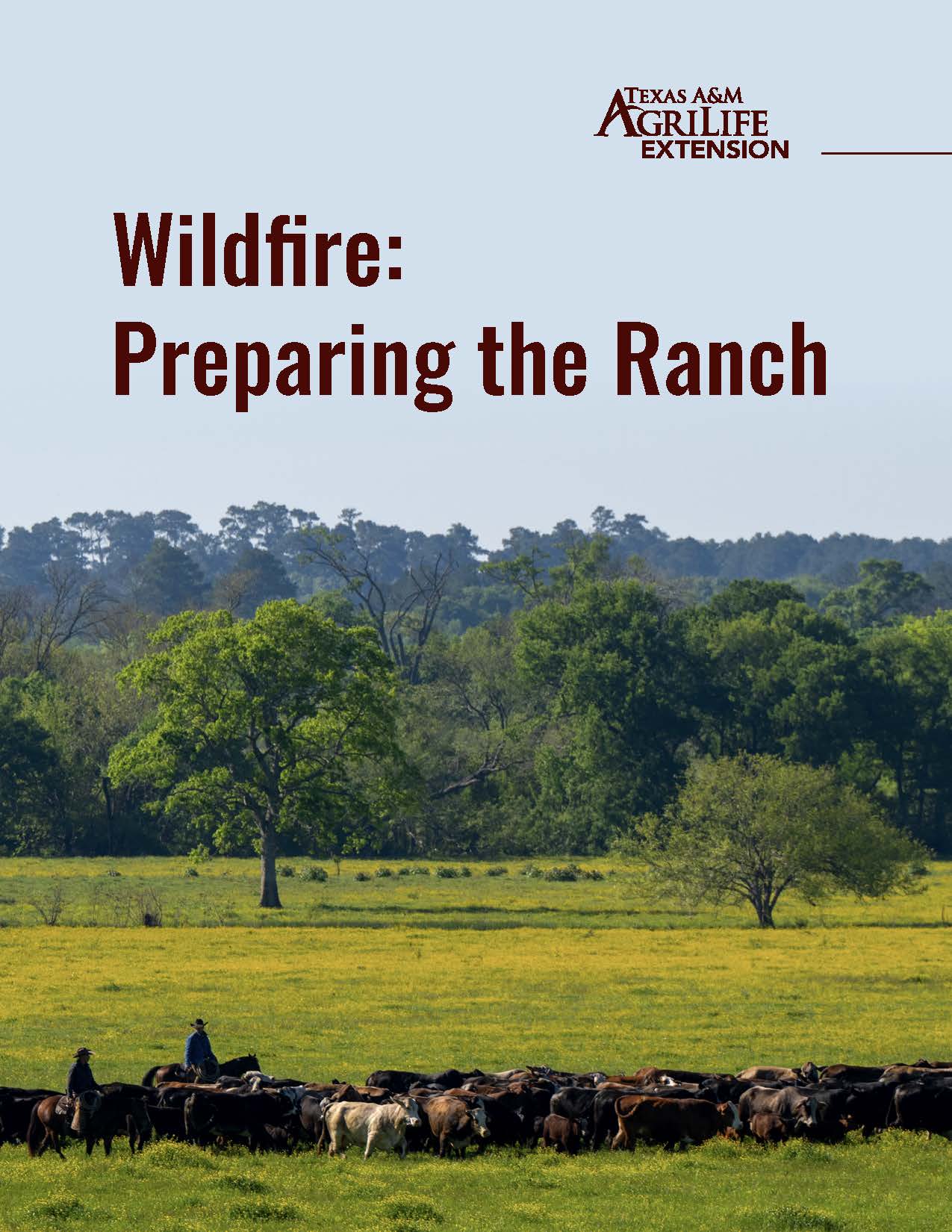
For more information, please download Wildfire…Preparing the Ranch!

Filed Under: La Niña, Wildfire Tagged With: fuel mitigation, Rangeland, wildfire

Dry, Warm, Windy, and Fuel.

November 19, 2025 by morgan.treadwell

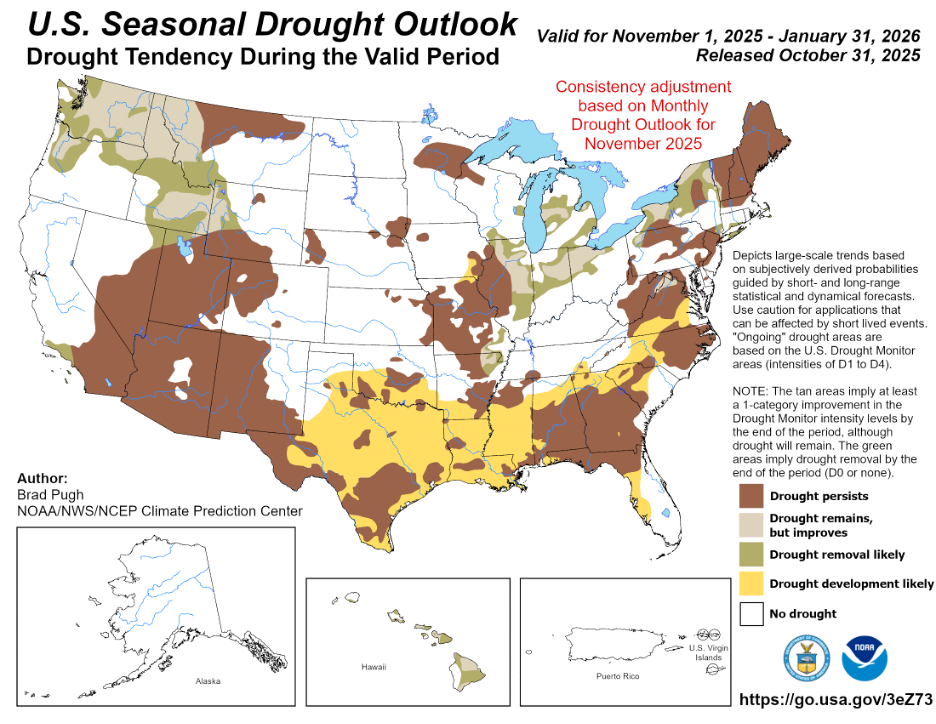
  • Drought conditions (D1–D4) increased to 33% of the state, up from 24% four weeks ago; statewide reservoir storage decreased to 73.9% full, down from 75.6% four weeks ago, about 6 percentage points below normal for this time of year.
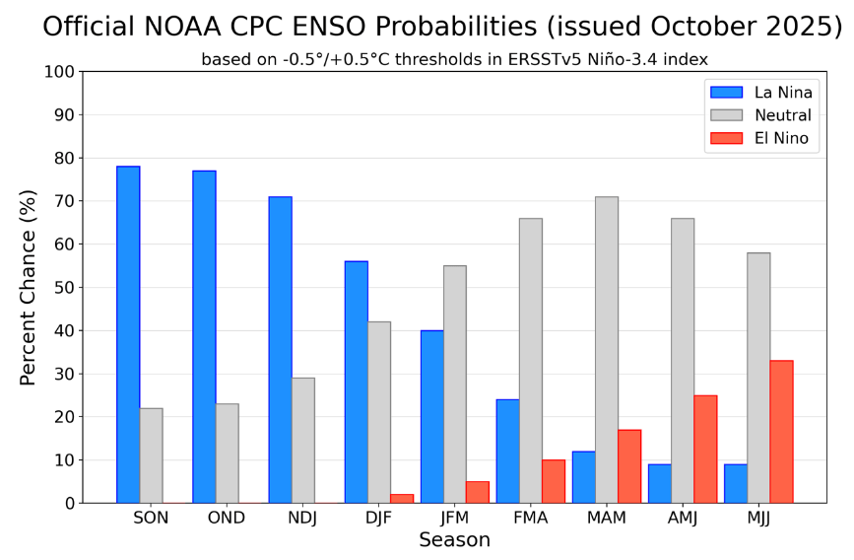
  • We are now a La Niña Advisory with a 55% chance of La Niña conditions continuing into the January-March season.
  • Most of the state is projected to be in drought over the next three months.

Isn’t it ironic that this last summer presented us with more than above average rainfall, yet not only is 33% of Texas in D1-D4 status, but our statewide reservoir storage is currently at 73.9%.  This becomes increasingly concerning as we watch La Niña take a firm hold with a 55% chance of La Niña conditions continuing into the January-March season.  Not only does this present challenging dormant season grazing management conditions, but wildfire will be at the top of rangeland manager’s concerns.

Bottom line, this winter will suck.  Get your game face on, dust off your drought plan, budget your numbers to see how late into winter/early spring your forage base can survive.  We will always remain optimistic, but we will also plan and prepare.  And with any rangeland management, we will remain adaptive holding strong to the grazing management and soil health principles guiding our practices and decisions.  For a comprehensive Wildfire Ready checklist, please click here and for our Preparing the Ranch publication click here.

Much appreciation to Robert Mace for his insight and wisdom in his outlook + water November 3, 2025 article found at: https://texaspluswater.wp.txstate.edu/.


Filed Under: Grazing Management, La Niña, Wildfire Tagged With: drought, Rangeland, wildfire

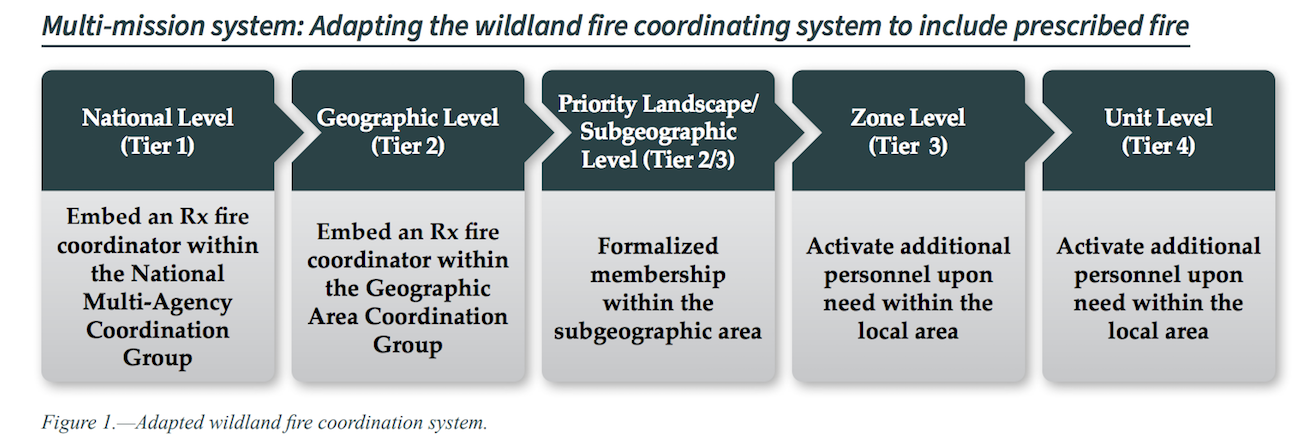
National Prescribed Fire Resource Mobilization Strategy

August 16, 2023 by jaime.sanford

This summer the National Prescribed Fire Resource Mobilization Strategy was released. The plan calls for six prescribed fire implementation teams to be created that will incorporate prescribed fire practitioners and expertise into a management structure.  This concept would support the implementation of prescribed fire at multiple organizational and complex levels. These teams would be tailored to meet specific needs and facilitate multiple projects simultaneously. Each function that supports the implementation of prescribed burning can be scaled up or down at any level, to ensure that logistical, financial, planning, safety, and public information are staffed accordingly. 


[Read more…] about National Prescribed Fire Resource Mobilization Strategy

Filed Under: Prescribed Burn Associations, Prescribed Burning, Wildfire, Wildfires Tagged With: Prescribed Burn, prescribed burn associations, prescribed burning, prescribed fire, RX Fire, rxfire, wildfire, Wildfires

Wildfire SAFE App!

June 21, 2023 by jaime.sanford

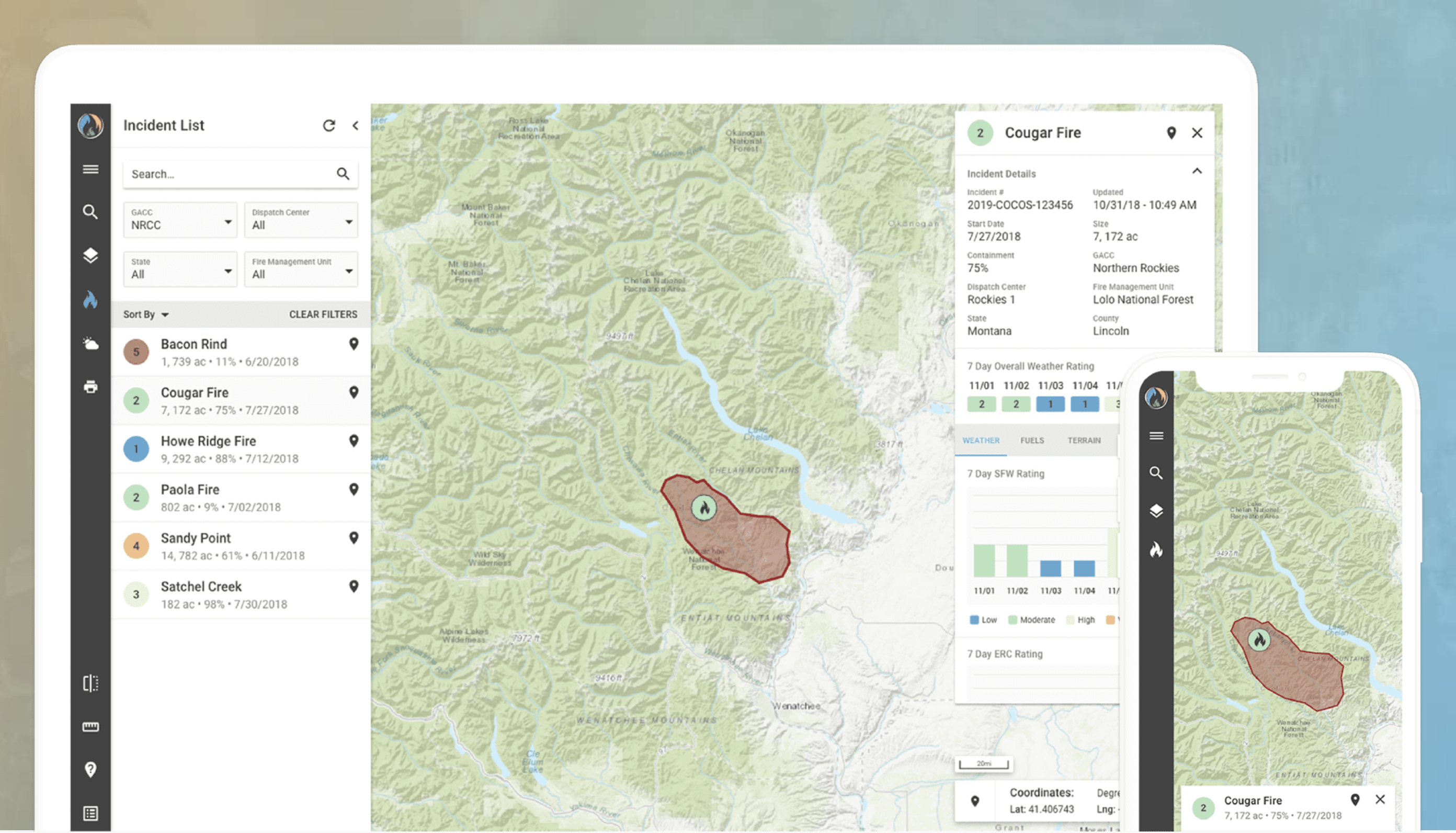
Depending on where you live in the United States, Wildfire season is either upon you or coming up. Crucial information about weather updates and knowing when and where potential severe fire conditions are key. Did you know that the Wildfire SAFE is an app that provides all of this information? 

[Read more…] about Wildfire SAFE App!

Filed Under: Wildfire Tagged With: wildfire, Wildfires

Thinking like a grassland…means thinking BIG!

March 6, 2020 by morgan.treadwell

Thinking like a grassland.

What does this mean to you?

Well, to Dr. David Augustine from the USDA-ARS Station in Fort Collins, CO and others, it means large-scale movement of many species.  This large-scale movement enables the Great Plains evolved strategies to contend with drought, floods, and even wildfires…in a nutshell….extreme variability in weather resulting in low forage production.

Currently, our pattern of land ownership and use of Great Plains grasslands challenges native species conservation.   For example, too much management is focused at the scale of individual pastures or ranches, limiting opportunities to conserve landscape-scale processes such as fire, animal movement, and metapopulation dynamics.

“Figure 1. Potential natural vegetation of US portion of the North American Great Plains, adapted from Kuchler (1964).”


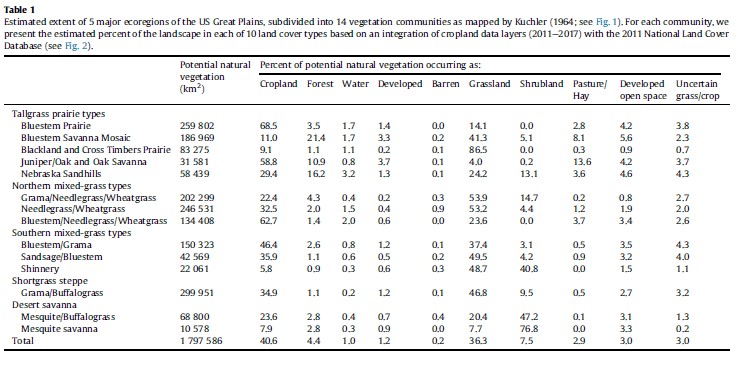
“Estimated extent of 5 major ecoregions of the US Great Plains, subdivided into 14 vegetation communities as mapped by Kuchler (1964; see Fig. 1). For each community, we present the estimated percent of the landscape in each of 10 land cover types based on an integration of cropland data layers (2011e2017) with the 2011 National Land Cover Database.”


Opportunities to increase the scale of grassland management include:

  1. Spatial prioritization of grassland restoration and reintroduction of grazing and fire.
  2. Finding creative approaches to increase the spatial scale at which fire and grazing can be applied to address watershed to landscape-scale objectives.
  3. Developing partnerships among government agencies, landowners, businesses, and conservation organizations that enhance cross-jurisdiction management and address biodiversity conservation in grassland landscapes, rather than pastures.

Thinking like a grassland should be pretty easy for us range managers…open spaces, big country, and…thinking big!!

For an in-depth view of “Thinking Like a Grassland: Challenges and Opportunities for
Biodiversity Conservation in the Great Plains of North America”, click on this link: Thinking like a grassland Augustine et al., 2020 REM.

Filed Under: Brush Management, Grazing Management, Prescribed Burn Associations, Prescribed Burning, Publications Tagged With: drought, floods, forage production, grasslands, prescribed fire, RX Fire, wildfire

More than just wildfire

June 20, 2016 by morgan.treadwell

Today, as the grass grows, the days get warmer, and we begin summer my mind drifts to what is to come.  I promise I am not a negative or pessimistic person. However, I do believe that we as land stewards, managers
of all things range, we have an obligation to be proactive in what is sure to be an impressive fire year.  Three years ago on June 28th, the Yarnell Hill Fire wreaked havoc and heartache on the west side of highway 89 in Arizona.  Fast-forward to June 8th, 2016 the Tenderfoot Fire burned over 4,000 acres on the east side of the Yarnell Hill Fire scar on the opposite side of highway 89 forcing another evacuation of Yarnell, Arizona.  As Texans, you are probably wondering what the hell does this have to do with us.  Easy…it could happen to us.  Impressive spring precipitation was a blessing, but fast-forward a couple of weeks and our outlook will change tremendously.

As we ramp up for summer prescribed burns and wildfires.  Please, take the time to read “Honor the Fallen – The Big Lie” by Mark Smith.  Whether you belong to an agency, burn association, or you just like to carry a torch, please take a moment to honor and learn from those making the same high-risk decisions you make everyday.

On another note, Dad (in the feature picture) has decided to keep fighting the good fight this summer and is on a Type 2 IMT in Idaho, Jake, my brother, helps out when needed for Type 2 crews and engines in Arizona.

These are the men that I honor.  They are apart of our fire community…even in Texas.

vxfx

Filed Under: Prescribed Burn Associations, Prescribed Burning Tagged With: fire community, prescribed burning, wildfire

Recent Posts

  • Prepared Today, Resilient Tomorrow: Making Wildfire Preparedness Part of Rangeland Stewardship
  • Fuel, Weather, and Risk: Monitoring Wildfire Conditions on Your Land
  • Roads, Buffers, and Water: Preparing Your Ranch for Wildfire
  • Fuel on the Ground: Managing Vegetation to Reduce Wildfire Risk 
  • Managing Old World Bluestems…A Review

Categories

  • 4-H Range Contests
  • Beef Cattle
  • Brush Management
  • Carbon Credits
  • Carbon Markets
  • Conservation
  • Conservation Practices
  • Drought Management
  • El Niño
  • Events
  • Goats
  • Grazing Management
  • La Niña
  • Land
  • Lessons Learned
  • Meet A County Extension Agent
  • Plant ID
  • Podcast
  • Prescribed Burn Associations
  • Prescribed Burning
  • Publications
  • Range Concepts
  • RAP
  • Sheep
  • Society for Range Management
  • Soil
  • Staff
  • Targeted Grazing
  • Uncategorized
  • Water
  • Weather
  • Why I Ranch
  • Wild Pigs
  • Wildfire
  • Wildfires
  • Wind
  • Woody Encroachment
  • Youth Range Workshop

Archives

Texas A&M AgriLife Extension Service
Texas A&M University System Member
  • Compact with Texans
  • Privacy and Security
  • Accessibility Policy
  • State Link Policy
  • Statewide Search
  • Veterans Benefits
  • Military Families
  • Risk, Fraud & Misconduct Hotline
  • Texas Homeland Security
  • Texas Veteran's Portal
  • Equal Opportunity
  • Open Records/Public Information