The Central Texas Fuels Reduction Grant has officially opened! This an opportunity for Central Texas Landowners to apply for the SFAM Mechanical Fuels Reduction Grant to help reduce risks posed to their property by wildfire.
Prescribed Burn School April 19 – 21, 2023 – San Angelo, Texas
Prescribed Burn School April 19 – 21, 2023 – San Angelo, Texas
Dr. Morgan Treadwell is back with her first Prescribed Burn School for 2023 in San Angelo, Texas on April 19 – 21! If you are curious about prescribed fire or would like to get more hands-on experience, this 3-day school is for you! View the agenda here.
[Read more…] about Prescribed Burn School April 19 – 21, 2023 – San Angelo, Texas
Wood Plant Encroachment in Grasslands: Teaching by RAP’ping
Are you headed to Texas and Southwestern Cattle Raisers Conference this weekend? If so, be sure to stop by and see our very own Erika Sullivan during the Graduate Poster Presentation.
[Read more…] about Wood Plant Encroachment in Grasslands: Teaching by RAP’ping
Prescribed Fire Checklist and Wildfire Ready Checklist
Current drought conditions coupled with hot and windy days is a recipe for all things fire. Be ready on your place for a wildfire or put that wildfire to use with a burn plan and burnout operations!
Here are two checklists that will help you prepare you for wildfires and/or assist you in executing a prescribed fire or burnout operations on your property!
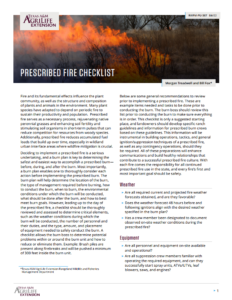
To find the full factsheet, click the image above or follow the link below.
https://agrilifelearn.tamu.edu/s/product/prescribed-fire-checklist/01t4x000004P8BE
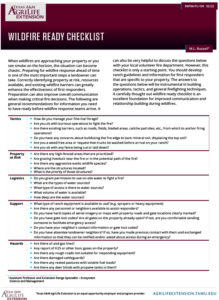
To find the full factsheet, click the image above or follow the link below.
https://agrilifelearn.tamu.edu/s/product/wildfire-ready-checklist/01t4x000004OUeKAAW
New Publication Available Now!
The Prescribed Fire Communications Kit provides resources to aid in discussion and facilitate interactions between those who conduct prescribed fires and the local community. This toolkit was designed for the landowner, county agent, or local government in mind. The goals of this free resource is to provide stewards of the land with the information to educate others and advocate for the safety and benefits of prescribed burning.
This publication can be downloaded from the link below or on the AgriLife Learn website, just search for Prescribed Burning Communication Kit.

prescribed-burning-communication-kits
Don’t forget to check us out on Facebook at West Texas Rangelands!
Fighting Fire with Fire: Rx Fire Toolbox to Combat Identified Social Barriers
Interested in attending our online webinar on July 27, 2020 at 9:00 AM showcasing the research findings from Texas A&M University Dr. Urs Kreuter’s Joint Fire Science Program project:
“Fighting Wildfire with Prescribed Burning in the Southern Great Plains: Social and Regulatory Barriers and Facilitators” (funded by the Bureau of Land Management Joint Fire Science Program (Contract #L16AC00206))??
Please register HERE!

Range Concepts – Rangeland Analysis Platform
Check out our new YouTube Channel featuring videos and handouts dedicated to increasing County Extension Agent knowledge and enhancing landowner’s understanding of tools, resources, techniques, and strategies on rangelands!
Our latest post features application and utility of Rangeland Analysis Platform, an online free resources for understanding trends in vegetative cover on rangelands. Get the Rangeland Analysis Platform Handout here and watch the YouTube video here!
Thinking like a grassland…means thinking BIG!
Thinking like a grassland.
What does this mean to you?
Well, to Dr. David Augustine from the USDA-ARS Station in Fort Collins, CO and others, it means large-scale movement of many species. This large-scale movement enables the Great Plains evolved strategies to contend with drought, floods, and even wildfires…in a nutshell….extreme variability in weather resulting in low forage production.
Currently, our pattern of land ownership and use of Great Plains grasslands challenges native species conservation. For example, too much management is focused at the scale of individual pastures or ranches, limiting opportunities to conserve landscape-scale processes such as fire, animal movement, and metapopulation dynamics.
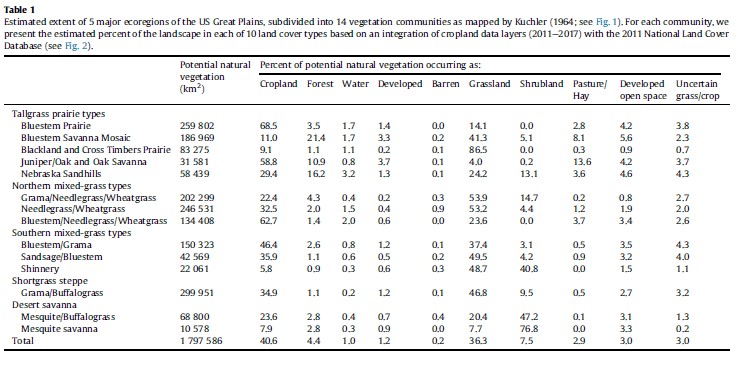
“Figure 1. Potential natural vegetation of US portion of the North American Great Plains, adapted from Kuchler (1964).”
“Estimated extent of 5 major ecoregions of the US Great Plains, subdivided into 14 vegetation communities as mapped by Kuchler (1964; see Fig. 1). For each community, we present the estimated percent of the landscape in each of 10 land cover types based on an integration of cropland data layers (2011e2017) with the 2011 National Land Cover Database.”
Opportunities to increase the scale of grassland management include:
- Spatial prioritization of grassland restoration and reintroduction of grazing and fire.
- Finding creative approaches to increase the spatial scale at which fire and grazing can be applied to address watershed to landscape-scale objectives.
- Developing partnerships among government agencies, landowners, businesses, and conservation organizations that enhance cross-jurisdiction management and address biodiversity conservation in grassland landscapes, rather than pastures.
Thinking like a grassland should be pretty easy for us range managers…open spaces, big country, and…thinking big!!
For an in-depth view of “Thinking Like a Grassland: Challenges and Opportunities for
Biodiversity Conservation in the Great Plains of North America”, click on this link: Thinking like a grassland Augustine et al., 2020 REM.
Prescribed Burn School… Going Digital!
Ok, get excited because I have some news to share with you! For the past year, I have been putting together an improved burn school experience in the form of an online course. This course packs all of the prescribed burn education I go through in the first two days of a burn school and lets you go through the content at your own pace.
This course is perfect for you if…
• You are ready to see an improvement in your rangeland and ecosystem
• You are limited on time and want to learn how best to bring life back to your land
• You are interested in learning more about prescribed burning and the benefits of burns
• You currently are or are interested in becoming a Certified and Insured Prescribed Burn Manager (CIPBM)
• You want to be eligible for future certification from the Texas Department of Agriculture
Prescribed Burning Benefits
Prescribed burning, also known as controlled burning, is a technique used by certified fire experts to manage rangeland productivity and restore health to ecosystems.
Fire has played a significant but complicated historical role. Land managers have tried for decades to remove fire from fire-dominant ecosystems, which has affected future generations of land managers. It is important for us to be informed about the role that fire plays in our ecosystem in order to maintain rangeland productivity, especially systems challenged by brush encroachment.
Prescribed burning can be defined as hazard-reducing burning of a wildfire, set intentionally for purposes of forest management, farming, and prairie restoration. Prescribed fires are intentionally ignited in order to achieve specific land management objectives, such as restore ecosystem health and recycle nutrients.
Many species depend on fire to maintain their habitat. Fire is one of the best management tools for invasive plant control and prescribed burning can prepare the land for new trees and vegetation.
Prescribed burns help manage weeds and lower the risk of wildfires by reducing the amount of flammable fuel in the area. Additionally, they can restore nutrients to the soil and encourage healthy plant growth.
Ready to take the next step in restoring your land through prescribed burns?
Prescribed Burn School Details
Cost: $200
Sections: 13
Time: 24 hours
Launch Date: February 10, 2020
Self-paced, available year-round
Once the course is launched, you can enroll at any time and set your own pace for learning. The course allows for flexible study time to go through the materials whenever you want.
Prescribed burning requires extensive planning, training, personnel, and equipment. There are important steps that have to be taken prior to the day of the burn in order to conduct a prescribed burn safely and correctly.
This course walks you through all of the steps of a prescribed burn and gets you ready to participate in a burn field day.
Upon completion of this course, you will be able to:
• Explain the history of fire as an ecological tool
• Evaluate fuels present across many environments according to their defining characteristics
• Describe fire behavior according to physical and chemical principles
• Prepare for weather conditions as they relate to burning
• Discuss the impact topographic influences have on fire behavior
• Analyze the effect that fire has on plant communities and wildlife habitat
• Plan a prescribed burn
• Identify proper burning equipment and safety techniques
• Employ proper firing technique according to the prescribed burn goals and objectives
• Mitigate smoke impacts
• Understand laws and regulations regarding prescribed burning
• Evaluate potential burn sites
After you successfully complete the course and earn your certificate, you will have 1 year from the date of completion to sign up and participate in a field day to become eligible for certification through the TDA. Available field dates will be listed at the end of the course.
The Prescribed Burn School course goes live on February 10, 2020. Find it on AgriLife Learn, Texas A&M AgriLife Extension’s new online learning platform.
Want us to send you a reminder when the course launches? Sign up today and we will notify you as soon as the course is open for registration.
Click here for more info on this course!
Published to Pasture…Soil Health!
Soil Health…kind of catchy, right?! I agree. And, so do thousands of other range managers and landowners. It’s the buzz word of the century and it’s here to stay. So what do we know about soil health and how the heck can our ranchers use it?
Today, we will be looking at 2 relatively recent articles on soil health. First, “Usable Science: Soil Health” written by Justin Derner, Chuck Stanley, and Chad Ellis. Secondly, we will look at “Soil Health as a Transformational Change Agent for US Grazing Lands Management” written by Justin Derner, Alexander Smart, Theodore Toombs, Dana Larsen, Rebecca McCulley, Jeff Goodwin, Scott Sims, and Leslie Roche.
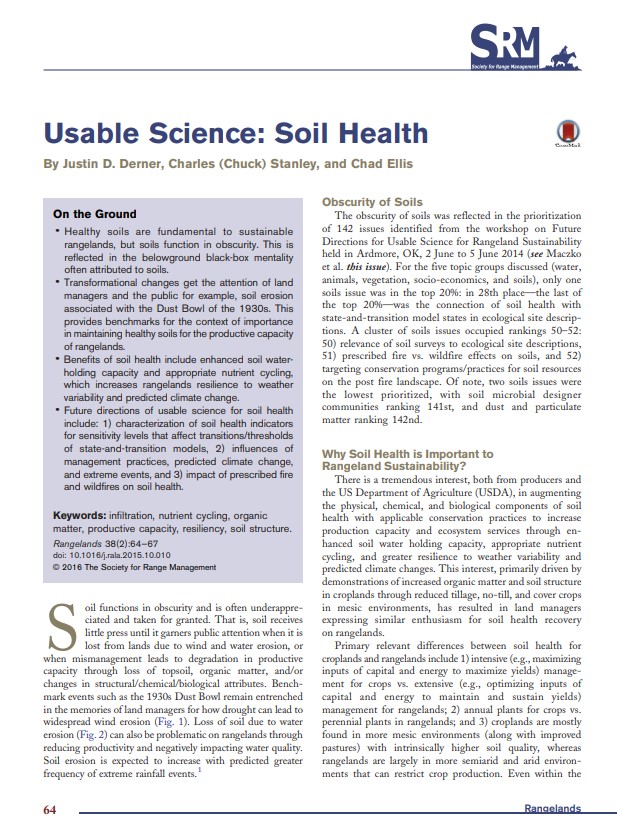 Why is soil health on the minds of every range manager these days? Easy. Dust Bowl of the 1930s was a benchmark event that changed every single range, crop, and land-man’s way of thinking. Total game changer. As Derner and others stated, “The 1930s Dust Bowl remains entrenched in the memories of land managers for how drought can lead to widespread wind erosion.” I couldn’t agree more. As range managers, we seek to learn from our mistakes – not repeat them. So now we have the most talented scientists working out the details of a very complex, obscure, and complicated science of the physical, chemical, and biological components of soil and how applicable conservation practices increase production, capacity, and ecosystem services through enhanced soil water holding capacity, appropriate nutrient cycling, and greater resiliency to weather variability and predicted climate changes. For example, utilizing novel experiments with adaptive grazing management wherein short “pulses” of grazing with a large herd followed by rest periods of more than 1 year provides experimental platforms to evaluate the efficacy of soil health monitoring efforts. Can I get an amen from the range gospel choir?! Wahoo!!! It’s about dang time!
To summarize what the Rangelands article is talking about, here we go:
#1. What are the effects of conservation practices (e.g., prescribed grazing, prescribed fire, and brush management) on the chemical, physical, and biological components of soil health?
#2. Can the chemical, physical, and biological components of soil health be used as “early indicators” of phase, transition, and/or threshold shifts in plant communities for state-and-transition models to enhance ecological site descriptions?
#3. How can the chemical, physical, and biological components of soil health be enhanced through adaptive management to increase the resilience of soils to weather variability and changing climate?
#4. How can the soil health tool kit to provide more robust and broad assessments of soil health and/or monitoring of the chemical, physical, and biological components for land managers in a timely and responsive manner to facilitate adaptive management be expanded?
Fast forward to our next article, Soil Health as a Transformational Change Agent for US Grazing Lands Management and now is where we get to the cool nerd stuff. Current soil health is an opportunity not to focus on improvement of soil health on lands where potential is limited but rather to forward science-based management on grazing lands via
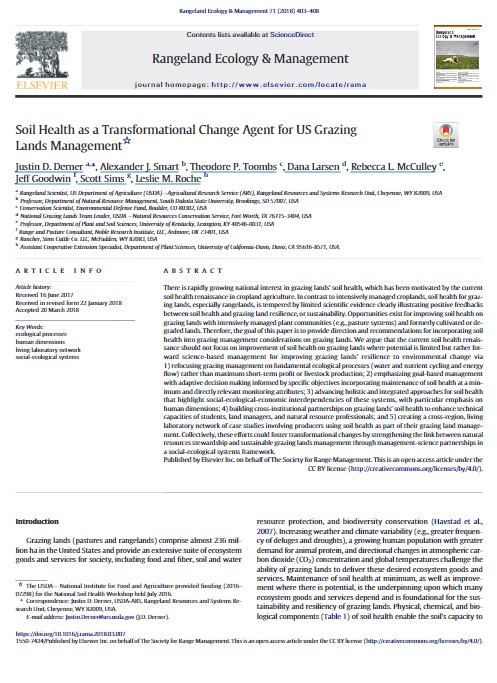 #1. Refocusing grazing management on fundamental ecological processes (water and nutrient cycling and energy flow) rather than maximum short-term profit or livestock production
#2. Emphasizing goal-based management with adaptive decision making informed by specific objectives incorporating maintenance of soil health at a minimum and directly relevant monitoring attributes
#3. Advancing holistic and integrated approaches for soil health that highlight social-ecological-economic inter-dependencies of these systems, with particular emphasis on human dimensions
#4. Building cross-institutional partnerships on grazing lands’soil health to enhance technical capacities of students,land managers, and natural resource professionals
#5. Creating across-region, living laboratory network of case studies involving producers using soil health as part of their grazing land management. Explicitly incorporating soil health into grazing management and the matrix of ecosystems services provided by grazing lands provides transformational opportunities by building tangible links between natural resources stewardship and sustainable grazing management, as well as providing paths to reach broader audiences and enhance communications among producers,customers, and the general public.
Now, we can really jump up and say “hallelujah!!!!”
This is what their vision looks like:
My favorite part, is “Re-focus grazing management on fundamental ecological processes.” What a concept!!

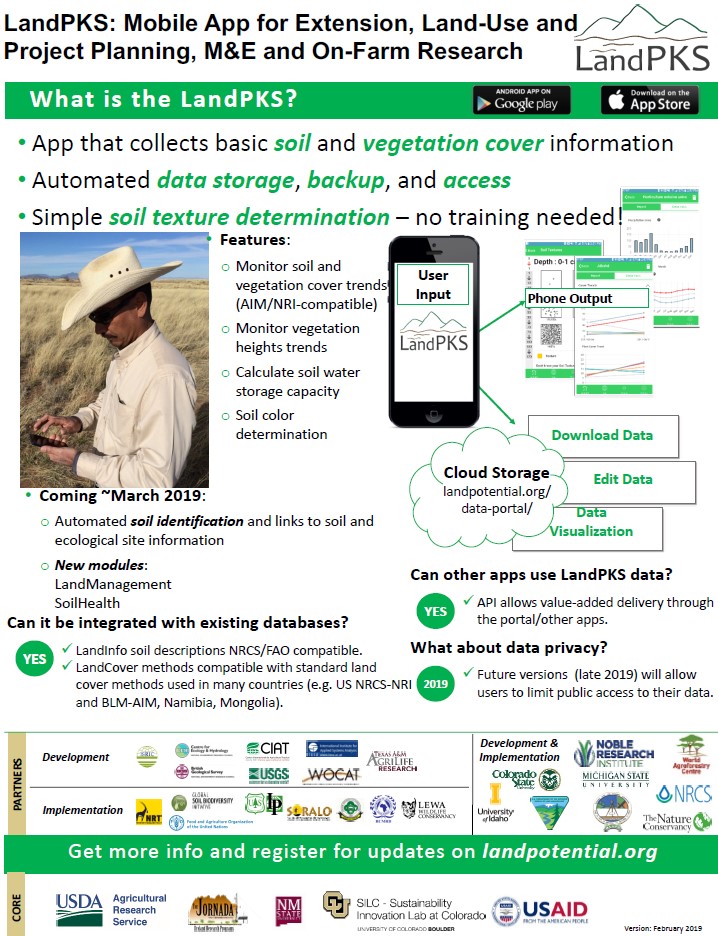
Better yet! There is an app for that! Check out LandPKS on your smartphone device and start collecting data on LandInfo, LandCover, and LandManagment!
Please click here for more information regarding this remarkable tool!
 Believe it or not, Soil Health is more fun and easy than you think! We just overcomplicated it!