Article written by Holt Teplicek
West Texas Rangelands Intern
Undergraduate Student – Texas A&M University
Mesquite trees are one of the most persistent brush species found across West Texas rangelands. While they provide some wildlife habitat, dense mesquite infestations compete with desirable grasses for sunlight, soil moisture, and nutrients. Over time, this competition can reduce forage production, limit grazing capacity, and make rangeland management more difficult.
One effective method of controlling mesquite is grubbing, a mechanical practice that removes the entire root crown of the tree. Unlike simply cutting a mesquite tree at ground level, grubbing removes the portion of the root system where new shoots develop. When the root crown is completely removed below the bud zone, the tree is much less likely to resprout, making grubbing a long-term control option.
Grubbing is most effective on small to medium-sized mesquite trees and is commonly performed using hand tools such as grub hoes or specialized grubbing tools. This method is especially useful for treating scattered trees, fence lines, wildlife food plots, and areas where herbicide applications may not be practical or desired.
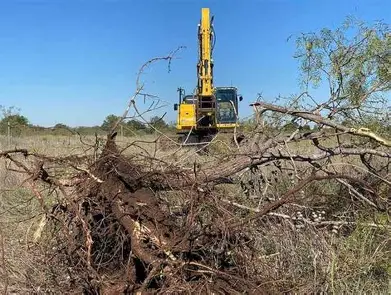
Timing can also influence success. Grubbing can be performed throughout much of the year, but favorable soil moisture conditions make the job easier by allowing the root crown to be removed more completely. It is important to remove enough of the root crown to prevent regrowth. Leaving any portion of the bud zone behind can allow the tree to resprout.
Removing mesquite provides several benefits for rangeland health. Native grasses and other desirable plants have greater access to water, nutrients, and sunlight, allowing them to establish and produce more forage. Improved grass cover also helps reduce soil erosion, improves rainfall infiltration, and supports healthier wildlife habitat. For livestock producers, increased forage production can lead to improved grazing opportunities and better overall pasture condition.
Although grubbing is an effective tool, it is often most successful when used as part of an integrated brush management program. Depending on the size of the infestation and land management goals, grubbing may be combined with prescribed fire, herbicide applications, proper grazing management, or reseeding efforts to maintain healthy, productive rangelands over the long term.
Every ranch is different, and selecting the best brush management strategy depends on factors such as mesquite density, tree size, labor availability, equipment, and management objectives. Working with your local Texas A&M AgriLife Extension Service office can help determine the most effective and economical approach for your operation.
By removing mesquite before it becomes well established, landowners can improve forage production, conserve valuable soil moisture, and promote healthier West Texas rangelands for future generations.
Source: https://agrilifeextension.tamu.edu/asset-external/brush-management-methods/