Across much of Texas, producers are continually looking for ways to improve forage utilization, increase ranch productivity, and manage woody plant encroachment without sacrificing livestock performance. While cattle are the foundation of many ranching operations, growing evidence suggests that adding small ruminants such as goats can provide benefits that extend beyond simply adding another revenue stream.
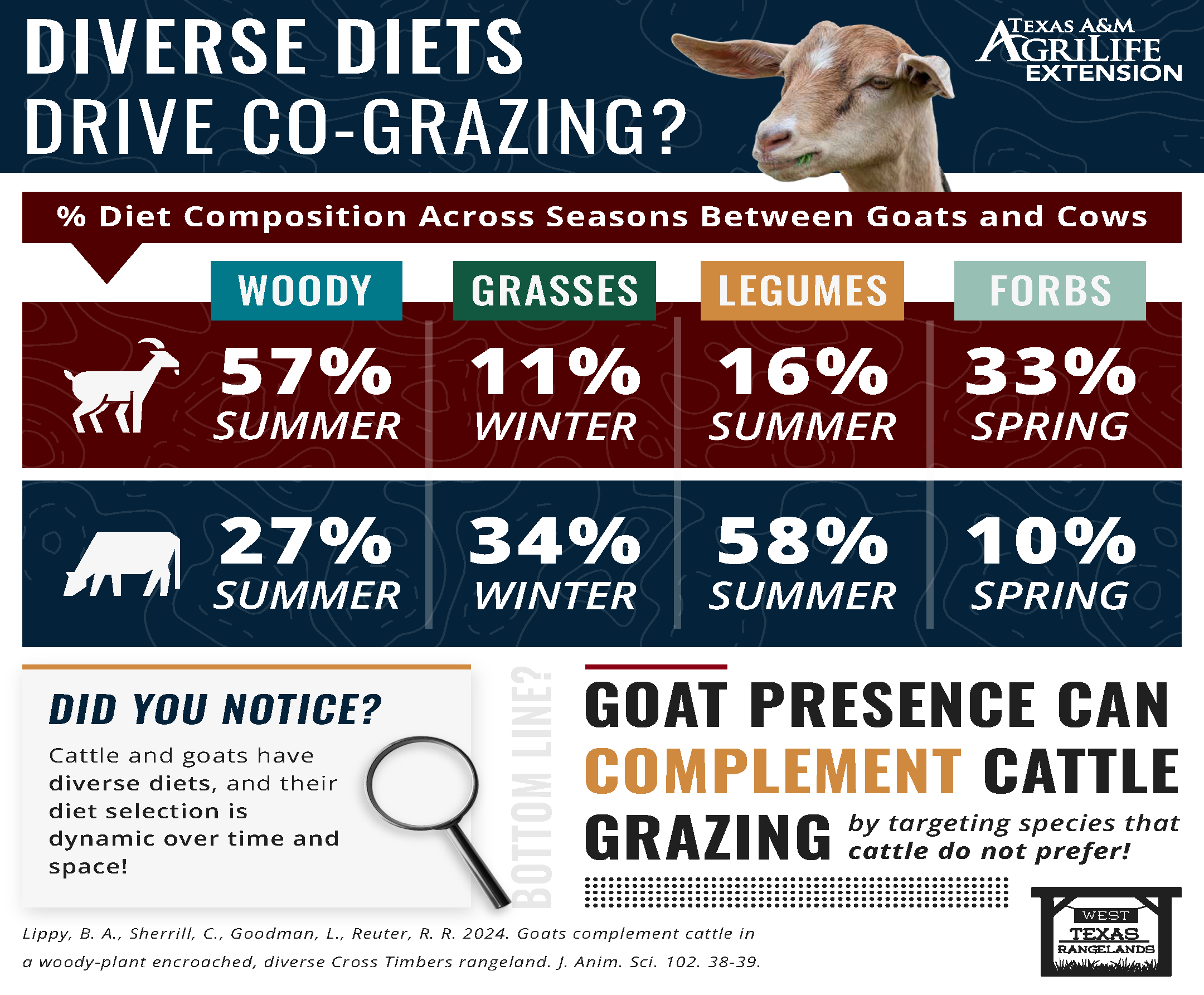
Research conducted in the Cross Timbers region found that cattle and goats utilize available plants very differently throughout the year, allowing them to occupy distinct feeding niches on the same landscape. The study demonstrated that goats consumed substantially more woody vegetation and forbs than cattle, while cattle relied more heavily on grasses and legumes. This dietary separation is one reason co-grazing systems can be so effective. Lippy et al. (2024), Journal of Animal Science 102:38-39.
Understanding the Grazing Niche
Every grazing animal has evolved to take advantage of different plant resources. Cattle are generally classified as grazers, meaning they prefer grasses and grass-like plants. Their anatomy, grazing behavior, and digestive systems are well-suited for harvesting large amounts of herbaceous forage close to the ground.
Goats, on the other hand, behave more like browsers. Rather than focusing primarily on grasses, they frequently select leaves, twigs, shrubs, vines, and broadleaf plants. Their smaller mouths and unique feeding behavior allow them to be highly selective and utilize vegetation that cattle may largely ignore.
This difference is important because rangelands rarely consist of a single plant type. A healthy landscape often contains a mixture of grasses, forbs, legumes, and woody species. When only one livestock species is present, portions of the available forage resource may remain underutilized, while preferred plants receive disproportionate grazing pressure.
Why Dietary Diversity Matters
The infographic illustrates that cattle and goats shift their diets seasonally while maintaining different forage preferences throughout the year. Those differences allow multiple livestock species to harvest forage from different parts of the plant community rather than directly competing for the same forage resources.
From a ranch management perspective, this creates opportunities to increase overall forage utilization while distributing grazing pressure across a greater variety of plant species. Instead of concentrating consumption on a narrow subset of desirable plants, co-grazing can encourage more balanced use of the landscape.
Research has shown that diverse grazing pressure can influence plant community composition over time. By incorporating animals that utilize different forage types, producers may be able to improve forage distribution and reduce the competitive advantage of less desirable species.
Managing Woody Plant Encroachment
One of the most significant rangeland challenges facing Texas is the expansion of woody plants into grass-dominated ecosystems. Species such as mesquite, juniper, and various brush species can reduce forage production, alter wildlife habitat, and impact water resources.
Traditional brush management tools remain important, but goats can serve as a valuable component of an integrated management strategy. Because goats readily consume many woody plant species, they can apply consistent browsing pressure that complements mechanical and chemical control efforts.
While goats are not a silver bullet for brush management, their dietary preferences allow them to target vegetation that cattle generally avoid. Over time, this additional grazing pressure can help suppress regrowth and provide another tool for managing woody plant expansion.
Improving Drought Resilience
Diverse grazing systems may also improve flexibility during variable forage conditions.
Texas producers are no strangers to drought. During dry periods, forage availability often changes rapidly. Some plant groups decline earlier than others, and livestock that can utilize a broader range of available vegetation may offer additional management options.
Because goats and cattle respond differently to changing forage conditions, co-grazing can help producers access forage resources across multiple plant communities. This flexibility can be particularly valuable when environmental conditions limit the growth of preferred forage species.
Maintaining diverse plant communities and utilizing multiple grazing niches can contribute to the overall resilience of both livestock operations and the rangelands on which they depend.
Looking Beyond Production
The benefits of co-grazing extend beyond forage utilization alone. Many producers find that incorporating multiple livestock species supports broader ranch objectives, including:
- Improved use of available forage resources
- Increased management flexibility
- Enhanced brush management efforts
- Diversified income opportunities
- More balanced grazing pressure across plant communities
- Potential improvements in rangeland condition over time
As with any management practice, successful implementation depends on factors such as fencing, predator management, labor availability, marketing opportunities, and operation-specific goals. However, understanding how different livestock species interact with vegetation can help producers make informed management decisions.
A Rangeland Perspective
One of the most important lessons from this research is that livestock should not simply be viewed as consumers of forage. Different animal species interact with rangelands in unique ways, creating opportunities for managers to influence plant communities through grazing management.
The differences highlighted in the infographic demonstrate why co-grazing has become an important consideration for many Texas producers. By combining grazers and browsers, ranchers may be able to utilize more of the available forage base, address vegetation management challenges, and support healthier, more resilient rangelands.
When cattle and goats are allowed to do what they naturally do best, the result is often a more efficient use of the landscape and a management approach that works with ecological processes rather than against them.