Article written by Jacob Court
West Texas Rangelands Intern
Graduate Student – Texas A&M University
With the widespread issue of woody encroachment on the Texas rangelands, the proper management of juniper is crucial. Unfortunately, due to overgrazing and poor land management, much of our rangelands have already been taken over by large juniper trees.
Prescribed fire is a great method to manage juniper when it is utilized correctly. One thing to note is that some juniper like Alligator Juniper (J. deppeana) and Redberry Juniper (J. pinchottii) can resprout from a bud bank beneath the surface. These bud banks make plants more resilient to the effects of burning; although fire can help to kill smaller trees, higher-intensity fires can work to kill larger trees. Even so, other management methods may be more effectively used to try and kill these resprouters. For non-resprouting trees, fire is an effective method throughout the early life cycles. Often, conducting growing season fires will help kill seedlings, preventing more growth while also helping to kill any larger trees. Like with the resprouting trees, more intense fire might be necessary for the removal of any larger non-sprouting trees, and the concern of them recovering from that damage is much less.
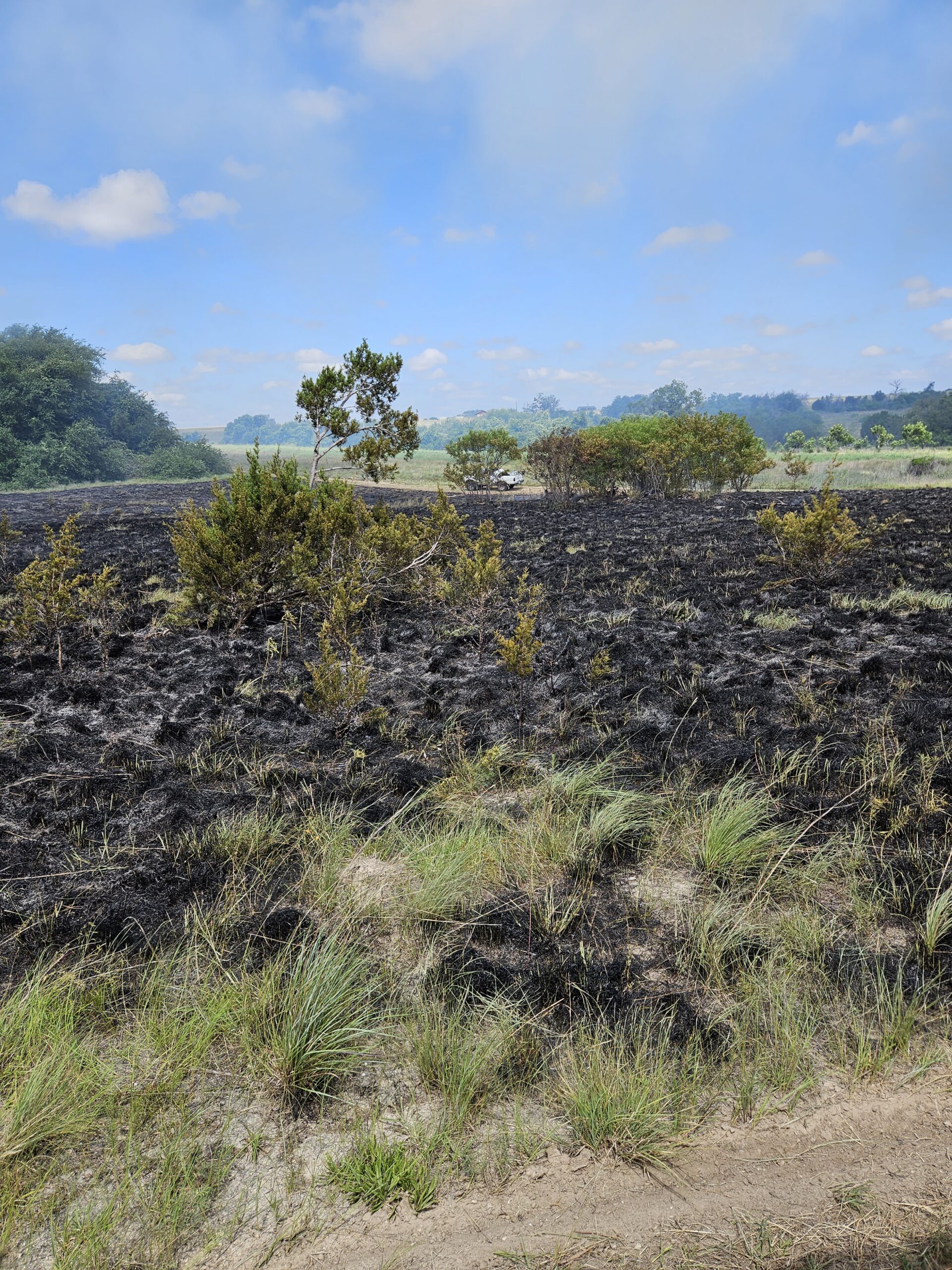
A great way to create these high-intensity fires is with the cut-and-stuff method. The idea behind this method is to cut branches off (or gather other fuels) and pile them underneath large juniper trees. This creates a continuous ladder of fuel all the way up the tree. Utilizing this method solves both of the two main issues when trying to burn larger trees: a lack of fuel to catch the tree on fire and not having flames long enough to burn the branches. By letting the flames climb this fuel ladder, we can successfully ignite the entire tree, greatly increasing the effectiveness of our prescribed fire. Some more things to consider when trying to burn juniper are waiting for the fuel beneath the tree to dry out so that it ignites and burns more effectively. It’s also important to put the fuel beneath the upwind side of the tree as this allows the majority of the fire to be blown into the main part of the tree instead of away from it.
While prescribed fire is a great method of juniper control, the implementation of grazing alongside burning can increase the overall effectiveness. Goats are especially good in this sense, as they will target the high-quality new growth from these juniper trees post-fire. The idea behind this method is to have fires in an area to kill off large swaths of juniper and then have the goats graze it afterward. Fire will kill the aboveground sections, allowing for new plants to sprout. Then the goats can target these sprouts, preventing any large-scale regrowth from happening. The utilization of pyric herbivory in this manner is cost-effective and will work for a variety of situations. One issue is still the management of the larger and more developed juniper trees. In these cases, chemical or mechanical methods may be the best strategy.
References
Texas A&M AgriLife Extension – Managing Texas Juniper with Prescribed Burning
Texas A&M AgriLife Extension – Managing Juniper (Cedar) with Goats
Oklahoma Cooperative Extension Service- Cut and Stuff Practices for Enhancing Cedar Control with Prescribed Fire