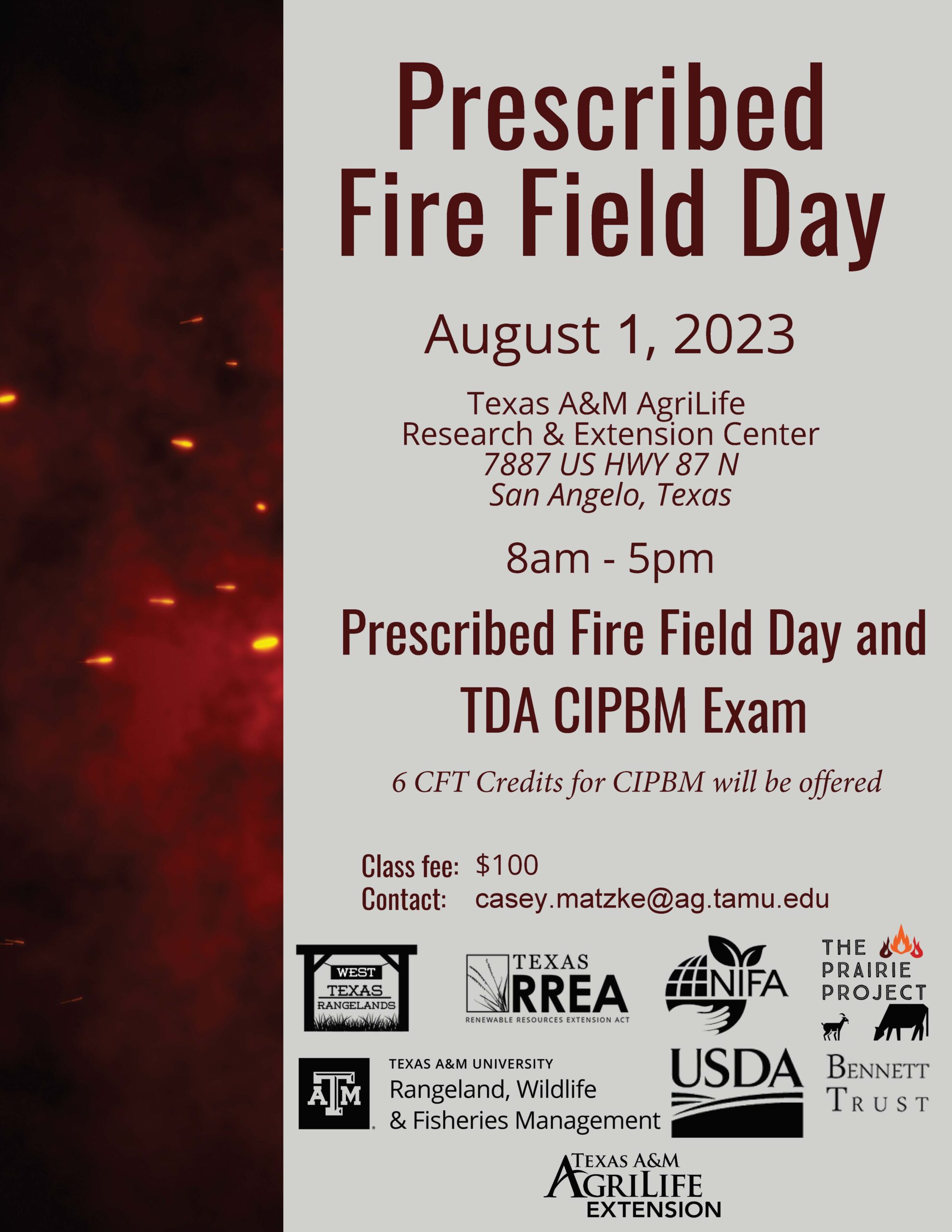
 Are you interested in becoming a licensed Prescribed Burn Manager with the Texas Department of Agriculture? Have you seen our Fire Field Day that we are having in August?
Prescribed Burn School April 19 – 21, 2023 – San Angelo, Texas
Prescribed Burn School April 19 – 21, 2023 – San Angelo, Texas
Dr. Morgan Treadwell is back with her first Prescribed Burn School for 2023 in San Angelo, Texas on April 19 – 21! If you are curious about prescribed fire or would like to get more hands-on experience, this 3-day school is for you! View the agenda here.
[Read more…] about Prescribed Burn School April 19 – 21, 2023 – San Angelo, Texas
Fighting Fire with Fire: Rx Fire Toolbox to Combat Identified Social Barriers
Interested in attending our online webinar on July 27, 2020 at 9:00 AM showcasing the research findings from Texas A&M University Dr. Urs Kreuter’s Joint Fire Science Program project:
“Fighting Wildfire with Prescribed Burning in the Southern Great Plains: Social and Regulatory Barriers and Facilitators” (funded by the Bureau of Land Management Joint Fire Science Program (Contract #L16AC00206))??
Please register HERE!

Range Concepts – Texas Ecosystem Analytical Mapper and Seed Mix Map
This week’s Range Concepts dives into the Texas Ecosystem Analytical Mapper (TEAM) from Texas Parks and Wildlife. TEAM is an easy-to-use FREE resource that includes soil mapping, plant community descriptions, threatened and endangered species, and much more!
The Seed Mix Map from Caesar Kleberg Wildlife Research Institute displays a FREE custom seed mix for an identified area defined by soil type within each ecoregion.
Both of these tools can be synergistically used together to build reseeding recommendations for disturbed rangelands, or for enhanced understanding of rangeland soils and plant communities!
Handout: Texas Ecosystem Analytical Mapper and Seed Mix Map
YouTube Tutorial Video: https://youtu.be/Nd_K7zbr0kg
Thinking like a grassland…means thinking BIG!
Thinking like a grassland.
What does this mean to you?
Well, to Dr. David Augustine from the USDA-ARS Station in Fort Collins, CO and others, it means large-scale movement of many species. This large-scale movement enables the Great Plains evolved strategies to contend with drought, floods, and even wildfires…in a nutshell….extreme variability in weather resulting in low forage production.
Currently, our pattern of land ownership and use of Great Plains grasslands challenges native species conservation. For example, too much management is focused at the scale of individual pastures or ranches, limiting opportunities to conserve landscape-scale processes such as fire, animal movement, and metapopulation dynamics.
“Figure 1. Potential natural vegetation of US portion of the North American Great Plains, adapted from Kuchler (1964).”
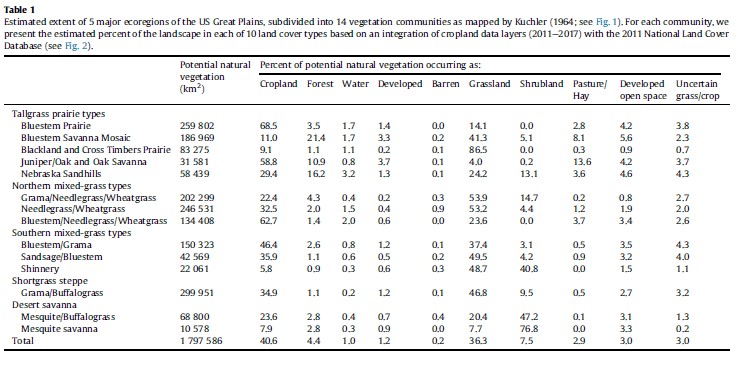
“Estimated extent of 5 major ecoregions of the US Great Plains, subdivided into 14 vegetation communities as mapped by Kuchler (1964; see Fig. 1). For each community, we present the estimated percent of the landscape in each of 10 land cover types based on an integration of cropland data layers (2011e2017) with the 2011 National Land Cover Database.”
Opportunities to increase the scale of grassland management include:
- Spatial prioritization of grassland restoration and reintroduction of grazing and fire.
- Finding creative approaches to increase the spatial scale at which fire and grazing can be applied to address watershed to landscape-scale objectives.
- Developing partnerships among government agencies, landowners, businesses, and conservation organizations that enhance cross-jurisdiction management and address biodiversity conservation in grassland landscapes, rather than pastures.
Thinking like a grassland should be pretty easy for us range managers…open spaces, big country, and…thinking big!!
For an in-depth view of “Thinking Like a Grassland: Challenges and Opportunities for
Biodiversity Conservation in the Great Plains of North America”, click on this link: Thinking like a grassland Augustine et al., 2020 REM.
Prescribed Burn School… Going Digital!
Ok, get excited because I have some news to share with you! For the past year, I have been putting together an improved burn school experience in the form of an online course. This course packs all of the prescribed burn education I go through in the first two days of a burn school and lets you go through the content at your own pace.
This course is perfect for you if…
• You are ready to see an improvement in your rangeland and ecosystem
• You are limited on time and want to learn how best to bring life back to your land
• You are interested in learning more about prescribed burning and the benefits of burns
• You currently are or are interested in becoming a Certified and Insured Prescribed Burn Manager (CIPBM)
• You want to be eligible for future certification from the Texas Department of Agriculture
Prescribed Burning Benefits
Prescribed burning, also known as controlled burning, is a technique used by certified fire experts to manage rangeland productivity and restore health to ecosystems.
Fire has played a significant but complicated historical role. Land managers have tried for decades to remove fire from fire-dominant ecosystems, which has affected future generations of land managers. It is important for us to be informed about the role that fire plays in our ecosystem in order to maintain rangeland productivity, especially systems challenged by brush encroachment.
Prescribed burning can be defined as hazard-reducing burning of a wildfire, set intentionally for purposes of forest management, farming, and prairie restoration. Prescribed fires are intentionally ignited in order to achieve specific land management objectives, such as restore ecosystem health and recycle nutrients.
Many species depend on fire to maintain their habitat. Fire is one of the best management tools for invasive plant control and prescribed burning can prepare the land for new trees and vegetation.
Prescribed burns help manage weeds and lower the risk of wildfires by reducing the amount of flammable fuel in the area. Additionally, they can restore nutrients to the soil and encourage healthy plant growth.
Ready to take the next step in restoring your land through prescribed burns?
Prescribed Burn School Details
Cost: $200
Sections: 13
Time: 24 hours
Launch Date: February 10, 2020
Self-paced, available year-round
Once the course is launched, you can enroll at any time and set your own pace for learning. The course allows for flexible study time to go through the materials whenever you want.
Prescribed burning requires extensive planning, training, personnel, and equipment. There are important steps that have to be taken prior to the day of the burn in order to conduct a prescribed burn safely and correctly.
This course walks you through all of the steps of a prescribed burn and gets you ready to participate in a burn field day.
Upon completion of this course, you will be able to:
• Explain the history of fire as an ecological tool
• Evaluate fuels present across many environments according to their defining characteristics
• Describe fire behavior according to physical and chemical principles
• Prepare for weather conditions as they relate to burning
• Discuss the impact topographic influences have on fire behavior
• Analyze the effect that fire has on plant communities and wildlife habitat
• Plan a prescribed burn
• Identify proper burning equipment and safety techniques
• Employ proper firing technique according to the prescribed burn goals and objectives
• Mitigate smoke impacts
• Understand laws and regulations regarding prescribed burning
• Evaluate potential burn sites
After you successfully complete the course and earn your certificate, you will have 1 year from the date of completion to sign up and participate in a field day to become eligible for certification through the TDA. Available field dates will be listed at the end of the course.
The Prescribed Burn School course goes live on February 10, 2020. Find it on AgriLife Learn, Texas A&M AgriLife Extension’s new online learning platform.
Want us to send you a reminder when the course launches? Sign up today and we will notify you as soon as the course is open for registration.
Click here for more info on this course!
Published to Pasture…Liability and Prescribed Fire: Perception and Reality (EPPBA)
In 2017, a group of prescribed fire researchers (including me!) set out to answer the age-old question…is prescribed fire liability…prescribed fire’s scapegoat? Check out this work that talks about the Edwards Plateau Prescribed Burn Association escape prescribed fire lawsuit here.
(J.R.Weir,U.P.Kreuter,C.L.Wonkka,etal.,LiabilityandPrescribedFire:PerceptionandReality,RangelandEcology&Management, https://doi.org/10.1016/j.rama.2018.11.010)
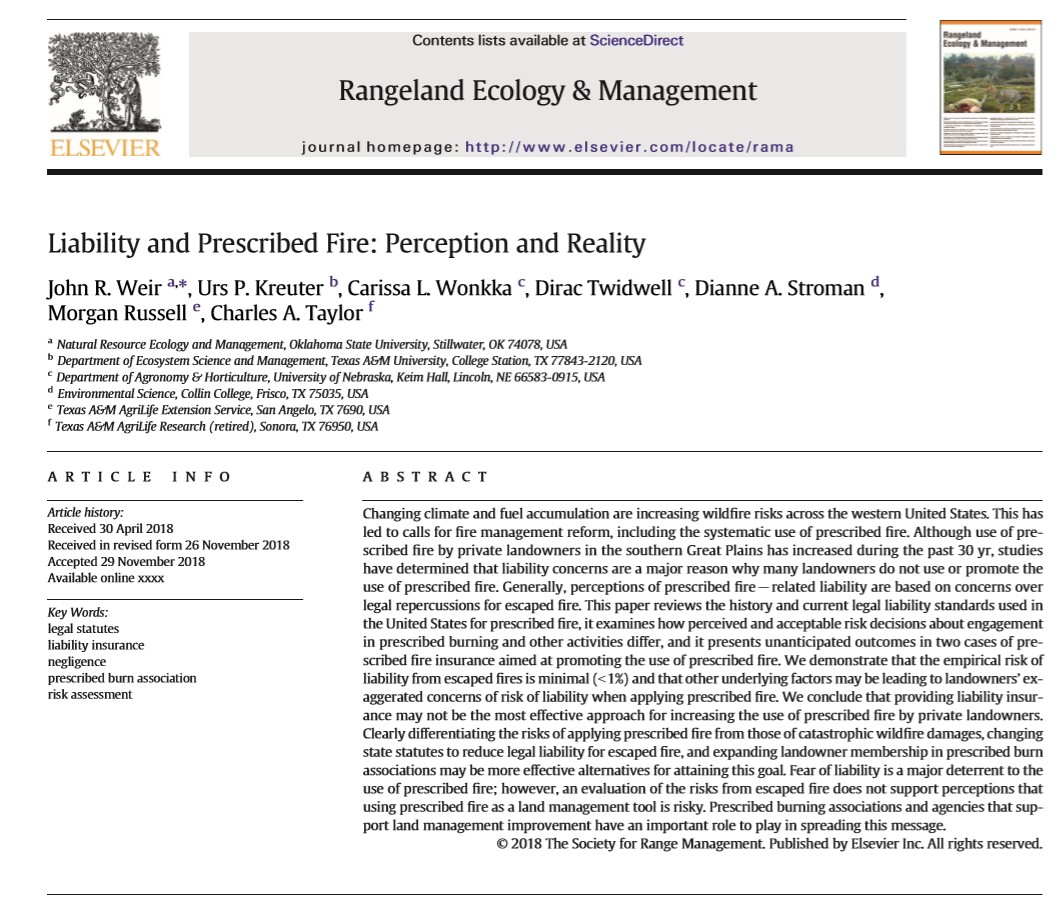
Although use of prescribed fire by private landowners in the southern Great Plains has increased during the past 30 yr, studies have determined that liability concerns are a major reason why many landowners do not use or promote the use of prescribed fire. Generally, perceptions of prescribed fire−related liability are based on concerns over legal repercussions for escaped fire. This paper reviews the history and current legal liability standards used in the United States for prescribed fire, it examines how perceived and acceptable risk decisions about engagement in prescribed burning and other activities differ, and it presents unanticipated outcomes in two cases of prescribed fire insurance aimed at promoting the use of prescribed fire. We demonstrate that the empirical risk of liability from escaped fires is minimal and that other underlying factors may be leading to landowners’ exaggerated concerns of risk of liability when applying prescribed fire. We conclude that providing liability insurance may not be the most effective approach for increasing the use of prescribed fire by private landowners. Clearly differentiating the risks of applying prescribed fire from those of catastrophic wildfire damages, changing state statutes to reduce legal liability for escaped fire, and expanding landowner membership in prescribed burn associations may be more effective alternatives for attaining this goal. Fear of liability is a major deterrent to the use of prescribed fire; however, an evaluation of the risks from escaped fire does not support perceptions that using prescribed fire as a land management tool is risky. Prescribed burning associations and agencies that support land management improvement have an important role to play in spreading this message.
EPPBA LAWSUIT
In the second case, insurance provided to members of a PBA in Central Texas contributed to the initiation of multiple lawsuits following an escaped fire that negatively affected the use of prescribed fire by some landowners. The specifics of this incident and its aftermath were obtained through interviews with people involved in the lawsuits and through analysis of legal briefs and motions filed with the Sutton County court. In March 2011, a contractor who was neither certified as a burn manager nor insured was hired by a pair of private landowners in Sutton County, Texas to conduct a prescribed burn on their property during a burn ban. The contractor had recently become a member of the local PBA and counseled the landowners who hired him to also join the PBAs so that they would be covered by the prescribed fire insurance provided by the association to its members. To comply with the PBA’s insurance requirements, the contractor also filed a burn plan with the PBA. In addition, these people requested an exemption from the county judge to apply prescribed fire during the burn ban. The judge ruled that only certified burn bosses would be granted a variance and denied the request. In contravention to this ruling, the contractor nevertheless proceeded with the planned burn. In preparation for the burn, the fire crew pre-burned backfires along firebreaks to create blacklines on the downwind side of the planned fire. During blackline burning, the wind direction shifted, causing the fire to ignite a stand of extremely dry juniper trees. Embers from the burning junipers were blown outside of the burn unit and initiated an escaped fire that burned approximately 405 ha on the contracting landowners’ property and three adjacent properties. Even though there was no major property damage or injury, the escaped fire led to multiple lawsuits. Three plaintiffs filed lawsuits involving the landowner’s property, where the fire started; the PBA; and a founding member of the PBA who had disapproved the proposed burn. Two insurance companies became involved in claims by the three landowners including the company that underwrote the PBA’s prescribed fire insurance policy and the company that provided insurance for the landowners who had signed the contract for the burn. Initially, the latter insurance company stated its policy did not cover prescribed fire damage but ultimately agreed to pay for the claimed damages to settle the litigation. Once the insurance companies agreed to pay for the specified damages, the defendants were dropped from the lawsuit. The ultimate effect of the lawsuits for the unapproved burn was that the insurance company withdrew coverage of the PBA’s prescribed fire insurance policy. Importantly, the insurance company omitted to include an “illegal activities” clause in the policy with which the insurance company would not have had to pay any claims because this was a fire conducted against
the ruling of a county judge. The PBA was named in the lawsuit due to wording in its bylaws that erroneously made it appear that the PBA did contract burning for landowners. As a result, numerous PBAs rewrote their bylaws to emphasize they only provide education, training, and opportunities for landowners to conduct prescribed burns and to clarify that PBA membership does not provide the right to burn outside state laws or prescribed burning guidelines set by the PBA. The fear of liability from this one incident has dramatically reduced the use of prescribed fire in the region, even though the escaped fire and subsequent lawsuits stemmed from an illegally and improperly conducted burn. One informative statement came from an individual who was a PBA member and had burned regularly but became concerned about risk following the outcome of the lawsuits stemming from this illegal burn in which he had no part. He stated: “How could I get started burning in 2003 without checking my insurance coverage for hostile (escaped) fire? There was no visceral ‘fear.’ Also, there were no escapes on my30-plus fires. Now the fear is intellectual. With it comes inertia. No one wants to have an escape, and we all know that with any fire there is always that risk. Why doesn’t planning allay that fear? The damage done by the arrogance of the escaped fire in 2011 hangs around our shoulders like a cloak.”
This individual experienced risk reversal and stopped using prescribed fire because of concerns about the actions of others—in this case a lawsuit initiated by a neighbor because his land was burned and due to the existence of an insurance policy against which he could claim. Most other people in the area who had used prescribed fire and were not covered by the PBA’s insurance policy continued to burn undeterred.
Outside the Fire…Chris Schenck
Chris Schenck works as the Texas Parks and Wildlife Department Statewide Fire Program Leader for the Wildlife Division. He also serves on the Texas Department of Agriculture Prescribed Burn Board and, most importantly, he is a friend, colleague, and admirably passionate about fire’s role on Texas rangelands.
How did you get introduced to fire? In 1979 as a college student at Utah State University (the other Aggies), I got a summer job as a Fire Prevention Technician on the Wasatch Cache National Forest. The long time Fire Management Officer Neff Hardman took me and others under his wing and gave us lots of opportunities in fire and fuels. In the fall when most students were in a dull work study job several of us would be burning brush piles in the afternoon on the forest till dark. Later when ranching in Idaho I tried burning windrows of sage brush with little experienced in “controlled burning.” I found out after burning down a Union Pacific drift fence and part of the neighbors pasture how little I actually knew about Prescribed Burning.
What started as a really good summer job became a thirty plus year career in Fire and Aviation with the US Forest Service. I continued to learn and progress in many areas in fire during my time. I was blessed to work throughout much of the country and even Alaska and Australia. I worked on Hand Crews, Engines, Helicopter Crews and Incident Management Teams. I also worked in Structural Fire and as an Emergency Medical Technician. Later I was a Fire Management Officer of a District and then a National Forest.
I did make a pretty good living in fire suppression and we did a fair amount of Prescribed Burning in the shoulder seasons and traveling throughout the south in the winter. A lot to times on real big wildfires, I wondered if what we were doing really made a difference. Seemed like those wildfires were going to go out when they wanted to, but we would take credit for it any way. I did notice many times when we had conducted Prescribed Fires and other fuels treatments and big wildfires ran in to those areas we had a better chance to actually manage the fire.
The US Forest Service has a mandatory retirement of age 57 for folks in fire. This was tough for me as I had just about figured out what I was doing at that age. Fortunately a job came along with Texas Parks and Wildlife Department. The State Fire Program Leader for the Wildlife Division is the job I am currently in. This is perhaps the best job I have ever had in fire management. I am paid well travel all of Texas and don’t have to supervise anyone. More so my supervisors have empowered me to try to make a difference in the Division and there for in Prescribed Fire in Texas. The Division burns about 30-40,000 acres on Public lands and provides Technical Guidance for Prescribed Fire on 6-12,000 acres of private lands each year. Perhaps this work in prescribed fire is a little penance for all the fire suppression of my youth.
How early do you start planning for a prescribed burn? A year in advance would not be too soon to start planning for prescribed burns. The Division allows burn plans to stand without major revision for 5 years. This would signify a 5 year rotation for fire on the burnable land in a given project. Our Burn Plans also receive technical review by another Burn Boss. We have developed burn plans with short turn around for Private Land Technical Guidance Prescribed Fire within a month. These are usually low complexity Prescribed Burns. Most important are site visits and developing a fuels and weather prescription.
What’s most unique about a post-fire environment? I think looking at the various fire effects and how the phoenix rises from the ashes so to speak. Certainly the immediate or first order fire effects is shocking to most viewers. Less so to me as I have a pretty good idea that with in a growing season new plant growth is coming. I have noticed in many ecosystems many native plants are hidden by the invasive species only to flourish in the post fire environment. Even in stand replacing fires in some fuel types we see results within that growing season. I am often disturbed by the terms used by the media about “destructive wildfires” or “total devastation.” Certainly these fires are destructive to people, infrastructure and livestock. The ecosystem is often very resilient and comes back to more properly function stages. That’s where the phoenix comes from.
In your opinion, what makes a successful fire? Success is multi-faceted. At the most basic level is that we kept the fire in the box and folks were safe in doing it. At the most complex levels is that we achieved our most desirable management or ecological goal. In between there are a variety of measures of success. For land owner Technical Guidance, first entry burns I often here the land owner say ”At first I was a little worried about burning, but now I see that under the right conditions it can be done.”
On or public lands larger projects after multiple entries it is rewarding to see quantifiable changes in forage production and type, or actual improved water yields. On landscape prescribed fires it is great to see communities able to sustain and manage a wild fire because of strategic prescribed fire and fuels reduction programs.
Who or what would you never burn without? There are a few things: A good prescribed burn plan with a sound fire behavior and weather prescription. Good preparation of fire lines or holding features. Good dependable people and equipment. I truly believe that 70% of success in prescribed fire is in planning and preparation. If you have that the mindful execution of the plan makes the other 30% of the burn day enjoyable. Even with an occasional spot or slop over, you had a plan to catch it before it was an escape. That’s the way 99% of prescribed fires go
Published to Pasture…Collaborative Adaptive Rangeland Management
In 2018, Wilmer and others published “Collaborative adaptive rangeland management foster management-science partnerships” in Rangeland Ecology and Management (check it out here). I really valued this paper, because fostering management-science relationships is what Extension is all about!
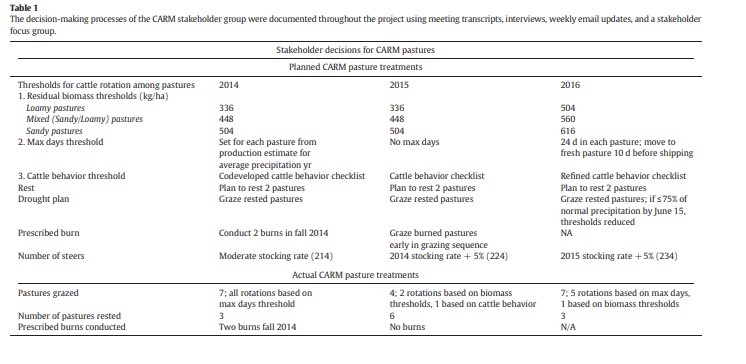
This paper is a case study, based on qualitative social data collected from meeting notes and interview transcripts recorded from ranchers and agency representatives in a Collaborative Adaptive Rangeland Management (CARM) study. In this synthetic assessment, they explored to what extent participation in the CARM experiment enabled adaptive decision making by a group of rangeland stakeholders (landowners, agencies, non-profit, etc..).
The specific objectives of this study were to 1) document how diverse stakeholder experiences and knowledge (meaning their socially constructed theories and justifications for rangeland management knowledge) contribute to the CARM project, 2) evaluate how co-produced knowledge informed management decision making through three grazing seasons, and 3) explore the implications of participation in the CARM experiment for rangeland stakeholders.
Here are some snapshot comments from ranchers, agency, and NGO reps on uncertainties, learning/collaboration, and motivations:
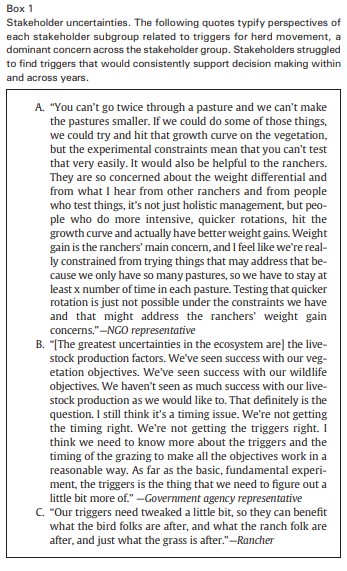
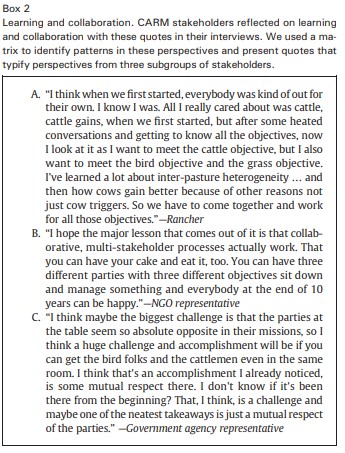
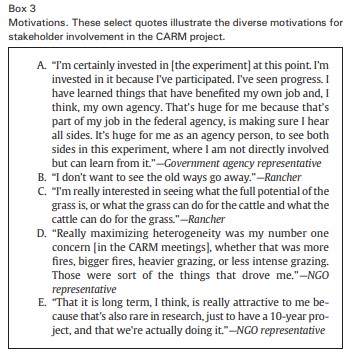
The authors found that this interactive process can reveal the differences among stakeholder knowledge about complex rangeland systems, but does not reconcile those differences. And that it is HIGHLY UNLIKELY that stakeholder decision-making related to cattle rotation and prescribed fire decisions will be made on data from research or experiments. However, it is likely that Collaborative Adaptive Rangeland Management (CARM) can build awareness and appreciation for the diverse ways of knowing about rangeland management. Stakeholders are more likely to utilize:
- Discussion and consideration of different reasoning for management actions
- Enhanced understanding when stakeholders are involved in the project design and monitoring data collection and presentation.
- Frequent discussion of the rational for decisions
- Presentations of multiple information sources
- Focus groups or tours that encourage sharing participants’ ways of knowing and experiences
Bottom line, rangeland management stakeholders prefer making decisions based on the broadest range of available information, INSTEAD of exclusively using scientifically derived knowledge!!!
Next, data from this paper showed TRUST among stakeholder and researcher groups may improve social learning by increasing the transparency of unique stakeholder experiences and knowledge. Stakeholder trust over time facilitated engagement and commitment from stakeholders and researchers to work toward a common goal.
So…are you a landowner, rancher, producer that agrees with this? I certainly hope so because this is all about what Extension creates, facilitates, and nurtures. Our job is to provide YOU the landowner with all the information and bring YOU to a network of stakeholders that you TRUST!
As Extension, we should:
- Make direct efforts to share and acknowledge managers’ different rangeland management experiences, epistemologies, and knowledge
- Involve long-term research commitment in time and funding to social, as well as experimental, processes that promote trust building among stakeholders and researchers over time
This all is very ironic to me, because it is what ranchers have been telling me for a long time. But, now that we have it in a published journal, maybe the other half can start listening!
I love my job. I love delivering information. I love working with ranchers. I serve at the pleasure of West Texas ranchers, and it is a an honor. Thank you!!
Outside the Fire…Dr. Bill Rogers
Do you remember a certain professor/teacher/mentor that just naturally pushed you to think differently or harder? Someone that encouraged you to see beyond the data and critically look at theories, ideas, and concepts, and not that you had to or were forced to, but because you were actually excited to? Meet Dr. Bill Rogers, a Professor in the Department of Ecosystem Science and Management at Texas A&M University. Dr. Rogers’ and his research team recently received funding from the Joint Fire Sciences Program to analyze resprouting characteristics of mesquite and native grasses under varying intensities of fire. Bill is cool. He is easy to talk to, he loves research, and it’s an honor to hear his story of fire.
How did you get introduced to fire? I was born and raised in Minnesota and my family even owns some land on the prairie-forest ecotone where fire would have been a historically frequent natural phenomenon, but the state has some of the strictest liability legislation in the nation regarding the use of prescribed burning. Consequently, except during an occasional state park visit where some burning had been done, I was not very familiar with the use of fire as a management tool in my youth. It wasn’t until I visited Yellowstone National Park in Wyoming and Montana in early 1990s, shortly after the “Let-Burn” policy for the wildfires on federal lands was enacted, that I was exposed to large-scale ecological burning as a natural process and management activity. In the mid-90s, I enrolled at Kansas State University and began working on my doctoral research studies at the Konza Prairie Research Natural Area (a Long-term Ecological Research site located in the Flint Hills tallgrass prairie) where I examined the interactive effects of fire and animal-generated soil disturbances on plant community dynamics. At this stage, I became much more fully immersed in various aspects of fire science and prescribed burning management.
How early do you start planning for a prescribed burn? Because most of the burning I am involved with has a strong ecological research component, the planning and conceptualizing of what type of burning (location, size area, desired fuel loads, environmental conditions, etc.) activities we are going to conduct is typically done over a year in advance. As the time for implementing the prescribed burns approaches, we are usually monitoring weather conditions and finalizing assessments for our equipment and personnel a couple weeks ahead of the time we intend to put fire on the ground.
What’s most unique about a post-fire environment? I find myself frequently frustrated when various news-media outlets describe a fire as having “destroyed” a natural area. It is undeniably tragic when an unintentional fire negatively affects human lives and personal property. However, fire is a natural process in so many ecosystems and many of these landscapes are incredibly resilient, not only quickly recovering post-fire, but thriving afterward. Another aspect of prescribed fire that has not been adequately communicated to the broader public is the tremendous insulating capacity of soil. Aside from the most severe and extreme fires with exceptionally heavy fuel loads, the heat from a prescribed fire is typically completely dissipated after only a couple centimeters below the ground surface. This leaves the majority of plant roots, belowground buds, seeds and other plant parts undamaged despite what may be total fuel consumption aboveground. The post-fire interactions between abiotic conditions (dynamics of essential nutrients like nitrogen, phosphorus, and carbon) and biotic processes (vegetation, bacteria, and fungi) and ways in which these belowground processes influence aboveground vegetation recovery is something I also find extremely fascinating.
In your opinion, what makes a successful fire? First and foremost, a successful prescribed fire is one that is conducted safely. Risk is an inherent component of any management activity, but risks associated with fire are often magnified and taking precautions and following safety protocols should be paramount. Next, it is important to conduct prescribed fires with an a priori desired outcome. Setting goals and identifying objectives for a prescribed burn will allow an individual to assess the success of a prescribed fire activity. Of course, these objectives can vary widely and will depend on a variety of ecological, environmental, and socio-economic factors. A wise person stated “Every management action is an opportunity for an experiment.” I fully agree that setting goals and objectives, then assessing whether you have met those milestones is essential for advancing our knowledge and achieving even better successes in the future.
Who or what would you never burn without? I would never burn without a sufficient quantity and quality of both experienced personnel and safety equipment. Again, the risks of prescribed burning are considerable, but working with knowledgeable and well-prepared individuals can sufficiently mitigate many of these concerns.