• Skip to primary navigation
  • Skip to main content
  • Skip to primary sidebar
  • Texas A&M Forest Service
  • Texas A&M Veterinary Medical Diagnostics Laboratory
  • Texas A&M AgriLife Extension Service
  • Texas A&M AgriLife Research
  • Texas A&M College of Agrculture and Life Sciences
West Texas Rangelands
West Texas RangelandsWe hope to provide a variety of science-based rangeland information and current research on prescribed fire, wildfires, brush management, and grazing management!
  • Menu
  • Home
  • About & Contact
  • Publications
    • Extension Publications
    • Refereed Journal Articles
    • Program Summaries
  • Events
  • Lunch N’ Learn
  • Infographics
    • Drought
    • Grazing
    • Herbicide
    • Prescribed Fire
    • Rangeland Plants
    • Wildfire
  • Range Resources
    • Published to Pasture
    • Range Concepts
  • Fire Resources
  • Sponsors
  • AgriLife Learn Online Courses

SRM Multidisciplinary Rangeland Ecosystem Services Report

August 30, 2023 by jaime.sanford

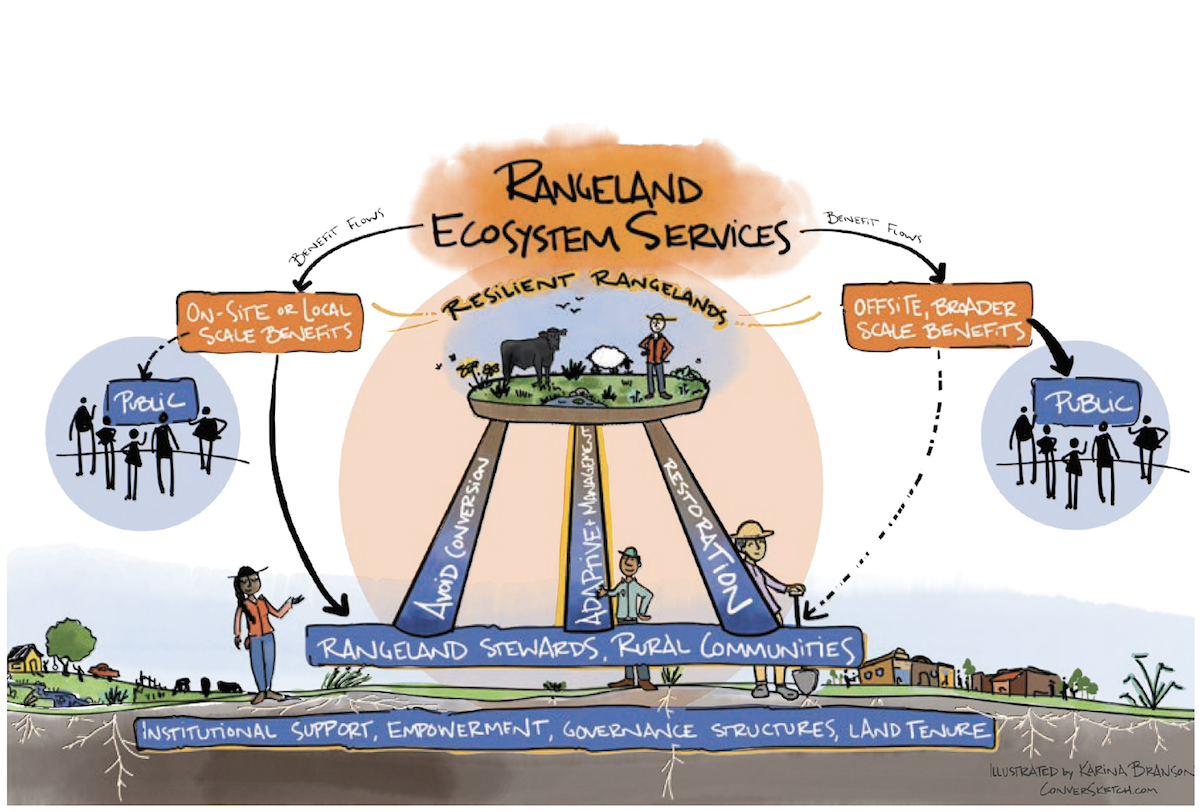
The Society for Rangeland Management recently released their Rangeland Ecosystem Services Report: Connecting Nature and People. The report includes five key rangeland service topic areas including; food and fiber, water as an ecosystem driver in rangelands, carbon sequestration and security, plant and insect biodiversity, and wildlife habitat provision. 


Photo: Rangeland Ecosystem Services Report

[Read more…] about SRM Multidisciplinary Rangeland Ecosystem Services Report

Filed Under: Beef Cattle, Conservation, Conservation Practices, Grazing Management, Society for Range Management Tagged With: brush management, Conservation, Conservation Management, Conservation Practices, Grazing

Exploring Texas 4-H Range Judging

March 29, 2023 by jaime.sanford

Did you know that Texas 4-H has a Range Judging component? The AgriLife Extension Explore Handbook has everything you need to know and more on how to get involved in Texas 4-H Range Judging.

[Read more…] about Exploring Texas 4-H Range Judging

Filed Under: 4-H Range Contests, Conservation Practices, Plant ID, Range Concepts Tagged With: 4-H, Grazing, Range Concepts, Range Contests

Targeted Grazing with Goats and Sheep

March 1, 2023 by jaime.sanford

Before producers can consider adding additional species to their operations, forage production and carrying capacity must be determined. This is crucial and the foundation of any operation.  More information on determining stocking rate and carry capacity can be found in this AgriLife Extension Publication – Stocking Rate: The Key Grazing Management Decision.

What is Targeted Grazing?

[Read more…] about Targeted Grazing with Goats and Sheep

Filed Under: Goats, Grazing Management, Range Concepts, Sheep, Targeted Grazing Tagged With: Goats, Grazing, grazing management, Sheep, Targeted Grazing

Published to Pasture…Soil Health!

July 11, 2019 by morgan.treadwell

Soil Health…kind of catchy, right?!  I agree.  And, so do thousands of other range managers and landowners.  It’s the buzz word of the century and it’s here to stay.  So what do we know about soil health and how the heck can our ranchers use it?

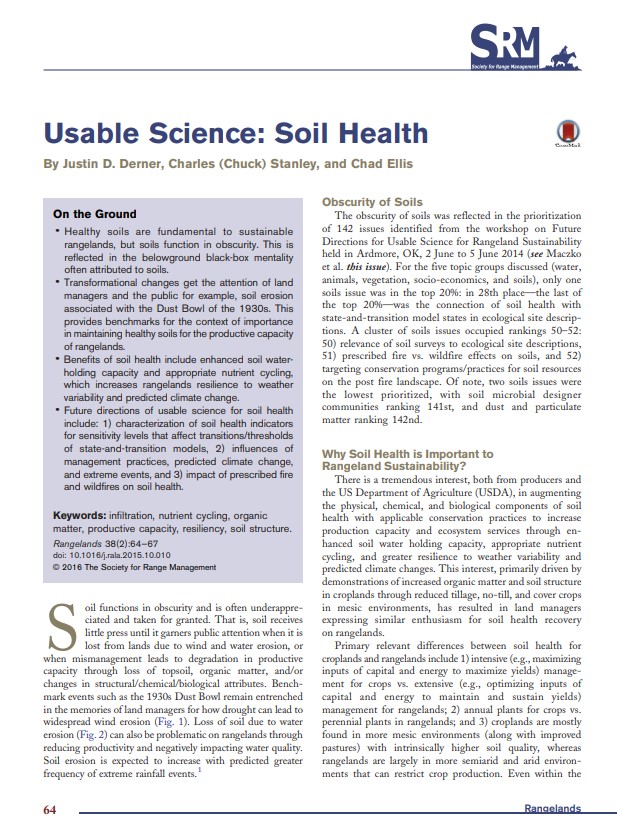
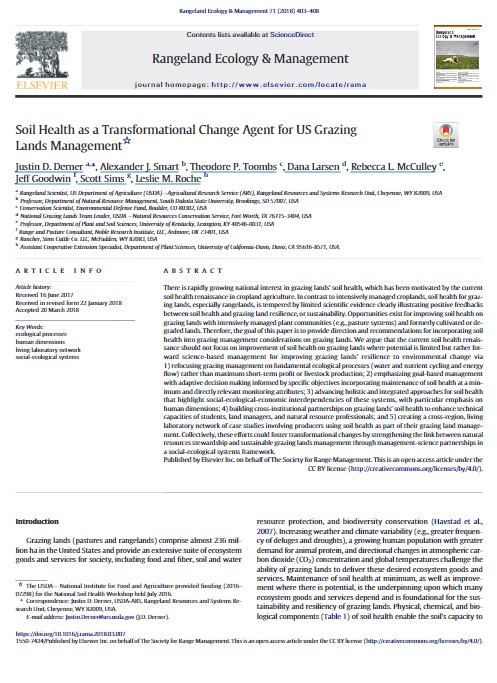
Today, we will be looking at 2 relatively recent articles on soil health.  First, “Usable Science: Soil Health” written by Justin Derner, Chuck Stanley, and Chad Ellis.  Secondly, we will look at “Soil Health as a Transformational Change Agent for US Grazing Lands Management” written by Justin Derner, Alexander Smart, Theodore Toombs, Dana Larsen, Rebecca McCulley, Jeff Goodwin, Scott Sims, and Leslie Roche.

Usable Science- Soil Health 

Why is soil health on the minds of every range manager these days?  Easy.  Dust Bowl of the 1930s was a benchmark event that changed every single range, crop, and land-man’s way of thinking.  Total game changer.  As Derner and others stated, “The 1930s Dust Bowl remains entrenched in the memories of land managers for how drought can lead to widespread wind erosion.”  I couldn’t agree more.  As range managers, we seek to learn from our mistakes – not repeat them.  So now we have the most talented scientists working out the details of a very complex, obscure, and complicated science of the physical, chemical, and biological components of soil and how applicable conservation practices increase production, capacity, and ecosystem services through enhanced soil water holding capacity, appropriate nutrient cycling, and greater resiliency to weather variability and predicted climate changes. For example, utilizing novel experiments with adaptive grazing management wherein short “pulses” of grazing with a large herd followed by rest periods of more than 1 year provides experimental platforms to evaluate the efficacy of soil health monitoring efforts.  Can I get an amen from the range gospel choir?!  Wahoo!!! It’s about dang time!

To summarize what the Rangelands article is talking about, here we go:

#1. What are the effects of conservation practices (e.g., prescribed grazing, prescribed fire, and brush management) on the chemical, physical, and biological components of soil health?

#2. Can the chemical, physical, and biological components of soil health be used as “early indicators” of phase, transition, and/or threshold shifts in plant communities for state-and-transition models to enhance ecological site descriptions?

#3. How can the chemical, physical, and biological components of soil health be enhanced through adaptive management to increase the resilience of soils to weather variability and changing climate?

#4. How can the soil health tool kit to provide more robust and broad assessments of soil health and/or monitoring of the chemical, physical, and biological components for land managers in a timely and responsive manner to facilitate adaptive management be expanded?


Fast forward to our next article, Soil Health as a Transformational Change Agent for US Grazing Lands Management and now is where we get to the cool nerd stuff. Current soil health is an opportunity not to focus on improvement of soil health on lands where potential is limited but rather to forward science-based management on grazing lands via

#1. Refocusing grazing management on fundamental ecological processes (water and nutrient cycling and energy flow) rather than maximum short-term profit or livestock production

#2. Emphasizing goal-based management with adaptive decision making informed by specific objectives incorporating maintenance of soil health at a minimum and directly relevant monitoring attributes

#3. Advancing holistic and integrated approaches for soil health that highlight social-ecological-economic inter-dependencies of these systems, with particular emphasis on human dimensions

#4. Building cross-institutional partnerships on grazing lands’soil health to enhance technical capacities of students,land managers, and natural resource professionals

#5. Creating across-region, living laboratory network of case studies involving producers using soil health as part of their grazing land management. Explicitly incorporating soil health into grazing management and the matrix of ecosystems services provided by grazing lands provides transformational opportunities by building tangible links between natural resources stewardship and sustainable grazing management, as well as providing paths to reach broader audiences and enhance communications among producers,customers, and the general public.


Now, we can really jump up and say “hallelujah!!!!”

This is what their vision looks like:

My favorite part, is “Re-focus grazing management on fundamental ecological processes.”  What a concept!!

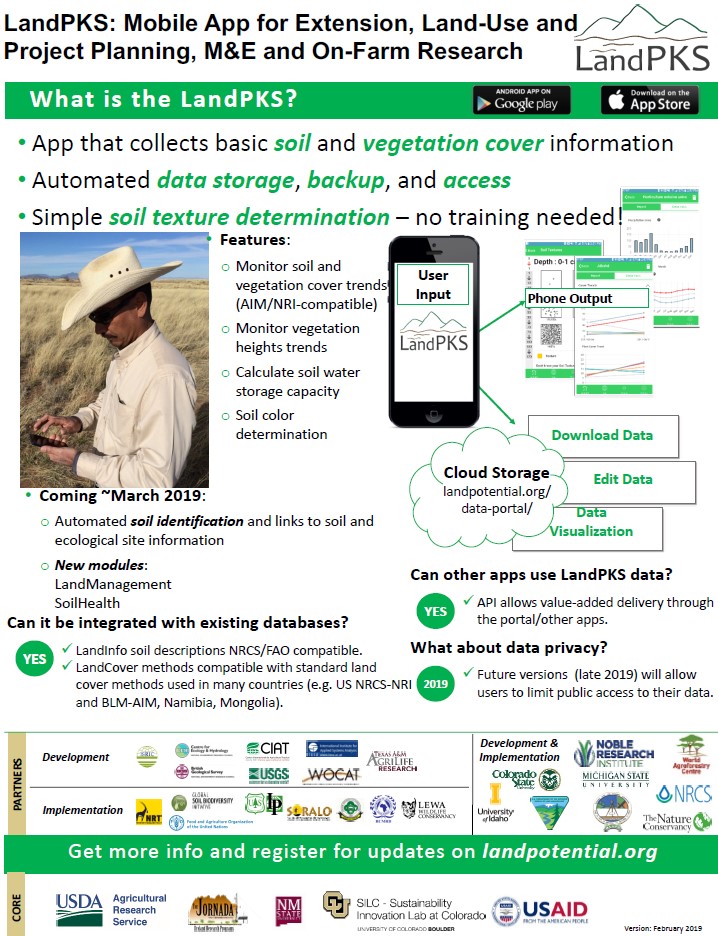
Better yet!  There is an app for that!  Check out LandPKS on your smartphone device and start collecting data on LandInfo, LandCover, and LandManagment!

Please click here for more information regarding this remarkable tool!

Believe it or not, Soil Health is more fun and easy than you think!  We just overcomplicated it!

Filed Under: Brush Management, Grazing Management, Prescribed Burning, Publications Tagged With: #grazing #ranchmanagement #brush #grasslands, brush management, fire effects, grass production, Grazing, prescribed fire

Published to Pasture…Collaborative Adaptive Rangeland Management

January 31, 2019 by morgan.treadwell

In 2018, Wilmer and others published “Collaborative adaptive rangeland management foster management-science partnerships” in Rangeland Ecology and Management (check it out here).  I really valued this paper, because fostering management-science relationships is what Extension is all about!

This paper is a case study, based on qualitative social data collected from meeting notes and interview transcripts recorded from ranchers and agency representatives in a Collaborative Adaptive Rangeland Management (CARM) study. In this synthetic assessment, they explored to what extent participation in the CARM experiment enabled adaptive decision making by a group of rangeland stakeholders (landowners, agencies, non-profit, etc..).

The specific objectives of this study were to 1) document how diverse stakeholder experiences and knowledge (meaning their socially constructed theories and justifications for rangeland management knowledge) contribute to the CARM project, 2) evaluate how co-produced knowledge informed management decision making through three grazing seasons, and 3) explore the implications of participation in the CARM experiment for rangeland stakeholders.


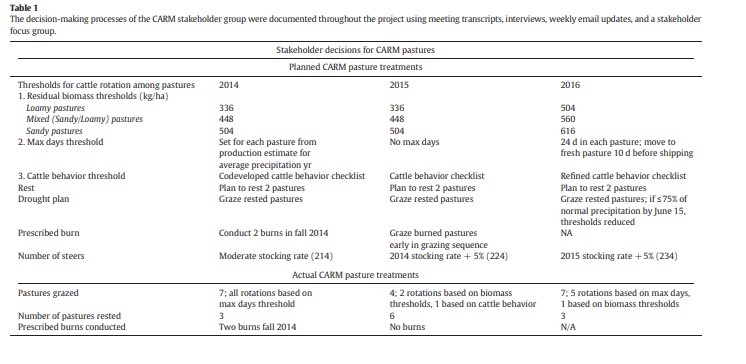
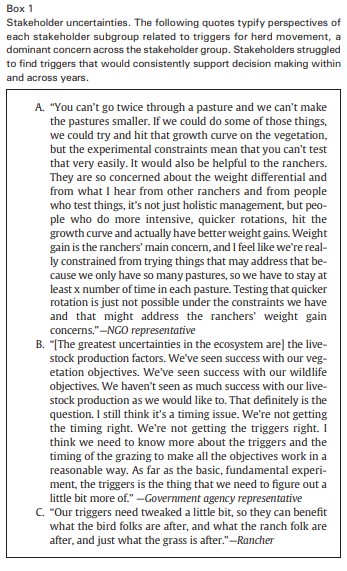
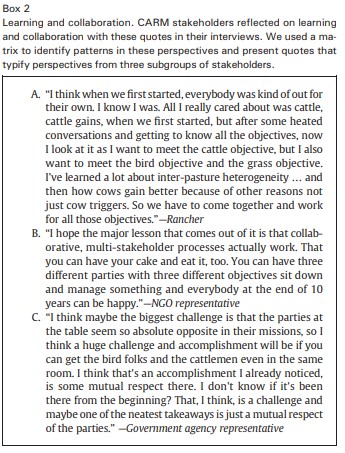
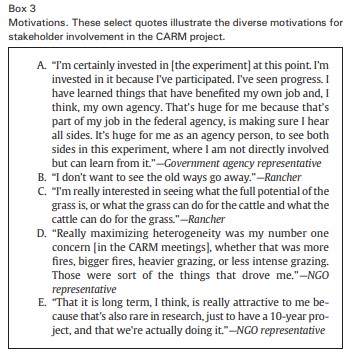
Here are some snapshot comments from ranchers, agency, and NGO reps on uncertainties, learning/collaboration, and motivations:


The authors found that this interactive process can reveal the differences among stakeholder knowledge about complex rangeland systems, but does not reconcile those differences.  And that it is HIGHLY UNLIKELY that stakeholder decision-making related to cattle rotation and prescribed fire decisions will be made on data from research or experiments.  However, it is likely that Collaborative Adaptive Rangeland Management (CARM) can build awareness and appreciation for the diverse ways of knowing about rangeland management.  Stakeholders are more likely to utilize:

  1. Discussion and consideration of different reasoning for management actions
  2. Enhanced understanding when stakeholders are involved in the project design and monitoring data collection and presentation.
  3. Frequent discussion of the rational for decisions
  4. Presentations of multiple information sources
  5. Focus groups or tours that encourage sharing participants’ ways of knowing and experiences

Bottom line, rangeland management stakeholders prefer making decisions based on the broadest range of available information, INSTEAD of exclusively using scientifically derived knowledge!!!

Next, data from this paper showed TRUST among stakeholder and researcher groups may improve social learning by increasing the transparency of unique stakeholder experiences and knowledge.  Stakeholder trust over time facilitated engagement and commitment from stakeholders and researchers to work toward a common goal.

So…are you a landowner, rancher, producer that agrees with this?  I certainly hope so because this is all about what Extension creates, facilitates, and nurtures.  Our job is to provide YOU the landowner with all the information and bring YOU to a network of stakeholders that you TRUST!

As Extension, we  should:

  1. Make direct efforts to share and acknowledge managers’ different rangeland management experiences, epistemologies, and knowledge
  2. Involve long-term research commitment in time and funding to social, as well as experimental, processes that promote trust building among stakeholders and researchers over time

This all is very ironic to me, because it is what ranchers have been telling me for a long time.  But, now that we have it in a published journal, maybe the other half can start listening!

I love my job.  I love delivering information.  I love working with ranchers.  I serve at the pleasure of West Texas ranchers, and it is a an honor.  Thank you!!


Wilmer, H., J.D. Derner, M.E. Fernandez-Gimenez, D.D. Briske, D.J. Augustine, L.M. Porensky, the CARM Stakeholder Group.  2017. Collaborative adaptive rangeland managment fosters management-science partnerships. Rangeland Ecology and Management 71: 646-657. 

Filed Under: Brush Management, Grazing Management, Prescribed Burn Associations, Prescribed Burning, Publications Tagged With: Grazing, networking, prescribed burning, rangelands, society for range management, stewarship

Prussic Acid Misconceptions – Dr. Ted McCollum

August 30, 2016 by morgan.treadwell

Dr. Ted McCollum, Extension Beef Cattle Specialist with Texas A&M AgriLife Extension Service, explains that prussic/cyanide levels when there is a frost/freeze event is one of the most confusing and misleading statements in most extension and popular press articles.  Here’s the skinny on the actual facts brought to you by thee Dr. McCollum:

“The cyanide(prussic acid) in plants does not exist in a free, liberated state.  The cyanide is part of a larger molecule called a cyanogenic glycoside. In members of the sorghum family this compound is Dhurrin; in chokecherries, wild cherries, mountain mahogany, among others, and the kernels of almonds, peaches,  apricots and apples this is Amygdalin (laetrile) and Prunasin; in cassava, white clover, flax and lima beans this is Linamarin.  These compounds themselves are harmless; the breakdown and liberation of the cyanide is the insult.  

A hand grenade represents a “potential” explosion.  As long as the pin is in place and the lever (trigger) has not been released that “potential” is not realized; the grenade is harmless.  But when the pin is pulled and the trigger is released and the fuse activates and catalyzes the explosion, the potential is realized and potential harm ensues.  The cyanogenic glycoside is like the hand grenade.   As long as the cyanogenic glycoside remains intact there is only the potential for toxicity; this is sometimes referred to as “cyanide potential”.  In order for the potential to be realized, something has to trigger the enzymatic action to liberate the cyanide molecule from the glycoside.   The beta-glucosidase enzymes that liberate cyanide from the parent glycoside are found in the plant tissue. In the intact plant tissue, the cyanogenic glycosides are found in vacuoles while the enzymes are found in the cytosol.  In order for the cyanide to be released the plant tissue must be damaged so that the glycosides and the enzymes come together. The enzymes are also produced by ruminal microbes.  Cutting, crimping, mastication, trampling, hail damage, and frost/freeze disrupt cellular structure and allow the glycosides and enzymes to mix and liberate cyanide from the parent glycoside.  Introduction into the ruminal environment presents the glycosides to the microbial enzymes and releases cyanide. 

So back to the grenade, the cyanogenic glycoside is the grenade and represents “potential toxicity”.  The damage to the plant tissue or introduction to the ruminal environment pulls the pin and releases the trigger.  The subsequent mixing of the glycoside with the enzymes activates the fuse and catalyzes the release of cyanide and a possibly toxic insult.  

Back to the freeze/frost — 

First, freeze/frost causes tissue damage and will indeed result in an increase in the “free” cyanide present in plant tissue (In fact, when analyzing cyanide in the lab, the forage samples are first frozen in order to release all of the cyanide; simply analyzing cyanide on fresh samples only indicates what is “free” in the tissue).  But remember, when the animal bit, chewed and swallowed that same forage into the ruminal environment just hours before the freeze or frost, the same cascade of events occurred as when the standing forage was exposed freeze/frost a few hours later.  The potential for toxicity was always there, different events pulled the pin and released the trigger. So, in order for a freeze/frost to increase toxicity for ruminants (more later) as is stated in the many pubs, the freeze/frost would have to actually stimulate dhurrin (cyanogenic glycoside) synthesis by the plant.  In other words, the freeze/frost would have to stimulate the plant to make more hand grenades. I have searched for research to prove that freeze/frost increases dhurrin synthesis (specifically dhurrin since that is the glycoside in sorghums, sudans, johnsongrass) in the plant.  It is not there.  I recently contacted Dr. Ros Gleadow from Australia who works in the area of cyanogenensis in plants and her response to my query was quote “Dhurrin is not synthesised in response to frost.” 

So, the plant does not make more hand grenades in response to frost/freeze which goes back to Dr. Halliburton’s comment which I have reworded with my interpretation of his meaning – The potential toxicity after the freeze was the same as the day before the freeze.

I think some of the misinterpretation and source of information in the pubs stems from studies of long ago where the researchers collected plant samples before and after a freeze and analyzed the cyanide content of the forage tissue.  However, they did not freeze the samples before they analyzed them.  So, they did not release all of the cyanide before analyses.  They found that the amount of “Free” cyanide was higher after the freeze.  This is indeed true. BUT, they did not measure “cyanide potential” which is the real concern and as far as I have discerned, if they had measured cyanide potential they would have found no difference before and after the freeze.

We typically deal with ruminants in these grazing forage situations.  Ruminants are typically more susceptible to cyanide toxicity because (1) ruminal microbial beta-glucosidase activity, (2) ruminal pH near neutrality – the optimum pH for beta-glucosidase activity.

What about nonruminants?  Typically less susceptible to cyanide toxicity (1) no microbial activity in the first stage of digestion (2) acid pH in first stage of digestion slows/eliminates beta-glucosidase activity in ingested forages.  So when the nonruminant is ingesting forage with “cyanide potential”, they have some protection because the enzymatic activities that release cyanide are suppressed or absent.

BUT, following a freeze/frost, the possibility for toxicity in a nonruminant may increase.  The frost or freeze has liberated the cyanide and the animal will be ingesting free cyanide.  The other “protective” mechanisms – no microbial digestion, acid pH in stomach – have been circumvented.”


Filed Under: Grazing Management, Plant ID Tagged With: Grazing, Prussic Acid, Range Nutrition

Recent Posts

  • Fire Up Plant Diversity!
  • New Publication! Photosensitization
  • Dry, Warm, Windy, and Fuel.
  • Lessons Learned – Pyro-Vortex Tornado on the Deer Creek Fire
  • Mapping Fire Before It Starts: How the Fireshed Project Strengthens Readiness in West Texas

Categories

  • 4-H Range Contests
  • Beef Cattle
  • Brush Management
  • Carbon Credits
  • Carbon Markets
  • Conservation
  • Conservation Practices
  • Drought Management
  • El Niño
  • Events
  • Goats
  • Grazing Management
  • La Niña
  • Land
  • Lessons Learned
  • Meet A County Extension Agent
  • Plant ID
  • Podcast
  • Prescribed Burn Associations
  • Prescribed Burning
  • Publications
  • Range Concepts
  • RAP
  • Sheep
  • Society for Range Management
  • Soil
  • Staff
  • Targeted Grazing
  • Uncategorized
  • Water
  • Weather
  • Why I Ranch
  • Wild Pigs
  • Wildfire
  • Wildfires
  • Wind
  • Woody Encroachment
  • Youth Range Workshop

Archives

Texas A&M AgriLife Extension Service
Texas A&M University System Member
  • Compact with Texans
  • Privacy and Security
  • Accessibility Policy
  • State Link Policy
  • Statewide Search
  • Veterans Benefits
  • Military Families
  • Risk, Fraud & Misconduct Hotline
  • Texas Homeland Security
  • Texas Veteran's Portal
  • Equal Opportunity
  • Open Records/Public Information