West Texas Rangelands would like to extend our gratitude to Mr. Luke Drosche for collaborating with us and providing this weather update for our readers. We thank him for sharing his time, talents, and knowledge with us as a guest contributor. Luke serves with Texas A&M AgriLife Extension Service as a Disaster Assessment and Recovery Specialist.
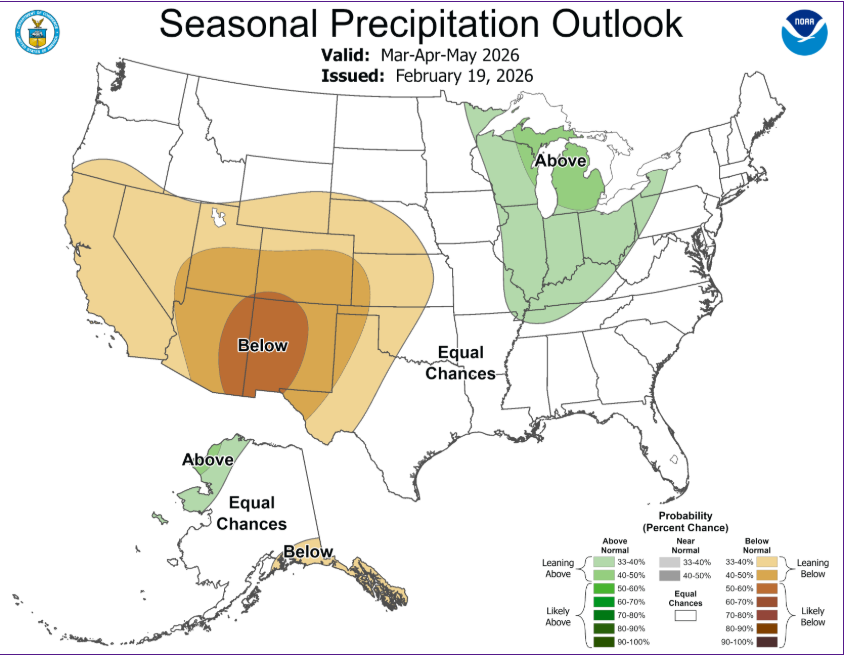
3-Month Precipitation Outlook:
The first few days of March have brought areas of rain and severe storms to a large portion of the State. Those across the Coastal Plains have enjoyed some much-needed precipitation, while our areas in the Panhandle and out west have continue to be mostly dry with the exception of a few supercell thunderstorms. The month of March should continue to bolster higher rain chances before tapering back off closer to May. The 3-month outlook has shown that a majority of the state is in an “Equal Chances” Category for rain. Meaning that we are most likely to mark near normal on our rain gauges. NOAA has predicated the month of March to be potentially wetter than average for the Northeastern part of the State before marking close to normal through April and May. While the far western and Northwestern areas are forecasted to be drier. This is the time of year we need to make sure we always have a way to receive weather warnings. Severe Weather in Texas is year-round but increases dramatically in the springtime. For anywhere you are in the State of Texas, all modes of Severe weather are possible. It is important to have a plan for you, your family, and your property should severe weather impact you. Know how to communicate, plan to live a few days without power or water, and who to contact if you are affected by severe weather. Keep an eye to the sky.
3-Month Temperature Outlook:
Rinse and Repeat from our winter months is predicted as we remain warmer than average. March has a high likelihood of marking above normal temperature with higher-than-normal temperatures likely through at least May, areas out west have higher potential to be warmer than average. The entire state is under this prediction due to our current La Nina Conditions. These bring warmer temperatures to our area. However, we are seeing a transition out of La Nina into ENSO Neutral Conditions. This transition will happen over the next few months. Later in the year we look to potentially move into an El Nino weather pattern closer to next Fall. We will take this as a hope for more beneficial rain as 19.2 million of us in the State of Texas are in a Drought Designation.
 Drought Update:
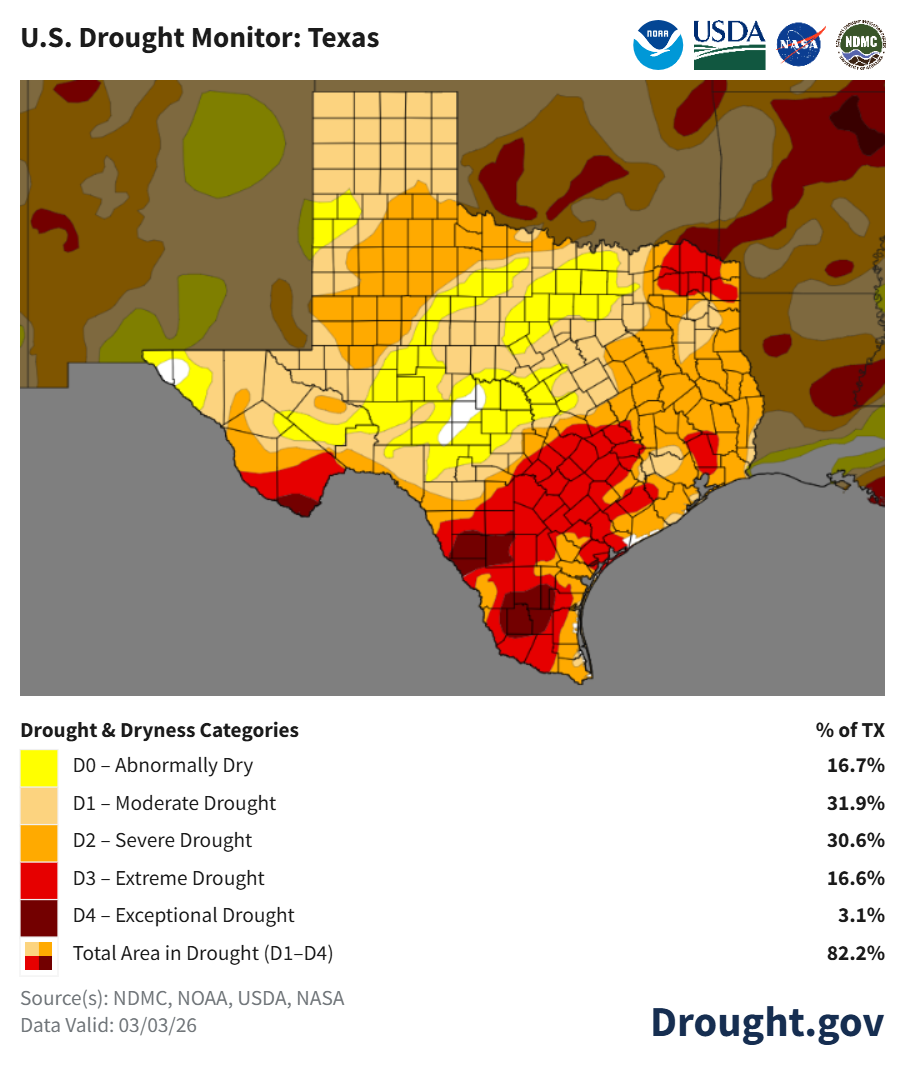
Extreme Drought Conditions persist in Central and South Texas with nearly the entire state in some dryness/drought category. Panhandle regions remain in Moderate Drought and areas slightly south of there creep into the Severe Drought Designation. Early March’s rain will provide some relief to the Coastal Plains and parts of Central Texas when the next Drought updates come in roughly a month from now. More rainy days are predicted through March and will hopefully continue to improve conditions. The next few months, March, April, and May typically bring weather systems across much of the state. These systems pack a punch with severe storms and high rainfall rates. We always prefer longer, drawn out rainfall events that allow the rainfall to soak into the soil, rather than run off the dry, packed ground. However, once the soil is primed with some moisture from whatever form of rain we get, we benefit more. With the transition predicted us of La Nina and into ENSO Neutral conditions, we are hopeful for some improvement in overall drought conditions across the State. Over many months in recent history, we have been in a La Nina designation, which is what has continued to push our drought conditions. As we transition into Neutral Conditions in the short term, we will see more weather patterns indicative of repeated rainfall come into play. No doubt we will still see long periods of dry weather, but let’s keep a hopeful eye on next fall as we should move into El Nino Conditions.
 References and Resources: https://www.cpc.ncep.noaa.gov/, https://www.drought.gov/states/texas