• Skip to primary navigation
  • Skip to main content
  • Skip to primary sidebar
  • Texas A&M Forest Service
  • Texas A&M Veterinary Medical Diagnostics Laboratory
  • Texas A&M AgriLife Extension Service
  • Texas A&M AgriLife Research
  • Texas A&M College of Agrculture and Life Sciences
West Texas Rangelands
West Texas RangelandsWe hope to provide a variety of science-based rangeland information and current research on prescribed fire, wildfires, brush management, and grazing management!
  • Menu
  • Home
  • About & Contact
  • Publications
    • Extension Publications
    • Refereed Journal Articles
    • Program Summaries
  • Events
  • Lunch N’ Learn
  • Infographics
    • Drought
    • Grazing
    • Herbicide
    • Prescribed Fire
    • Rangeland Plants
    • Wildfire
  • Range Resources
    • Published to Pasture
    • Range Concepts
  • Fire Resources
  • Sponsors
  • AgriLife Learn Online Courses

Stability of C3 and C4 Grass Patches in Woody Encroached Rangeland after Fire and Simulated Grazing

August 28, 2024 by jaime.sanford

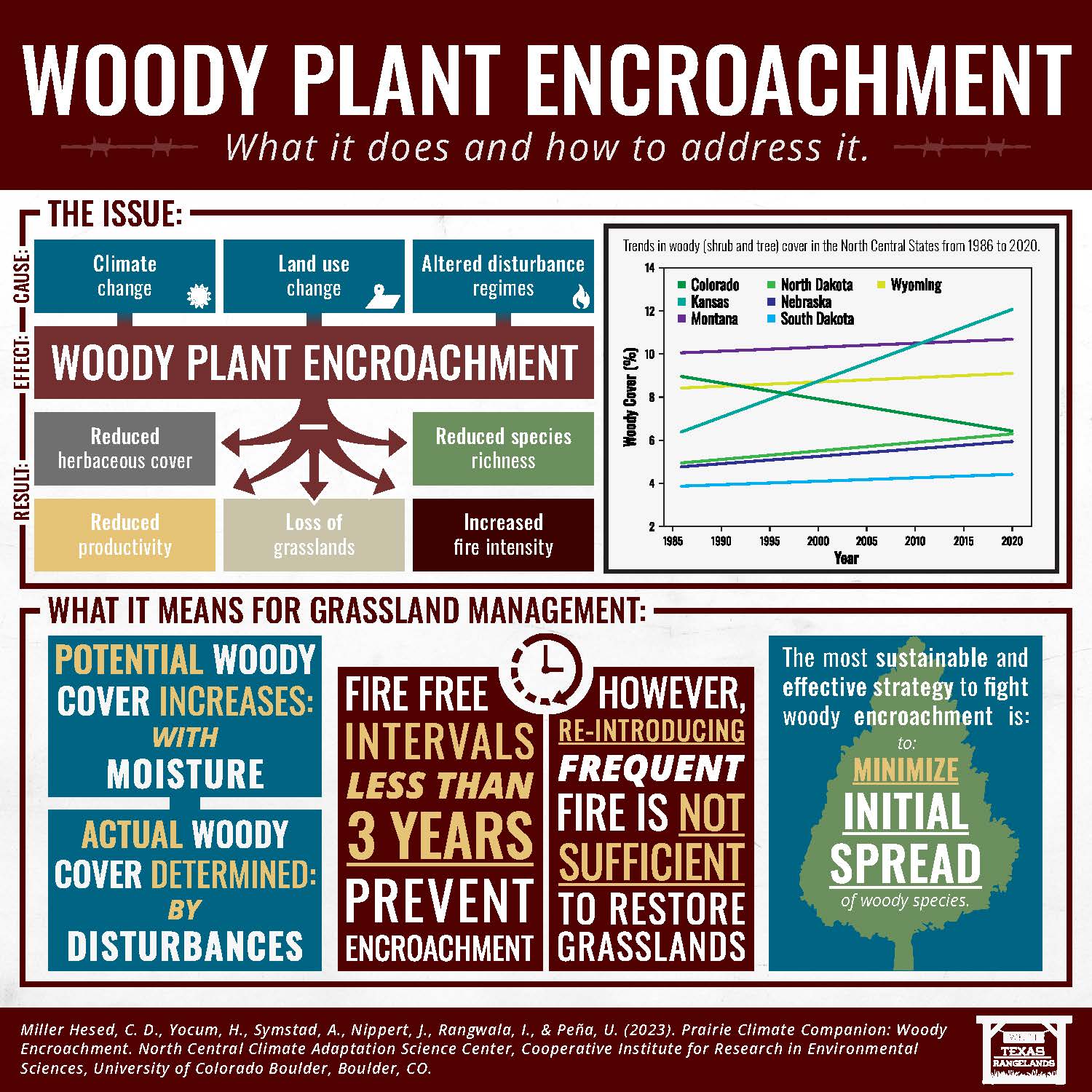
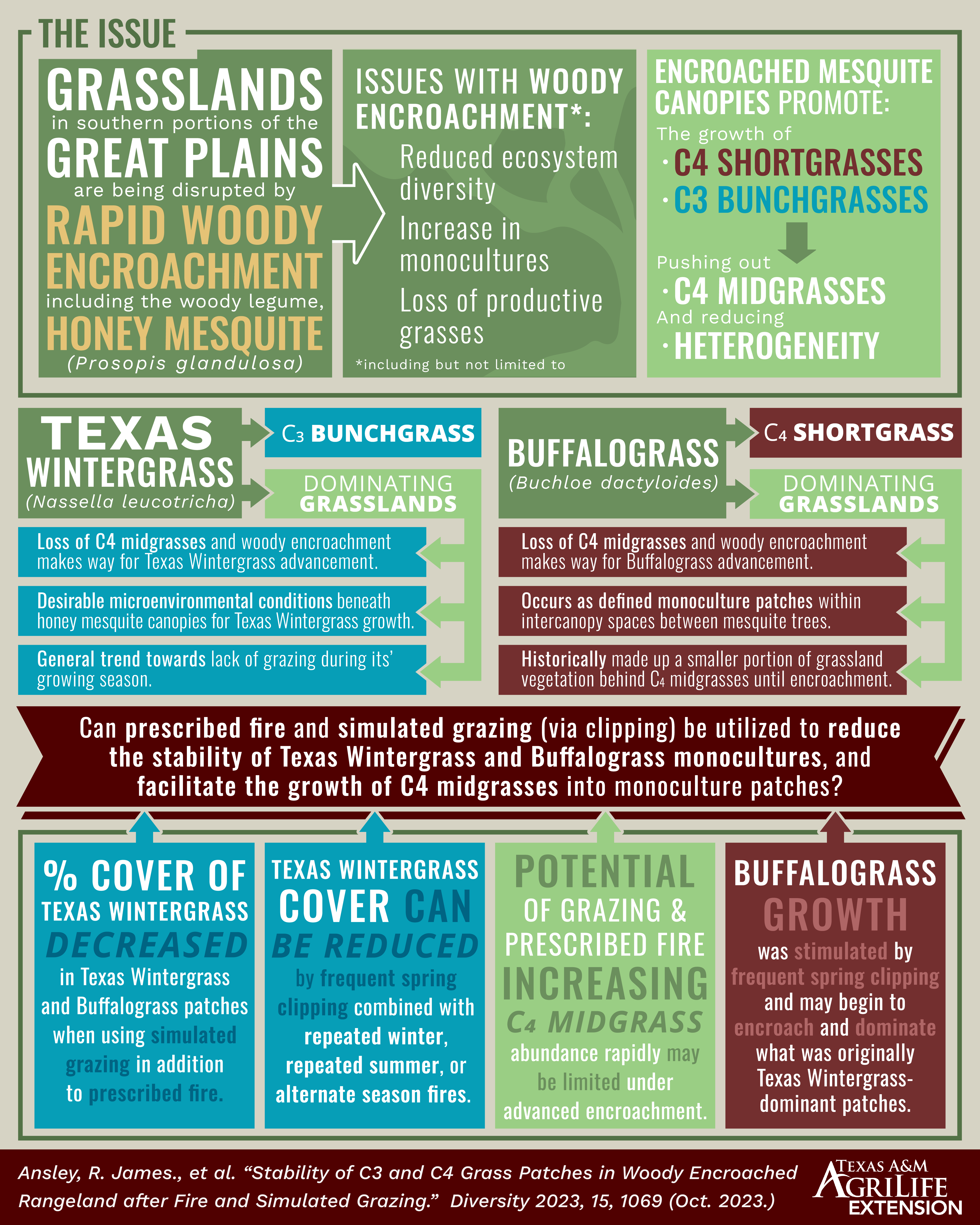
In the western portion of the southern Great Plains, grasslands are defined as “southern mixed”, with warm season or C4 mid-grasses being dominant and cool season or C3 short-grasses in less frequent densities. As woody plant encroachment increasingly dominates, the productive warm season C4 grasses begin to decline with less abundance on the landscape and even less productivity. Woody plant dominance also reduces plant diversity eroding heterogeneity in the mixed-grass prairie. Recently, researchers measured the effects of various combinations of spring clipping (mimicked cattle grazing) and prescribed fire treatments over an 8 year period on Texas wintergrass and buffalograss with the overall objective of reducing Texas wintergrass abundance and increasing warm season C4 mid-grass species and diversity.

[Read more…] about Stability of C3 and C4 Grass Patches in Woody Encroached Rangeland after Fire and Simulated Grazing

Filed Under: Brush Management, Conservation, Conservation Practices, Grazing Management, Prescribed Burning, Woody Encroachment

Prescribed Fire Lessons

May 29, 2024 by jaime.sanford

The Nebraska Prescribed Fire Council has published its second issue of Prescribed Fire Lessons Learned! The Nebraska Prescribed Fire Council takes submissions from practitioners on lessons learned from prescribed fires to assist producers, landowners, PBAs, and other prescribed fire professionals to keep improving season after season.  This forum has been invaluable in learning from one another in hopes that mistakes or judgment calls turn into valuable lessons for all of us building and contributing to prescribed fire culture. Below are some highlights from this issue. 

[Read more…] about Prescribed Fire Lessons

Filed Under: Brush Management, Lessons Learned, Prescribed Burn Associations, Prescribed Burning, Wildfire

Prescribed Fire Drip Torch Burn – Rapid Lesson Sharing

May 8, 2024 by jaime.sanford

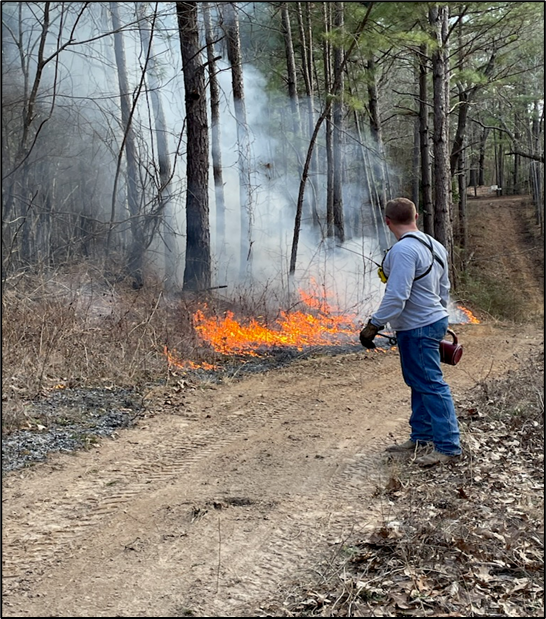
The Oconee Ranger District conducted a 1,637-acre prescribed fire in Eatonton, Georgia on February 22nd. On the day of the prescribed fire, three firefighters were assigned to the ignition crew and other personnel were assigned to holding and overhead positions. As the morning brief occurred, discussion on hazards including entanglements in vines were common to the area. 

[Read more…] about Prescribed Fire Drip Torch Burn – Rapid Lesson Sharing

Filed Under: Lessons Learned, Prescribed Burning

CO2 Flux over Burned Honey Mesquite Savanna Rangeland

April 24, 2024 by jaime.sanford

Prescribed fire is a management practice used to reduce woody plant encroachment on rangeland and maintain native perennial grass diversity and productivity. Prescribed fire effects on CO2 fluxes and their contribution to atmospheric CO2 is not well known. The study below discusses the effect of fire on net ecosystem CO2 flux above Prosopis glandulosa Torr. (honey mesquite) using the Bowen ratio/energy balance method (BREB), and to compare these fluxes to fluxes determined by an empirical model.

[Read more…] about CO2 Flux over Burned Honey Mesquite Savanna Rangeland

Filed Under: Brush Management, Conservation, Conservation Practices, Prescribed Burning, Woody Encroachment

Cost and Trends of Rx Fire in Southern Forestry Practices

April 10, 2024 by jaime.sanford

Forest Landowners Foundation in conjunction with Auburn University have created a survey to analyze the cost and trends of forestry management and practices. This survey is conducted bi-annually and provides a historical analysis of costs and management practices.

[Read more…] about Cost and Trends of Rx Fire in Southern Forestry Practices

Filed Under: Prescribed Burn Associations, Prescribed Burning

Extreme Prescribed Fire during Drought Reduces Survival and Density of Woody Resprouters

April 3, 2024 by jaime.sanford

Researchers looked at extreme fire conditions during drought in humid subtropical and semi-arid ecoregions that require innovative management strategies that go beyond the traditional restoration and conservation practices. These practices have either been historically ineffective or economically cost-prohibitive at restoring grass-dominated ecosystems following conversion to resprouting shrublands.

[Read more…] about Extreme Prescribed Fire during Drought Reduces Survival and Density of Woody Resprouters

Filed Under: Conservation, Conservation Practices, Prescribed Burning, Woody Encroachment

Lessons Learned – Contributing Factors to UTV Rollover on Prescribed Fire

March 27, 2024 by jaime.sanford

In Feb. 2023, Oakmulgee Ranger District was conducting their first large burn of the season. Multiple off-unit resources had been requested to assist with the burn, including various firefighters from other regions, Job Corps, Bureau of Land Management, and local militia. 

[Read more…] about Lessons Learned – Contributing Factors to UTV Rollover on Prescribed Fire

Filed Under: Lessons Learned, Prescribed Burn Associations, Prescribed Burning

An Economic Comparison of Prescribed Extreme Fire and Alternative Methods for Managing Invasive Brush Species in Texas: a Modeling Approach

March 20, 2024 by jaime.sanford

Did you know that 40% of the Earth’s surface is covered in Rangelands? However with the increase of brush encroachment, there has been an increase in conversion from rangeland into undesirable and unproductive species. In the Rolling Plains the primary invasive species focused on is prickly pear cactus, in South Texas Plains huisache is the primary focused species, and in the Edwards Plateau, Ashe & Redberry Juniper are of concerns. One fun fact, Mesquite is considered to be a secondary problem in all three of these ecoregions.

[Read more…] about An Economic Comparison of Prescribed Extreme Fire and Alternative Methods for Managing Invasive Brush Species in Texas: a Modeling Approach

Filed Under: Conservation, Grazing Management, Prescribed Burning, Woody Encroachment

UTV Incidents Dominates 2023 Lessons Learned

March 6, 2024 by jaime.sanford

One of the big takeaways from the 2023 summary of incident reports from the Wildland Fire Lessoned Learned Center was the increase of UTV related incidents. Over the past 14 years, the most UTV related incidents in one year was 5. In 2023 however, there were 13 related incidents. The graph shows 15 accumulated years of UTV involved incidents, including rollovers, entrapments, equipment damage, and tree strikes.

[Read more…] about UTV Incidents Dominates 2023 Lessons Learned

Filed Under: Lessons Learned, Prescribed Burn Associations, Prescribed Burning

Prescribed Fire as a Tool for Controlling Tick Populations in the Southeastern United States

February 21, 2024 by jaime.sanford

Did you know that tick geographic ranges are expanding past their historical boundaries due to environmental changes? The Gulf Coast tick is found in the southeastern and southern midwestern United States and its range is expanding. 

[Read more…] about Prescribed Fire as a Tool for Controlling Tick Populations in the Southeastern United States

Filed Under: Prescribed Burning, Wildfire

  • « Go to Previous Page
  • Page 1
  • Page 2
  • Page 3
  • Page 4
  • Page 5
  • Interim pages omitted …
  • Page 8
  • Go to Next Page »

Recent Posts

  • Economic Incentives for Reducing Wildfire Risk
  • Building Knowledge and Confidence with the Updated Online Prescribed Burn School
  • The Cost of Prolonged Overgrazing: Ripple Effects on Watershed Health, Rainfall Infiltration, and Ranch Production
  • Advancing Wildland Fire Science: Inside the USDA Forest Service Fire Lab
  • Spring Weather Outlook By Luke Drosche – Texas A&M AgriLife Extension DAR Specialist

Categories

  • 4-H Range Contests
  • Beef Cattle
  • Brush Management
  • Carbon Credits
  • Carbon Markets
  • Conservation
  • Conservation Practices
  • Drought Management
  • El Niño
  • Events
  • Goats
  • Grazing Management
  • La Niña
  • Land
  • Lessons Learned
  • Meet A County Extension Agent
  • Plant ID
  • Podcast
  • Prescribed Burn Associations
  • Prescribed Burning
  • Publications
  • Range Concepts
  • RAP
  • Sheep
  • Society for Range Management
  • Soil
  • Staff
  • Targeted Grazing
  • Uncategorized
  • Water
  • Weather
  • Why I Ranch
  • Wild Pigs
  • Wildfire
  • Wildfires
  • Wind
  • Woody Encroachment
  • Youth Range Workshop

Archives

Texas A&M AgriLife Extension Service
Texas A&M University System Member
  • Compact with Texans
  • Privacy and Security
  • Accessibility Policy
  • State Link Policy
  • Statewide Search
  • Veterans Benefits
  • Military Families
  • Risk, Fraud & Misconduct Hotline
  • Texas Homeland Security
  • Texas Veteran's Portal
  • Equal Opportunity
  • Open Records/Public Information