• Skip to primary navigation
  • Skip to main content
  • Skip to primary sidebar
  • Texas A&M Forest Service
  • Texas A&M Veterinary Medical Diagnostics Laboratory
  • Texas A&M AgriLife Extension Service
  • Texas A&M AgriLife Research
  • Texas A&M College of Agrculture and Life Sciences
West Texas Rangelands
West Texas RangelandsWe hope to provide a variety of science-based rangeland information and current research on prescribed fire, wildfires, brush management, and grazing management!
  • Menu
  • Home
  • About & Contact
  • Publications
    • Extension Publications
    • Refereed Journal Articles
    • Program Summaries
  • Events
  • Lunch N’ Learn
  • Infographics
    • Drought
    • Grazing
    • Herbicide
    • Prescribed Fire
    • Rangeland Plants
    • Wildfire
  • Range Resources
    • Published to Pasture
    • Range Concepts
  • Fire Resources
  • Sponsors
  • AgriLife Learn Online Courses

An Economic Comparison of Prescribed Extreme Fire and Alternative Methods for Managing Invasive Brush Species in Texas: a Modeling Approach

March 20, 2024 by jaime.sanford

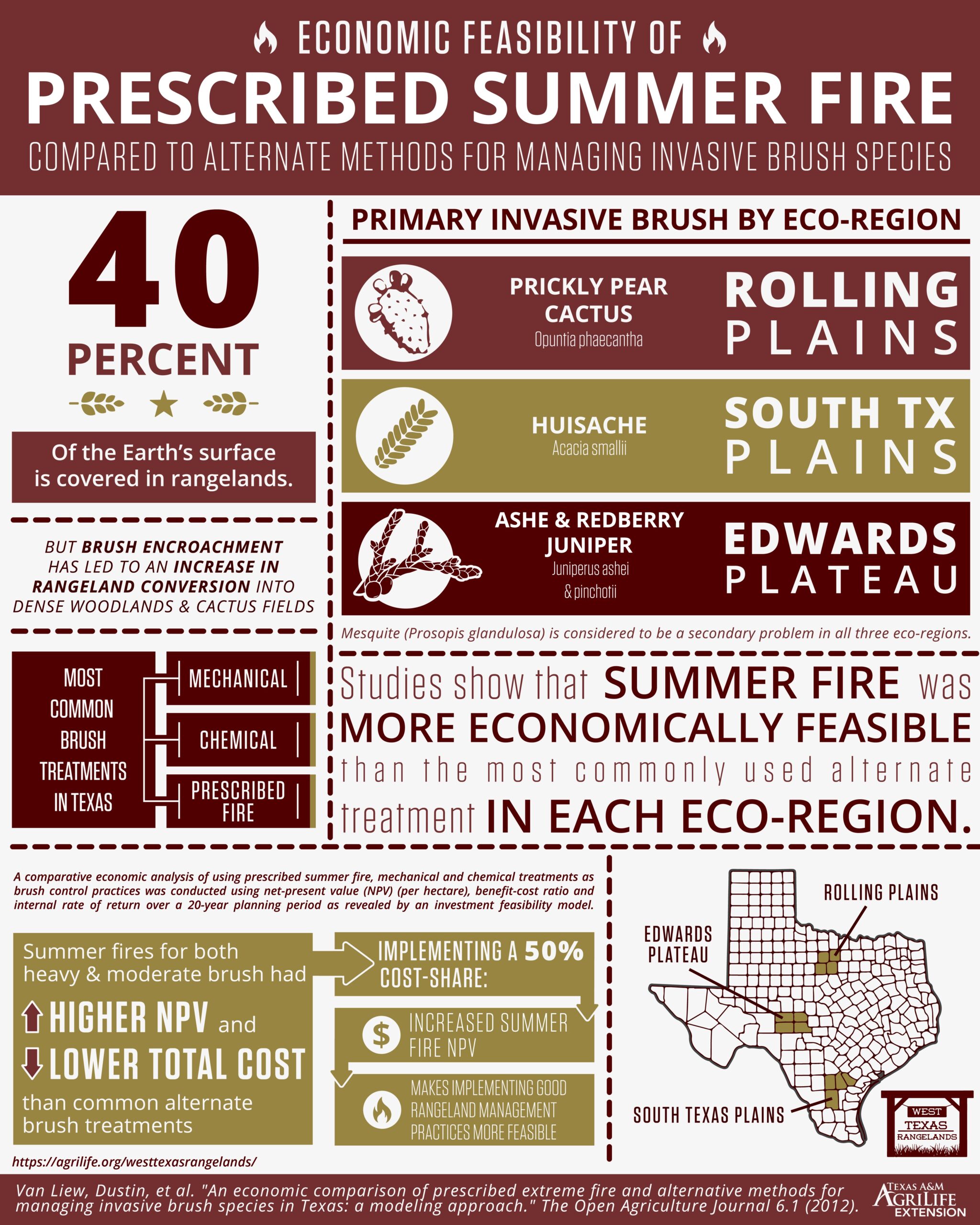
Did you know that 40% of the Earth’s surface is covered in Rangelands? However with the increase of brush encroachment, there has been an increase in conversion from rangeland into undesirable and unproductive species. In the Rolling Plains the primary invasive species focused on is prickly pear cactus, in South Texas Plains huisache is the primary focused species, and in the Edwards Plateau, Ashe & Redberry Juniper are of concerns. One fun fact, Mesquite is considered to be a secondary problem in all three of these ecoregions.


This study shows an economic comparison among using prescribed fire, mechanical, and chemical treatments since these are the most common brush treatments in Texas. The analysis was conducted using net-present value (NPV) (per hectare), benefit-cost ratio and internal rate of return over a 20-year planning period. 

The study shows that summer fire was more economically feasible than the most commonly used alternate treatment in each ecoregion. Summer fires for both heavy and moderate brush across all regions had higher NPV and lower total cost than common alternate brush treatments. This also helps make implementing good rangeland management practices more feasible. 

For more information and the full study, check it out here!

Van Liew, Dustin, et al. “An economic comparison of prescribed extreme fire and alternative methods for managing invasive brush species in Texas: a modeling approach.” The Open Agriculture Journal 6.1 (2012).

Filed Under: Conservation, Grazing Management, Prescribed Burning, Woody Encroachment

Recent Posts

  • Lessons Learned – Pyro-Vortex Tornado on the Deer Creek Fire
  • Mapping Fire Before It Starts: How the Fireshed Project Strengthens Readiness in West Texas
  • Revegetation vs. Encroachment: Why There’s No “Silver Bullet” for Woody Plant Management
  • Everything that reflects, is not gold
  • Ten Years of Mesquite Application Timing…Spray a Healthy Tree or Wait Until 75F Soil Temperature?

Categories

  • 4-H Range Contests
  • Beef Cattle
  • Brush Management
  • Carbon Credits
  • Carbon Markets
  • Conservation
  • Conservation Practices
  • Drought Management
  • El Niño
  • Events
  • Goats
  • Grazing Management
  • La Niña
  • Land
  • Lessons Learned
  • Meet A County Extension Agent
  • Plant ID
  • Podcast
  • Prescribed Burn Associations
  • Prescribed Burning
  • Publications
  • Range Concepts
  • RAP
  • Sheep
  • Society for Range Management
  • Soil
  • Staff
  • Targeted Grazing
  • Uncategorized
  • Water
  • Weather
  • Why I Ranch
  • Wild Pigs
  • Wildfire
  • Wildfires
  • Wind
  • Woody Encroachment
  • Youth Range Workshop

Archives

Texas A&M AgriLife Extension Service
Texas A&M University System Member
  • Compact with Texans
  • Privacy and Security
  • Accessibility Policy
  • State Link Policy
  • Statewide Search
  • Veterans Benefits
  • Military Families
  • Risk, Fraud & Misconduct Hotline
  • Texas Homeland Security
  • Texas Veteran's Portal
  • Equal Opportunity
  • Open Records/Public Information