• Skip to primary navigation
  • Skip to main content
  • Skip to primary sidebar
  • Texas A&M Forest Service
  • Texas A&M Veterinary Medical Diagnostics Laboratory
  • Texas A&M AgriLife Extension Service
  • Texas A&M AgriLife Research
  • Texas A&M College of Agrculture and Life Sciences
West Texas Rangelands
West Texas RangelandsWe hope to provide a variety of science-based rangeland information and current research on prescribed fire, wildfires, brush management, and grazing management!
  • Menu
  • Home
  • About & Contact
  • Publications
    • Extension Publications
    • Refereed Journal Articles
    • Program Summaries
  • Events
  • Lunch N’ Learn
  • Infographics
    • Drought
    • Grazing
    • Herbicide
    • Prescribed Fire
    • Rangeland Plants
    • Wildfire
  • Range Resources
    • Published to Pasture
    • Range Concepts
  • Fire Resources
  • Sponsors
  • AgriLife Learn Online Courses

The Long-Term Cost of Overgrazing—and How to Avoid It

February 25, 2026 by morgan.treadwell

Rangeland health is shaped by cumulative management decisions rather than single events. Grazing practices that consider timing, recovery, and monitoring support long-term productivity and resilience.

Avoiding overgrazing requires consistency, observation, and flexibility. Just as our environmental conditions change (whiplash drought), so must our grazing strategies.

Connecting the Pieces

Understanding overgrazing, reading rangeland condition, and applying recovery-based grazing strategies work together. Each piece informs the next, creating a management approach that responds to what rangeland needs.

When these elements are aligned, rangelands are better equipped to handle drought, variable weather, fires, woody plant encroachment, and changing conditions.

Long-Term Benefits of Intentional Grazing

Over time, well-managed grazing supports stronger plant communities, improved soil cover, and greater forage stability. These benefits accumulate gradually, reinforcing the importance of patience and long-term thinking.

Stewardship Over Short-Term Gains

Successful rangeland management prioritizes sustainability over short-term use. Grazing decisions made with long-term outcomes in mind help ensure rangelands remain productive and functional for future generations. These strategies also create more flexibility across the operation because pastures are kept productive, healthy, and ready for the next grazing rotation despite challenging environmental conditions.

What Long-Term Success Looks Like on Rangeland

Long-term rangeland success is not defined by a single good year, but by consistent patterns over time. Healthy rangelands tend to show stable plant communities, adequate ground cover, and the ability to recover after grazing or environmental stress.

Successful grazing systems remain flexible. Stocking rates, timing, and pasture use are adjusted based on current conditions rather than fixed plans or continuous use. Monitoring becomes a regular habit, allowing managers to respond early instead of reacting after damage has occurred.

Over time, this approach supports more reliable forage production, improved soil protection, and greater resilience during drought and variable weather. Long-term success is built through intentional decisions made season after season, with the rangeland guiding every single management choice.
Filed Under: Brush Management, Conservation, Conservation Practices, Grazing Management Tagged With: #grazing #ranchmanagement #brush #grasslands, brush management, Conservation Practices, Grazing, grazing management, range management

Integrated Pest Management for Woody Encroachment

September 20, 2023 by jaime.sanford

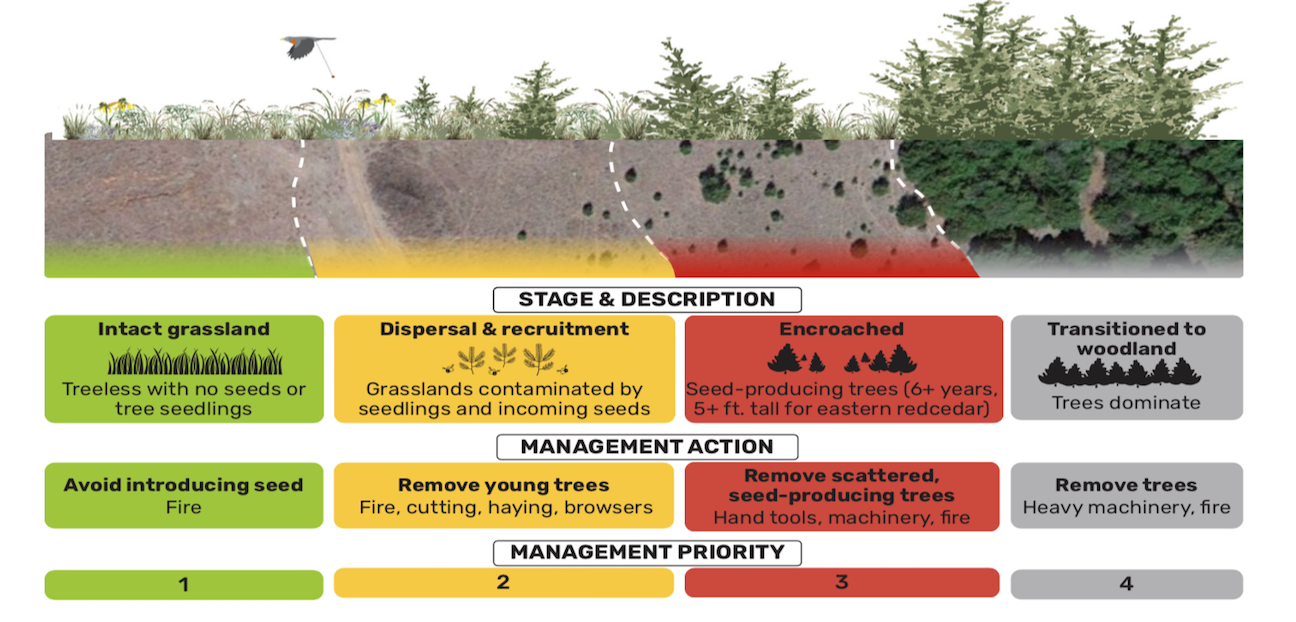
The top 5 woody invasive plant species in the Great Plains Grasslands include; Eastern redcedar, Honey mesquite, Chinese tallow, Ashe juniper, and Redberry juniper. Past brush management efforts have been unable to stop or reverse the loss of grasslands at county, state, or regional scales. Traditional management efforts have assumed that there are tolerable levels of the top five woody pests in grasslands before encroachment becomes a resource concern and mechanical or chemical removal of woody plants will restore a site back to a grassland. Scientists are now recommending more integrated approaches for dealing with woody species and ending the reinvasion cycle in grasslands. 

[Read more…] about Integrated Pest Management for Woody Encroachment

Filed Under: Brush Management, Conservation, Conservation Practices, Grazing Management, Publications, Woody Encroachment Tagged With: #grazing #ranchmanagement #brush #grasslands, brush management, Conservation, Conservation Management, Conservation Practices, Range Concepts, woody encroachment

SRM Multidisciplinary Rangeland Ecosystem Services Report

August 30, 2023 by jaime.sanford

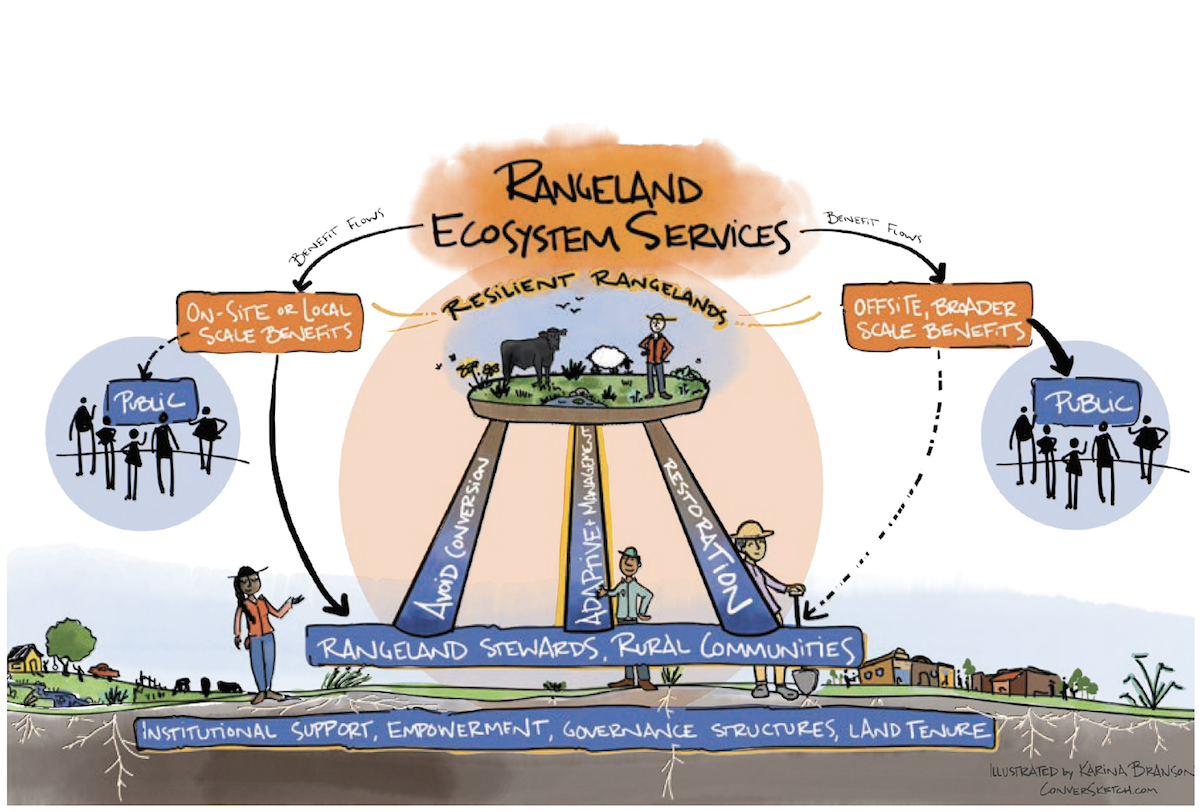
The Society for Rangeland Management recently released their Rangeland Ecosystem Services Report: Connecting Nature and People. The report includes five key rangeland service topic areas including; food and fiber, water as an ecosystem driver in rangelands, carbon sequestration and security, plant and insect biodiversity, and wildlife habitat provision. 


Photo: Rangeland Ecosystem Services Report

[Read more…] about SRM Multidisciplinary Rangeland Ecosystem Services Report

Filed Under: Beef Cattle, Conservation, Conservation Practices, Grazing Management, Society for Range Management Tagged With: brush management, Conservation, Conservation Management, Conservation Practices, Grazing

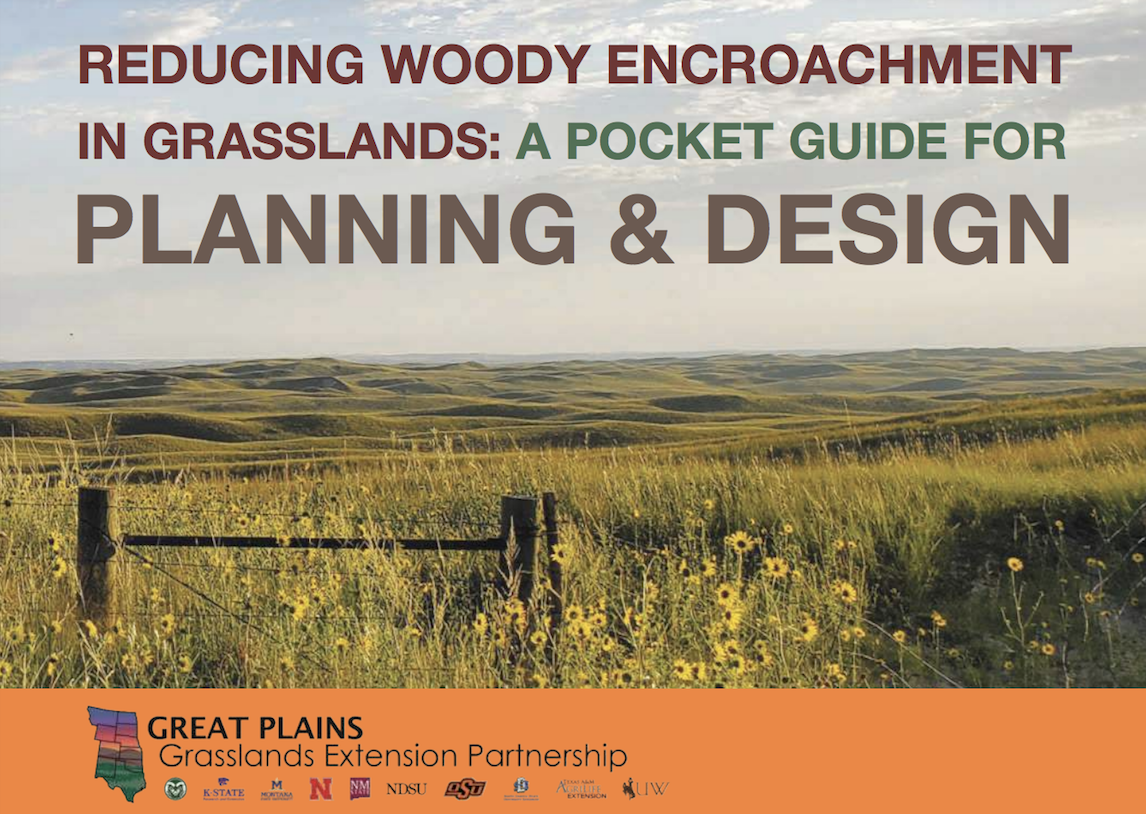
Reducing Woody Encroachment in Grasslands: A Pocket Guide for Planning and Design

August 23, 2023 by jaime.sanford

Have you seen the latest Pocket Guide from the Great Plains Grasslands Extension Partnership? This Pocket Guide integrates new guidelines for reducing woody encroachment with a planning process. It is also an important resource that further incorporates the latest, science-based approaches for reducing woody encroachment.


[Read more…] about Reducing Woody Encroachment in Grasslands: A Pocket Guide for Planning and Design

Filed Under: Brush Management, Conservation, Conservation Practices, Grazing Management, Range Concepts, Woody Encroachment Tagged With: #grazing #ranchmanagement #brush #grasslands, brush management, Conservation, Conservation Management, Conservation Practices, Range Concepts, woody encroachment

Remove, Reduce, or Manipulate? Best Practices for Brush Management Conservation Standards in Great Plains Grasslands

August 9, 2023 by jaime.sanford

One of the biggest confusion points in brush management is the decision between removing, reducing, or manipulating woody plants. Past management decisions have addressed the symptoms of woody encroachment but not the root cause of the problem. To contribute to the efforts to confront the loss of grasslands at county and state, clarity is needed on which woody species need complete removal versus species who can be reduced or manipulated  without the threat of grassland loss.

[Read more…] about Remove, Reduce, or Manipulate? Best Practices for Brush Management Conservation Standards in Great Plains Grasslands

Filed Under: Brush Management, Grazing Management, Publications, Range Concepts, Woody Encroachment Tagged With: brush management, grazing management, woody encroachment

22.4 Million Tons of Rangeland Production Lost to Woody Encroachment in Great Plains Grasslands

July 12, 2023 by jaime.sanford

Did you know that 22.4 million tons of rangeland production are lost annually in the Great Plains to woody encroachment? Or that The Great Plains accounts for approximately 95% of the nation’s lost rangeland production to woody encroachment?

[Read more…] about 22.4 Million Tons of Rangeland Production Lost to Woody Encroachment in Great Plains Grasslands

Filed Under: Brush Management, Conservation, Conservation Practices, Range Concepts, Woody Encroachment Tagged With: brush management, Range Concepts, woody encroachment

USDA funds Texas A&M AgriLife Extension West Texas Rangeland Conservation Projects

May 24, 2023 by jaime.sanford

Four separate projects have been funded by the U.S. Department of Agriculture’s Grazing Lands Conservation Initiative with West Texas Rangelands Involvement! These projects will combine the expertise of Texas A&M AgriLife Research and Texas A&M AgriLife Extension Service to provide livestock producer support and increase the use of conservation principles on grazing lands.

[Read more…] about USDA funds Texas A&M AgriLife Extension West Texas Rangeland Conservation Projects

Filed Under: Beef Cattle, Brush Management, Conservation Practices, Grazing Management, Prescribed Burning Tagged With: brush management, Conservation Practices, prescribed burning

Rangeland Analysis Platform Virtual Training

May 3, 2023 by jaime.sanford

Rangeland Analysis Platform, also known as RAP, have you heard of it? It is a platform that was created with a partnership between the University of Montana (UM), the United States Department of Agriculture (USDA), and the U.S. Department of Interior (DOI).

[Read more…] about Rangeland Analysis Platform Virtual Training

Filed Under: Brush Management, Conservation Practices, Grazing Management, Range Concepts, RAP Tagged With: brush management, Conservation Practices, grazing management, Range Concepts, RAP

Central Texas Fuels Reduction Grant

April 12, 2023 by jaime.sanford

The Central Texas Fuels Reduction Grant has officially opened! This an opportunity for Central Texas Landowners to apply for the SFAM Mechanical Fuels Reduction Grant to help reduce risks posed to their property by wildfire. 

[Read more…] about Central Texas Fuels Reduction Grant

Filed Under: Brush Management, Conservation, Conservation Practices, Prescribed Burning, Wildfires Tagged With: brush management, Conservation, Grants, Prescribed Burn, Wildfires

Published to Pasture…Soil Health!

July 11, 2019 by morgan.treadwell

Soil Health…kind of catchy, right?!  I agree.  And, so do thousands of other range managers and landowners.  It’s the buzz word of the century and it’s here to stay.  So what do we know about soil health and how the heck can our ranchers use it?

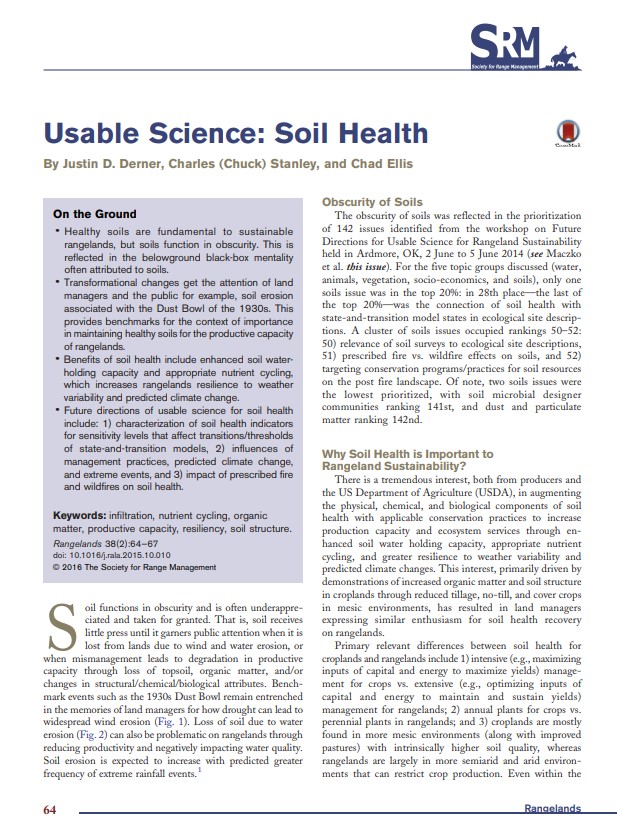
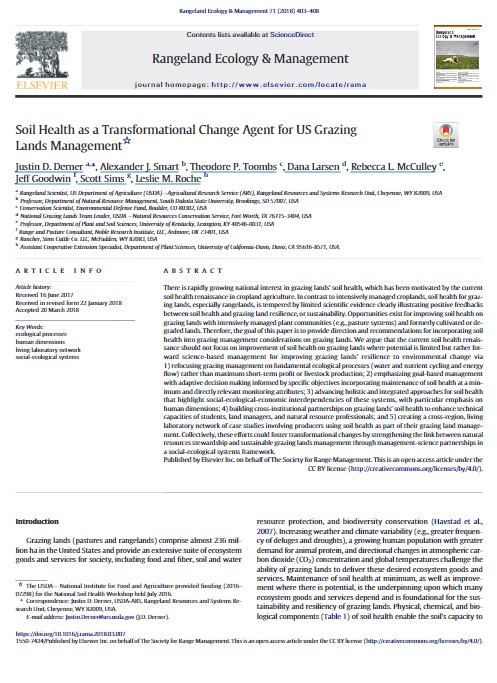
Today, we will be looking at 2 relatively recent articles on soil health.  First, “Usable Science: Soil Health” written by Justin Derner, Chuck Stanley, and Chad Ellis.  Secondly, we will look at “Soil Health as a Transformational Change Agent for US Grazing Lands Management” written by Justin Derner, Alexander Smart, Theodore Toombs, Dana Larsen, Rebecca McCulley, Jeff Goodwin, Scott Sims, and Leslie Roche.

Usable Science- Soil Health 

Why is soil health on the minds of every range manager these days?  Easy.  Dust Bowl of the 1930s was a benchmark event that changed every single range, crop, and land-man’s way of thinking.  Total game changer.  As Derner and others stated, “The 1930s Dust Bowl remains entrenched in the memories of land managers for how drought can lead to widespread wind erosion.”  I couldn’t agree more.  As range managers, we seek to learn from our mistakes – not repeat them.  So now we have the most talented scientists working out the details of a very complex, obscure, and complicated science of the physical, chemical, and biological components of soil and how applicable conservation practices increase production, capacity, and ecosystem services through enhanced soil water holding capacity, appropriate nutrient cycling, and greater resiliency to weather variability and predicted climate changes. For example, utilizing novel experiments with adaptive grazing management wherein short “pulses” of grazing with a large herd followed by rest periods of more than 1 year provides experimental platforms to evaluate the efficacy of soil health monitoring efforts.  Can I get an amen from the range gospel choir?!  Wahoo!!! It’s about dang time!

To summarize what the Rangelands article is talking about, here we go:

#1. What are the effects of conservation practices (e.g., prescribed grazing, prescribed fire, and brush management) on the chemical, physical, and biological components of soil health?

#2. Can the chemical, physical, and biological components of soil health be used as “early indicators” of phase, transition, and/or threshold shifts in plant communities for state-and-transition models to enhance ecological site descriptions?

#3. How can the chemical, physical, and biological components of soil health be enhanced through adaptive management to increase the resilience of soils to weather variability and changing climate?

#4. How can the soil health tool kit to provide more robust and broad assessments of soil health and/or monitoring of the chemical, physical, and biological components for land managers in a timely and responsive manner to facilitate adaptive management be expanded?


Fast forward to our next article, Soil Health as a Transformational Change Agent for US Grazing Lands Management and now is where we get to the cool nerd stuff. Current soil health is an opportunity not to focus on improvement of soil health on lands where potential is limited but rather to forward science-based management on grazing lands via

#1. Refocusing grazing management on fundamental ecological processes (water and nutrient cycling and energy flow) rather than maximum short-term profit or livestock production

#2. Emphasizing goal-based management with adaptive decision making informed by specific objectives incorporating maintenance of soil health at a minimum and directly relevant monitoring attributes

#3. Advancing holistic and integrated approaches for soil health that highlight social-ecological-economic inter-dependencies of these systems, with particular emphasis on human dimensions

#4. Building cross-institutional partnerships on grazing lands’soil health to enhance technical capacities of students,land managers, and natural resource professionals

#5. Creating across-region, living laboratory network of case studies involving producers using soil health as part of their grazing land management. Explicitly incorporating soil health into grazing management and the matrix of ecosystems services provided by grazing lands provides transformational opportunities by building tangible links between natural resources stewardship and sustainable grazing management, as well as providing paths to reach broader audiences and enhance communications among producers,customers, and the general public.


Now, we can really jump up and say “hallelujah!!!!”

This is what their vision looks like:

My favorite part, is “Re-focus grazing management on fundamental ecological processes.”  What a concept!!

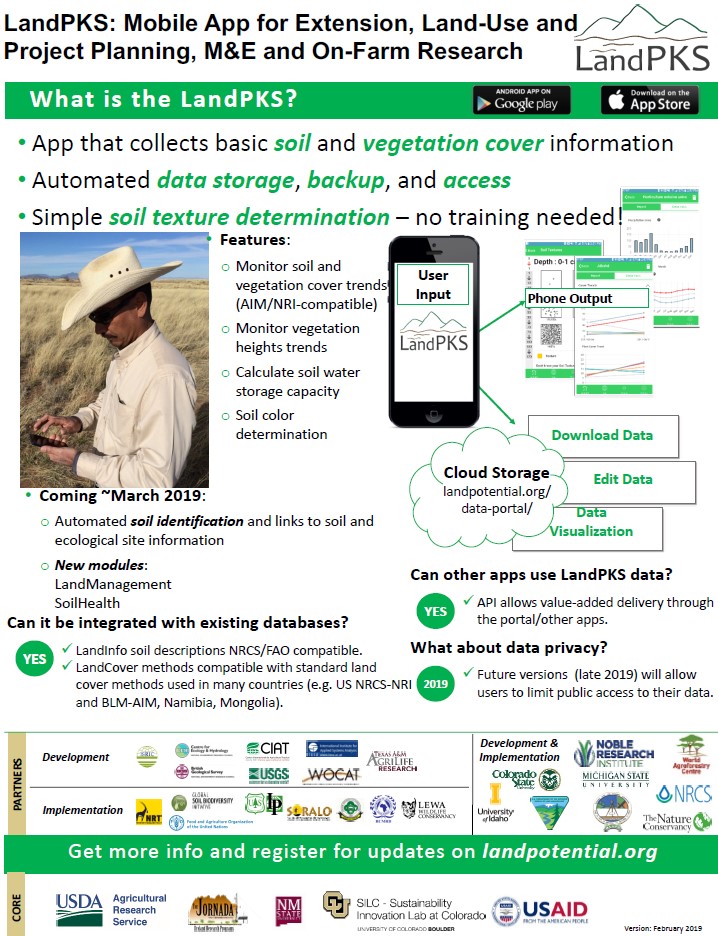
Better yet!  There is an app for that!  Check out LandPKS on your smartphone device and start collecting data on LandInfo, LandCover, and LandManagment!

Please click here for more information regarding this remarkable tool!

Believe it or not, Soil Health is more fun and easy than you think!  We just overcomplicated it!

Filed Under: Brush Management, Grazing Management, Prescribed Burning, Publications Tagged With: #grazing #ranchmanagement #brush #grasslands, brush management, fire effects, grass production, Grazing, prescribed fire

  • Page 1
  • Page 2
  • Go to Next Page »

Recent Posts

  • Using Birds to Read Rangeland Health
  • Fire Field Day – Mason, Tx: A Hands-On Learning Experience for Landowners
  • The Long-Term Cost of Overgrazing—and How to Avoid It
  • Grazing Isn’t the Problem. Unmanaged Pressure Is.
  • What Your Rangeland Is Telling You: If You Know How to Look

Categories

  • 4-H Range Contests
  • Beef Cattle
  • Brush Management
  • Carbon Credits
  • Carbon Markets
  • Conservation
  • Conservation Practices
  • Drought Management
  • El Niño
  • Events
  • Goats
  • Grazing Management
  • La Niña
  • Land
  • Lessons Learned
  • Meet A County Extension Agent
  • Plant ID
  • Podcast
  • Prescribed Burn Associations
  • Prescribed Burning
  • Publications
  • Range Concepts
  • RAP
  • Sheep
  • Society for Range Management
  • Soil
  • Staff
  • Targeted Grazing
  • Uncategorized
  • Water
  • Weather
  • Why I Ranch
  • Wild Pigs
  • Wildfire
  • Wildfires
  • Wind
  • Woody Encroachment
  • Youth Range Workshop

Archives

Texas A&M AgriLife Extension Service
Texas A&M University System Member
  • Compact with Texans
  • Privacy and Security
  • Accessibility Policy
  • State Link Policy
  • Statewide Search
  • Veterans Benefits
  • Military Families
  • Risk, Fraud & Misconduct Hotline
  • Texas Homeland Security
  • Texas Veteran's Portal
  • Equal Opportunity
  • Open Records/Public Information