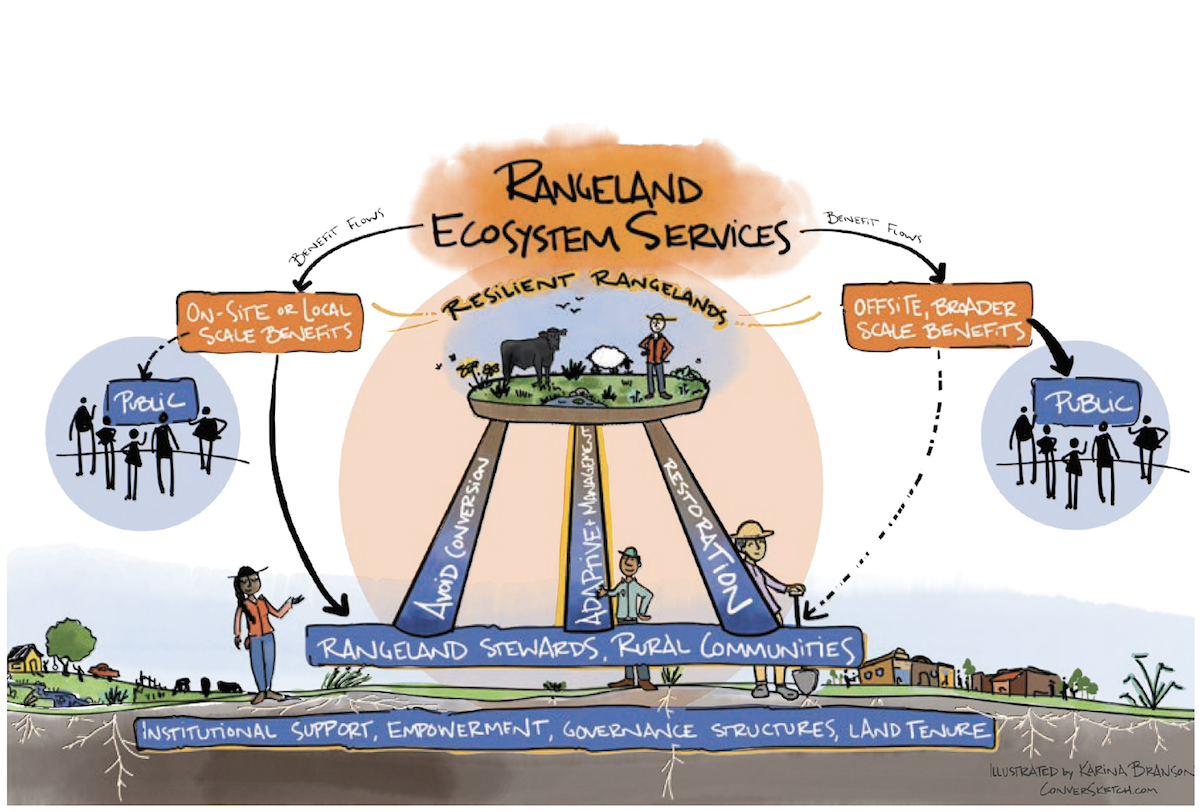
 The Society for Rangeland Management recently released their Rangeland Ecosystem Services Report: Connecting Nature and People. The report includes five key rangeland service topic areas including; food and fiber, water as an ecosystem driver in rangelands, carbon sequestration and security, plant and insect biodiversity, and wildlife habitat provision.
Photo: Rangeland Ecosystem Services Report
When it comes to livestock and fiber, production from rangelands has an economic value as well as a subsistence value. Being able to sustainably increase production is needed as the human population continues to increase. Livestock can be managed as a tool to sustain or enhance other ecosystem services, while providing food and fiber. It is important for producers to understand the threats to the conservation of rangelands and pastures.
While water scarcity is the norm for rangelands, it is also the scarcity that emphasizes its importance. Maximizing the amount of water available to plants supports many different ecosystems and benefits the rangeland. The increase for the demand of surface water and groundwater occurs when the land cover and land use conversions happen. One of the ways producers can combat this is by converting croplands back to rangelands which in turn will decrease water demands.
Soil carbon sequestration is the process by which carbon is fixed from the atmosphere through plants and stored in the soil profile. The amount of carbon in the soil changes depending on the soil texture, the temperature and precipitation, as well as the types of vegetation. Restoring croplands back to rangelands can result in a large increase of carbon in the soil.
According to the 2016 National Survey of Fishing, Hunting and Wildlife-Associated Recreation, showed that 41% of the U.S. population participated in wildlife related recreational activities. Conversion of rangeland to cropland has been the greatest threat to native wildlife species. AS rangelands acreage shrinks so do habitats and wildlife species populations.
For more information on these five topics and what producers can do to help, be sure to read the full report that can be found here.
Society for Range Management. Rangeland Ecosystem Services: Connecting Nature and People.August 10. 2023.