• Skip to primary navigation
  • Skip to main content
  • Skip to primary sidebar
  • Texas A&M Forest Service
  • Texas A&M Veterinary Medical Diagnostics Laboratory
  • Texas A&M AgriLife Extension Service
  • Texas A&M AgriLife Research
  • Texas A&M College of Agrculture and Life Sciences
West Texas Rangelands
West Texas RangelandsWe hope to provide a variety of science-based rangeland information and current research on prescribed fire, wildfires, brush management, and grazing management!
  • Menu
  • Home
  • About & Contact
  • Publications
    • Extension Publications
    • Refereed Journal Articles
    • Program Summaries
  • Events
  • Lunch N’ Learn
  • Infographics
    • Drought
    • Grazing
    • Herbicide
    • Prescribed Fire
    • Rangeland Plants
    • Wildfire
  • Range Resources
    • Published to Pasture
    • Range Concepts
  • Fire Resources
  • Sponsors
  • AgriLife Learn Online Courses

Fire Field Day – Mason, Tx: A Hands-On Learning Experience for Landowners

March 4, 2026 by morgan.treadwell

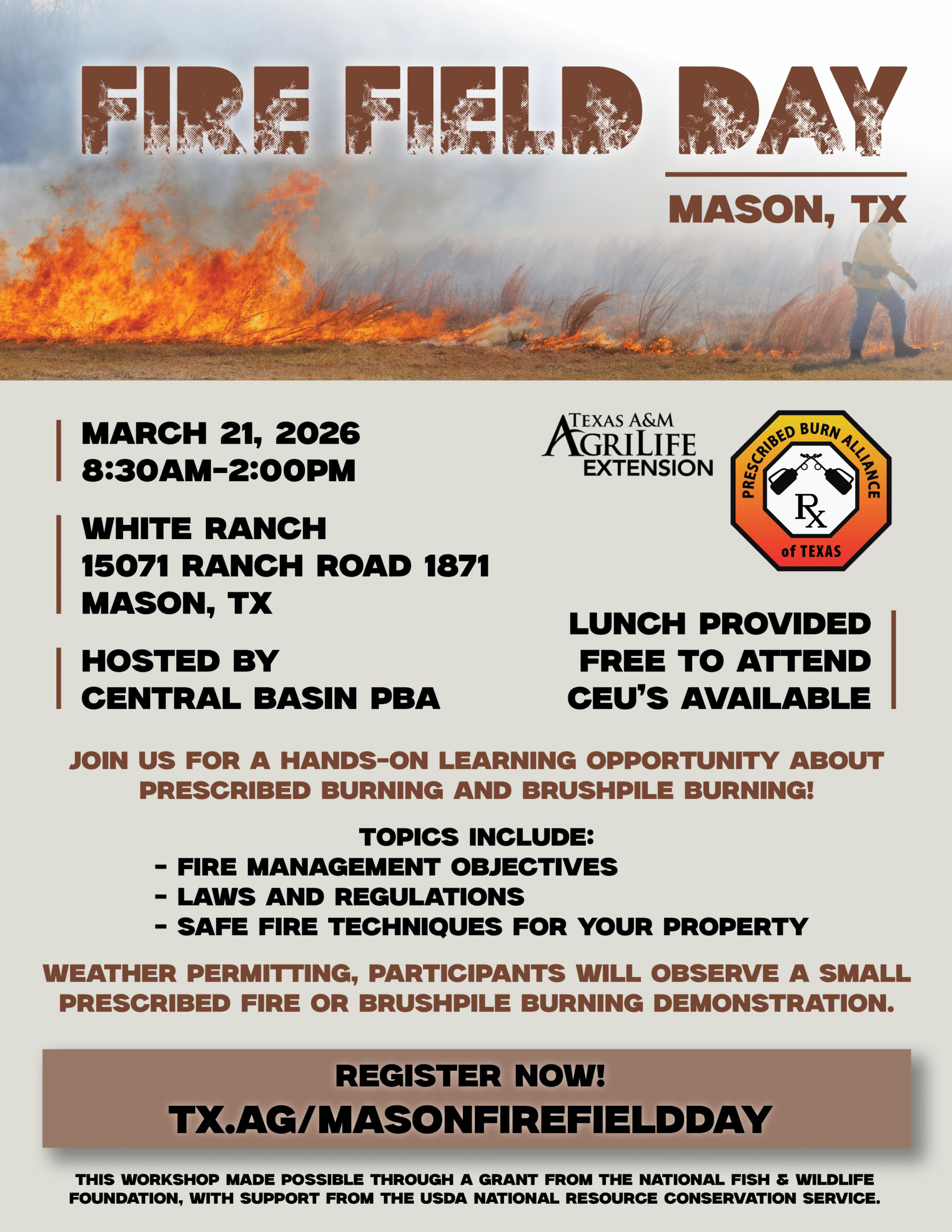
Landowners, ranchers, and natural resource managers across the region are invited to take part in an exciting and educational Fire Field Day.  The event is slated for March 21, 2026, at the scenic White Ranch in Mason, Texas. This in-person workshop offers a unique opportunity to learn directly from prescribed fire experts and the Central Basin Prescribed Burn Association (PBA).

With growiA promotional flyer for a “Fire Field Day” event in Mason, Texas, featuring a background photo of an active grass fire with flames and smoke. Event details include date, time, location at White Ranch, and host information. The flyer highlights topics such as prescribed burning, brushpile burning, fire management objectives, regulations, and safe techniques. It notes lunch is provided, the event is free, CEUs are available, and participants may observe a live demonstration. A registration link is included at the bottom.ng interest in safe and effective rangeland management practices, prescribed fire has become an essential tool for improving rangeland health, reducing wildfire risk, and managing brush and tree encroachment. This event is designed to equip participants with both foundational knowledge and practical, hands-on experience.
What to Expect at Fire Field Day
The workshop runs from 8:30am to 2:00pm, and lunch will be provided at no cost to attendees. The day includes expert-led discussions and demonstrations focusing on:

⭐ Fire Management Objectives
Learn why fire is such an effective ecological tool, how it benefits rangelands, and what outcomes you can expect when applying prescribed burning on your property.

⭐ Laws and Regulations
Prescribed fire is a powerful tool that comes with responsibilities. Attendees will gain clarity on Texas laws governing burn plans, permitting, liability, and proper safety protocols.

⭐ Safe Fire Techniques for Your Property
From ignition methods to firebreak preparation, participants will walk away with practical strategies they can apply at home.

Weather permitting, the event will also feature a live prescribed fire or brushpile burn demonstration, giving attendees a chance to observe fire behavior and management techniques in real time.

This Fire Field Day is proudly hosted by the Central Basin Prescribed Burn Association, with support from Texas A&M AgriLife Extension and the Prescribed Burn Alliance of Texas. These organizations are committed to helping landowners apply safe, science-based fire practices to improve their rangeland and encourage healthier ecosystems across the region.

Why Prescribed Fire Matters
Prescribed burning is one of the most cost-effective and natural methods for managing unwanted brush and trees, improving wildlife habitat, stimulating new plant growth, and reducing the intensity of future wildfires. For many Texas landowners, gaining confidence and practical knowledge is the key first step toward implementing burns on their own property.

This workshop is an ideal starting point, whether you are brand new to prescribed fire or looking to expand your experience with support from certified professionals.

We hope you will mark your calendar and JOIN US!
📍 Location: White Ranch – 15071 Ranch Road 1871, Mason, TX
📅 Date: March 21, 2026
⏰ Time: 8:30 AM–2:00 PM
💲 Cost: FREE
🍽️ Lunch Included
📜 CEU’s Available

For more information and to register please visit: TX.AG/MASONFIREFIELDDAY
Spaces often fill quickly for hands-on burn workshops so don’t miss this chance to learn from experts and connect with landowners across the region.

Stay Connected with Us!
Follow along for more land management events, educational workshops, and updates across the region.

Filed Under: Brush Management, Conservation, Conservation Practices, Prescribed Burn Associations, Prescribed Burning, Range Concepts, Wildfire Tagged With: #BrushManagement, #CentralBasinPBA, #FireEcology, #FireFieldDay, #PrescribedBurn, #RanchManagement, #SustainableLandManagement, #TexasAgriLifeExtension, #TexasLandowners, #TexasRangeManagement, #WildfirePrevention

Grazing Isn’t the Problem. Unmanaged Pressure Is.

February 18, 2026 by morgan.treadwell

Grazing is often viewed as a disturbance or impediment to rangeland health, but it is just the opposite! When applied intentionally, it can support plant diversity and ecosystem function. The key is managing pressure, timing, and recovery rather than applying constant use in a continuous grazing system.  Even if managers are conservatively or low-stocked, continuous grazing is a recipe for poor rangeland condition.  

Grazing strategies that prioritize rest allow plants to recover and strengthen root systems. 

Rest and Recovery Matter 

Plants need time after grazing to regrow leaves and rebuild energy reserves that sustains populations during drought and dormancy. Without sufficient recovery, repeated grazing weakens native perennial grasses and reduces long-term productivity and diversity. 

Planned grazing systems incorporate rest periods that match plant growth patterns and environmental conditions. 

Managing Pressure, Not Just Numbers 

Stocking rate alone does not determine grazing success. Duration and distribution of grazing pressure often have a greater impact on plant health than animal numbers. 

Adjusting pasture size, rotation timing, and water placement can help distribute grazing pressure more evenly across the landscape. 

Grazing as a Management Tool 

When managed properly, grazing can reduce excess vegetation, promote plant diversity, and support soil health. Used intentionally, livestock become a win-win synergistic balance that contributes to rangeland resilience rather than degradation. 

Filed Under: Brush Management, Conservation, Grazing Management, Range Concepts Tagged With: #grazing #ranchmanagement #brush #grasslands, Grazing, grazing management, rangelands

What Your Rangeland Is Telling You: If You Know How to Look

February 11, 2026 by morgan.treadwell

The condition of your rangeland shows how management decisions are affecting it. By paying attention to plant communities, soil cover, and overall structure, land managers can identify potential issues early and respond effectively. Regular observation is one of the most important tools in long-term rangeland stewardship. 

Key Indicators to Watch 

Plant diversity is a strong indicator of rangeland health. A mix of grasses, forbs, cool and warm season species, and varying plant heights often signals a functioning system. Uniform vegetation or dominance by a single species may indicate stress or management imbalance. Think monocultures of Purple Threeawn or Texas Wintergrass.  

Soil surface condition is equally important. Adequate litter and ground cover protect soil from erosion, temperatures, and help retain moisture. Increasing bare ground can signal declining rangeland condition.  Bare ground between bunchgrasses of plants will slowly start to expand, increasing soil movement and soil loss.  

Monitoring Beyond the Growing Season 

Rangeland monitoring does not stop when plants are dormant! Winter and early spring observations can reveal grazing patterns, hoof impact, and areas where pressure may be too concentrated.  Monitoring native perennial grasses during the winter is just as important as monitoring during the growing season, because what you protect in the winter is what jumpstarts new growth this spring.   

Tracking changes season-to-season rather than reacting to a single observation provides a clearer picture of trends and management outcomes.  

Using Monitoring to Guide Decisions 

Monitoring allows managers to make informed adjustments to grazing timing, duration, and intensity. When rangeland conditions are regularly evaluated, management becomes proactive rather than reactive setting pastures off to a great start this spring.  

Filed Under: Conservation, Grazing Management, Range Concepts, Woody Encroachment Tagged With: #grazing #ranchmanagement #brush #grasslands, Conservation, Conservation Practices, grazing management

Prickly Pear and the South American Cactus Moth

March 19, 2025 by jaime.sanford

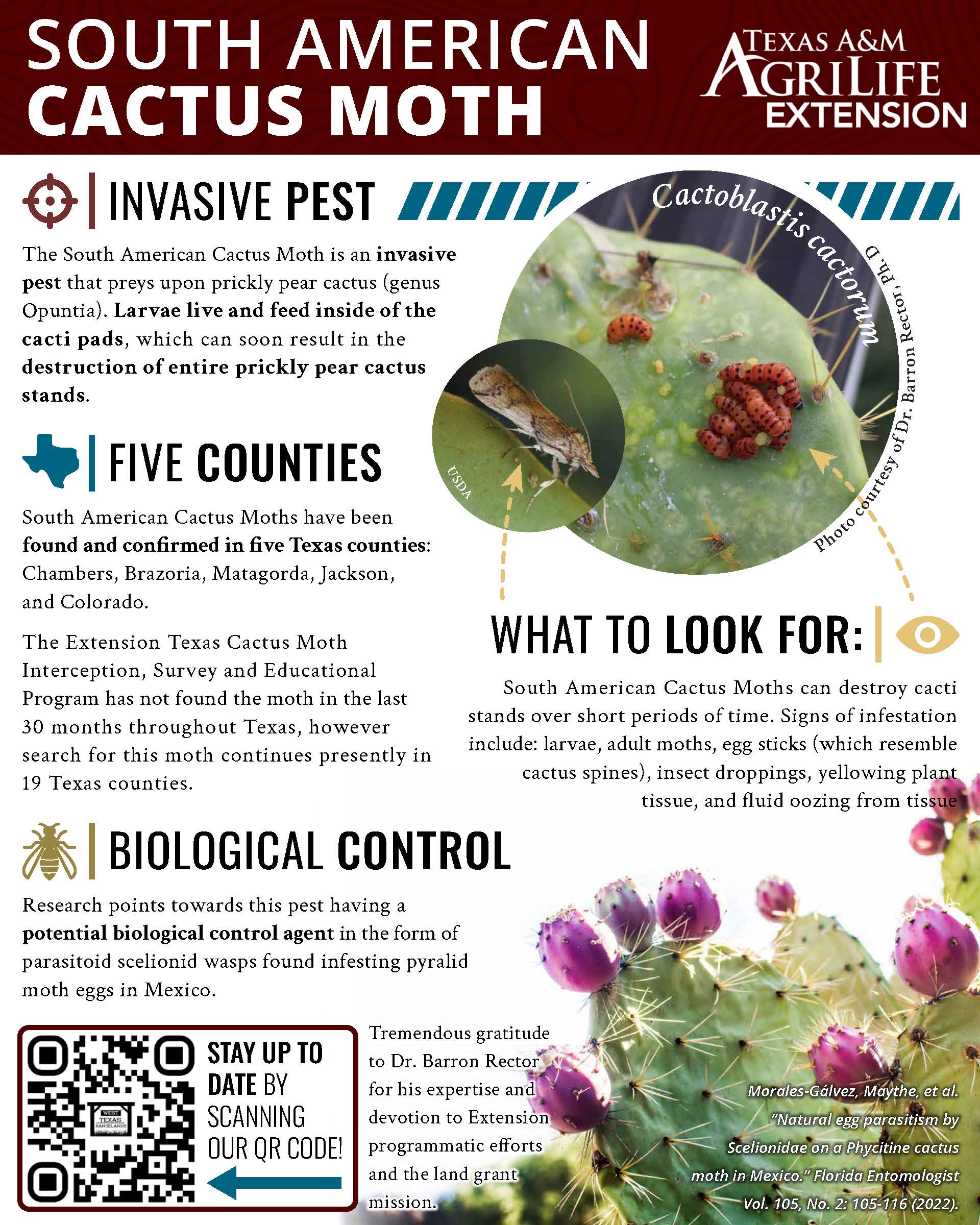
Cactus Moth InfographicTexas is known for its rugged landscapes and iconic, opportunistic, and problematic prickly pear. While these plants readily provide headaches to the grazing manager, oftentimes pear also serves as food and habitat for wildlife and is a native species on Texas rangelands. However, the South American Cactus Moth has been found and confirmed in five Texas counties. 

[Read more…] about Prickly Pear and the South American Cactus Moth

Filed Under: Brush Management, Grazing Management, Plant ID, Range Concepts

A Comparison of the 2017 & 2022 USDA Ag Census Data for West Texas Counties

February 12, 2025 by jaime.sanford

The U.S. Department of Agriculture’s National Agricultural Statistics Service (NASS) has released 2022 Census of Agriculture data. The graphic presents a fascinating snapshot of the ranching landscape impacting four West Texas counties: Tom Green, Schleicher, Crockett, and Menard. Using data from the 2017 and 2022 USDA Agricultural Census, we can glean valuable insights into trends and shifts within this vital sector of Texas’s economy and heritage.

[Read more…] about A Comparison of the 2017 & 2022 USDA Ag Census Data for West Texas Counties

Filed Under: Beef Cattle, Land, Range Concepts, Sheep

Gone With the Wind: Examining the Impact of Windfarms on Property Value

January 15, 2025 by jaime.sanford

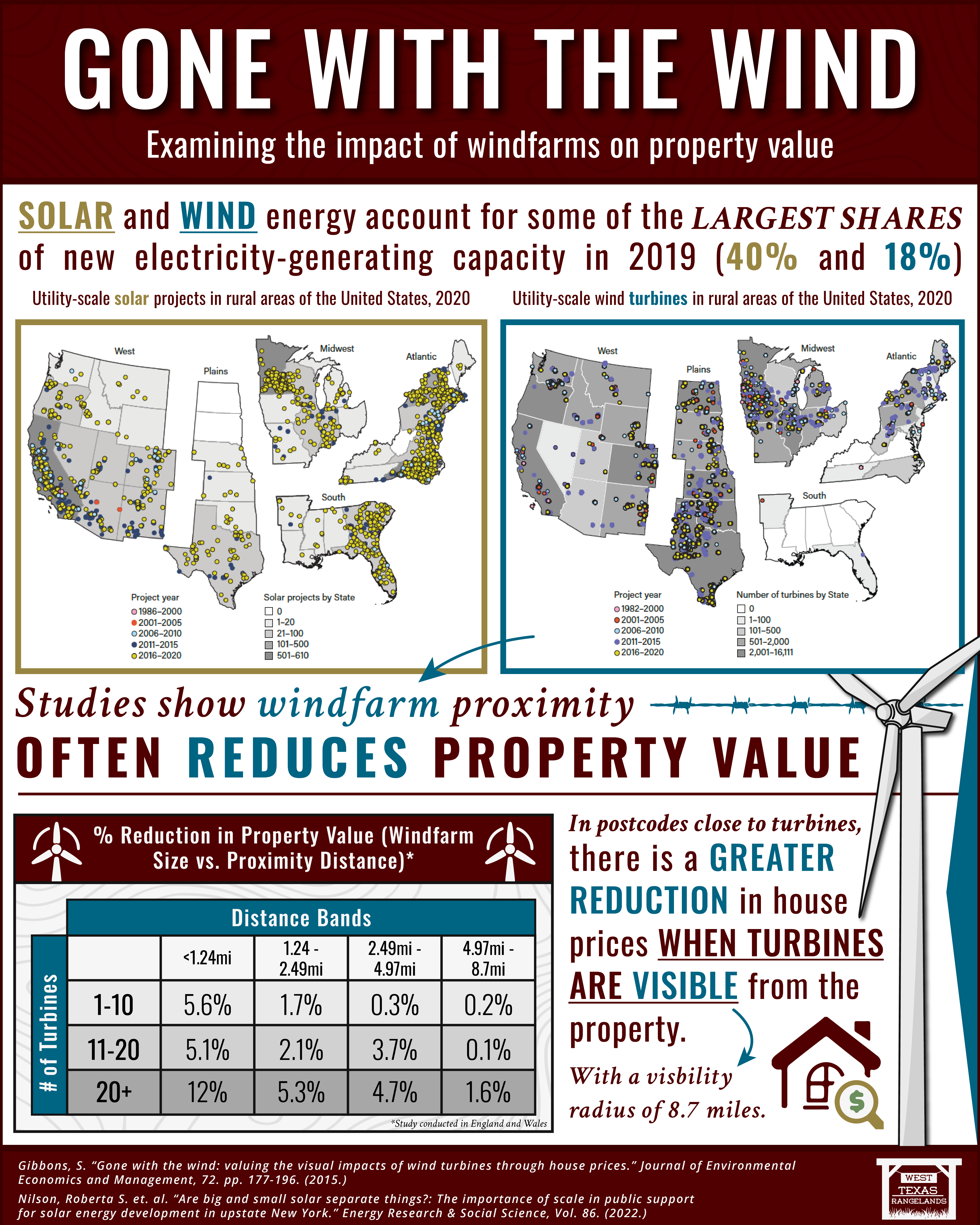
Solar and wind energy development on rangeland is everywhere. They accounted for a whopping 40% and 18% of new electricity generation capacity in the United States in 2019, respectively. Inevitably, these projects often lead to habitat fragmentation, soil disturbance, and changes in hydrology, which can negatively impact native vegetation and wildlife species reliant on these landscapes. However, few ecological studies exist documenting plant community impacts, soil health dynamics, and wildlife habitat alterations, however, some studies conducted on wind and solar development have shown that proximity to wind farms can often reduce overall property values. This reduction is more significant when the wind turbines are visible from the property. The visual impact of wind turbines is a major factor in overall property value depreciation. Research suggests that the visibility radius for wind turbines can extend up to 8.7 miles.

[Read more…] about Gone With the Wind: Examining the Impact of Windfarms on Property Value

Filed Under: Conservation, Range Concepts

Blue Grama (Bouteloua gracilis)

December 18, 2024 by jaime.sanford

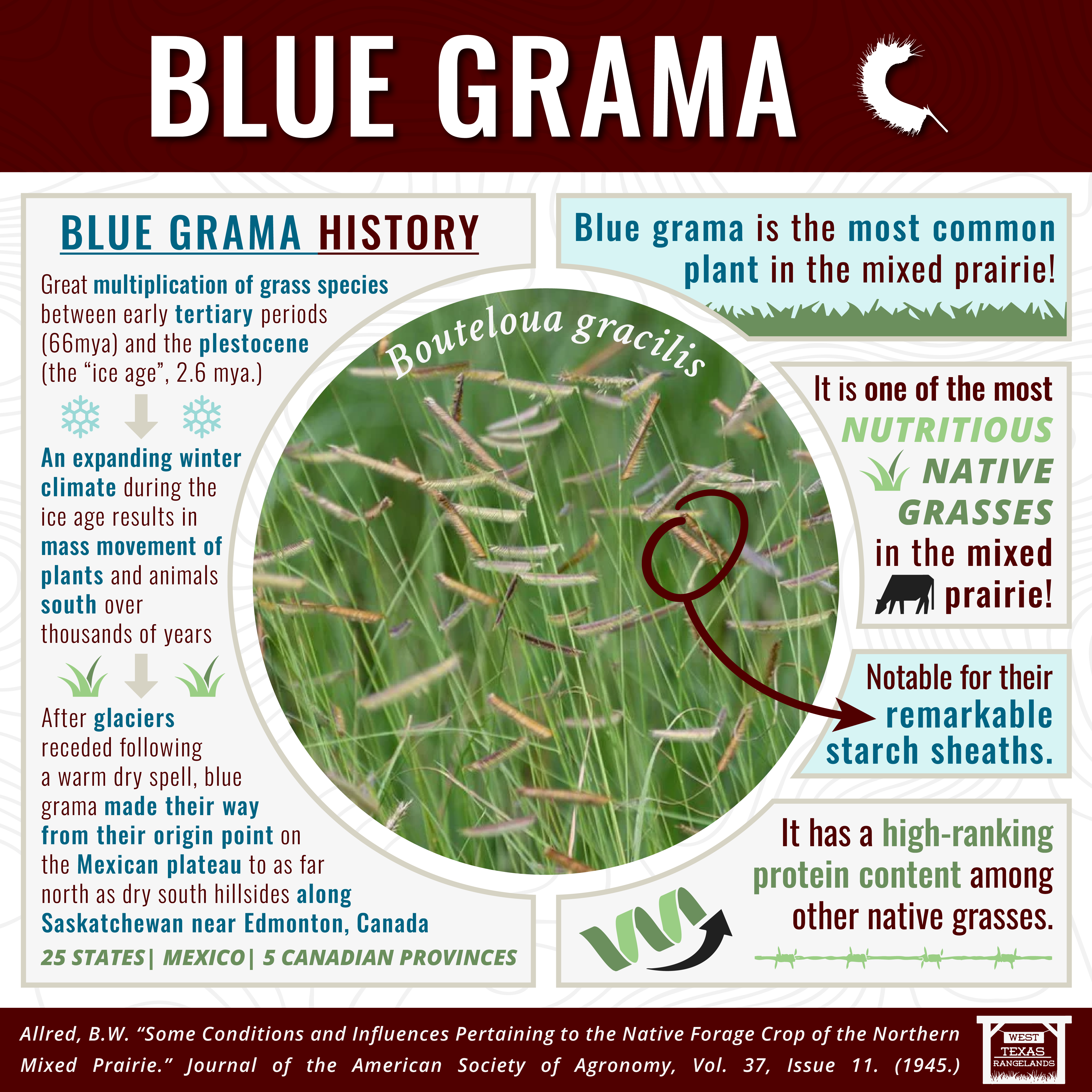
As stewards, let’s all just take a Christmas moment reflection and a deep breath of blue grama.  Did you know that blue grama is the most common plant found throughout the mixed prairie? Even more impressively, blue grama possesses the most general distribution thriving as far north as Canada and as far south as Mexico. 

[Read more…] about Blue Grama (Bouteloua gracilis)

Filed Under: Conservation, Grazing Management, Plant ID, Range Concepts

Let’s Dance: Finding a Fire Rhythm for a Native Perennial Grass

October 23, 2024 by jaime.sanford

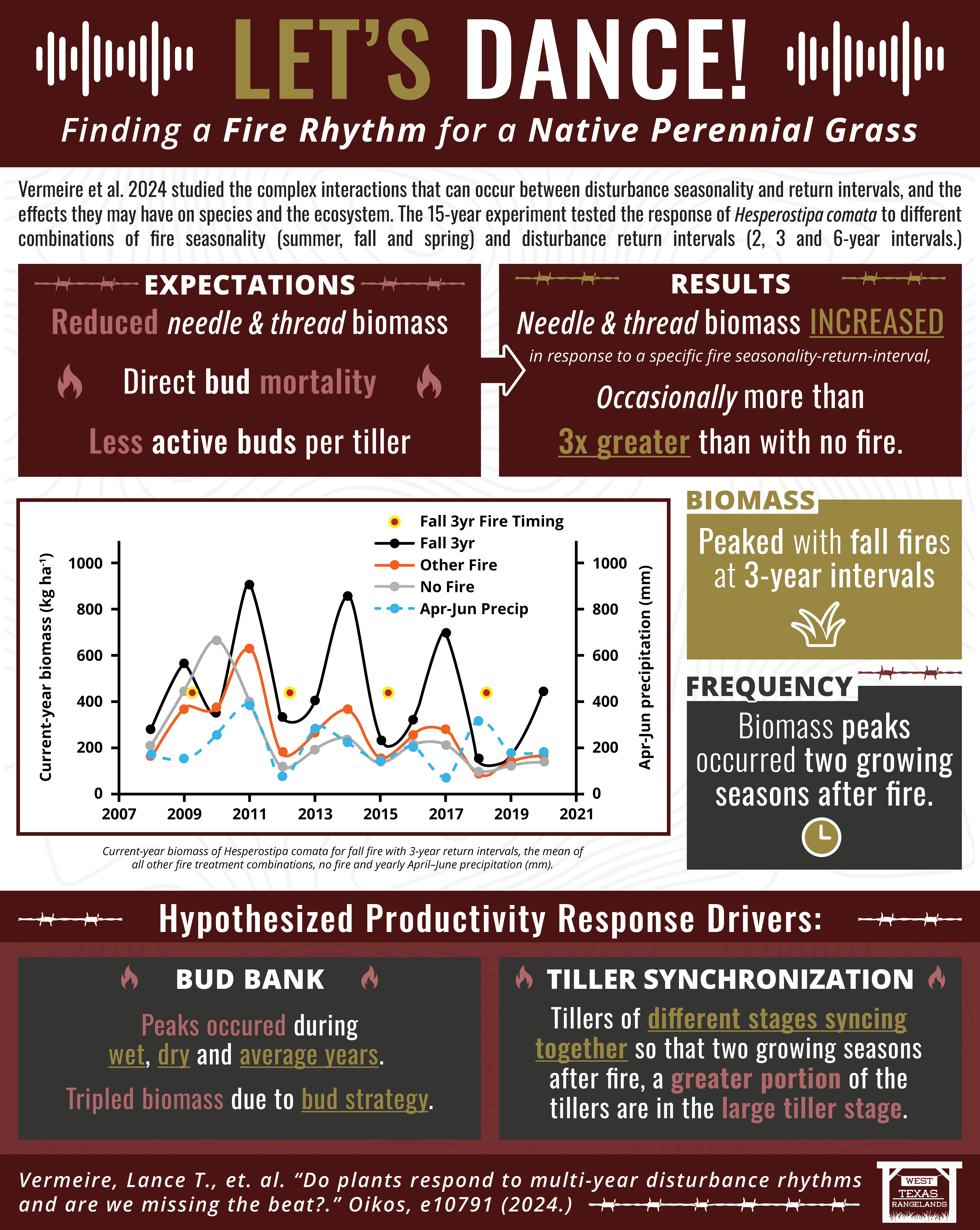
As rangeland ecologists and managers, we are quick to produce definitive results  after short-term treatments or management strategies.  For example, many of our research studies revolve on the same timeline as graduate students.  That in rangeland time, is pretty dang short.  That’s why this study is so important.  It is the first of its kind and it emphasizes just how crucial long-term research is, because what we think is the answer may just be the tip of the iceberg.  There are certain rhythms to pick up on, especially after fire.  We just need to stick around long enough with it, to find that rhythm.  

[Read more…] about Let’s Dance: Finding a Fire Rhythm for a Native Perennial Grass

Filed Under: Prescribed Burning, Range Concepts

Herbicide Efficacy Following Defoliation on Honey Mesquite

July 23, 2024 by jaime.sanford

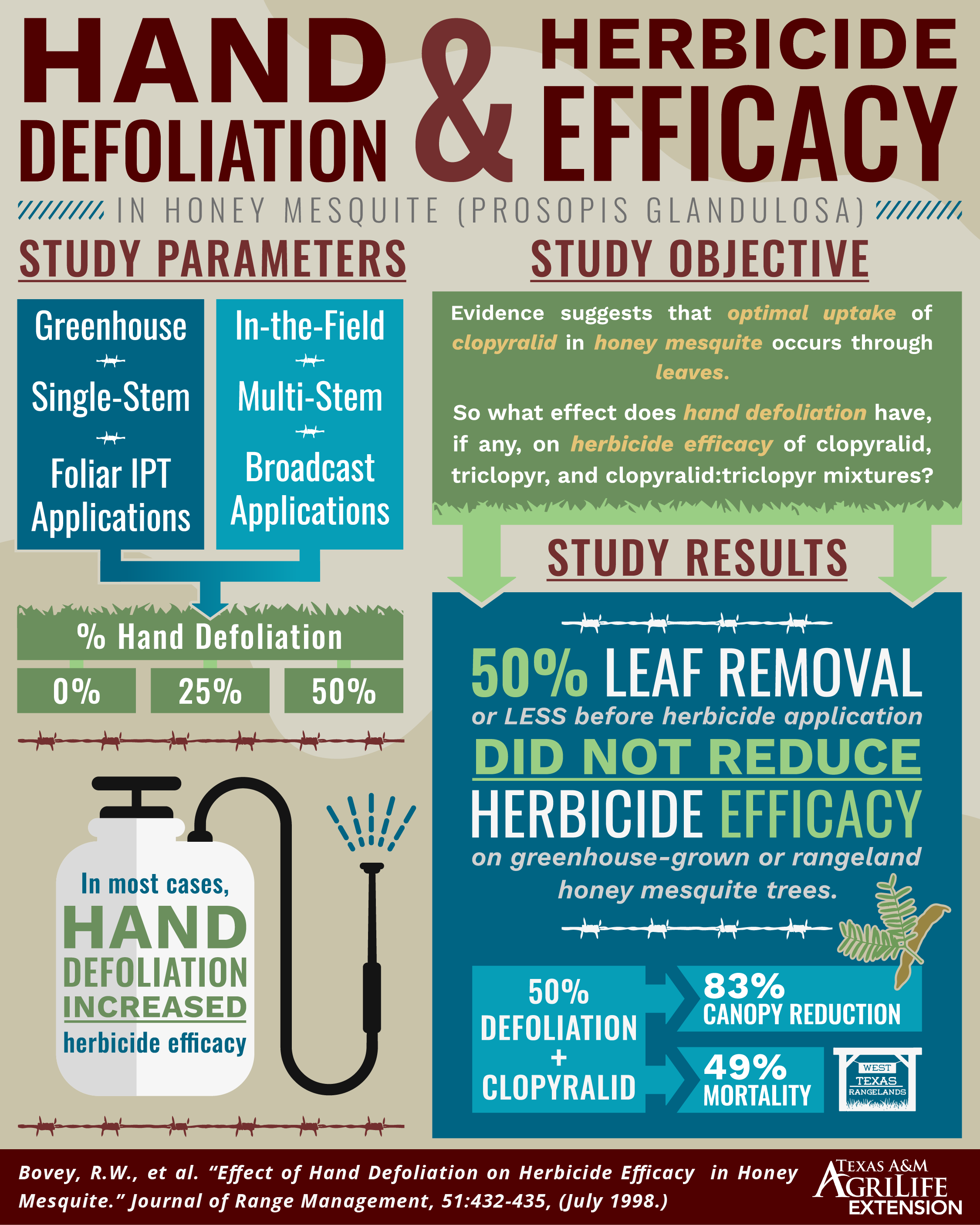
Grasshoppers are in full force this year!  Has that delayed your foliar herbicide applications on mesquite? If herbicide application success is dependent on optimal uptake through healthy, mature leaves, then what effect can varying defoliation rates have on herbicide efficacy of clopyralid, triclopyr, and clopyralid+triclopyr applications?

[Read more…] about Herbicide Efficacy Following Defoliation on Honey Mesquite

Filed Under: Brush Management, Grazing Management, Range Concepts

Earth Map

May 15, 2024 by jaime.sanford

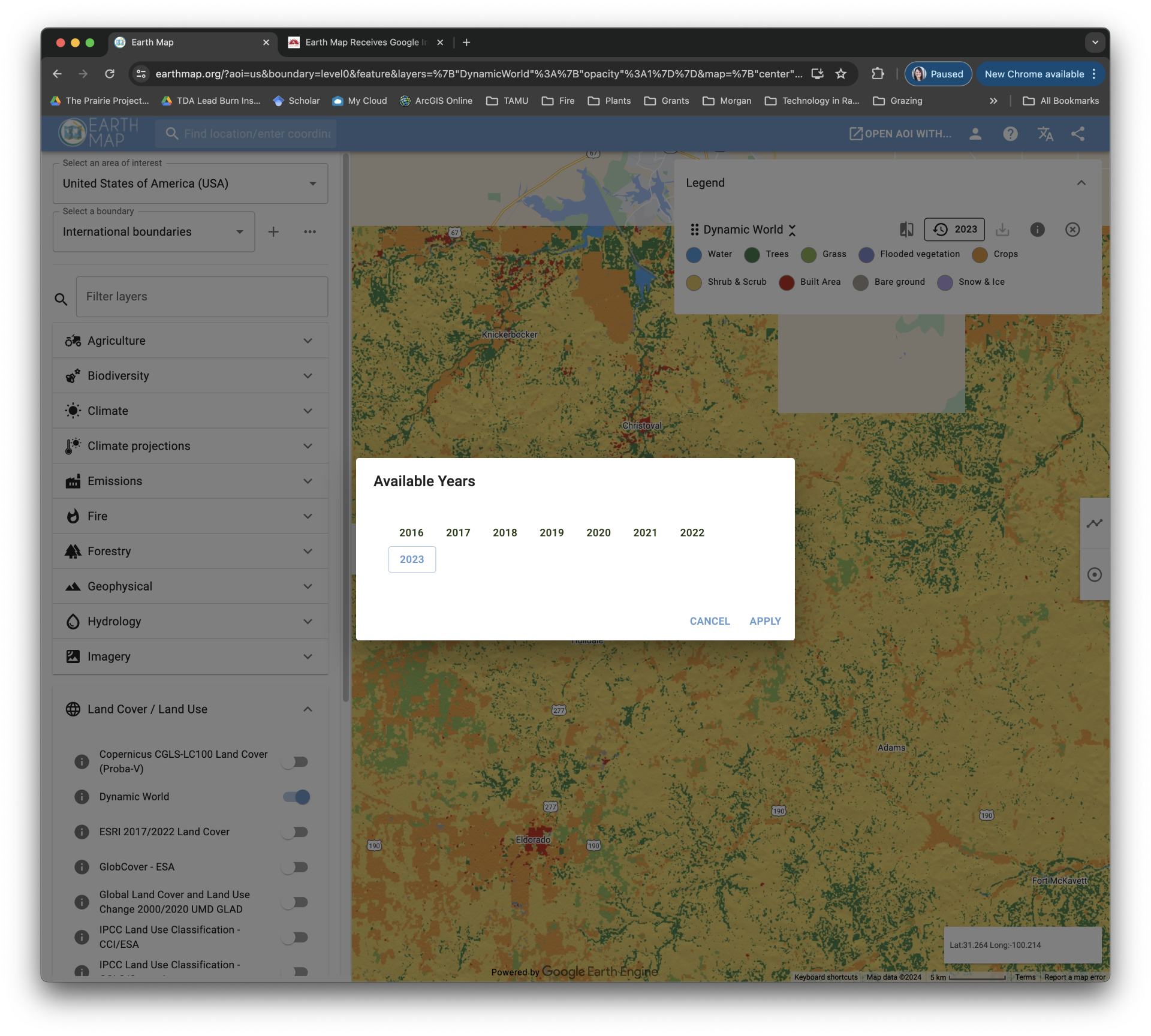
Have you heard of Earth Map or seen the capabilities it holds?

[Read more…] about Earth Map

Filed Under: Conservation Practices, Grazing Management, Range Concepts

  • Page 1
  • Page 2
  • Page 3
  • Go to Next Page »

Recent Posts

  • Fire Field Day – Mason, Tx: A Hands-On Learning Experience for Landowners
  • The Long-Term Cost of Overgrazing—and How to Avoid It
  • Grazing Isn’t the Problem. Unmanaged Pressure Is.
  • What Your Rangeland Is Telling You: If You Know How to Look
  • When Does Grazing Become Overgrazing?

Categories

  • 4-H Range Contests
  • Beef Cattle
  • Brush Management
  • Carbon Credits
  • Carbon Markets
  • Conservation
  • Conservation Practices
  • Drought Management
  • El Niño
  • Events
  • Goats
  • Grazing Management
  • La Niña
  • Land
  • Lessons Learned
  • Meet A County Extension Agent
  • Plant ID
  • Podcast
  • Prescribed Burn Associations
  • Prescribed Burning
  • Publications
  • Range Concepts
  • RAP
  • Sheep
  • Society for Range Management
  • Soil
  • Staff
  • Targeted Grazing
  • Uncategorized
  • Water
  • Weather
  • Why I Ranch
  • Wild Pigs
  • Wildfire
  • Wildfires
  • Wind
  • Woody Encroachment
  • Youth Range Workshop

Archives

Texas A&M AgriLife Extension Service
Texas A&M University System Member
  • Compact with Texans
  • Privacy and Security
  • Accessibility Policy
  • State Link Policy
  • Statewide Search
  • Veterans Benefits
  • Military Families
  • Risk, Fraud & Misconduct Hotline
  • Texas Homeland Security
  • Texas Veteran's Portal
  • Equal Opportunity
  • Open Records/Public Information