• Skip to primary navigation
  • Skip to main content
  • Skip to primary sidebar
  • Texas A&M Forest Service
  • Texas A&M Veterinary Medical Diagnostics Laboratory
  • Texas A&M AgriLife Extension Service
  • Texas A&M AgriLife Research
  • Texas A&M College of Agrculture and Life Sciences
West Texas Rangelands
West Texas RangelandsWe hope to provide a variety of science-based rangeland information and current research on prescribed fire, wildfires, brush management, and grazing management!
  • Menu
  • Home
  • About & Contact
  • Publications
    • Extension Publications
    • Refereed Journal Articles
    • Program Summaries
  • Events
  • Lunch N’ Learn
  • Infographics
    • Drought
    • Grazing
    • Herbicide
    • Prescribed Fire
    • Rangeland Plants
    • Wildfire
  • Range Resources
    • Published to Pasture
    • Range Concepts
  • Fire Resources
  • Sponsors
  • AgriLife Learn Online Courses

Fire Up Plant Diversity!

December 3, 2025 by morgan.treadwell

A recent study from Texas A&M researchers, published in Landscape Ecology, dives into how prescribed fires impact plant diversity in mesquite-oak savannas like those on the Edwards Plateau. By analyzing data from over 288 plots before and after a prescribed fire, the team found that these fires boost local plant diversity, encouraging more species richness and evenness in burned areas. This is especially true in soils with better water-holding capacity, where post-fire regrowth thrives amid the mosaic of burned and unburned patches. But there’s a flip side: fires can reduce beta-diversity, meaning less variation in plant communities across your land, as similar species start dominating post-burn.

The study highlights how soil types and rainfall play starring roles in these outcomes. In areas with deeper, moisture-retaining soils like Kavett silty clay, fires sparked significant gains in forb and grass diversity, helping control woody encroachment from mesquite and juniper while creating prime grazing spots. However, in shallower, drier soils like Tarrant, the effects were muted, underscoring the need to time burns with wetter periods to avoid stressing your vegetation. Precipitation patterns around the 2019 burns, drier than average, further mediated results, showing that fire heterogeneity (those patchy burns) shapes spatial diversity patterns, ultimately supporting a more resilient ecosystem for livestock and wildlife alike.

For ranchers looking to implement pyric-herbivory, combining fire with grazing, this research is a game-changer!! It suggests strategic burns can sustain biodiversity, improve forage quality, and maintain ecosystem services without homogenizing your landscape. Start by mapping your soil types and monitoring rainfall forecasts to maximize benefits. While the study focused on semi-arid savannas, its insights encourage adaptive management: test small-scale burns, observe plant responses, and adjust for your ranch’s unique conditions. In the end, embracing fire thoughtfully could ignite long-term health for your rangeland, turning potential threats into thriving, diverse, opportunities!

For more information on the study led by Jaime Xavier as part of The Prairie Project, please click here!

Filed Under: Prescribed Burn Associations, Prescribed Burning, Woody Encroachment Tagged With: plant diversity, prescribed fire, rangelands

Legal Barriers to Prescribed Burning

September 17, 2025 by jaime.sanford

For centuries, fire has been a natural and essential part of Texas ecosystems. Before modern fire suppression, grasslands and forests across the Southeast and into Texas grasslands burned routinely—some every 2 to 10 years. These natural fire regimes kept resprouting trees and understory brush in check, enhanced wildlife habitat, and sustained resilient, productive rangelands.

But decades of fire suppression have come at a cost. Without fire, woody plants like ashe juniper and eastern redcedar creep across pastures. Native grasses struggle to compete and are choked out. Wildlife habitat declines due to unbalanced monocultures and loss of species richness. And volatile fuel builds up, making wildfires hotter, longer,, and harder to control.

[Read more…] about Legal Barriers to Prescribed Burning

Filed Under: Prescribed Burn Associations, Prescribed Burning

Fire and Follow-through!

July 9, 2025 by jaime.sanford

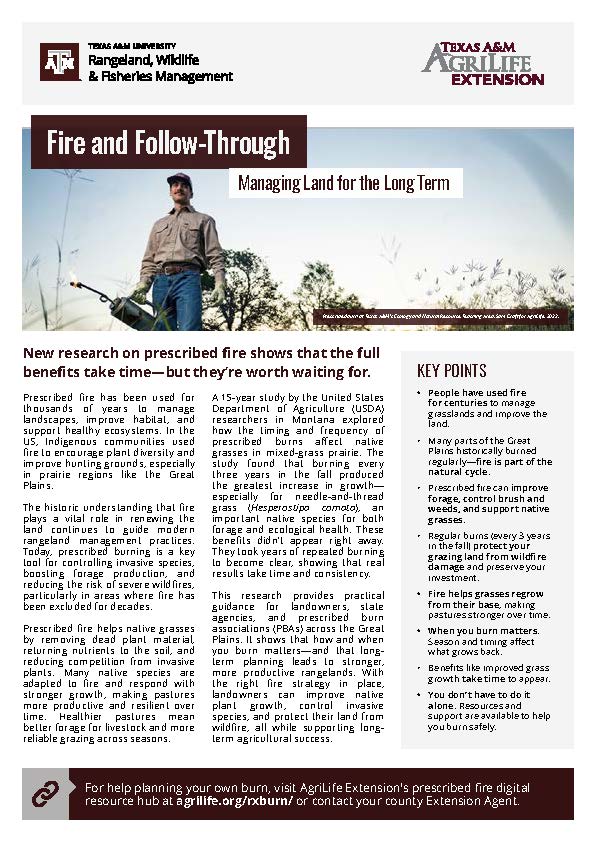
We are so grateful to showcase the amazing work of our department’s graduate students in RWFM 621!  We worked with a devoted team of M.Sc. and Ph.D. students on developing a Communications Strategies and Extension Publication final project.  This team took on an exciting task of making new science readily available to ranchers, landowners, and prescribed fire practitioners.  Well done ya’ll and THANK YOU!!

For thousands of years, fire has played a vital role in shaping healthy grasslands across the Great Plains. From Indigenous communities using fire to manage hunting grounds to today’s producer striving for resiliency in rangeland pastures, prescribed fire continues to be a powerful process for rangeland stewardship. But as NEW research shows, it’s not just about the initial fire—it’s about timing, consistency, and PROCESS. 

[Read more…] about Fire and Follow-through!

Filed Under: Prescribed Burn Associations, Prescribed Burning, Publications

Escaped Prescribed Fire Patterns

May 28, 2025 by jaime.sanford

Prescribed fires are a necessary process for rangeland management, helping to reduce fuel loads, restore ecosystems, and mitigate the risk of catastrophic wildfires. More importantly, the estimated escape rate across the U.S. is quite low, at 0.16% (2022). A recent study by Li et al. (2025) sheds light on the spatial and temporal patterns of escape prescribed fires, offering crucial insights for rangeland managers and fire professionals.

[Read more…] about Escaped Prescribed Fire Patterns

Filed Under: Grazing Management, Prescribed Burn Associations, Prescribed Burning

East Texas Landowners: $800,000 Available for Prescribed Burning

September 4, 2024 by jaime.sanford

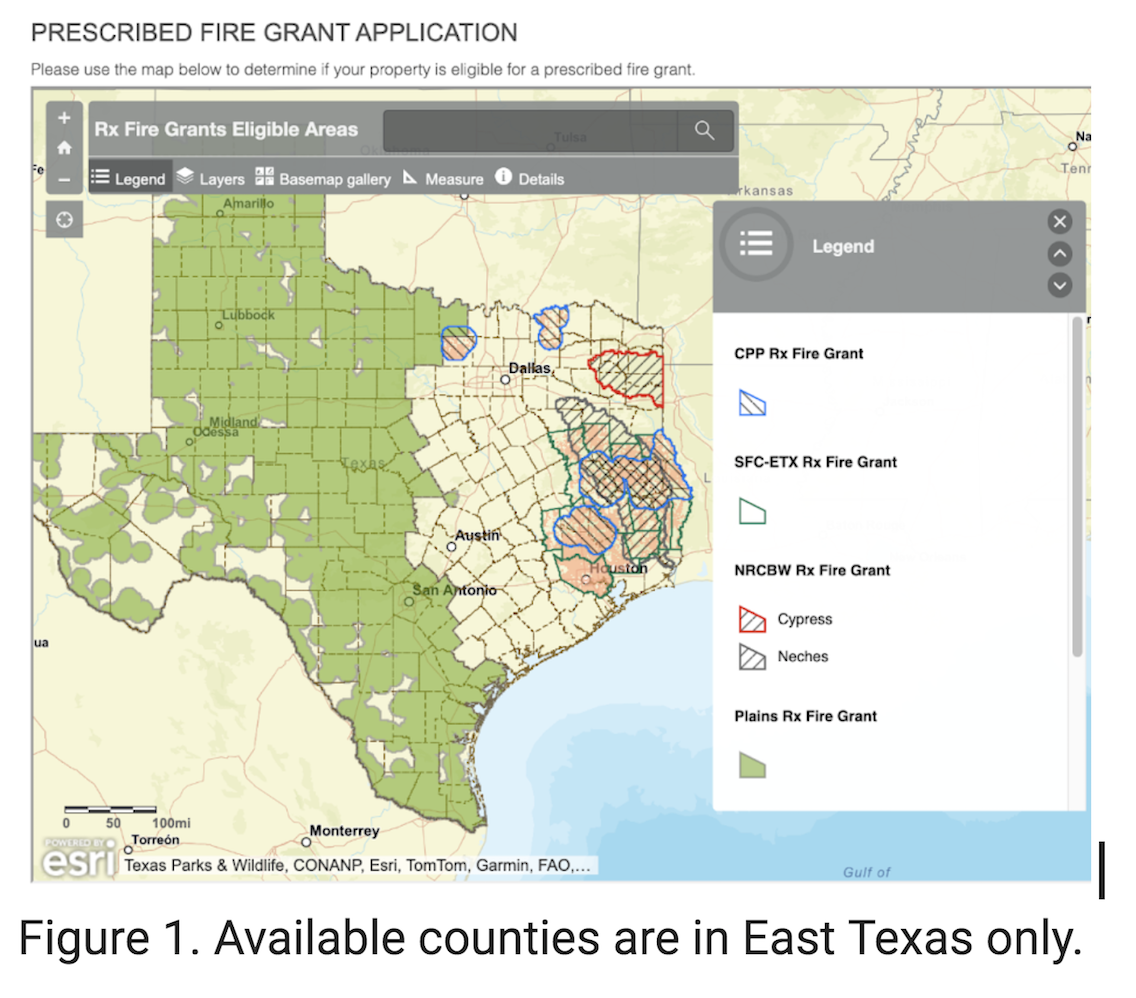
Texas A&M Forest Service grant application period is now open and will close September 30, 2024 for prescribed fire grants awarded to East Texas Landowners.

To determine if you are eligible to apply and to access the online application, be sure to visit the Texas A&M Forest Service Site. There have been some changes this year including the name, eligible area for the program and rate changes. In addition, the recipient of this award must be a licensed or utilize a contractor who is licensed by the Texas Department of Agriculture as a certified and insured prescribed burn manager. Texas A&M Forest Service does not conduct the prescribed burns. 

Below are the changes that have been made to this year’s grant program:

  • The program name has changed to the State Fire Capacity near Federal Lands in East Texas Prescribed Fire Grant (SFC-ETX).
  • The program area has shifted to 20 counties in southeast Texas
  • Applicants who desire to burn on a 2-year fire return interval, the rate has been reduced to $22.50 per area
  • Maximum reimbursement rate for a new project is $30.00 per acre
  • If you received payments in 2024, you are not eligible for 2025 funding
  • If you were approved in 2024 and did not complete your project, you will be given priority in 2025
  • If you received funding in 2023 and are reapplying, the maximum reimbursement rate is $22.50 per acre
  • If you received funding in 2022 or prior, maximum reimbursement is $30.00 per acre

You can find more information about each of these programs here!

For questions please reach out to – ETxRxFireGrants@tfs.tamu.edu

Filed Under: Prescribed Burn Associations, Prescribed Burning

Prescribed Fire Lessons

May 29, 2024 by jaime.sanford

The Nebraska Prescribed Fire Council has published its second issue of Prescribed Fire Lessons Learned! The Nebraska Prescribed Fire Council takes submissions from practitioners on lessons learned from prescribed fires to assist producers, landowners, PBAs, and other prescribed fire professionals to keep improving season after season.  This forum has been invaluable in learning from one another in hopes that mistakes or judgment calls turn into valuable lessons for all of us building and contributing to prescribed fire culture. Below are some highlights from this issue. 

[Read more…] about Prescribed Fire Lessons

Filed Under: Brush Management, Lessons Learned, Prescribed Burn Associations, Prescribed Burning, Wildfire

Cost and Trends of Rx Fire in Southern Forestry Practices

April 10, 2024 by jaime.sanford

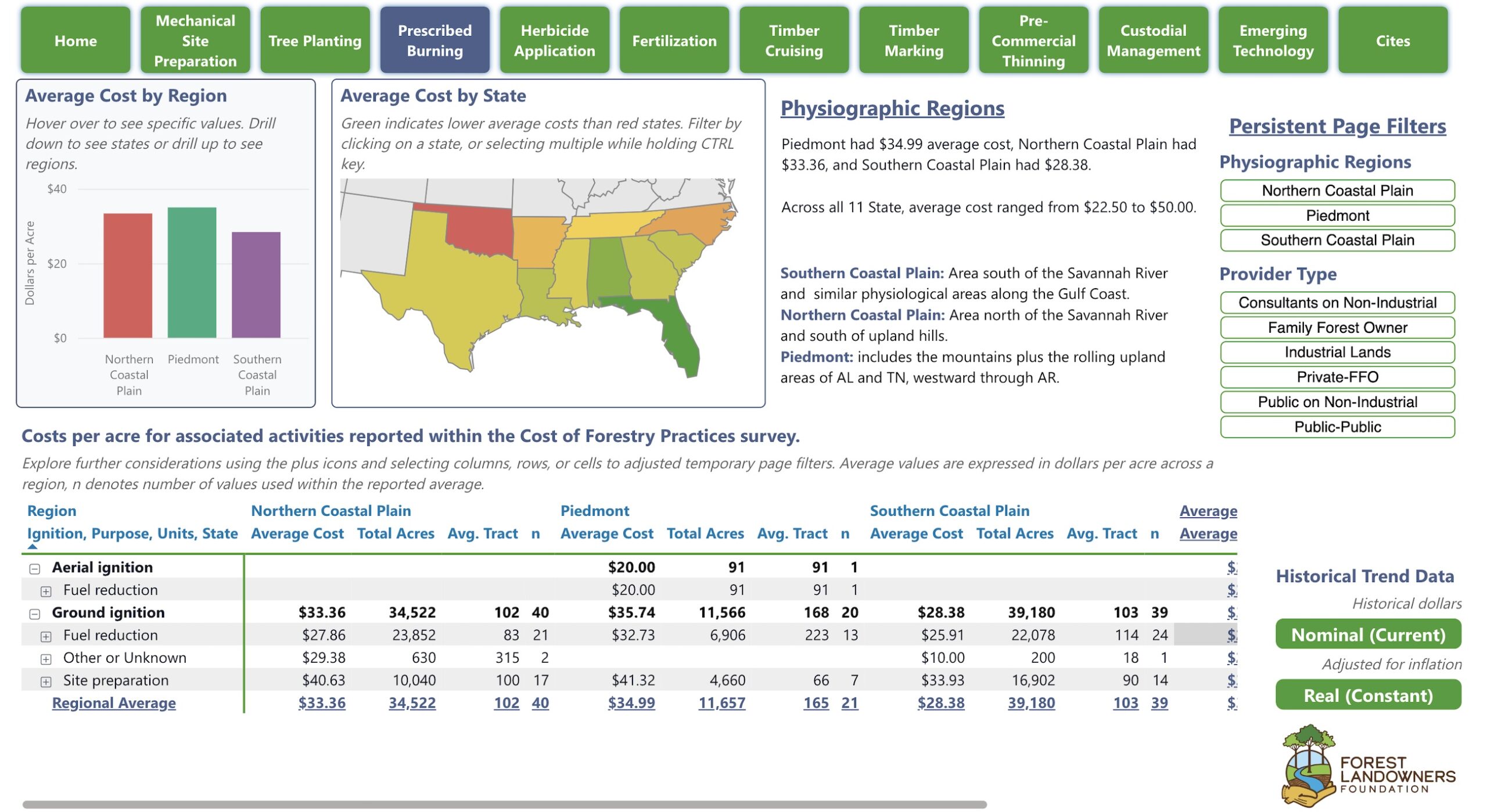
Forest Landowners Foundation in conjunction with Auburn University have created a survey to analyze the cost and trends of forestry management and practices. This survey is conducted bi-annually and provides a historical analysis of costs and management practices.

[Read more…] about Cost and Trends of Rx Fire in Southern Forestry Practices

Filed Under: Prescribed Burn Associations, Prescribed Burning

Lessons Learned – Contributing Factors to UTV Rollover on Prescribed Fire

March 27, 2024 by jaime.sanford

In Feb. 2023, Oakmulgee Ranger District was conducting their first large burn of the season. Multiple off-unit resources had been requested to assist with the burn, including various firefighters from other regions, Job Corps, Bureau of Land Management, and local militia. 

[Read more…] about Lessons Learned – Contributing Factors to UTV Rollover on Prescribed Fire

Filed Under: Lessons Learned, Prescribed Burn Associations, Prescribed Burning

UTV Incidents Dominates 2023 Lessons Learned

March 6, 2024 by jaime.sanford

One of the big takeaways from the 2023 summary of incident reports from the Wildland Fire Lessoned Learned Center was the increase of UTV related incidents. Over the past 14 years, the most UTV related incidents in one year was 5. In 2023 however, there were 13 related incidents. The graph shows 15 accumulated years of UTV involved incidents, including rollovers, entrapments, equipment damage, and tree strikes.

[Read more…] about UTV Incidents Dominates 2023 Lessons Learned

Filed Under: Lessons Learned, Prescribed Burn Associations, Prescribed Burning

Exotic Herbivores and Fire Energy Drive Standing Herbaceous Biomass but do not Alter Compositional Patterns in a Semiarid Savanna Ecosystem

February 14, 2024 by jaime.sanford

Did you know that fire regime alterations are pushing open ecosystems worldwide past tipping points where alternative steady states characterized by woody dominance prevail. The intensity and frequency of surface fires are reduced, limiting their effectiveness for controlling cover of woody plants. Grazing pressure can also reinforce woody encroachment by potentially reducing fine-fuel loads. 

[Read more…] about Exotic Herbivores and Fire Energy Drive Standing Herbaceous Biomass but do not Alter Compositional Patterns in a Semiarid Savanna Ecosystem

Filed Under: Prescribed Burn Associations, Prescribed Burning, Publications

  • Page 1
  • Page 2
  • Page 3
  • Interim pages omitted …
  • Page 5
  • Go to Next Page »

Recent Posts

  • Fire Up Plant Diversity!
  • New Publication! Photosensitization
  • Dry, Warm, Windy, and Fuel.
  • Lessons Learned – Pyro-Vortex Tornado on the Deer Creek Fire
  • Mapping Fire Before It Starts: How the Fireshed Project Strengthens Readiness in West Texas

Categories

  • 4-H Range Contests
  • Beef Cattle
  • Brush Management
  • Carbon Credits
  • Carbon Markets
  • Conservation
  • Conservation Practices
  • Drought Management
  • El Niño
  • Events
  • Goats
  • Grazing Management
  • La Niña
  • Land
  • Lessons Learned
  • Meet A County Extension Agent
  • Plant ID
  • Podcast
  • Prescribed Burn Associations
  • Prescribed Burning
  • Publications
  • Range Concepts
  • RAP
  • Sheep
  • Society for Range Management
  • Soil
  • Staff
  • Targeted Grazing
  • Uncategorized
  • Water
  • Weather
  • Why I Ranch
  • Wild Pigs
  • Wildfire
  • Wildfires
  • Wind
  • Woody Encroachment
  • Youth Range Workshop

Archives

Texas A&M AgriLife Extension Service
Texas A&M University System Member
  • Compact with Texans
  • Privacy and Security
  • Accessibility Policy
  • State Link Policy
  • Statewide Search
  • Veterans Benefits
  • Military Families
  • Risk, Fraud & Misconduct Hotline
  • Texas Homeland Security
  • Texas Veteran's Portal
  • Equal Opportunity
  • Open Records/Public Information