Farm animal confinement statutes such as California’s Proposition 12, have been popular in news stories, the legislative branch, and the judiciary around the country. In recent months, there has been significant developments that necessitate an update on where things currently stand with farm animal confinement statutes.
For some background and history on this issue and a discussion of National Pork Producers Council v. Ross, the United States Supreme Court decision involving Proposition 12, click here to read my Congressional Testimony from July 2025.
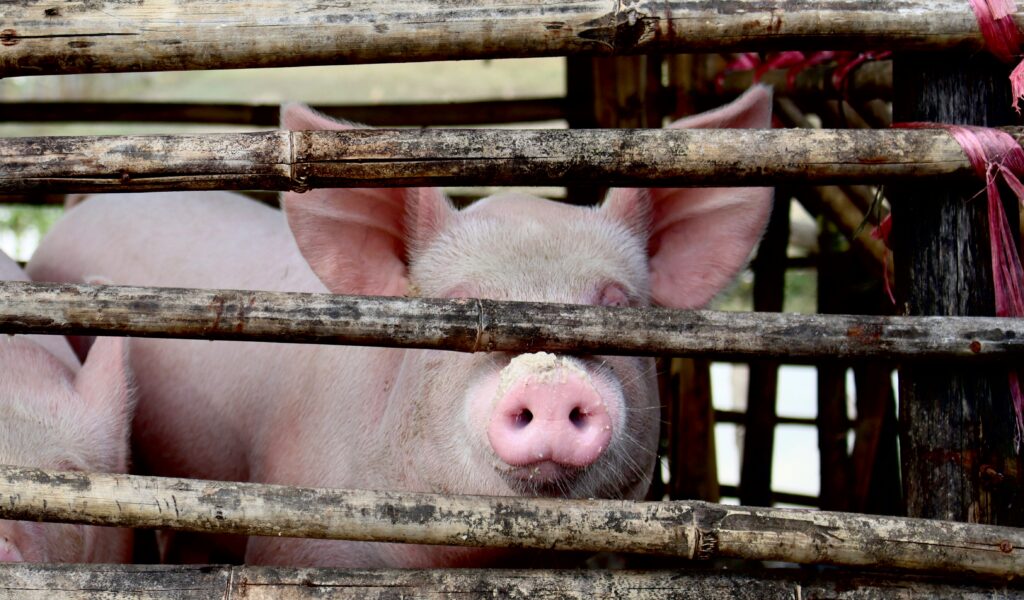
Photo by Shimmerx Lyan on Unsplash / A pink pig stands looking through the bars of an enclosure.
Farm Bill 2.0 Language
The United States House Committee on Agriculture included language addressing state farm animal confinement laws in its Farm, Food, and National Security Act of 2026, often referred to as “Farm Bill 2.0.” The provision in the Farm Bill, Section 12006, is titled “Ensuring the Free Movement of Livestock-Derived Products in Interstate Commerce.”
The Committee states that the purpose of the section is to protect the free movement in interstate commerce of products derived from covered livestock, to encourage a national market for these products, to ensure producers of covered livestock are not subject to a patchwork of state laws, and to ensure the US continues to uphold international trade obligations.
The language in the Farm Bill 2.0 would declare producers of covered livestock have a federal right to raise and market their livestock in interstate commerce. Because of this, the statute provides that no state or subdivision thereof may enact or enforce a condition for sale or consumption based on any condition or standard of production on products derived from covered livestock not raised in the State that are different or in addition to the conditions on production applicable in the state where production occurs. In other words, laws like Proposition 12 that ban the sale of products not raised in accordance with California standards regardless of where the animals are raised would not be permissible.
Two key definitions in the statutory language are:
- Covered Livestock: any domestic animal raised for slaughter for human consumption or producing products manufactured for human consumption that are derived from processing milk. Covered livestock does not include domestic animals raised for the primary purpose of egg production.
- Production: raising and breeding of covered livestock. Production does not include the movement, harvest, or further processing of covered livestock.
Currently, the Farm Bill 2.0 has been passed by the House Committee on Agriculture. The next step will be a vote by the full House of Representatives. If the bill passes that vote, it will proceed to the Senate.
Triumph Foods v. Campbell
In October 2025, the United States Court of Appeals for the First Circuit affirmed the trial court’s dismissal of Triumph Foods v. Campbell, a constitutional challenge to Massachusetts’ “Act to Prevent Cruelty to Farm Animals,” commonly called Question 3. We wrote a full summary of the decision here. The court addressed a number of constitutional claims.
Privileges and Immunities Clause: The court quickly disposed of this argument holding that the Privileges and Immunities clause does not apply to business entities, and the Plaintiffs are companies, LLCs, LLPs, a corporation, and a cooperative. Thus, the Privileges and Immunities claim was properly dismissed.
Full Faith and Credit Clause: The court rejected the plaintiffs claim that Question 3 is in direct conflict with their states’ Right to Farm statutes, thus violating the Full Faith and Credit clause. The court explained that Question 3 did not ban the farming practices the plaintiffs claim their Right to Farm Acts protect. They are free to continue with any farming practice they choose, but may not be able to sell their products in Massachusetts. Thus, the court affirmed this dismissal.
Due Process Clause: The court found that based on statutory and regulatory definitions, the terms “engage in the sale” and “turn around freely” were not unconstitutionally vague in Question 3.
Import-Export Clause: The court held that the Import-Export clause applies only to products imported from foreign countries, not other states.
Preemption: The court rejected arguments that Question 3 was preempted by both the Federal Meat Inspection Act (FMIA) and the Packers and Stockyards Act (PSA). FMIA did not preempt Question 3, the court held, because FMIA applies only to practices at processing facilities, whereas Question 3 applies to production practices beyond the slaughterhouse gate. PSA did not preempt Question 3 because the court found Question 3 to be non-discriminatory and, therefore, there is no unreasonable preference, advantage, or disadvantage because all producers were treated the same.
Dormant Commerce Clause: This is the most common claim filed against these types of statutes, and the one that has been addressed by the United States Supreme Court looking at Proposition 12 in National Pork Producers Council v. Ross. Here, the court rejected both plaintiffs’ intentional discrimination and discriminatory effect theories. With regard to intentional discrimination, the court noted that the law was neutral and applied to both in-state and out-of-state producers alike. The fact that there may be more (or only) out-of-state producers actually impacted does not show intentional discrimination. On the question of discriminatory effect, the court relied on the United State Supreme Court’s decision in National Pork Producers Council v. Ross and reached the same result.
Importantly, note that a Petition for Certiorari has been filed with the United States Supreme Court.
Triumph Foods v. Bonta
This case, filed in the United States District Court for the Central District of California challenged California’s Proposition 12 and the accompanying regulations. In March 2026, the court dismissed the case. [Read Ruling here.] In addition to some technical issues, a number of constitutional issues were addressed.
Preemption: The court rejected the plaintiffs’ claim that Proposition 12 was preempted by the FMIA because the animal production practices at issue do not occur at FMIA-inspected facilities. Further, the ban on the sale of non-compliant meat does not occur on the premises of slaughterhouses. There are simply not any new or additional requirements on FMIA-inspected facilities under Proposition 12 or the regulations. Thus, the court dismissed this claim.
Implied Preemption: The court dismissed this claim as well finding that Triumph did not allege field preemption and that it failed to allege impossibility preemption. There were no facts showing that it was impossible to comply with both Proposition 12 and FMIA. Additionally, the stated purposes of the two laws are different and there was no evidence of obstacles to the accomplishment of the FMIA purpose by the enforcement of Proposition 12 or its regulations.
Commerce Clause: The court previously rejected an argument regarding discrimination against out-of-state producers based on the lead time as being time-barred. Here, they also rejected the claim that Proposition 12 contains a discriminatory loophole in its “slaughterhouse exception” by allowing in-state pork processors to sell noncompliant pork meat from their federally inspected facility if the buyer takes possession at the facility. The court found this exception was non-discriminatory as it excludes from the Proposition 12 definition of “sales” those sales undertaken at any federally inspected slaughterhouses–not only federally inspected slaughterhouses in California. The slaughterhouse exception did not treat out-of-state businesses differently. Additionally, the court found no plausible allegation of substantial burden on interstate commerce under the slaughterhouse exception. This claim was dismissed.
Due Process Clause & the Fourteenth Amendment: The plaintiffs claimed that terms like “engage in the sale” and “California commerce” were unconstitutionally vague. The court rejected this argument, finding that the plain language of the statute is clear.
Import-Export Clause: The court held that the Import-Export clause applies only to international trade, not to interstate commerce.
Thus, the Defendants’ Motion to Dismiss was granted. The court did, however, dismiss the Dormant Commerce Clause and Due Process claims without prejudice, allowing them to be amended should the plaintiffs choose to do so.
Two Egg Cases
Lastly, the United States Department of Justice filed two lawsuits related to the statutory provisions applicable to laying hens in California and Michigan. Both lawsuits claimed that the provisions of Proposition 12 applicable to laying hens were preempted by the Egg Products Inspection Act.
The first, United States of America v. California, was dismissed in March when the United States District Court for the Central District of California found the plaintiffs lacked standing to bring the case. [Read Order here.] Perhaps my favorite line of the opinion, “And unlike with the chickens and eggs at issue here, there is no question that an analysis of standing must come first.” Here, the Department of Justice did not claim any sort of sovereignty injury to the federal government to support a claim of standing.
The second, United States of America v. Michigan, involves a similar challenge to the Michigan statute banning the sale of caged-hen eggs in the state. This lawsuit was filed in the United States District Court for Western District of Michigan. [Read Complaint here.] No rulings have been issued to date.
Key Takeaways
While some may have thought the issue of farm animal confinement statutes was answered by the United States Supreme Court in National Pork Producers Council v. Ross, that is far from the truth. Similar laws in various states, ongoing litigation around the country, and the potential for Congressional action in the Farm Bill 2.0 has kept this a hot topic in agricultural law.