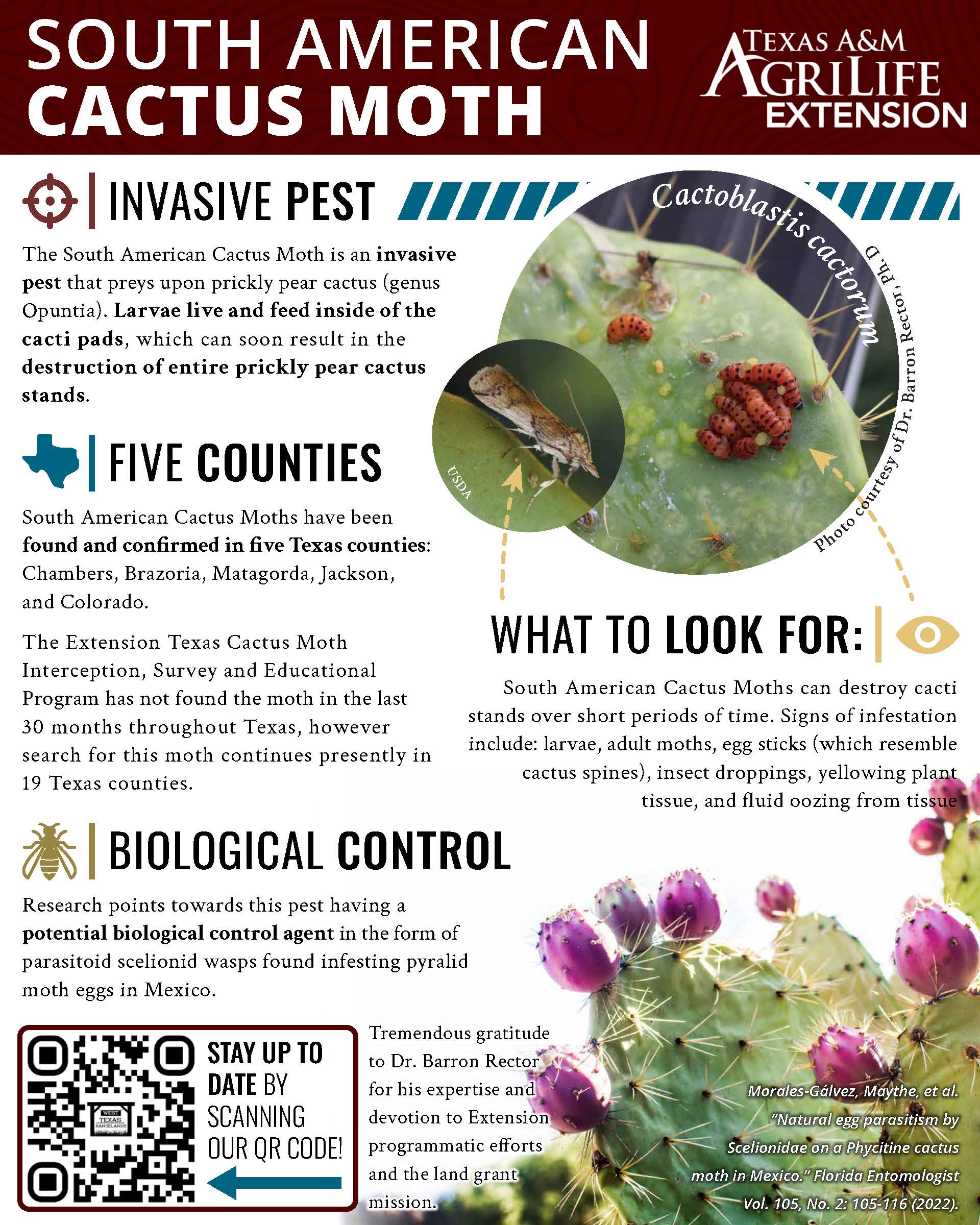
 Texas is known for its rugged landscapes and iconic, opportunistic, and problematic prickly pear. While these plants readily provide headaches to the grazing manager, oftentimes pear also serves as food and habitat for wildlife and is a native species on Texas rangelands. However, the South American Cactus Moth has been found and confirmed in five Texas counties.
The South American Cactus Moth (Cactoblastis cactorum) is an invasive insect (origins from South America) primarily threatening prickly pear (genus Opuntia).The larvae of the moth are the primary concern, burrowing into the pads of the cactus and feeding from the inside out. This internal feeding quickly leads to the deterioration of the pads and, eventually, entire prickly pear mortality.
While the South American Cactus Moth has been confirmed in Chambers, Brazoria, Matagorda, Jackson, and Colorado counties the potential for its spread is a major concern. The Texas A&M AgriLife Extension Service has been actively monitoring the moth through its Texas Cactus Moth Interception, Survey and Educational Program led by Dr. Barron Rector. Although the moth hasn’t been detected in the last 30 months across the state (primarily due to the Uri Freeze in 2021), ongoing surveillance continues in 19 counties (presently in Chambers, Jefferson, Brazoria, Matagorda, Jackson, Calhoun, Wharton, Refugio, San Patricio, Nueces, Aransas, Brazos, Kerr, Kendall, Hays, Gillespie, Tom Green, Dallas and Hood Counties). Surveys conducted last week below Freeport at Bryan Beach still show no sign of present activity of the cactus moth infecting prickly pear plants on the dunes of the coast.
Early detection is crucial in controlling the spread of this destructive pest. Look for these signs of infestation:
- Larvae: The caterpillars themselves, found inside the cactus pads.
- Adult Moths: Though less noticeable, the adult moths are a sign of their presence.
- Egg Sticks: These resemble cactus spines and are where the moths lay their eggs.
- Insect Droppings: Frass (insect excrement) near entry holes.
- Yellowing Plant Tissue: A sign of internal damage.
- Fluid Oozing: From the damaged tissue.
We are beyond grateful for the incredible insight and expertise from Dr. Barron Rector for his knowledge, leadership, and devotion to Texas A&M AgriLife Extension.
For more information be sure to read the full study – 2025 Natural egg parasitism by Scelionidae on a Phycitine cactus moth in Mexico
Morales-Gálvez, Maythe, et al. “Natural egg parasitism by Scelionidae on a Phycitine cactus moth in Mexico.” Florida Entomologist Vol. 105, No. 2. 105-116 (2022).