The Eastland Court of Appeals recently ruled in Surrento v. Cactus Growers, Inc., a vehicle-versus-cow case involving a number of defendants. This case illustrates a number of important considerations when it comes to Texas fence law.
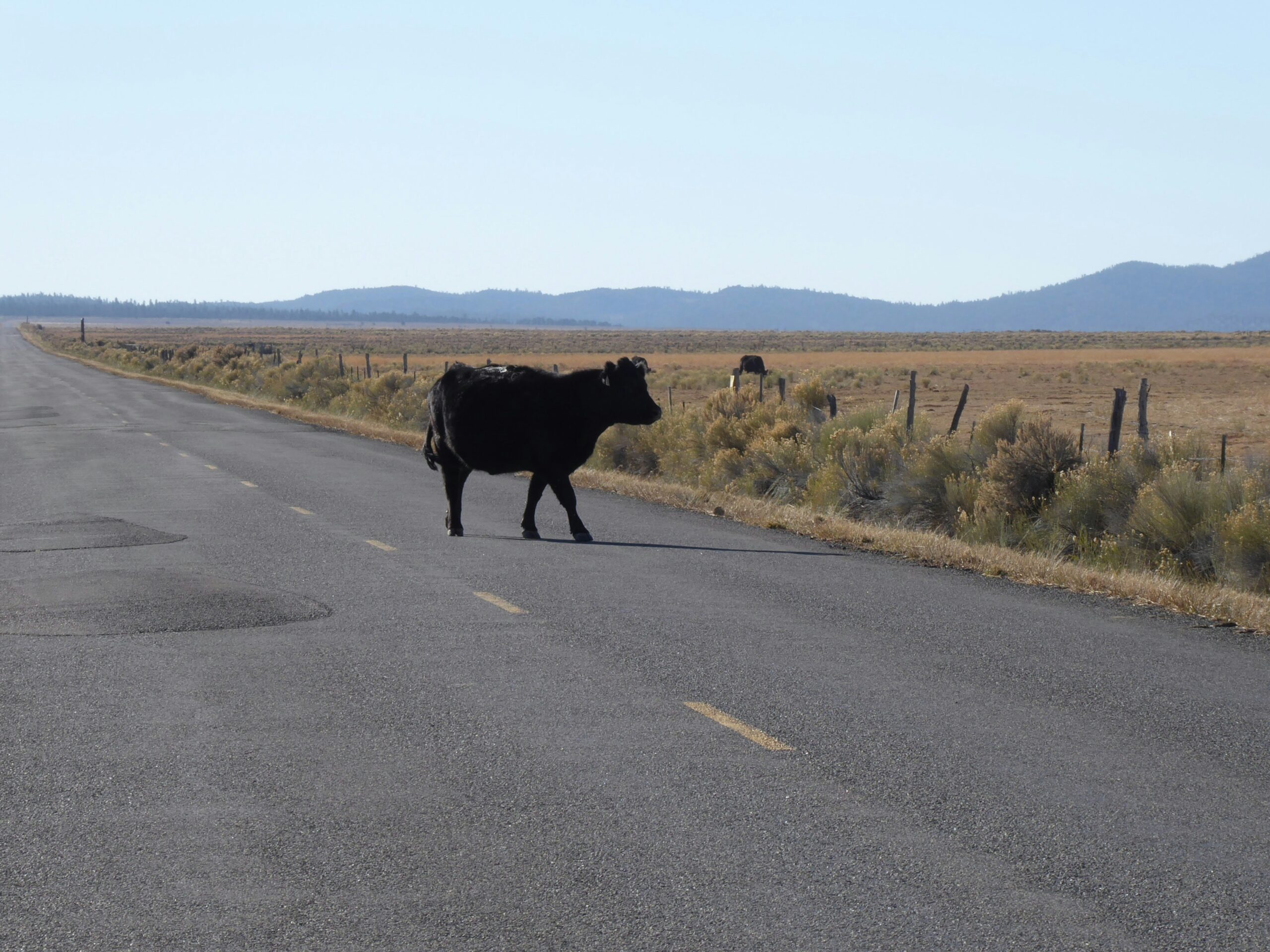
Cow walking on paved roadway / Photo by Karin Kim on Unsplash
Background
Brianna Surrento was killed when her vehicle hit a cow on the highway near the Doss Ranch.
The Doss Ranch is owned by the Doss Foundation. At the time of the accident, the ranch was leased to Jackie Warren. Warren had entered into a grazing lease agreement with Jeffrey Carlisle, who kept about 250 head of cattle on the land pursuant to an agreement with Cactus Growers, who owned the cattle herd.
Relevant here are two pastures, the West and East Pastures, which are divided by County Road 135. South of the two pastures is State Highway 180. Jeffrey Carlisle testified that cattle were kept only in the West Pasture.
Between 4:00 and 6:00 pm on the day of the accident, the Gaines County Sheriff’s Office was dispatched to a location near the Doss ranch for a cow outside the fence. She had a green ear tag. The Sergeant on scene called Jeffrey Carlisle to ask about the cow. Jeffrey said his cattle had yellow and blue tags but admitted there may be a few with green tags. The Sergeant herded the cow to a gate leading to the East pasture, let her in, and secured the gate. After receiving the call from the Sheriff’s deputy, Jeffrey Carlisle sent one of his ranch hands to investigate the property, fences, and cattle. The hand said the fences showed no breaches, gates were closed, and he did not see cattle outside of the fenced area.
At 8:19 pm, dispatch received another call that two black cows were spotted on Highway 180 just west of County Road 135. The dispatcher called the ranch hand to let him know. Shortly after that, the accident that killed Brianna occurred.
Jeffrey Carlisle said he could not identify the cow involved in the accident. However, a Texas Department of Public Safety Trooper testified that while at the scene, Carlisle told her the cow was owned by Cactus Feeders and was part of the herd he was taking care of for Cactus.
Litigation
Brianna’s father, Michael, brought suit against Cactus Growers, the Doss Foundation, Jeffrey Carlisle, and Jackie Warren claiming gross negligence and statutory liability under the Texas Agriculture Code Section 143.102.
The Defendants moved for summary judgment, and the trial court granted those motions and dismissed the case.
Brianna’s father appealed.
Eastland Court of Appeals Opinion
The Eastland Court of Appeals affirmed. [Read order here.]
The court addressed a number of issues on appeal.
Procedural Issues
Michael raised several procedural issues.
Expert report exclusion: The court excluded two expert reports that Michael offered as summary judgment evidence, finding that he failed to properly disclose these experts, and the reports were not provided in discovery. Michael provided the expert names and reports after the deadline and offered no effort to demonstrate good cause for the late designation. The appellate court held the trial court did not err in excluding these reports.
Excluded exhibits: The court also excluded a number of additional exhibits Michael sought to offer such as depositions, the lease agreement between the Doss Foundation and Warren, and a DPS crash investigation report. The court took each of these exhibits into consideration during their review of the appeal, and held that even if they were properly admitted, they would not have changed the result of the trial court’s rulings, so any error in the court’s striking them was harmless.
Adequate discovery time: Michael argued that the trial court granted summary judgment before allowing adequate time for discovery on whether Cactus “knowingly permitted” the cow to run at large. Michael, however, did not file a verified motion for continuance or an affidavit seeking more time for discovery on the issue of “knowingly permitted” as required by Texas law to extend discovery time. Additionally, the appellate court found that Michael did not exercise due diligence in obtaining the requested discovery. He delayed the deposition of Cactus Growers for 17 months after the filing of the lawsuit and only sought to take it 15 days before the discovery deadline. The trial court did not abuse its discretion in denying Michael’s motion for further discovery.
Merits
The court turned next to Michael’s merits arguments.
Texas fence law: The court set forth a detailed description of recent Texas case law regarding animals hit on a state highway. Pursuant to Texas Agriculture Code 143.102, a state and US highways are closed range, and a livestock owner may not “knowingly permit” animals from running at large. Texas courts have explained that it is not enough that a livestock owner should have known but does not actually know their livestock have been permitted to roam at large on the highway. Likewise, courts have held “the mere fact an animal escapes and makes its way onto a highway does not support a finding of culpability.” To satisfy the “knowingly permit” standard, there must be evidence that a livestock owner was reasonably certain a cow could escape and roam at large. The most probative evidence is the actual knowledge of the livestock owner in the current situation. Additional circumstantial evidence can include the condition of the fences and the history of the owner’s animals escaping. This requires more than a “temporary escape,” but instead must show the animal was allowed as a matter of course to graze and move freely in an unconfined area.
Jeffrey Carlisle: Carlisle filed a summary judgment motion claiming there was no evidence that he permitted a cow to roam at large on Highway 180. Michael argued a combination of inadequate fencing and prior escapes was sufficient evidence to create an issue of fact on this question. The appellate court disagreed, finding that he failed to offer sufficient evidence that the West Pasture fences (where the cattle were kept) were inadequate, focusing instead only on the East Pasture fencing. Additionally, the fencing evidence was offered by the expert that the court property excluded from trial. Thus, it could not be considered. Additionally, the court found insufficient evidence to show that there were cattle allowed to be in the East Pasture. When there was the earlier report of cattle out, Carlisle sent his ranch hand to inspect the fences, gates, and cows. He did not see any breach in the fencing. The court did not err in holding there was no evidence to show that Carlisle knowingly permitted the cow to run at large.
Cactus Growers: Michael claimed that Cactus was liable as the owner of the cow. Cactus argued that even if it was the owner, it did not have control of the cow because the responsibility for care and control was delegated to Carlisle. Importantly, the court refused to answer the question of whether an owner who delegates control of an animal to another can remain liable under Section 143.102, because regardless, there was no evidence that Cactus Growers knowingly permitted the cow to run at large. For the same reason that Michael’s circumstantial evidence regarding knowledge failed against Carlisle, it fails against Cactus Growers. There was simply no evidence of inadequate fencing or subsequent patterns of escapes. In light of this, summary judgment was properly granted.
Warren and the Doss Foundation: Both Warren and the Doss Foundation moved for summary judgement arguing there was no evidence that they had any ownership or responsibility for the cow and that there was no evidence they knowingly permitted the cow to run at large. Looking at the statutory language, the court notes the distinction of those who may be liable under the statute–those who own or have responsibility for the livestock animal–versus those who own the property. The applicability of Section 143.102 is to the person who owns or is responsible for the animals, not the land. Further, there was nothing in the lease agreements between the parties that gave Warren or the Doss Foundation control over the cattle. A clause stating that Warren would prorate the cost of fence repairs against the lease price did not create the necessary type of responsibility for the cattle. Regardless, the court noted, there was no evidence that Warren or the Doss Foundation acted knowingly to permit the cow to run at large. Summary judgment was proper against these defendants.
Gross Negligence: Because the court found no evidence to support Michael’s claims under Section 143.102, they needed not reach the question of gross negligence.
Amended Petitions
The court rejected an argument that the trial court improperly struck Michaels’ fifth amended petition. The appellate court held that this was harmless error because the summary judgement motion was sufficiently broad to respond to any differences between the fourth and fifth amended complaints.
Conclusion
The trial court ruling granting summary judgment in favor of the defendants was affirmed. (Do note that the deadline for filing a Petition for Review at the Texas Supreme Court has not yet passed.)
Key Takeaways
This case highlights many key points regarding fence law.
- For collisions on State and US highways, it is the “knowingly permit” standard that applies. This standard required more than just that the livestock owner should have known–but evidence that they were “reasonably certain” that the livestock would be out. Actual knowledge of the current situation is the best evidence, though evidence of poor fence quality or past escapes is also relevant.
- Any time a livestock owner receives information that they have livestock out, they should act as quickly as possible to contain the animals to avoid potential liability.
- In lease situations, the court has drawn a distinction between the person who owns and is responsible for the livestock (who may be held liable under the fence law statute) and the person who owns and is responsible for the land (who generally is not liable.) This can be changed, however, if there is a lease provision imposing such responsibility on the landowner.
- It is interesting to note that the court did not answer the question of whether a person caring for animals owned by another person could be liable for livestock on the roadway. The safe approach for anyone caring for livestock would be to behave as though there could be liability and to act accordingly.