In 2018, Wilmer and others published “Collaborative adaptive rangeland management foster management-science partnerships” in Rangeland Ecology and Management (check it out here). I really valued this paper, because fostering management-science relationships is what Extension is all about!
This paper is a case study, based on qualitative social data collected from meeting notes and interview transcripts recorded from ranchers and agency representatives in a Collaborative Adaptive Rangeland Management (CARM) study. In this synthetic assessment, they explored to what extent participation in the CARM experiment enabled adaptive decision making by a group of rangeland stakeholders (landowners, agencies, non-profit, etc..).
The specific objectives of this study were to 1) document how diverse stakeholder experiences and knowledge (meaning their socially constructed theories and justifications for rangeland management knowledge) contribute to the CARM project, 2) evaluate how co-produced knowledge informed management decision making through three grazing seasons, and 3) explore the implications of participation in the CARM experiment for rangeland stakeholders.
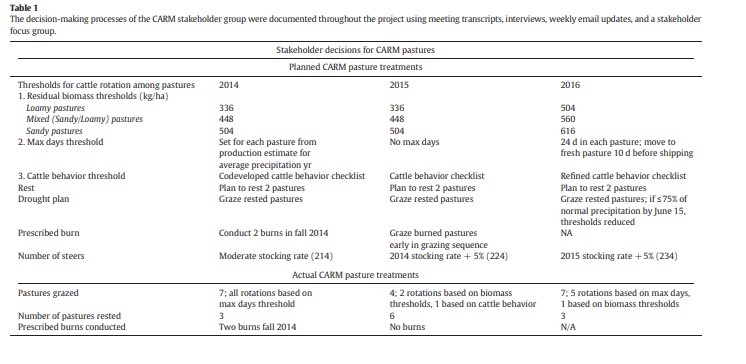
Here are some snapshot comments from ranchers, agency, and NGO reps on uncertainties, learning/collaboration, and motivations:
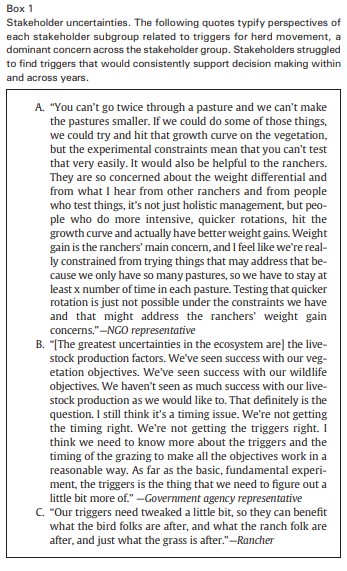
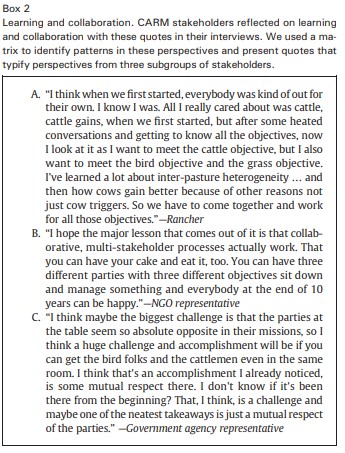
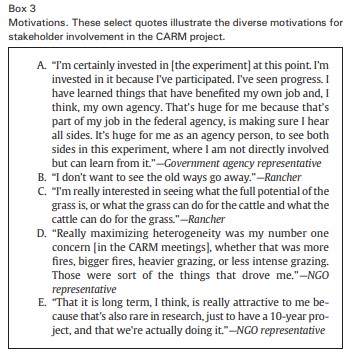
The authors found that this interactive process can reveal the differences among stakeholder knowledge about complex rangeland systems, but does not reconcile those differences. And that it is HIGHLY UNLIKELY that stakeholder decision-making related to cattle rotation and prescribed fire decisions will be made on data from research or experiments. However, it is likely that Collaborative Adaptive Rangeland Management (CARM) can build awareness and appreciation for the diverse ways of knowing about rangeland management. Stakeholders are more likely to utilize:
- Discussion and consideration of different reasoning for management actions
- Enhanced understanding when stakeholders are involved in the project design and monitoring data collection and presentation.
- Frequent discussion of the rational for decisions
- Presentations of multiple information sources
- Focus groups or tours that encourage sharing participants’ ways of knowing and experiences
Bottom line, rangeland management stakeholders prefer making decisions based on the broadest range of available information, INSTEAD of exclusively using scientifically derived knowledge!!!
Next, data from this paper showed TRUST among stakeholder and researcher groups may improve social learning by increasing the transparency of unique stakeholder experiences and knowledge. Stakeholder trust over time facilitated engagement and commitment from stakeholders and researchers to work toward a common goal.
So…are you a landowner, rancher, producer that agrees with this? I certainly hope so because this is all about what Extension creates, facilitates, and nurtures. Our job is to provide YOU the landowner with all the information and bring YOU to a network of stakeholders that you TRUST!
As Extension, we should:
- Make direct efforts to share and acknowledge managers’ different rangeland management experiences, epistemologies, and knowledge
- Involve long-term research commitment in time and funding to social, as well as experimental, processes that promote trust building among stakeholders and researchers over time
This all is very ironic to me, because it is what ranchers have been telling me for a long time. But, now that we have it in a published journal, maybe the other half can start listening!
I love my job. I love delivering information. I love working with ranchers. I serve at the pleasure of West Texas ranchers, and it is a an honor. Thank you!!