• Skip to primary navigation
  • Skip to main content
  • Skip to primary sidebar
  • Texas A&M Forest Service
  • Texas A&M Veterinary Medical Diagnostics Laboratory
  • Texas A&M AgriLife Extension Service
  • Texas A&M AgriLife Research
  • Texas A&M College of Agrculture and Life Sciences
West Texas Rangelands
West Texas RangelandsWe hope to provide a variety of science-based rangeland information and current research on prescribed fire, wildfires, brush management, and grazing management!
  • Menu
  • Home
  • About & Contact
  • Publications
    • Extension Publications
    • Refereed Journal Articles
    • Program Summaries
  • Events
  • Lunch N’ Learn
  • Infographics
    • Drought
    • Grazing
    • Herbicide
    • Prescribed Fire
    • Rangeland Plants
    • Wildfire
  • Range Resources
    • Published to Pasture
    • Range Concepts
  • Fire Resources
  • Sponsors
  • AgriLife Learn Online Courses

Published to Pasture…Liability and Prescribed Fire: Perception and Reality (EPPBA)

March 5, 2019 by morgan.treadwell

In 2017, a group of prescribed fire researchers (including me!) set out to answer the age-old question…is prescribed fire liability…prescribed fire’s scapegoat?  Check out this work that talks about the Edwards Plateau Prescribed Burn Association escape prescribed fire lawsuit here.

(J.R.Weir,U.P.Kreuter,C.L.Wonkka,etal.,LiabilityandPrescribedFire:PerceptionandReality,RangelandEcology&Management, https://doi.org/10.1016/j.rama.2018.11.010)
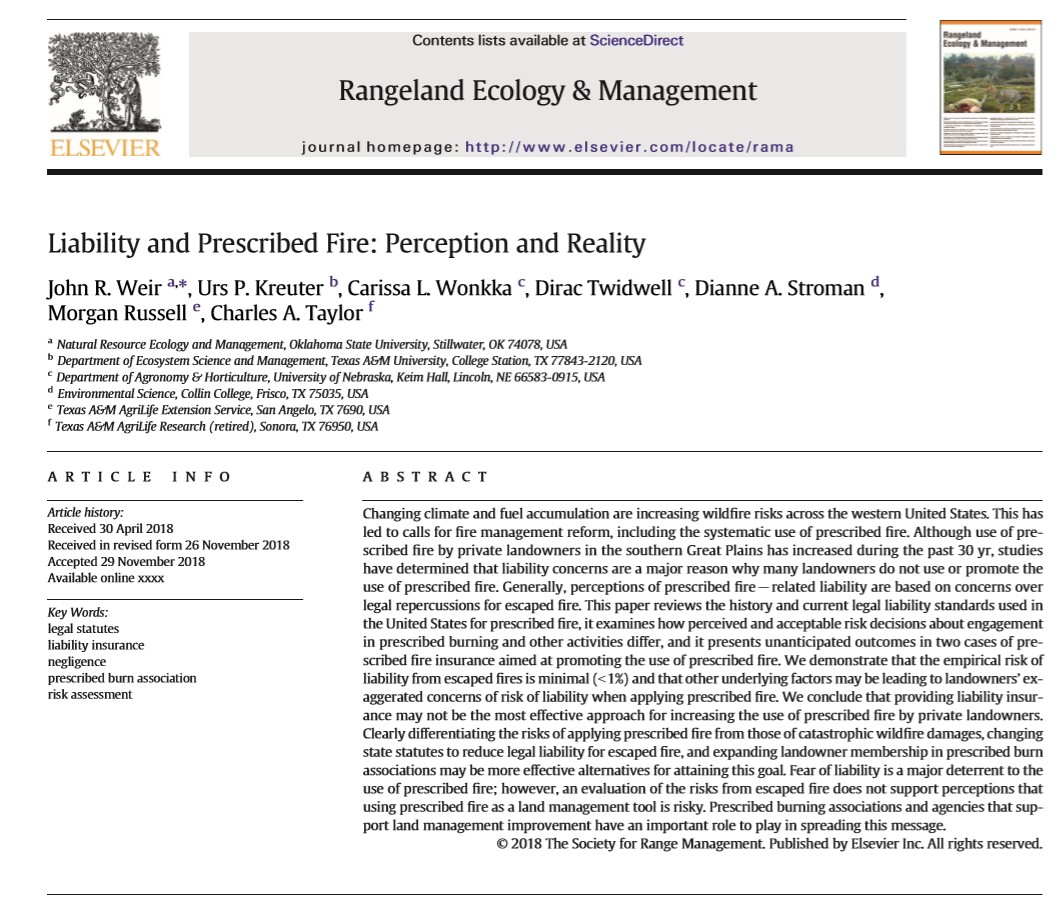
Although use of prescribed fire by private landowners in the southern Great Plains has increased during the past 30 yr, studies have determined that liability concerns are a major reason why many landowners do not use or promote the use of prescribed fire. Generally, perceptions of prescribed fire−related liability are based on concerns over legal repercussions for escaped fire. This paper reviews the history and current legal liability standards used in the United States for prescribed fire, it examines how perceived and acceptable risk decisions about engagement in prescribed burning and other activities differ, and it presents unanticipated outcomes in two cases of prescribed fire insurance aimed at promoting the use of prescribed fire. We demonstrate that the empirical risk of liability from escaped fires is minimal and that other underlying factors may be leading to landowners’ exaggerated concerns of risk of liability when applying prescribed fire. We conclude that providing liability insurance may not be the most effective approach for increasing the use of prescribed fire by private landowners. Clearly differentiating the risks of applying prescribed fire from those of catastrophic wildfire damages, changing state statutes to reduce legal liability for escaped fire, and expanding landowner membership in prescribed burn associations may be more effective alternatives for attaining this goal. Fear of liability is a major deterrent to the use of prescribed fire; however, an evaluation of the risks from escaped fire does not support perceptions that using prescribed fire as a land management tool is risky. Prescribed burning associations and agencies that support land management improvement have an important role to play in spreading this message.

EPPBA LAWSUIT

In the second case, insurance provided to members of a PBA in Central Texas contributed to the initiation of multiple lawsuits following an escaped fire that negatively affected the use of prescribed fire by some landowners. The specifics of this incident and its aftermath were obtained through interviews with people involved in the lawsuits and through analysis of legal briefs and motions filed with the Sutton County court. In March 2011, a contractor who was neither certified as a burn manager nor insured was hired by a pair of private landowners in Sutton County, Texas to conduct a prescribed burn on their property during a burn ban. The contractor had recently become a member of the local PBA and counseled the landowners who hired him to also join the PBAs so  that they would be covered by the prescribed fire insurance provided by the association to its members. To comply with the PBA’s insurance requirements, the contractor also filed a burn plan with the PBA. In addition, these people requested an exemption from the county judge to apply prescribed fire during the burn ban. The judge ruled that only certified burn bosses would be granted a variance and denied the request. In contravention to this ruling, the contractor nevertheless proceeded with the planned burn. In preparation for the burn, the fire crew pre-burned backfires along firebreaks to create blacklines on the downwind side of the planned fire. During blackline burning, the wind direction shifted, causing the fire to ignite a stand of extremely dry juniper trees. Embers from the burning junipers were blown outside of the burn unit and initiated an escaped fire that burned approximately 405 ha on the contracting landowners’ property and three adjacent properties. Even though there was no major property damage or injury, the escaped fire led to multiple lawsuits. Three plaintiffs filed lawsuits involving the landowner’s property, where the fire started; the PBA; and a founding member of the PBA who had disapproved the proposed burn. Two insurance companies became involved in claims by the three landowners including the company that underwrote the PBA’s prescribed fire insurance policy and the company that provided insurance for the landowners who had signed the contract for the burn. Initially, the latter insurance company stated its policy did not cover prescribed fire damage but ultimately agreed to pay for the claimed damages to settle the litigation. Once the insurance companies agreed to pay for the specified damages, the defendants were dropped from the lawsuit. The ultimate effect of the lawsuits for the unapproved burn was that the insurance company withdrew coverage of the PBA’s prescribed fire insurance policy. Importantly, the insurance company omitted to include an “illegal activities” clause in the policy with which the insurance company would not have had to pay any claims because this was a fire conducted against
the ruling of a county judge. The PBA was named in the lawsuit due to wording in its bylaws that erroneously made it appear that the PBA did contract burning for landowners. As a result, numerous PBAs rewrote their bylaws to emphasize they only provide education, training, and opportunities for landowners to conduct prescribed burns and to clarify that PBA membership does not provide the right to burn outside state laws or prescribed burning guidelines set by the PBA. The fear of liability from this one incident has dramatically reduced the use of prescribed fire in the region, even though the escaped fire  and subsequent lawsuits stemmed from an illegally and improperly conducted burn. One informative statement came from an individual who was a PBA member and had burned regularly but became concerned about risk following the outcome of the lawsuits stemming from this illegal burn in which he had no part. He stated: “How could I get started burning in 2003 without checking my insurance coverage for hostile (escaped) fire? There was no visceral ‘fear.’ Also, there were no escapes on my30-plus fires. Now the fear is intellectual. With it comes inertia. No one wants to have an escape, and we all know that with any fire there is always that risk. Why doesn’t planning allay that fear? The damage done by the arrogance of the escaped fire in 2011 hangs around our shoulders like a cloak.”

This individual experienced risk reversal and stopped using prescribed fire because of concerns about the actions of others—in this case a lawsuit initiated by a neighbor because his land was burned and due to the existence of an insurance policy against which he could claim. Most other people in the area who had used prescribed fire and were not covered by the PBA’s insurance policy continued to burn undeterred.
Filed Under: Brush Management, Prescribed Burn Associations, Prescribed Burning, Publications Tagged With: Edwards Plateau Prescribed Burn Association, fire, PBAs, prescribed burn associations, RX Fire

Outside the Fire…Chuck Stanley

November 14, 2017 by morgan.treadwell

Do you have any idea how blessed we are to have such incredible mentors of prescribed burning?  I believe what makes a good burner is one that never stops learning and always learns from every fire, every experience, every time.  I decided to showcase prescribed burn practitioners who are just AWESOME at what they do.  I have found that the best guys to burn with are the ones who do not care about the glory or the attention.  “Why I Burn” will showcase a prescribed burn practitioner who gets the job, doesn’t care about the credit, and has a true love and passion for prescribed burning.  These are their stories of fire.

Hello Chuck Stanley.  A friend. A colleague.  And a guy that has a wealth of knowledge underneath a dang good looking hat.  I first met Chuck through my dad.  Chuck and my dad were at a Society for Range Management meeting in Albuquerque and they were the only two men in the Advisory Council meeting that were #1) wearing black Stetsons and #2) talking common sense.  They would later bond over fire stories.  Fast-forward 8 years later and I am still hitting Chuck up for that common sense, boots-on-the-ground, hard-working, well-deserved, sweat-equity common sense.

Chuck has been putting fire on the landscape for 30 years, since his beginning range days at Texas Tech.  Chuck is a Range Management Specialist for the Natural Resource Conservation Service (NRCS) in Fort Worth.  He is, basically, the go-to-guy for all things RX Fire in Texas and, especially, with the NRCS.  In other words, he knows his stuff.  This is Chuck’s story of fire.

How did you get introduced to fire? Well that is interesting, To me anyway. When I first started Texas Tech, like many other freshmen, I had no idea what I wanted to do. I bounced from major to major and not really finding my niche. I believe at the time I was taking engineering classes and took an introductory course into range and wildlife habitat. That was when I decided to change majors once again and moved over to the Range and Wildlife department at TTU, thinking what a fortunate decision this would be as I could hunt and fish and get paid for it. So I had to go and visit with my new advisor to get my classes set up and little did I know I was sitting in front of the man who wrote the book on prescribed fire, Dr. Henry Wright. During my “interview” on classwork, Dr. Wright asked me if I had ever burned any rangeland. I thought it might be a trick question to see if I was or had been convicted of arson at some point. I have not been but I have “accidentally” burned a few acres in my younger days. Dr. Wright smiled and said “ well tomorrow we are going to go burn 5000 acres”, I said “on purpose?” From that point on, I was hooked and have been involved with prescribed fire for 30 years. Funny thing, I am getting paid for it.

Do you make special plans for fire in your management plans well in advance, or take advantage of good fuel and weather conditions as they come? It all depends on what type of burn we are needing to meet objectives, and where the burn is to take place (smoke management issues etc.) However, there are times that I have known a place that needed burning, and when a perfect day comes along, we get it done.

What’s the hook for you on fire? I would say the main hook for me is the rejuvenation of the vegetation following the burn. And the landowners satisfaction of the results. I really like to teach the art of prescribed fire and try to get others interested.

In your opinion, what makes a successful fire? Generally speaking, I would say one that stays within the perimeter of the burn site, and all personnel are safe. Beyond that, one where the objectives were met.

Who in your burn circle/crew would you never burn without? My matches and driptorch…. Over the years there have been a bunch of folks that I truly have absolute trust in while burning. Generally they have been doing this a good while, and know what to look for, and understand fire behavior very well. I would not hesitate calling anyone of them if they were in the vicinity. Because of my position now, I just don’t get to go and burn like I used to.

Filed Under: Brush Management, Prescribed Burn Associations, Prescribed Burning, Uncategorized Tagged With: brush, fire, grass, RX Fire

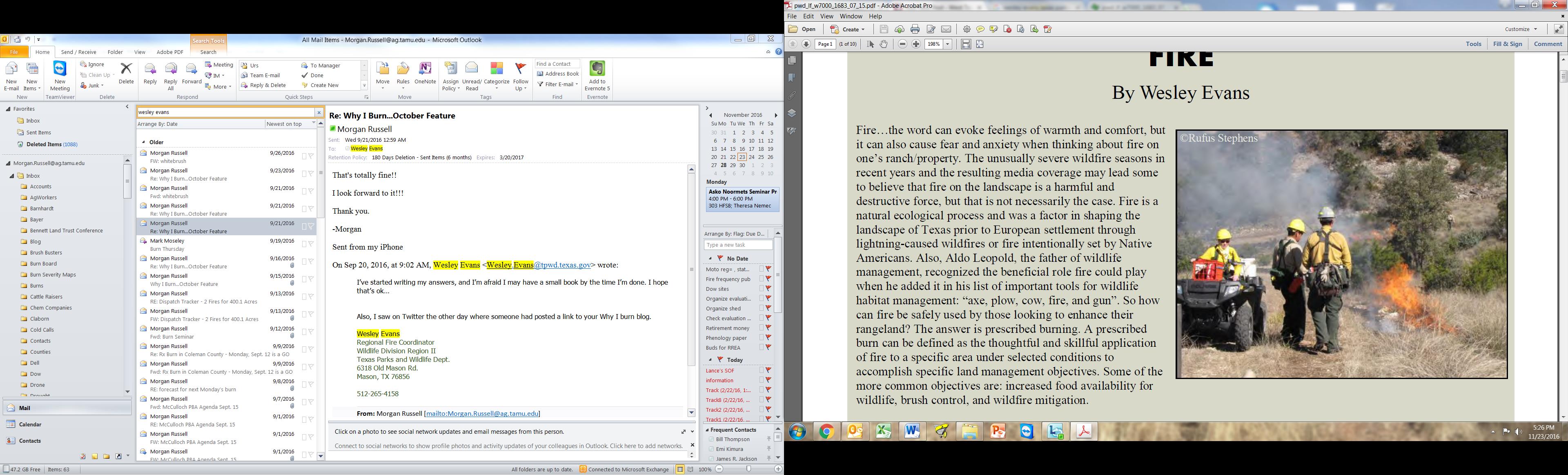
Outside the Fire – Wesley Evans, Regional Fire Coordinator, Texas Parks and Wildlife Dept.

November 23, 2016 by morgan.treadwell

This November we are featuring Wesley Evans, Regional Fire Coordinator for Texas Parks and Wildlife.  Wesley is based out of Mason, Texas and I have never met a more dedicated and caring individual for the stewardship of prescribed fire.  Wesley is super cool and he has my #1 favorite quality in prescribed burning practitioner – HE GET’S IT!  Meet one of my favorite TPW people, Wesley Evans…


tpwHow did you get introduced to fire?
I more or less lucked into fire. After graduating college, I didn’t have much direction or job prospects – I was literally sleeping on my buddy’s couch. One of my friend’s cousins was a District Fire Management Officer for the US Forest Service and she called me letting me know that they were going to have some firefighter jobs opening up soon and that I should apply. I applied and was hired on the Rolla Ranger District of the Mark Twain NF. The job was only a six month position, but only after a few weeks of prescribed burning and fighting wildfires I was hooked. As that job was starting to wind down, I began applying for fire positions all over the country. I was offered a position with the US Fish & Wildlife Service at Balcones Canyonlands NWR in the summer of 1999. I took the position, which turned out to be for a crewmember on a Prescribed Fire Module that would travel all over Texas (and the rest of the US) burning. The rest, as they say, is history. After 14 years with the USFWS, I moved to my current position with Texas Parks & Wildlife – still travelling and burning, but now just throughout Texas.

Do you make special plans for fire in your management plans well in advance, or take advantage of good fuel and weather conditions as they come? I try to find a way to do both. Weather is highly variable, so trying to plan a burn well in advance is most often an exercise in futility. I’ve found that the best approach is to take advantage of those good fire weather days as soon as possible because you might not get many more opportunities in a given burn season. This was relatively easy when I worked for an agency that had dedicated fire staff and equipment. With that being my only frame of reference for many years, I always that just thought that was the way it was done. The last few years in my new job working with private landowners, PBAs, and other agencies has shown me that this approach was the exception rather than the rule. While I was used to deciding to burn a particular unit the day before, I quickly learned that that’s more than often not possible in the “real world”. Now, I have to work through the same challenges that everyone else does in trying to balance prescribed burning with everything else we have to do. So how do I plan well in advance yet still take advantage of those good fire conditions? The very first thing is to set expectations from the start of the planning process. The more flexibility we can set in the burn plan, the more chance of success in both meeting the management goals or even getting a chance to burn. I try to dissuade my landowners from picking one specific day well in advance to burn. Sometimes it’s just the way it has to be, but I would much rather plan for a 3-5 consecutive day burn window during burn season or several days throughout the season. Planning to burn on January 22 really paints you into a corner and limits your flexibility. I’d rather see something like planning on burning January 20-23 and then picking a specific day once we are about a week out when the weather forecasts are a little more accurate. I’ve also had success with planning on burning on several days spaced out over time, such as Fridays in February. Breaking up a burn area into several smaller units and not just one large unit can also help to take advantage of those “just right” burn conditions and also allow for success if the burn day is marginal, but the people and equipment are available and ready to burn. More often than not it will take less people to burn a smaller burn unit, so it may be easier to get enough folks to burn 50 acres on short notice rather than 400. Along those same lines, if we have planned on a burn day in advance and the weather isn’t right for burning the whole unit there may be possibility to burn a smaller area. If the RH is too high, can you burn a small portion to make a blackline or buffer? If the wind direction isn’t good for the whole unit, can you still burn part of it that won’t smoke out your neighbor or that highway? I had one larger burn planned well in advance when we were going to have the proper amount of people and equipment, but it ended up snowing that day. We were still able to take advantage of having everyone there by burning piles that were along the edge of the burn unit, making burning the large unit much easier. I also try to make my prescriptions as broad as possible to take advantage of “marginal” burn days. For example, higher winds can offset higher RH and still produce adequate fire behavior to meet management goals. Having really good fire breaks can also let you take advantage of those marginal days on the other end of the prescription. I’m much more comfortable burning under hotter and drier conditions if we have nice and wide fire breaks down to mineral soil and no brush or volatile fuels close to the line. The bottom line is that building flexibility into the planning process and the burn plans will allow more success. This can also help in avoiding those situations where you may get stuck trying to burn under marginal conditions and either not meet management objectives OR have the fire get away.

What’s the hook for you on fire? I think there has been three different stages of my fire career, each with their own hook. When I first started, I loved prescribed fire because it was fun, exciting, and allowed me to travel. What 22-25 year old guy wouldn’t love traveling all over the country dragging a drip torch or working on a fire engine, right? After several years of this, fire is still exciting and fun but not the main reason that I enjoy prescribed burning. About 8 years ago I would have probably said that I burned just because it was a job, but looking back on it that’s not the case. At that point I loved prescribed fire because of the challenge/problem-solving aspect of it. I enjoyed (and still do) being given a difficult assignment on a burn and trying to find the best and safest way to complete it was the hook for me. Now, the main reason I love prescribed fire is that I can teach people about prescribed fire. When we assist a landowner who has little to know experience with fire (or who’s only experience is with wildfire) and show them what a properly planned and executed prescribed fire looks like, the reaction is always the same – “that wasn’t that bad/scary. I think that’s something we could do.” I love that. Or when you can see the light bulb come on as someone is doing something as simple as operating a drip torch. That’s the hook for me. I’ve seen it time and time again and it doesn’t matter who it is. Young or old, man or woman. At first they are timid, walking slow maybe even holding the torch with two hands. At the end of the day they are slinging that torch like a hotshot and showing others how to do it. That’s the hook for me now. I still enjoy the fun, excitement, and challenge – but the teaching/mentoring is what motivates me to keep burning.

In your opinion, what makes a successful fire? First of all, it’s a successful fire when everyone gets home safe (that’s probably the wildland firefighter in me). If we managed to keep all the equipment running and didn’t break anything, that’s a plus. I also think it’s successful if everyone involved learned something on the fire. It doesn’t really matter what they learned – as long as they learned something. It can be about fire behavior, specific firing techniques, weather influences, how a particular fuel burns, the planning process, etc. Even if someone learned that they don’t really care for burning and it’s not the tool for them, that’s still an important thing to know. A burn is also successful if we can put a column of smoke up in the air and it doesn’t result in a ton of calls into 911, worried neighbors, etc. This is really important in the wildland-urban interface. Getting communities more comfortable with prescribed burning is vitally important in growing the fire culture here in Texas. The last measure of success for me is meeting the management objectives. If we can be successful in all of the ways above and still meet objectives, than I’d consider a burn to be fully successful. If objective aren’t met yet everyone is safe, folks learned a thing or two, and we promoted the fire culture a little in the area – I’m still more than pleased.

Who in your burn circle/crew would you never burn without?  That’s a tough question just because I burn in so many different places with so many different folks. In most cases, I will do a burn on one ranch or with a cooperator and then on the next burn I do there will be a whole new set of people. I suppose it is one disadvantage of my job that I’m not able to burn with the same people every time. If you do 30 or 40 burns with someone, you get to know how they think and are able to predict their thoughts and actions somewhat. It’s like playing pick-up basketball. You play with the same bunch of guys for long enough, and you start to know each one’s tendencies and strengths/weaknesses. Then you go to a different court or gym and have to learn it all over again. In the second situation, you can only be successful if there is plenty of communication and everyone is willing to work with each other. Seems to me that’s about the same as a burn crew. Our staff here at TPWD are very well trained, so even if I’ve never burned with one of our employees or even just met them – I know that they have been trained to the same standard that we all have and know the basics. I’ve always had positive experiences burning with the PBAs as well. The wealth of knowledge and experience in all of the burn associations I’ve worked with is such that I’m comfortable on those burns even if I’ve never met some (or most) of the folks on the burn. So, I guess an answer to the question is that there isn’t anyone that I wouldn’t burn without. I don’t really have that luxury. As long as everyone is willing to learn and communicate, I’ve always had good experience with all my burn crews – even complete strangers.

Thank you Wesley for all that you do for prescribed burning on Texas rangelands!

Filed Under: Brush Management, Prescribed Burn Associations, Prescribed Burning, Uncategorized Tagged With: fire, prescribed burning, RX Fire, texas parks and wildlife

Outside the Fire with Jeff Goodwin

October 25, 2016 by morgan.treadwell

This October we are featuring Mr. Jeff Goodwin, Range and Pasture Consultant Agricultural Division with the Samuel Roberts Noble Foundation in Ardmore, OK.  Jeff is a Texas man, but more importantly he is a fire man who promotes the responsible and practical use of fire on rangelands.

How did you get introduced to fire?  I got introduced to fire as an undergraduate at Tarleton State goodwin-picUniversity’s Range and Ranch Management program. After graduate school, I had the opportunity to work with Dr. Bill Pinchak and Dr. Jim Ansley at the Texas A&M Research Center in Vernon, Texas conducting research projects utilizing fire to manage landscapes in the Rolling Plains of Texas.  The majority of my experience with fire however, has come through the 15 years I spent as a rangeland management specialist with USDA-NRCS. They provided the training, experience, and opportunity to work with landowners to address rangeland resource concerns and meet their management objectives. Very often in a fire starved landscape, those rangeland management objectives were achieved and/or aided with the proper application of prescribed fire

Do you make special plans for fire in your management plans well in advance, or take advantage of good fuel and weather conditions as they come?  I have been trained my entire career to be a planner, to think about how our management will meet a specific goal and how that action will affect other resources.  However, to answer the question Yes I make plans well in advance, but I also take advantage of favorable conditions as they arise. To me that’s the beauty of a well written and designed prescribed fire plan. Many times we have a specific goal or objective we want to accomplish within a particular burn unit. The challenge and objective should be to write your burn plan specific enough to meet the objective yet the prescription parameters should be open enough so that you have the flexibility to take advantage of those favorable conditions as they arise. The worst thing you can do is to make the prescription parameters so tight that you that you 1) will never meet them and thus never get the burn implemented or 2) push yourself to the limits of your plan parameters and possibly open yourself to liability issues should trouble arise. 

What’s the hook for you on fire? The hook for me with fire is that I am a student of Ecology. For too many years we have looked at fire as a “tool” to manage rangelands. Fire is not a tool, it is an ecological process. A “tool” can be put back in the toolbox and/or replaced. We are currently seeing across the region what happens when we try to replace or use fire sparingly as a tool. I currently live in the middle of the Southern Great Plains, an area encompassing the majority of Kansas, Oklahoma, and Texas. Every square inch of rangeland in this region evolved under a fire regime with a fire return frequency, it was part of the fire dependent ecology of this region. As “we” began to manage those rangelands, 150 years ago we suppressed that ecological process. Many of the battles that we fight today in the field of rangeland management are directly related to that suppression, (i.e. woody brush encroachment, reduced rangeland productivity, etc.). So my hook is returning the ecological functionality of our rangeland resources while meeting management objectives of the land stewards that care for them.

In your opinion, what makes a successful fire? A successful fire in my opinion is one that meets the goal and objective of the burn unit. I am not a fan of burning just to burn. Many times we miss opportunities or do not meet the specific objectives of a fire just because we want to get it “done”. For instance, if my goal is to control or suppress Prickly Pear cactus, I will need a couple of things to ensure that outcome. I will need to choose a year or time when we have grown enough fine fuel to carry the fire to adequately meet that objective. I should choose prescription parameters that will effectively allow for a fire hot enough to meet those objectives. If we burn on a day that does not meet those parameters then we will likely not meet the original objective and we will have utilized our fine fuel. Now, I agree there are multiple benefits to getting fire back on the landscape. However, I am in the business of meeting landowner objectives and managing rangeland, to do that we need to be successful with our management applications and fire is no exception. Earlier I stated that Fire was an ecological process that needed to return to Texas rangelands, that is true. With that said, we need to be the ones that decide, when, where, how much and how long. This is where we take the science of rangeland management and turn it into and art.

Who in your burn circle/crew would you never burn without?  I do not have a specific person that I would not burn without, however I will not burn without speaking to my Lord and Savior. I pray before each burn that the lord provides his hand in safety over the crew, the clarity to make the right decision at the right time, and the gratitude for the responsibility to care for the rangeland resources he has provided us dominion over. Fire is a necessary process but can be very unforgiving if the proper amount of respect is not given. Safety is and will always be our number one priority on a burn.

Thank you Jeff!

Filed Under: Brush Management, Prescribed Burn Associations, Prescribed Burning Tagged With: brush, fire, prescribed burning, rangelands, RX Fire

Recent Posts

  • Fire Up Plant Diversity!
  • New Publication! Photosensitization
  • Dry, Warm, Windy, and Fuel.
  • Lessons Learned – Pyro-Vortex Tornado on the Deer Creek Fire
  • Mapping Fire Before It Starts: How the Fireshed Project Strengthens Readiness in West Texas

Categories

  • 4-H Range Contests
  • Beef Cattle
  • Brush Management
  • Carbon Credits
  • Carbon Markets
  • Conservation
  • Conservation Practices
  • Drought Management
  • El Niño
  • Events
  • Goats
  • Grazing Management
  • La Niña
  • Land
  • Lessons Learned
  • Meet A County Extension Agent
  • Plant ID
  • Podcast
  • Prescribed Burn Associations
  • Prescribed Burning
  • Publications
  • Range Concepts
  • RAP
  • Sheep
  • Society for Range Management
  • Soil
  • Staff
  • Targeted Grazing
  • Uncategorized
  • Water
  • Weather
  • Why I Ranch
  • Wild Pigs
  • Wildfire
  • Wildfires
  • Wind
  • Woody Encroachment
  • Youth Range Workshop

Archives

Texas A&M AgriLife Extension Service
Texas A&M University System Member
  • Compact with Texans
  • Privacy and Security
  • Accessibility Policy
  • State Link Policy
  • Statewide Search
  • Veterans Benefits
  • Military Families
  • Risk, Fraud & Misconduct Hotline
  • Texas Homeland Security
  • Texas Veteran's Portal
  • Equal Opportunity
  • Open Records/Public Information