A new(er) peer-reviewed study published in the Journal of Environmental Management (Starns et al., 2022) provides some of the strongest experimental evidence to date that fire intensity—not just the presence of fire—is the critical factor in achieving meaningful mortality of honey mesquite (Prosopis glandulosa).
For decades, land managers in Texas, Oklahoma, and across the southern Great Plains have observed that typical “safe” prescribed fires top-kill mesquite but rarely kill it. The plant simply resprouts vigorously from protected buds beneath the bark (epicormic) and at the root crown (basal). This resilience has made prescribed fire alone an unreliable tool for restoring grass-dominated rangeland once mesquite has become dominant.
The 2022 study directly tested whether dramatically increasing fire energy could overcome those protective mechanisms—even without the added stress of severe drought.
Study Design (Sonora, Texas – 2018–2020)
- 48 similar-sized honey mesquite trees were selected.
- Plots received either:
- Low-energy fire (≈10,000 kJ/m²) – representative of standard prescribed burns using grass/hay fuel, or
- High-energy fire (≈105,000 kJ/m²) – created by adding cut redberry juniper as fuel to produce prolonged, intense heat.
- Half the trees in each fire treatment had soil removed from the root crown to test the importance of soil as a bud shield.
- Trees were monitored for survival and resprouting (basal and epicormic) for two full growing seasons.
Major Results Every Land Manager Should Know
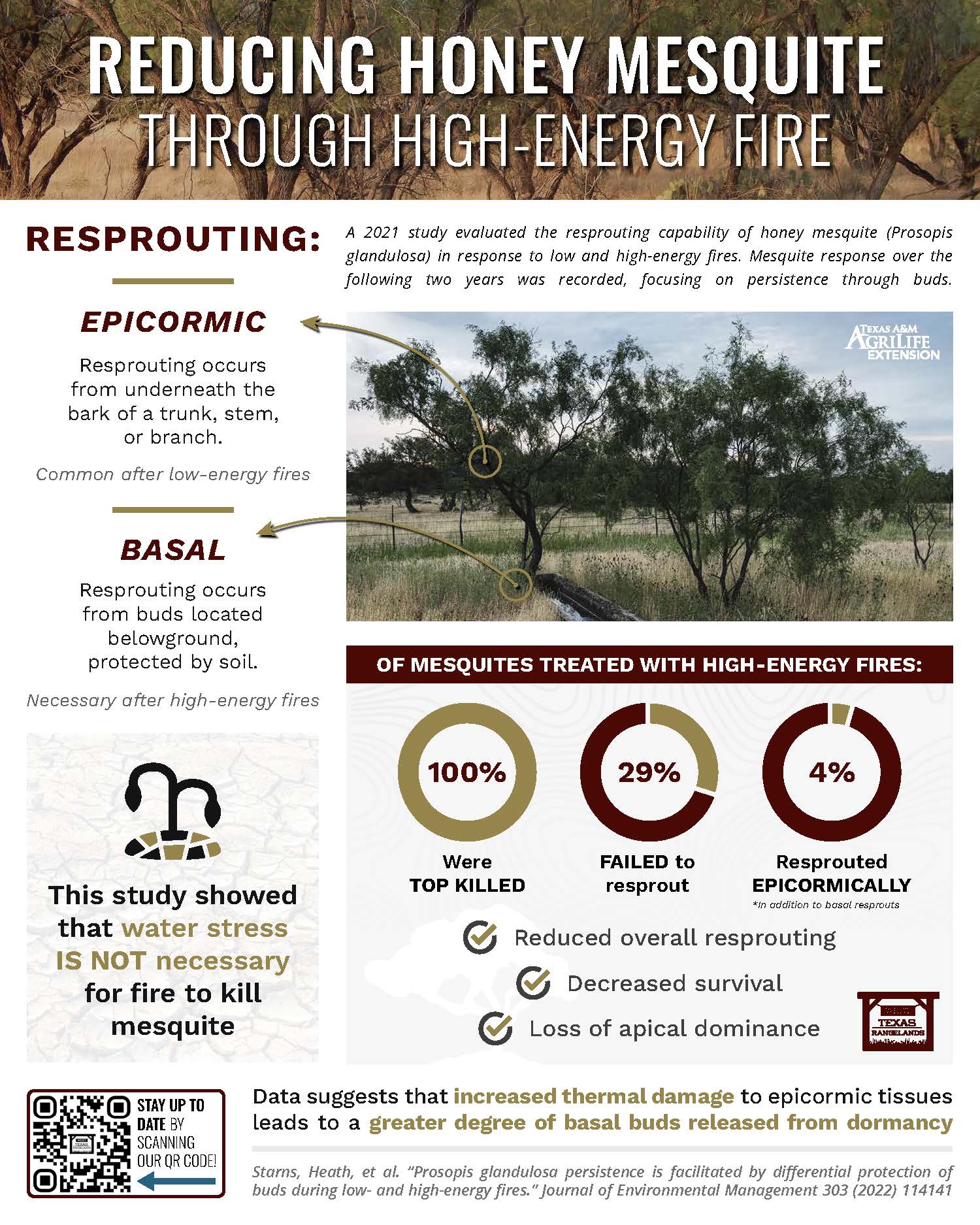
- 100% survival after low-energy fire Every mesquite exposed to low-energy fire resprouted and survived the 2-year study period.
- 29% apparent mortality after high-energy fire Seven of the 24 mesquites subjected to high-energy fire produced no live resprouts after two growing seasons—an unprecedented kill rate in a controlled experiment without drought stress.
- Epicormic (trunk) sprouting virtually eliminated Low-energy fires triggered abundant trunk sprouting (often >100 shoots per tree). High-energy fires almost completely prevented epicormic resprouting—only one tree produced any trunk shoots.
- Fewer basal resprouts with high-energy fire Although basal buds (protected by soil) were more heat-tolerant, high-energy fires still reduced the number of basal resprouts by roughly 50–70% in the first post-fire year compared with low-energy fires.
- Root-crown exposure helped in year one, but effect faded Excavating soil from the base reduced resprouting the first season, but by year two the difference disappeared.
- Results achieved under normal-to-wet conditions The burns were conducted during moderate soil moisture and were followed by above-average rainfall. This demonstrates that extreme fire energy alone—not plant water stress from drought—can significantly impair mesquite recovery.
Practical Implications for Ranchers and Prescribed-Fire Practitioners
- Standard low-intensity prescribed fire remains largely ineffective for reducing mesquite density or canopy cover.
- To achieve meaningful mortality, fires must deliver sustained high heat to the cambium and bud zone for several minutes. This typically requires substantial woody fuel loading (e.g., scattered juniper, brush piles, or heavy dead mesquite stems) and weather conditions that support fire spread.
- Adding targeted woody fuel around individual mesquites or in patches is a practical way to create localized “high-energy” zones even on days when broader landscape conditions are moderate.
- While complete stand replacement with a single fire is still unlikely, repeated high-energy fires over time—especially when residual dead stems remain standing—should progressively increase cumulative mortality.
In short, the study confirms what many experienced burn practitioners have long suspected: when the goal is mesquite control rather than simple top-kill, hotter is unequivocally better.
Citation: Starns, H.D., Wonkka, C.L., Dickinson, M.B., et al. 2022. Prosopis glandulosa persistence is facilitated by differential protection of buds during low- and high-energy fires. Journal of Environmental Management 303: 114141. https://doi.org/10.1016/j.jenvman.2021.114141. Feel free to download a pdf file here!
Safe, effective, and sufficiently intense prescribed fire can be a game-changing tool for restoring grass dominance in mesquite-invaded rangelands. This research gives us the science to justify turning up the heat!!