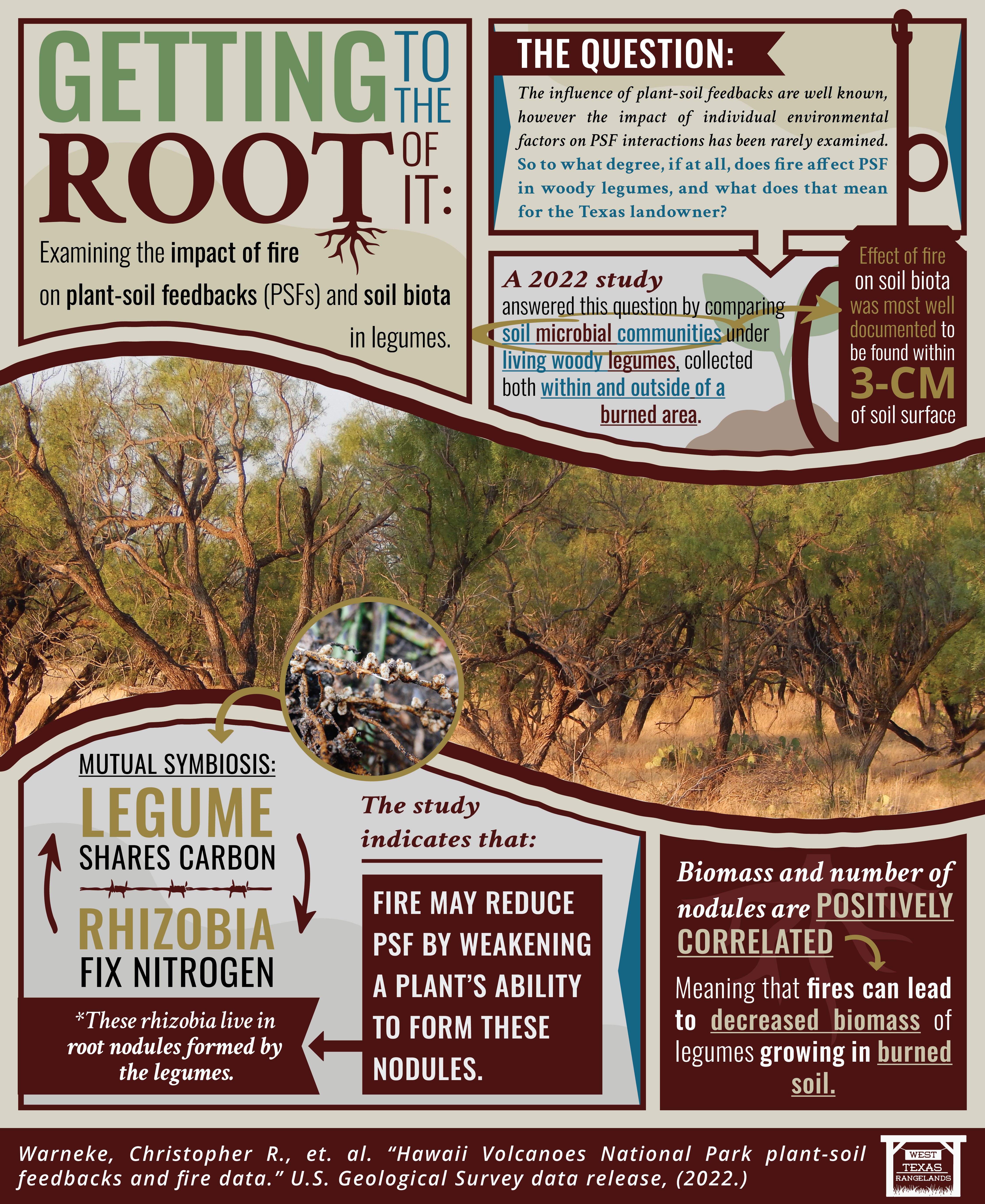
 Interactions between plants and soils, plant-soil feedbacks (PSFs) are widely known to influence patterns of plant diversity at local and landscape scales. However, these interactions are rarely examined in the context of environmental factors. Prescribed fire is an environmental factor that alters microbial communities (Pourreza et al. 2014, Hedo et al. 2015, Prendergast-Miller et al. 2017). Prior to the study below, the influence of fire on PSFs was unexamined. Does fire affect PSF in woody legumes and what does it mean for Texas landowners? This study helped to answer this question by comparing soil microbial communities under living woody legumes, collected both within and outside of a burned area.
Legumes were chosen for this study due to them engaging in a mutualism with rhizobial bacteria in the soil (Andrews and Andrews, 2017). Rhizobial fix nitrogen, which is shared with the plant, while the plant shares carbons and constructs nodules in which the bacteria live. They also provide a rich set of indicators both positive (mutualism with rhizobia) and negative (fungal pathogens) (Jack et al. 2019, Grman et al. 2020).
The prescribed fire took place in Fall of 2018 and after the burn, soil samples were collected from within and outside the burned area. In the Summer of 2019, soil samples were once again collected from within and outside the burned area.
The results indicated that the effects of fire on soil biota was most well documented to be found within 3-cm of soil surface. Fire may reduce PSF by weakening a plant’s ability to form nodules. The biomass and number of nodules are positively correlated, meaning that fires can lead to decreased biomass of legumes growing in burned soil.
What does this mean for Texas? Based on these results, prescribed fire reduces the biomass of the woody legumes which gives way for more native grasses to develop by weakening the legume-rhizobia symbiosis, which may further alter local competitive dynamics among canopy dominant tree species.
For more information and the full study, be sure to read it Soil Feedback
Warneke, Christopher R,. et al. “Hawaii Volcanoes National Park plant-soil feedbacks and fire data.” U.S. Geological Survey data release, (2022.)