• Skip to primary navigation
  • Skip to main content
  • Skip to primary sidebar
  • Texas A&M Forest Service
  • Texas A&M Veterinary Medical Diagnostics Laboratory
  • Texas A&M AgriLife Extension Service
  • Texas A&M AgriLife Research
  • Texas A&M College of Agrculture and Life Sciences
West Texas Rangelands
West Texas RangelandsWe hope to provide a variety of science-based rangeland information and current research on prescribed fire, wildfires, brush management, and grazing management!
  • Menu
  • Home
  • About & Contact
  • Publications
    • Extension Publications
    • Refereed Journal Articles
    • Program Summaries
  • Events
  • Lunch N’ Learn
  • Infographics
    • Drought
    • Grazing
    • Herbicide
    • Prescribed Fire
    • Rangeland Plants
    • Wildfire
  • Range Resources
    • Published to Pasture
    • Range Concepts
  • Fire Resources
  • Sponsors
  • AgriLife Learn Online Courses

Increase in Wildfires Across the Great Plains

March 8, 2023 by jaime.sanford

There have been rapid changes in wildfire patterns and increases in acres burned that have been documented on almost every continent. In Europe, forest fires have increased from 40,000 to more than 95,000 per year. In the United States, over 68,000 wildfires have occurred. With the increase in fires, there has been increasing pressure to identify areas that may experience increases in wildfires in future decades.

In one of her studies Dr. Donovan, walks us through the methods they used to determine if the Great Plains is a region that would be expecting an increase in fire and why it is important to determine this.

It is important to determine regions that could be expecting shifts in wildfires at it allows managers and communities to begin preparing. In looking at the Great Plains, if there is an increase in wildfire risk, many of the states would be ill equipped to handle these fires. In many of the states, the fire departments are volunteer departments and some of these states are unable to provide their departments with the equipment that is needed for fire suppression. It is crucial that studies like this are done to help states to prepare for potential wildfires.
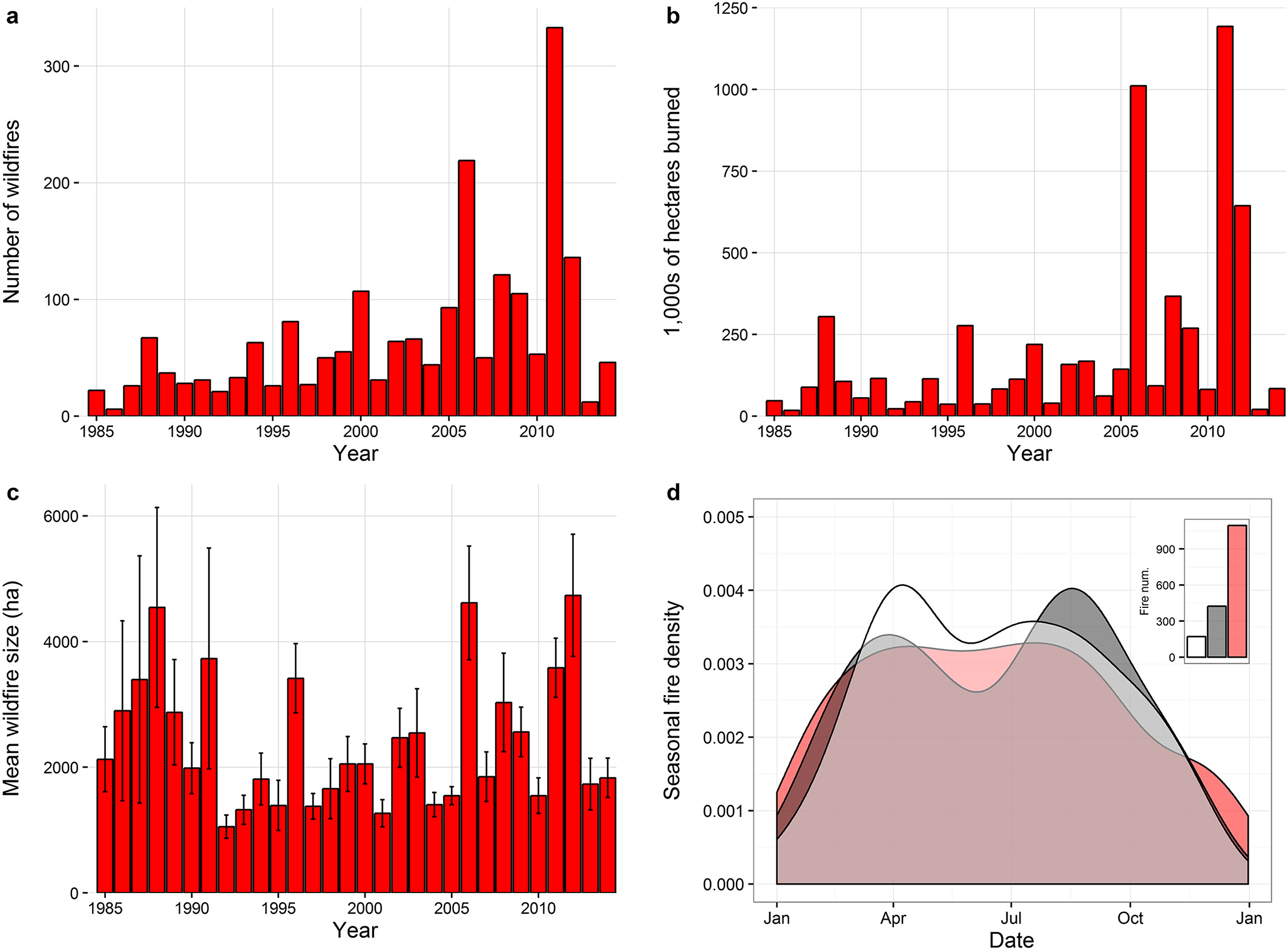
 

Figure 1.

The change in the (a) total number of large wildfires, (b) total area burned by large wildfires, (c) mean large wildfire size, and (d) density plots demonstrating the seasonal distributions of large wildfires during the 1985–1994 (white), 1995–2004 (grey), and 2005–2014 (red) decades in the U.S. Great Plains. Error bars represent standard error.

In her studies, she found that there was a 100% chance of a large wildfire occurring each year across the Great Plains. While the seasonality of fires remained relatively similar across the decades, large wildfires did become slightly more concentrated in the Spring and the Fall. The Great Plains is a large area, but her study breaks down the different regions within the Great Plains. While this study is just a starting point, more studies like these are needed. For more information and a look at the full study and details, be sure to read Dr. Victoria Donovan’s full Research Letter.

Filed Under: Wildfires Tagged With: Great Plains, Wildfires

Recent Posts

  • Fire Up Plant Diversity!
  • New Publication! Photosensitization
  • Dry, Warm, Windy, and Fuel.
  • Lessons Learned – Pyro-Vortex Tornado on the Deer Creek Fire
  • Mapping Fire Before It Starts: How the Fireshed Project Strengthens Readiness in West Texas

Categories

  • 4-H Range Contests
  • Beef Cattle
  • Brush Management
  • Carbon Credits
  • Carbon Markets
  • Conservation
  • Conservation Practices
  • Drought Management
  • El Niño
  • Events
  • Goats
  • Grazing Management
  • La Niña
  • Land
  • Lessons Learned
  • Meet A County Extension Agent
  • Plant ID
  • Podcast
  • Prescribed Burn Associations
  • Prescribed Burning
  • Publications
  • Range Concepts
  • RAP
  • Sheep
  • Society for Range Management
  • Soil
  • Staff
  • Targeted Grazing
  • Uncategorized
  • Water
  • Weather
  • Why I Ranch
  • Wild Pigs
  • Wildfire
  • Wildfires
  • Wind
  • Woody Encroachment
  • Youth Range Workshop

Archives

Texas A&M AgriLife Extension Service
Texas A&M University System Member
  • Compact with Texans
  • Privacy and Security
  • Accessibility Policy
  • State Link Policy
  • Statewide Search
  • Veterans Benefits
  • Military Families
  • Risk, Fraud & Misconduct Hotline
  • Texas Homeland Security
  • Texas Veteran's Portal
  • Equal Opportunity
  • Open Records/Public Information