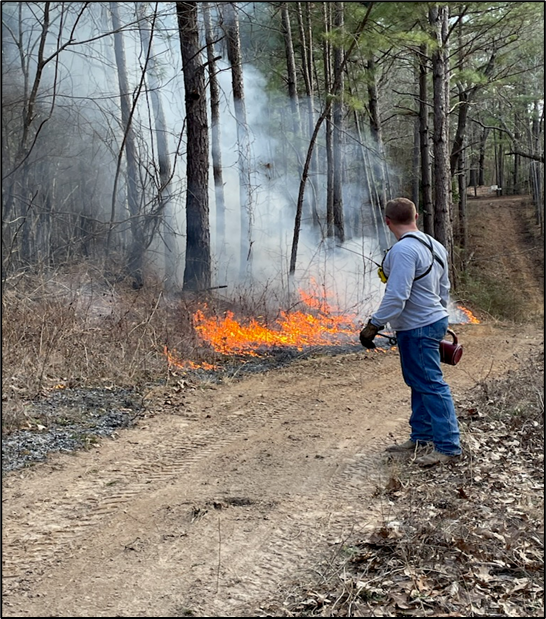
We’re excited to feature a guest blog this week, written by Samuel Campassi! Samuel brings a unique perspective and valuable insight to this topic—be sure to check out his full bio below.
Howdy! My name is Samuel Campassi. I am a senior Rangeland, Wildlife, and Fisheries Management (RWFM) major at Texas A&M University. As a generational hunter and outdoorsman, I am deeply passionate about all things conservation and priming the next generation of land stewards. This summer, I have the great honor of working under renowned range specialist and prescribe fire expert, Dr. Morgan Treadwell. I am so excited to be able to learn from Dr. Treadwell, and gain valuable range management skills that will benefit my career as a dedicated conservationist.
Why is Fire Important? What are the Goals?
One of the five essential land management tools championed by Aldo Leopold has long served as a natural mechanism for managing and sustaining ecosystems. For thousands of years, natural ignitions and intentional burns have helped maintain open landscapes and manipulate plant communities for desired land management outcomes. Today, prescribed fire continues to play a vital role in preserving ecosystem services by improving wildlife habitat, enhancing plant diversity, increasing forage production, and reducing wildfire risk by removing accumulated woody fuels. Rooted in a long evolutionary history, the goal of fire is that it continues to serve as a powerful ecological tool that restores and enhances wildlife habitat, supports biodiversity, nutrient cycling, and carbon sequestration. By strategically integrating fire into management plans, land managers can support rangeland and agricultural productivity while also maintaining long-term ecological resilience.
Benefits
- Promotes carbon sequestration.
- Supports both above- and below-ground biomass.
- Stimulates the growth of native grasses and forbs essential for wildlife.
- Reduces woody encroachment.
- Reduces fuel loads for potential wildfires
Considerations
When conducting a prescribed burn, many considerations factor into a management plan. One must determine a management objective: what is being managed for? The natural elements are integral to fire behavior: weather, relative humidity, fuel loading, wind speed and direction, drought conditions, and temperature. One must also be aware of the native wildlife: how will they respond to fire? Finally, land managers must be aware of burn bans and other regulatory requirements enforced by the TCEQ (Texas Commission for Environmental Quality for training and certificates by the Texas PBB (Prescribed Burning Board).