Merry Christmas!
As we gather with family and friends this holiday season, many of us are also thinking ahead to 2026 rangeland goals, especially the ongoing battle against invasive monocultures of Old-World bluestems. In the spirit of giving useful gifts, here’s a practical, research-backed summary from TAMU RWFM’S Dr. Lucero’s lab on the newest science on how to fight these tough grasses, just in time for your 2026 management planning!
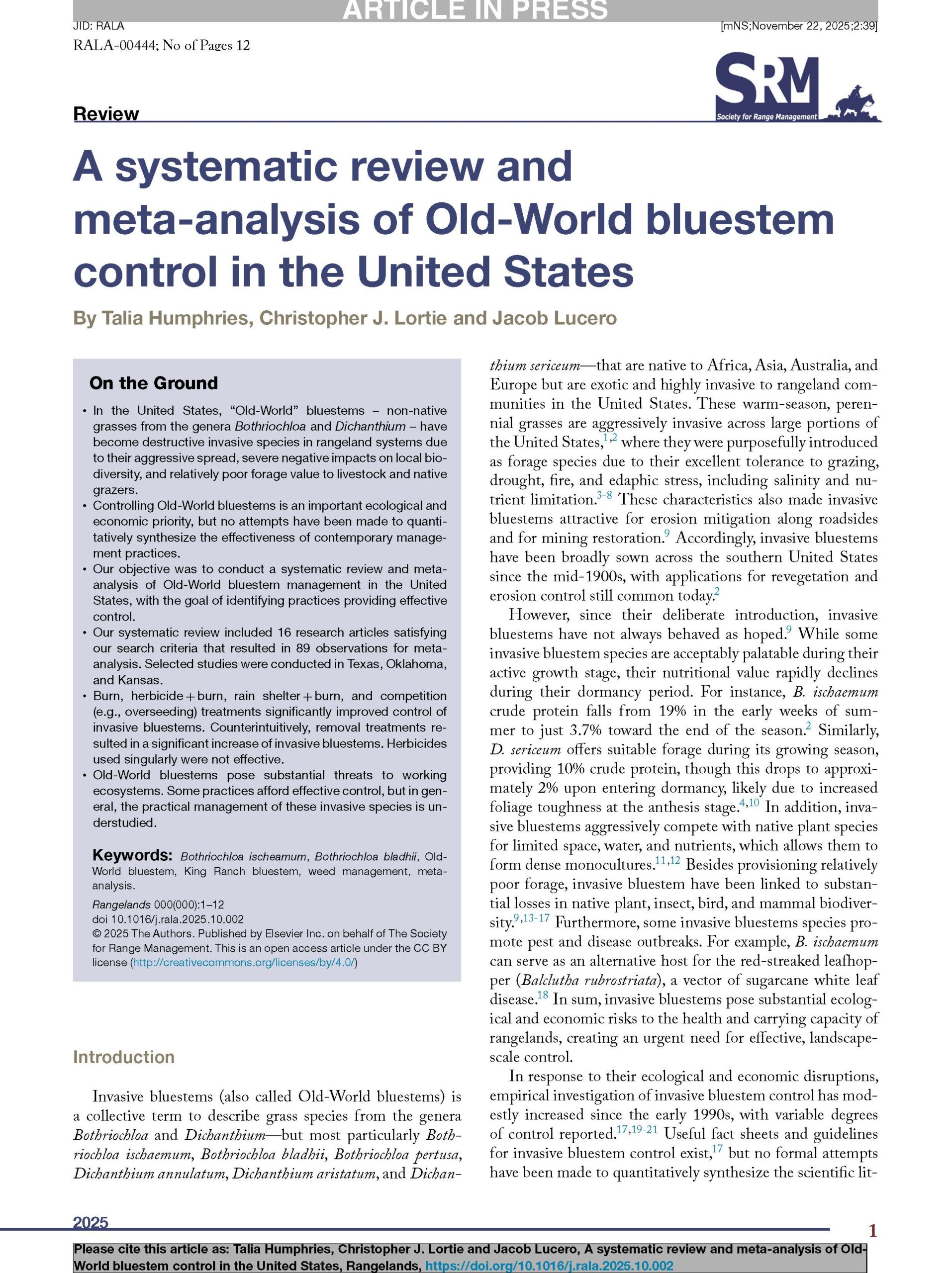
Old-World bluestems, non-native grasses from the genera Bothriochloa and Dichanthium, were originally introduced to the United States for forage and erosion control. However, these species have become invasive, spreading aggressively across rangelands, reducing biodiversity, and providing limited nutritional value to livestock as the growing season progresses. Their crude protein content, for instance, can decline from approximately 19% in early summer to as low as 3-4% later in the year, impacting grazing quality and ecosystem health.
A recent systematic review and meta-analysis, published in Rangelands (DOI: 10.1016/j.rala.2025.10.002) from TAMU Rangeland, Wildlife, and Fisheries Department Dr. Talia Humphries, Christopher J. Lortie and Dr. Jacob Lucero, synthesizes existing research on controlling these invasive grasses. This study examined 16 peer-reviewed articles from Texas, Oklahoma, and Kansas, yielding 89 observations. The analysis identifies effective management strategies while highlighting gaps in the literature.
Challenges Posed by Old-World Bluestems
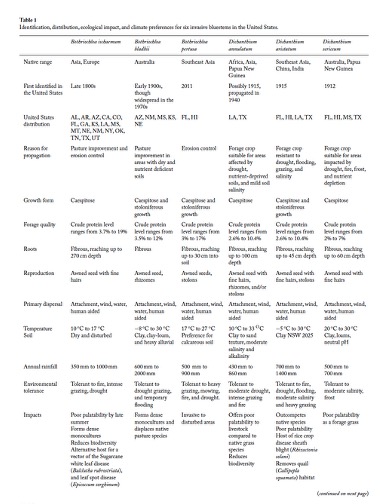
These warm-season perennial grasses, native to regions in Africa, Asia, Australia, and Europe, thrive in drought-prone, disturbed environments. Introduced since the late 1800s for their resilience to grazing, fire, and poor soil conditions, they now form dense monocultures that outcompete native species. This leads to decreased plant, insect, bird, and mammal diversity, as well as potential facilitation of pests and diseases, such as serving as hosts for vectors of sugarcane white leaf disease.
The review emphasizes the ecological and economic urgency of control, as these species continue to expand across southern U.S. states and Hawaii, threatening rangeland productivity and sustainability.
Key Findings on Control Strategies
The meta-analysis evaluated 15 treatments, measuring their impact on bluestem cover, frequency, biomass, and other metrics using Hedge’s g effect size. The overall effect across treatments was a moderate reduction in invasion (Grand mean = -0.49 ± 0.12). Notably:
- Prescribed Fire: This standalone treatment significantly reduced bluestem abundance (Hedge’s g = -0.9961, P < 0.0001), offering a practical option for rangeland restoration.
- Herbicide Combined with Burning: Integrating herbicide application prior to burning yielded strong control (Hedge’s g = -3.1234, P = 0.0018), enhancing efficacy through synergistic effects.
- Rain Shelter Combined with Burning: Simulating drought conditions via rain exclusion before burning also proved effective (Hedge’s g = -0.8887, P = 0.0100), particularly in arid regions where water stress weakens the grasses.
- Competition through Overseeding: Introducing competitive native or desirable species significantly curbed bluestem spread (Hedge’s g = -1.1602, P < 0.0001), promoting long-term ecosystem recovery.
Conversely, mechanical removal alone increased bluestem invasion (Hedge’s g = 0.9636, P = 0.0072), likely due to soil disturbance favoring regrowth. Standalone herbicide applications showed no significant effect.
Study duration influenced outcomes, with longer-term experiments indicating potential bluestem resurgence, underscoring the need for repeated or sustained interventions.
Research Gaps and Implications for Management
The analysis reveals a scarcity of studies—only 16 met inclusion criteria despite over 30 years of concern—limiting statistical power for some treatments. Most research focused on Bothriochloa ischaemum, with limited data on other species like Bothriochloa bladhii or Dichanthium annulatum. Few studies explored integrated approaches, suggesting a need for more research on combined strategies and broader geographic representation.
For ranchers, landowners, and conservationists:
- Prioritize burning or herbicide-burn combinations, consulting local experts for safe implementation and regulatory compliance.
- Incorporate overseeding with native species to foster competition and biodiversity.
- Avoid isolated mechanical removal, as it may exacerbate the issue.
- Monitor sites over multiple years to assess and adapt management plans.
This synthesis provides evidence-based guidance for addressing Old-World bluestems, supporting sustainable rangeland management. For detailed methodologies and results, refer to the full article in Rangelands. Collaboration with extension services can help tailor these strategies to specific locales.
From all of us who work to keep America’s grasslands healthy, we wish you a very Merry Christmas, a prosperous New Year, and strong success in restoring your pastures and prairies in 2026. May your cattle gain well, your native grasses flourish, and your Old-World bluestems finally meet their match.
Merry Christmas!