 A Fire danger index (FDI) is a measure that is used to assess the risk and severity of a fire. It relies on the combination of weather and fuel conditions. These FDI’s have been used to help predict and manage the risk of wildfires. Even with these tools, there is still uncertainty in predicting the likelihood of fire ignition or the potential size the fire can get.
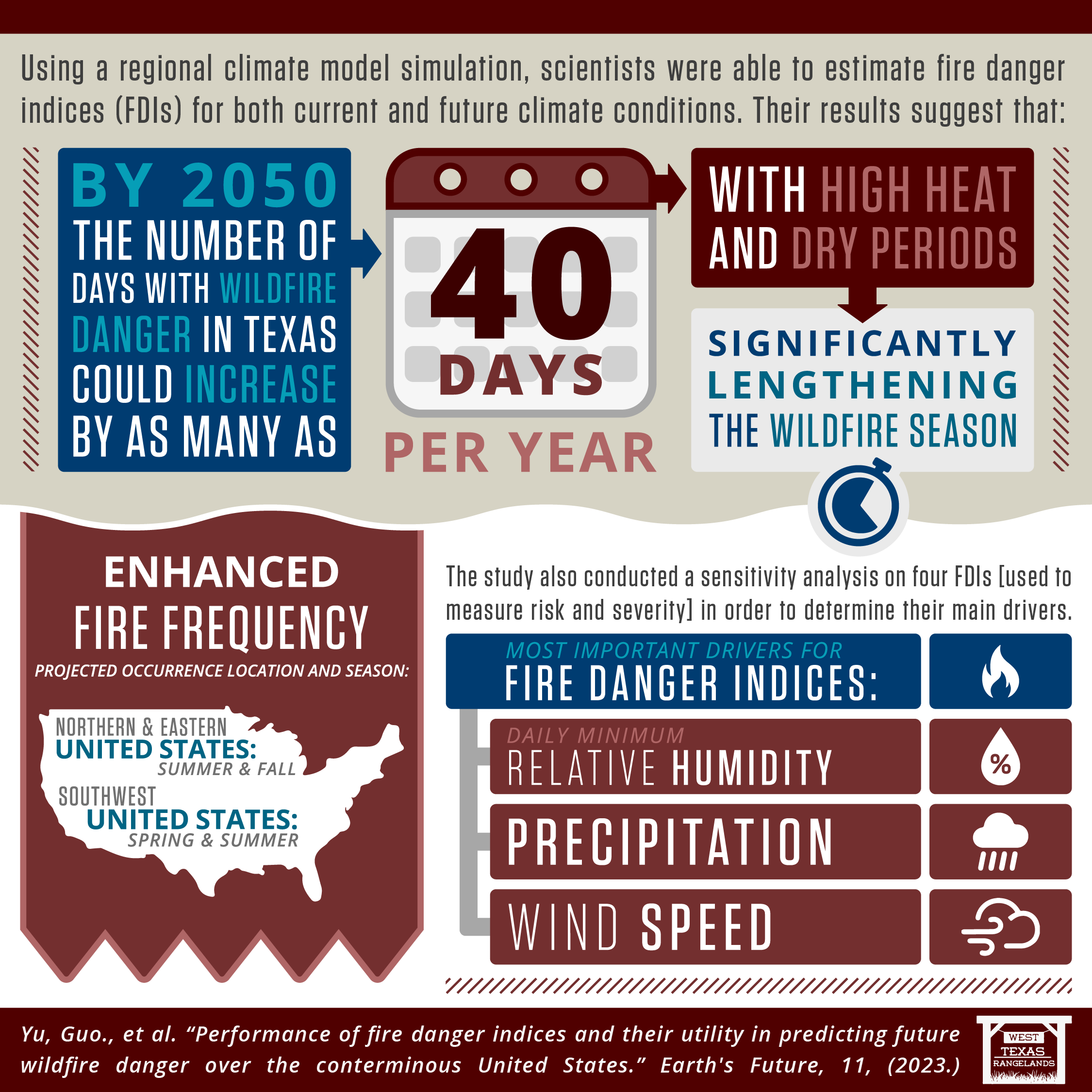
In the study below, four of the FDI’s were analyzed and had a sensitivity analysis performed on them to determine the most important drivers. The sensitivity analysis determined that daily minimum relative humidity, precipitation, and wind speed were the most important driving factors in future wildfire dangers, including length of a wildfire season.
The study also included a regional climate model simulation to derive FDI’s for current and future climate conditions. The results from this simulation suggested that an overall increase in fire potential and a prolonged wildfire season is expected in our future Texas climate. Enhanced fire frequency and fire season length is expected to occur in Spring and Summer throughout the Southern Great Plains.
By 2050, the number of days with wildfire danger in Texas could increase by as many as 40 days per year with high heat and dry periods significantly lengthening the wildfire season.
For more information and to read the study below, click here – Earth s Future – 2023 – Yu – Performance of Fire Danger Indices and Their Utility in Predicting Future Wildfire Danger Over!
Yu, G., Feng, Y., Wang, J., & Wright, D. B. (2023). Performance of fire danger indices and their utility in predicting future wildfire danger over the conterminous United States. Earth’s Future, 11(11). https://doi.org/10.1029/2023ef003823