• Skip to primary navigation
  • Skip to main content
  • Skip to primary sidebar
  • Texas A&M Forest Service
  • Texas A&M Veterinary Medical Diagnostics Laboratory
  • Texas A&M AgriLife Extension Service
  • Texas A&M AgriLife Research
  • Texas A&M College of Agrculture and Life Sciences
West Texas Rangelands
West Texas RangelandsWe hope to provide a variety of science-based rangeland information and current research on prescribed fire, wildfires, brush management, and grazing management!
  • Menu
  • Home
  • About & Contact
  • Publications
    • Extension Publications
    • Refereed Journal Articles
    • Program Summaries
  • Events
  • Lunch N’ Learn
  • Infographics
    • Drought
    • Grazing
    • Herbicide
    • Prescribed Fire
    • Rangeland Plants
    • Wildfire
  • Range Resources
    • Published to Pasture
    • Range Concepts
  • Fire Resources
  • Sponsors
  • AgriLife Learn Online Courses

Analysis of the Cost and Cost Components of Conducting Prescribed Fires in the Great Plains

January 24, 2024 by jaime.sanford

Fire is a naturally occurring process that was first applied by the Native Americans and continues today in the Great Plains by a diverse group of landowners. Fire is an incredible tool that is used to help restore fire regimes in the region. Not only is it used to restore fire regimes, it is also used to maintain and grow benefits for Agricultural outputs, risk reduction, and ecosystem maintenance.


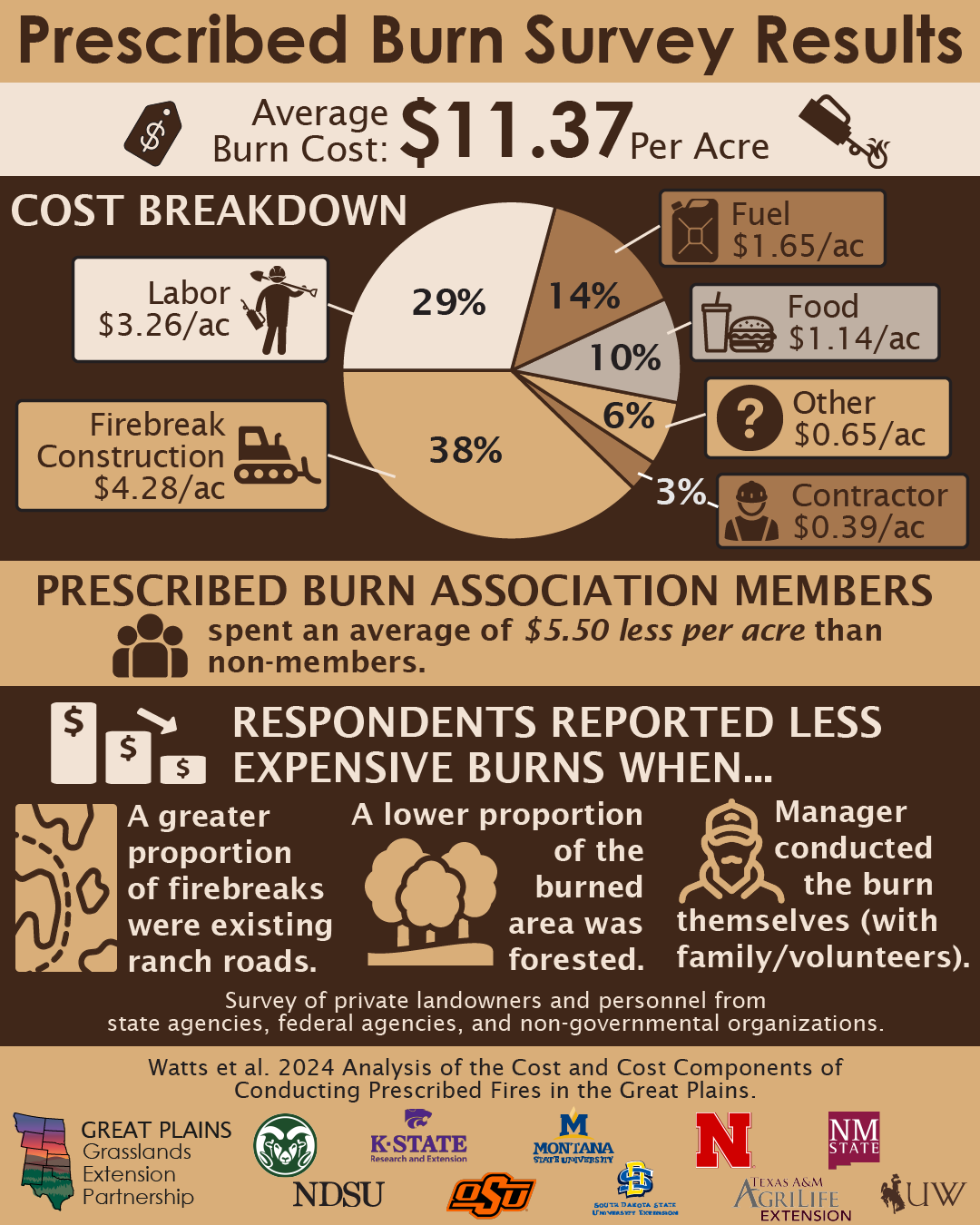
One of the key factors in the adoption of prescribed burning is the cost. In a recent study, prescribed burn professionals in the Great Plains were surveyed and the average cost of a prescribed burn reported was $11.37 per acre. This is less expensive than numbers that have been reported elsewhere.

There were seven significant variables that emerged during this study, some including, number of burns and acreage, firebreak type, and fuel characteristics. This study also suggests that economies of scale play an important role in the cost of prescribed burning. 

For more information and to read the full study, click here!

Filed Under: Conservation, Prescribed Burn Associations, Prescribed Burning, Woody Encroachment

Recent Posts

  • Fire Up Plant Diversity!
  • New Publication! Photosensitization
  • Dry, Warm, Windy, and Fuel.
  • Lessons Learned – Pyro-Vortex Tornado on the Deer Creek Fire
  • Mapping Fire Before It Starts: How the Fireshed Project Strengthens Readiness in West Texas

Categories

  • 4-H Range Contests
  • Beef Cattle
  • Brush Management
  • Carbon Credits
  • Carbon Markets
  • Conservation
  • Conservation Practices
  • Drought Management
  • El Niño
  • Events
  • Goats
  • Grazing Management
  • La Niña
  • Land
  • Lessons Learned
  • Meet A County Extension Agent
  • Plant ID
  • Podcast
  • Prescribed Burn Associations
  • Prescribed Burning
  • Publications
  • Range Concepts
  • RAP
  • Sheep
  • Society for Range Management
  • Soil
  • Staff
  • Targeted Grazing
  • Uncategorized
  • Water
  • Weather
  • Why I Ranch
  • Wild Pigs
  • Wildfire
  • Wildfires
  • Wind
  • Woody Encroachment
  • Youth Range Workshop

Archives

Texas A&M AgriLife Extension Service
Texas A&M University System Member
  • Compact with Texans
  • Privacy and Security
  • Accessibility Policy
  • State Link Policy
  • Statewide Search
  • Veterans Benefits
  • Military Families
  • Risk, Fraud & Misconduct Hotline
  • Texas Homeland Security
  • Texas Veteran's Portal
  • Equal Opportunity
  • Open Records/Public Information