• Skip to primary navigation
  • Skip to main content
  • Skip to primary sidebar
  • Texas A&M Forest Service
  • Texas A&M Veterinary Medical Diagnostics Laboratory
  • Texas A&M AgriLife Extension Service
  • Texas A&M AgriLife Research
  • Texas A&M College of Agrculture and Life Sciences
Texas Prescribed Burn Handbook
Texas Prescribed Burn HandbookTexas A&M Agrilife Extension
  • Menu
  • About
  • Texas Plants
    • General Rules of Thumb for Juniper
    • A partial list of sprouting and non-sprouting woody plants.
  • Planning
    • Planning a Prescribed Burn
    • General Prescription
    • Firebreaks
    • Estimating Fuel Quantity and Moisture
  • Burn Boss
    • Pre-Burn Contacts and Emergency Numbers
    • Burn Boss Checklist
    • Burn Boss Role
    • Fire Crew Duties
    • Prescribed Burn Documentation
  • Safety
    • Emergency First Aid
    • Personal Gear and Safety
    • Prescribed Fire Safety
    • Prescribed Fire Orders
    • Go/No-Go Checklist
    • Handtool Safety
    • Vehicle Safety
    • Operational Leadership
    • Duty
    • Respect
    • Integrity
    • Communication Responsibilities
    • Human Factor Barriers to Situational Awareness
    • After Action Review
  • Weather & Fuel
    • Severe Fire Behavior Potential Related to Relative Humidity and Fuel Moisture Content
    • Lightning Activity Level (LAL)
    • Keetch-Byram Drought Index (KBDI)
    • Spot Weather Forecast
    • General Guidelines for Juniper Leaf Moisture
    • Outputs of the NFDRS (National Fire Danger Rating System)
    • LAL and Spot Weather Forecast
    • Calculating One Hour Fuel Moisture And Probability of Ignition (PI)
    • NFDRS Fuel Model Description
    • Fuel Model Key
    • Estimate Live Juniper % Moisture
    • Reference Fuel Moisture Adjustment Tables
    • Probability of Ignition Table
    • Fire Behavior Hauling Chart
    • Relative Humidity: 1400′-4999’ Elevation
    • Wind Speed Ranges
    • Category Day (CD) For Smoke Management
Home » Weather & Fuel » Probability of Ignition Table

Probability of Ignition Table

  1. Using Table A, determine Reference Fuel Moisture (RFM) from intersection of temperature and relative humidity. Record this RFM percentage.
  2. Select Table B, C, or D to adjust RFM for local conditions by finding current month in table title.
    • Are the fine fuels more than 50 shaded by canopies and clouds? If yes, use bottom (shaded) portion of table. If no, use top (exposed) portion of table.
    • Determine the appropriate row based on aspect and slope. Determine the appropriate column-based on time of day and elevation of area of concern when compared to the wx site elevation.
    • Obtain the Dead Fuel Moisture Content Correction (%) from the intersection of row and column.
  3. Add the resulting Dead Fuel Moisture Content Correction (%) to the Reference Fuel Moisture
    (%).
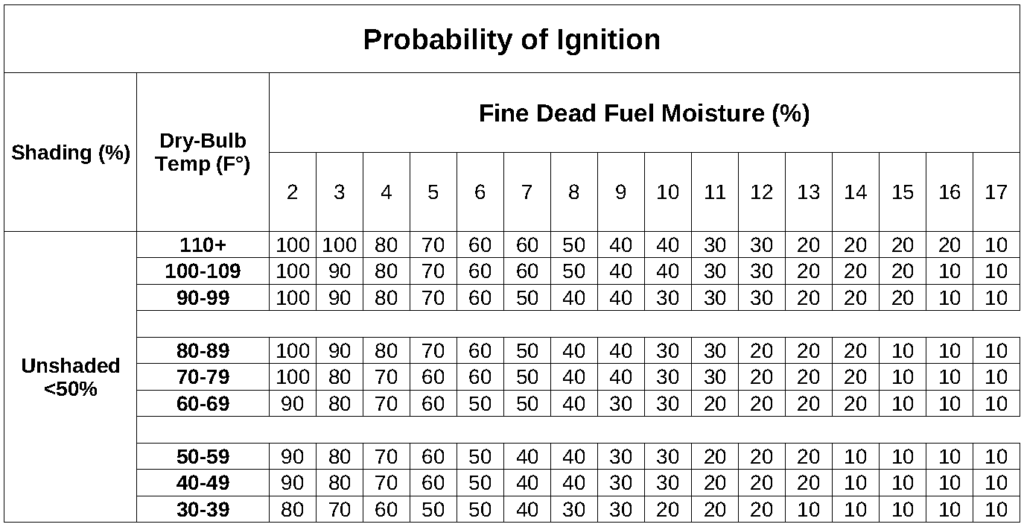
Probability of Ignition

Menu

  • Contact
  • Laws and Regulations
    • Burning Laws and Regulations
    • Certified Prescribed Burn Manager Commercial or Private
  • Equipment
    • Prescribed Fire Equipment
    • Water Delivery Information
  • Videos
    • Living With Texas Fire
    • Ring Fire Ignition Method
    • Fire Up Your Beef
    • The Business of Burning
    • Flame and Fortune Prescribed Burn School
    • Prescribed Burn Goals and Objectives
    • Fire Equipment (series)
    • Drip Torch Point of View
    • Prescribed Burning
  • Prescribed Fire Terms
    • Fire Behavior Terminology
    • Energy Release (ERC)
    • Burning Index (BI)
    • Haines Index (HI)
  • Publications
  • Links and Information
Texas RX Burn logo
Texas A&M AgriLife Extension Service
Texas A&M University System Member
  • Compact with Texans
  • Privacy and Security
  • Accessibility Policy
  • State Link Policy
  • Statewide Search
  • Veterans Benefits
  • Military Families
  • Risk, Fraud & Misconduct Hotline
  • Texas Homeland Security
  • Texas Veteran's Portal
  • Equal Opportunity
  • Open Records/Public Information