
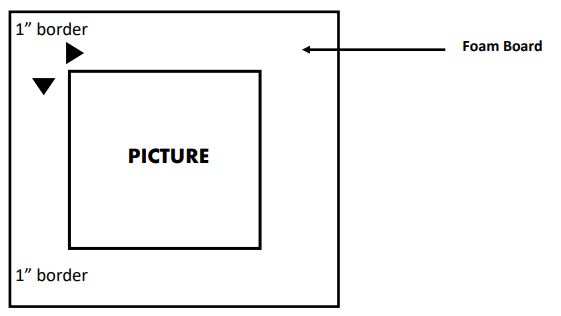
Click here for a mounted photo example
DIVISION Q – PHOTOGRAPHY
SUPERINTENDENT: Allison Terry, phone # 254-913-8072
SPECIAL RULES:
Photos must be turned in from 2:00-6:00 pm on Saturday, Feb. 7th in the lobby of the Assembly Hall at Cadence Bank Center.
**Photography will NOT be entered digitally.
1. Photo MUST be taken by exhibitor (exhibitor must not be in photo).
Submit only one entry per class. Photos must be taken after
February 8, 2025.
2. Photography will be judged on impact, creativity, technical aspects,
composition, and print quality. Make sure your photo meets class
definitions.
3. All entries must be printed on 5” x 7” photo paper, securely affixed
on a solid white 7” X 9” mount board or foam board (see sample in
fair book). Any other backer board will be disqualified. See
instructions for mounting photos on BCYF website.
4. The photo may be gloss or matte.
5. Photos must NOT be framed, and no glass or plexiglass is allowed,
these will be disqualified.
6. A label with the exhibitor number and class will be affixed to the back
of the foam board.
7. ONLY the following MINOR digital manipulation is allowed: red-eye
correction, cropping, and straightening of photo. If using a
smartphone for photography entry, filters should not be used.
8. Any exhibitor submitting a photograph acknowledges that they have
sufficient permission of any recognizable location/people appearing
in the photo and can produce a model/property release if requested.
9. If the same photo is entered by siblings, or by two
exhibitors, both individuals will be disqualified.
10. Photography will NOT be moved from one class to
another. Any photo submitted to the wrong class will
be disqualified.
DEFINITIONS:
ANIMALS-DOMESTIC: Photos focusing on the various
animals that have been tamed and made fit for a human
environment. To be considered domesticated, the animal
must have their behavior, life cycle, or physiology
systemically altered as a result of being under human control
for many generations.
Examples include Chickens, cows, dogs, cats, geese/ducks
(domestic use), hamsters, horses, pigs, sheep, goats, etc.
ANIMALS—WILDLIFE: Category focuses on animals not
tamed or domesticated and commonly found in the
wilderness or the bodies of water throughout the country or
world. Photos can be of wildlife in nature, zoos, and/or
petting zoos.
Examples include: Birds, deer, elephants, snakes, whales,
etc.
CATCH-ALL: Photos that do not fit into one of the other
categories. NOT ALLOWED: A duplicate photo also entered
in another category. Examples: Polaroid image & emulsion
transfers, still-life (inanimate objects), flat lay photography.
DETAILS & MACRO: Getting in close is the name of the
game for this category. The goal is to zoom in close on an
object to see its finer details or to make small objects appear
life-sized or larger that we do not normally get to see with the
naked eye. Examples: Insect eyes, veins on a leaf, a
reflection in a water droplet, etc.
ELEMENTS OF DESIGN: Images use of graphic elements
of design. Photos that showcase line, shape, pattern, form,
texture, perspective, etc. Photo can consist of any subject
matter.
Examples: Line, pattern, perspective, shape, etc.
NOT ALLOWED: Digital creations or graphic designs made
in software such as Photoshop, InDesign or Illustrator
FOOD: A still life specialization of photography, aimed at
producing attractive photographs of food for use in such
items of advertisements, packaging, menus and/or
cookbooks.
Examples: Cakes/pies, Easter eggs, fruits and place
settings, ingredients, sandwiches, Thanksgiving dinner, etc.
Not allowed: A photo of alcohol beverages.
LANDSCAPE & NATURE (NON-ANIMAL): The focus of this
category includes landscapes, outdoor scenic, nature
images, sunsets, urban landscapes, seascapes, cityscapes,
and farms. Images focus on the beauty of the outdoors.
Examples: Gardens/landscapes, outdoors, scenic, etc. Not
allowed: Primary subject is a person or wildlife.
Page 121
Leading Line: This image composition technique features
lines that draw the viewer’s eye from point A to point B, which
is the primary subject. Example: A river that begins in the
foreground and draws your attention to a photogenic bridge
in the background.
Motion/Action: The capture of movement within a single
photo. The subject appears stopped or frozen. Examples:
Ferris wheel spinning, sporting events, horse running across
a field, etc.
People: People focus from all walks of life, parenting and
family, children, babies, models/fashion, and couples. All
individuals in the photos must have provided consent and
permission as a subject. If requested, a release will be
needed from the photographer and subject. Examples:
Babies, families, kids, portraits, models/fashion, etc.
Plant/Flora: Photos of interesting, unique, and beautiful
flowers and flora. Photography can take place outdoors or
indoors. Photo subject should be that of a single flower, plant,
bush, tree, etc. Large collections of plant/flora should be
considered for entry in the Nature & Landscape category.
Examples: A rose, an upward shot of a tree, etc.
Shadow/Silhouette: A silhouette is an outline that appears
dark (typically a single color) with little or no details/features
against a brighter background. Recording patterns of light
and shade for a desired effect or emphasis is the definition of
a shadow. The silhouette or shadow must be the primary
subject and focus of the
image. Examples: shadows/silhouettes of people, plants,
animals, structures, architectures, or natural structures.
CLASSES:
Q-1 People – Black & White or Color – Junior
Q-2 People – Black & White or Color – Senior
Q-3 Animal Domestic – Black & White or Color – Junior
Q-4 Animal Domestic – Black & White or Color – Senior
Q-5 Animal Wildlife – Black & White or Color – Junior
Q-6 Animal Wildlife – Black & White or Color – Senior
Q-7 Food – Black & White or Color – Junior
Q-8 Food – Black & White or Color – Senior
Q-9 Details & Macro – Black & White or Color – Junior
Q-10 Details & Macro – Black & White or Color – Senior
Q-11 Landscape & Nature -Black & White or Color – Junior
Q-12 Landscape & Nature -Black & White or Color – Senior
Q-13 Plant/Flora – Black & White or Color – Junior
Q-14 Plant/Flora – Black & White or Color – Senior
Q-15 Motion/Action – Black & White or Color – Junior
Q-16 Motion/Action – Black & White or Color – Senior
Q-17 Elements of design – Black White or Color – Junior
Q-18 Elements of design – Black White or Color – Senior
Q-19 Leading Line -Black & White or Color – Junior
Q-20 Leading Line – Black & White or Color – Senior
Q-21 Catch-All- Black & White or Color – Junior
Q-22 Catch-All – Black & White or Color – Senior
Q-23 Shadow/Silhouette – Black & White or Color—Junior
Q-24 Shadow/Silhouette – Black & White or Color—Senior