Who Needs Limestone:
Many Texas soils are acid soils; that is, the soil pH is less than 7.0. Soil acidity is caused by various environmental, climatic, and cultural factors. The most common of these factors are:
- Parent material from which the soil is derived.
- Leaching by rainfall or irrigation that removes basic elements such as calcium, magnesium, and sodium from the soil profile leaving acidic hydrogen, aluminum, and manganese.
- Cultural practices such as nitrogen fertilization, removal of harvested crops and associated basic elements, and soil erosion, which results in a loss of basic elements.
Some plants are more sensitive to acid soil conditions than others. It is important to understand which species are more sensitive to soil acidity so limestone inputs may be made at the appropriate time.
Soil pH is a measure of hydrogen ion (H+) concentration in the soil solution and is used to indicate whether a soil needs any limestone. A lime-requirement test (buffer-pH test) is recommended to more accurately predict the amount of limestone needed to raise soil pH to a desired level.
What is Limestone:
Limestone is primarily composed of calcium carbonate but many contain small amounts of clay, silt and dolomite. Dolomitic limestones come from natural deposits which contain both calcium and magnesium carbonates. The magnesium content of limestone is especially important where soils are deficient in this essential plant nutrient. If a soil test indicates low magnesium, dolomitic limestone can be used to correct both the nutrient deficiency and pH.
The value of limestone is in its ability to neutralize soil acidity. Limestone’s properties differ considerably, and these differences influence the limestone’s ability to neutralize soil acidity. Effectiveness depends on the purity of the liming material and how finely it is ground. Pure limestone has a calcium carbonate equivalence (CCE), or neutralizing value, of 100%. All other liming materials are compared with this standard. The CCE of commercial limestone products should be available through the vendor. Agricultural limestones used in crop production systems are mainly ground calcium carbonate. Impurities contained in some limestones lower the neutralizing value.
Why Should You Apply Limestone?
Soil acidity reduces plant nutrient availability and increases aluminum and manganese toxicities. As pH drops below 5.5, the concentration of soluble aluminum increases and becomes toxic to plant root growth. Below pH 5.2, the concentration of manganese also increases and can become toxic. Optimum nutrient uptake by most crops occurs at a soil pH near 7.0. For specific crop recommendations contact your local County Extension Agent. The availability of fertilizer nutrients such as nitrogen, phosphorus, and potassium generally is reduced as soil pH decreases. Reduced fertilizer use efficiency and crop performance can be expected when soil acidity is not properly controlled.
When Should You Apply Limestone:
Timely soil sampling is important because limestone requires both soil moisture and time to neutralize soil acidity. Early sampling and limestone application several months in advance of crop growth provide time for pH adjustment. Soil pH fluctuates during the year becoming lowest in the fall, in part because of fertilizer applications and plant removal. Under intense grass production using high rates of nitrogen fertilizer, sandy soils will rapidly increase in acidity. Sampling at least every other year is recommended.
Although limestone can be applied at any time, several factors should be considered when planning an application. Soil moisture is critical to the reaction of limestone, therefore rainfall patterns in the area should be used as a guide. Coarse limestone reacts more slowly and, as will all limestones, is most effective when incorporated into the soil. When a more rapid and longer lasting pH adjustment is needed, the use of finely ground limestone is available.
How Should You Apply Limestone?
Liming materials differ in their ability to neutralize acid soils. Pure calcium carbonate is the standard against which other liming materials are measured and its neutralizing value or CCE is considered 100%. Fine limestone neutralizes much more acidity than coarser material. Anything larger than a BB pellet is too large of a particle and essentially has no value for neutralizing acid soils.
- Dry bulk limestone is typically applied using fertilizer spreader trucks.
The amount of limestone recommended to neutralize an acid soil is based on applying ECCE 100% limestone. If one ton of limestone is recommended per acre, and the cost of the ECCE 62% coarse limestone is $48/ton applied in the field, the actual cost of one ton of the coarse limestone is $77.42
62% divided by 100 = 0.62 x 2,000 lbs/ton = 1,240 lbs of effective lime material (ELM) so you will need more of the 62% ECCE coarse limestone to equate to 1 ton or 2,000 lbs of effective lime material.
2,000 lb ELM/ton divided by 1, 240 lb ELM/ton = 1.61 x $48/ton = $77.42
Compare this to the cost of a ton of the fine limestone (ECCE 100%) selling for $50
2,000 lb ELM/ton divided by 2,000 lb ELM/ton = 1 x $50/ton = $50.00
- Liquid lime is a combination of very fine limestone in water with 1 to 2 % clay to form a suspension that is about 50 to 60% solids. The material is typically spread using a tank truck equipped with a boom and high-volume nozzles. Liquid lime is usually more expensive per ton than limestone applied dry due to increased costs for finely ground materials, freight and product application.
Soil pH should be routinely monitored as part of annual soil testing to determine crop nutrient needs. The Texas A&M AgriLife Extension Service’s Soil, Water, and Forage Testing Laboratory in College Station evaluates soil pH and provides a limestone recommendation, where appropriate, as part of a routine soil test (http://soiltesting.tamu.edu).
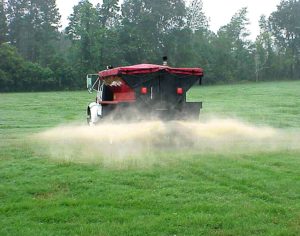
Lime Spreading Truck