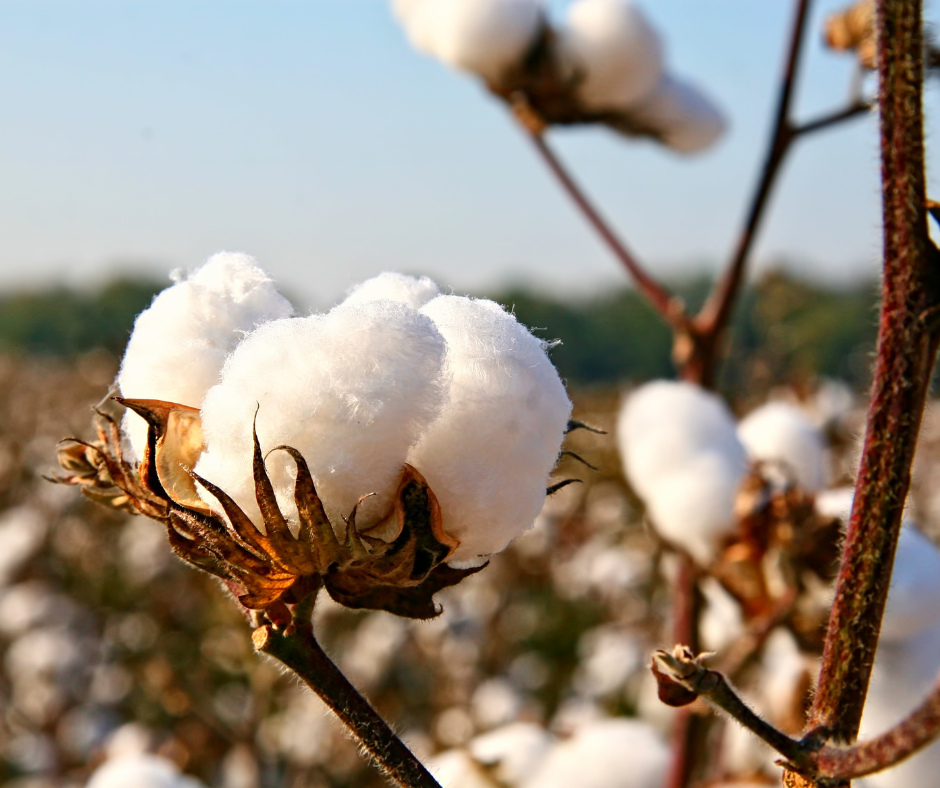
 After a hot and dry summer, many producers will face the difficult choice of whether to harvest cotton from low-yielding fields. Today, we will review a decision aid called the Cotton Harvest Decision Budget. This tool will help you analyze the harvest decision for low-yielding cotton fields to determine whether harvesting this cotton will be a profitable decision this year.
Board Update 10/2/2023
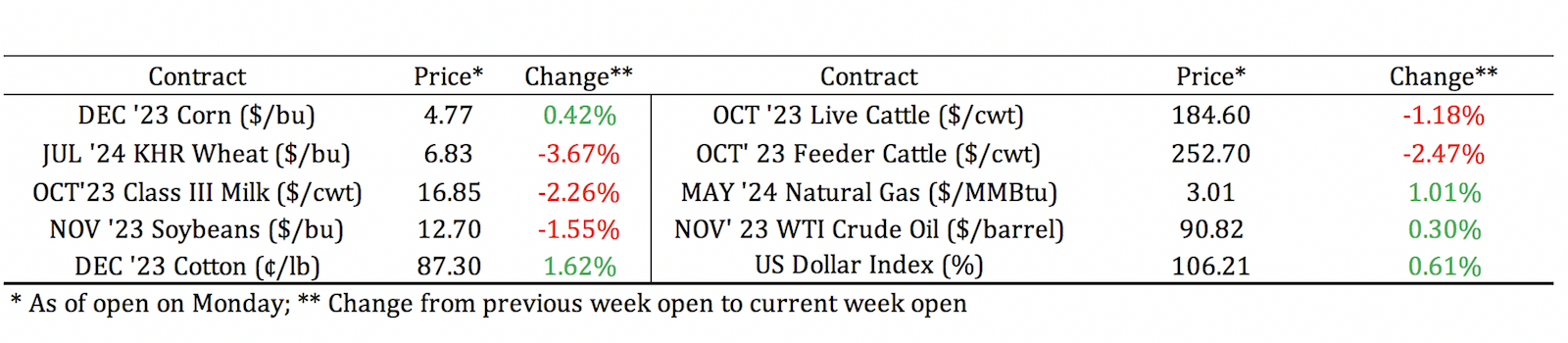
Tulia, Amarillo, Dalhart Average – Cattle Prices by Category 9/21/2023
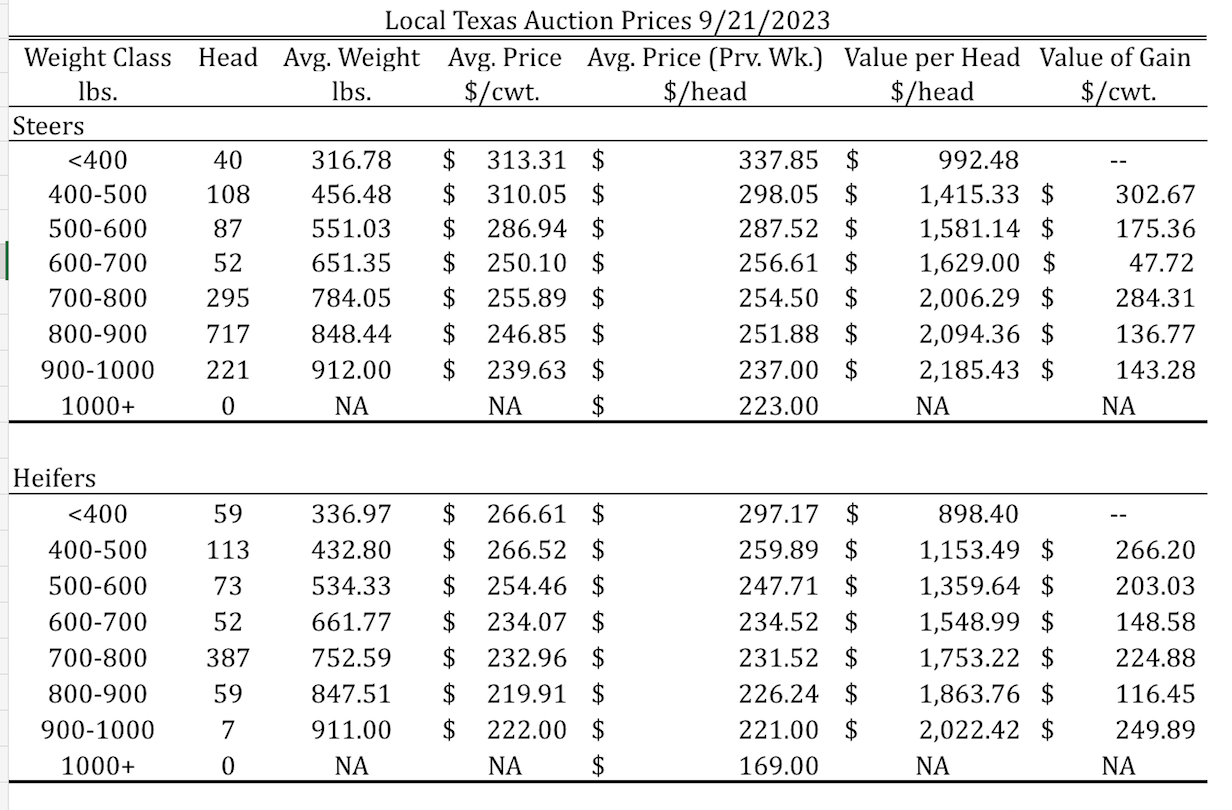
Dates & Deadlines
10/23-27/2023 – College Station – Ranch Management University
11/2/2023 – Online – Wildfire and Prescribed Fire on Your Property
11/3/2023 – Online – Overton Pesticide CEU Program
12/6-8/2023 – College Station – Beef 101
12/7/2023 – Online – Minimizing Drift on Grazing Lands
The Cotton Harvest Decision Budget
After a hot and dry summer, many producers will face the difficult choice of whether to harvest cotton from low-yielding fields. On one hand, if you don’t harvest this cotton, you may leave some profits unrealized. On the other hand, the amount and quality of cotton that you get from these fields may not generate enough revenue to justify the time, effort, and cost required to harvest it.
Today, we will review a decision aid called the Cotton Harvest Decision Budget. This tool will help you analyze the harvest decision for low-yielding cotton fields to determine whether harvesting this cotton will be a profitable decision this year.
Using the Budget
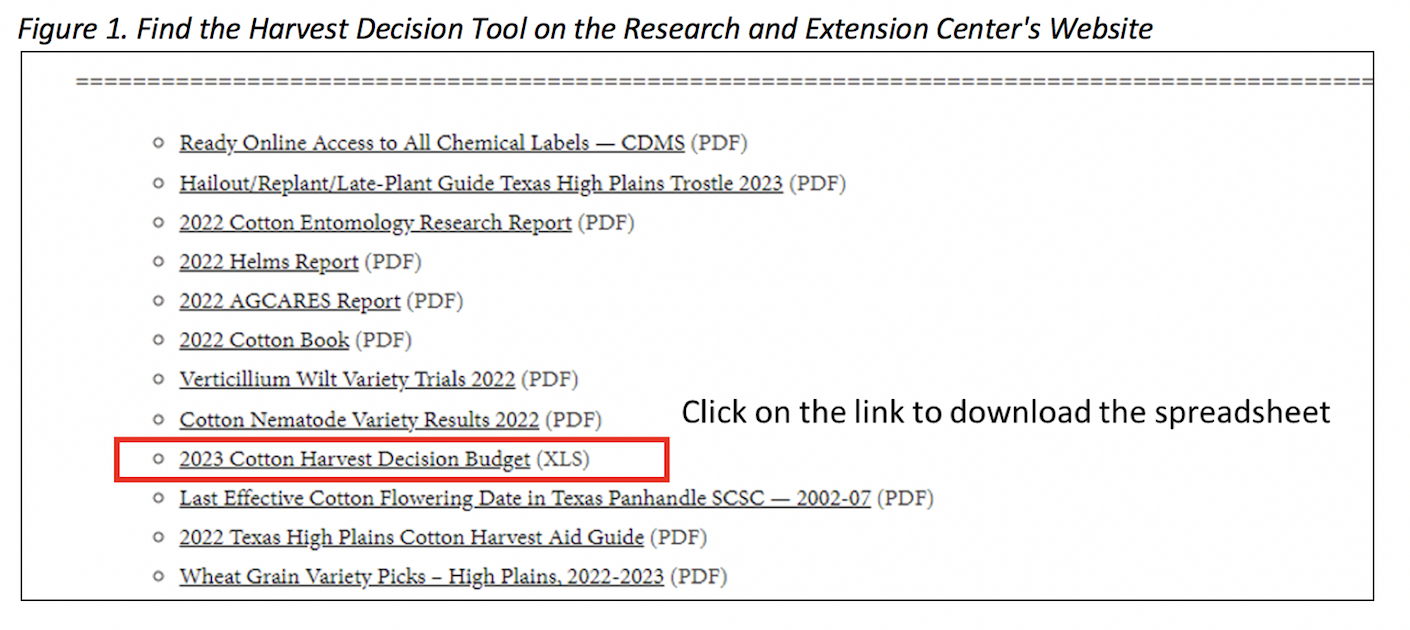
You can find this tool on the homepage for the Texas A&M AgriLife Research and Extension Center at Lubbock. On the homepage, scroll down past the horizontal dashed lines and you will see a link titled 2023 Cotton Harvest Decision Budget (XLS). Click on this link to download the spreadsheet (see Figure 1).
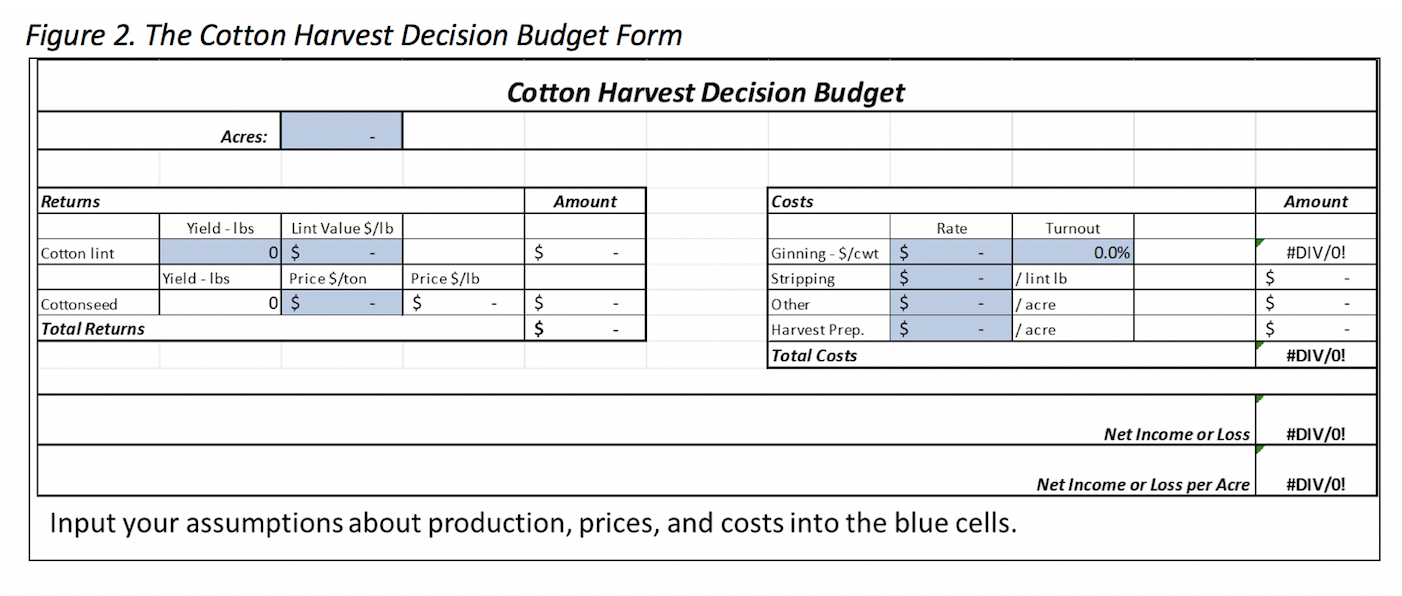
In the spreadsheet you will see two sections. The top section is the budget tool that you will use to evaluate the potential profitability of harvesting low-yielding cotton. In this section, you will input the information that the tool needs into the blue cells (see Figure 2 below). Once you input your information into the tool, the budget will calculate the net income or loss that you can expect from harvesting cotton both for your entire operation and on a per-acre basis.
An Example Scenario
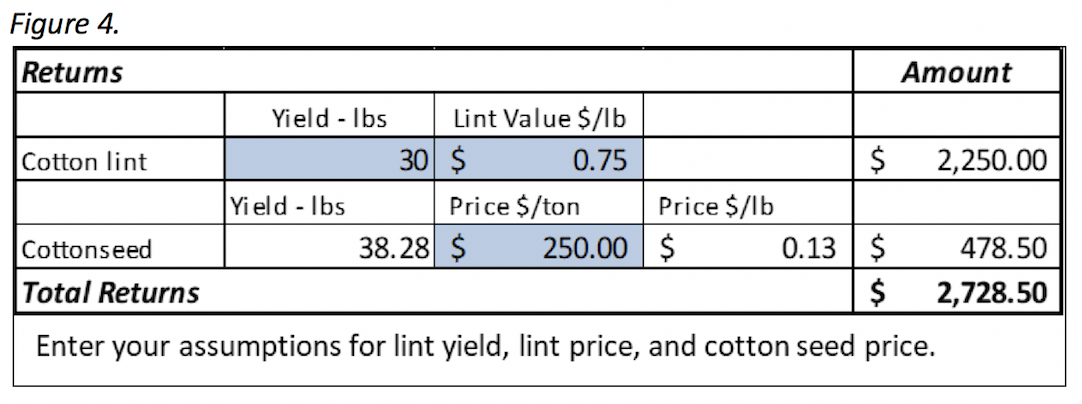
Now, let’s look at an example scenario to see how this tool works. For this example, assume that I have 100 acres of low-yielding cotton that I am trying to decide whether to harvest. I believe that these acres will yield about 30 lbs. of lint per acre and I am pretty sure that I can get a price of $0.75/lb. of lint and $250/ton of cottonseed from this cotton.
To use the tool, I would enter 100 into the blue cell at the top of the budget (Figure 3).

Then, in the left-hand side of the tool (titled Returns) I input my assumptions about lint yield, lint price, and cotton seed price (Figure 4).
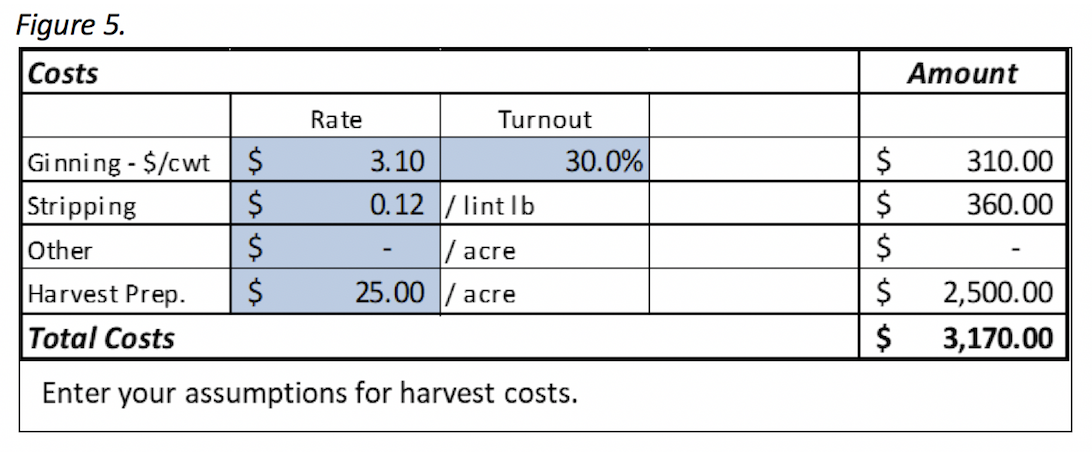
Finally, in the right-hand side of the spreadsheet (titled Costs) I input my assumptions about harvest costs (Figure 5). For this example, I’m using the tool’s default costs assumptions; however, you would need to adjust these assumptions to reflect the costs that you will face.
Based on the information that I input into the decision tool, the budget estimates that I will incur a loss of $441.50, or $4.42/acre, if I attempt to harvest this cotton (Figure 6); therefore, I will choose not to harvest these acres. If the budget calculates a positive net income, then it makes sense to harvest.

Sensitivity Analysis
So, at what price would it make economic sense to harvest a field that yields 30 lbs./acre? Or, if I can get a price of $0.75/lb., how much cotton does a field need to yield to make harvesting it profitable? To answer this question, you can use the bottom section of the decision tool. This part of the tool gives you the expected net income or loss per acre for a variety of price and yield combinations, based on the cost data that you have entered into the budget form. For example, if I look at the column for $0.75 in this table, I see that harvesting cotton results in a loss at yields from 0 to 30 lbs., and a profit when yield is at least 40 lbs./acre (Figure 7). If I look at the row for 30 lbs., I see that harvesting becomes profitable at prices above $0.90/lb. (Figure 8).

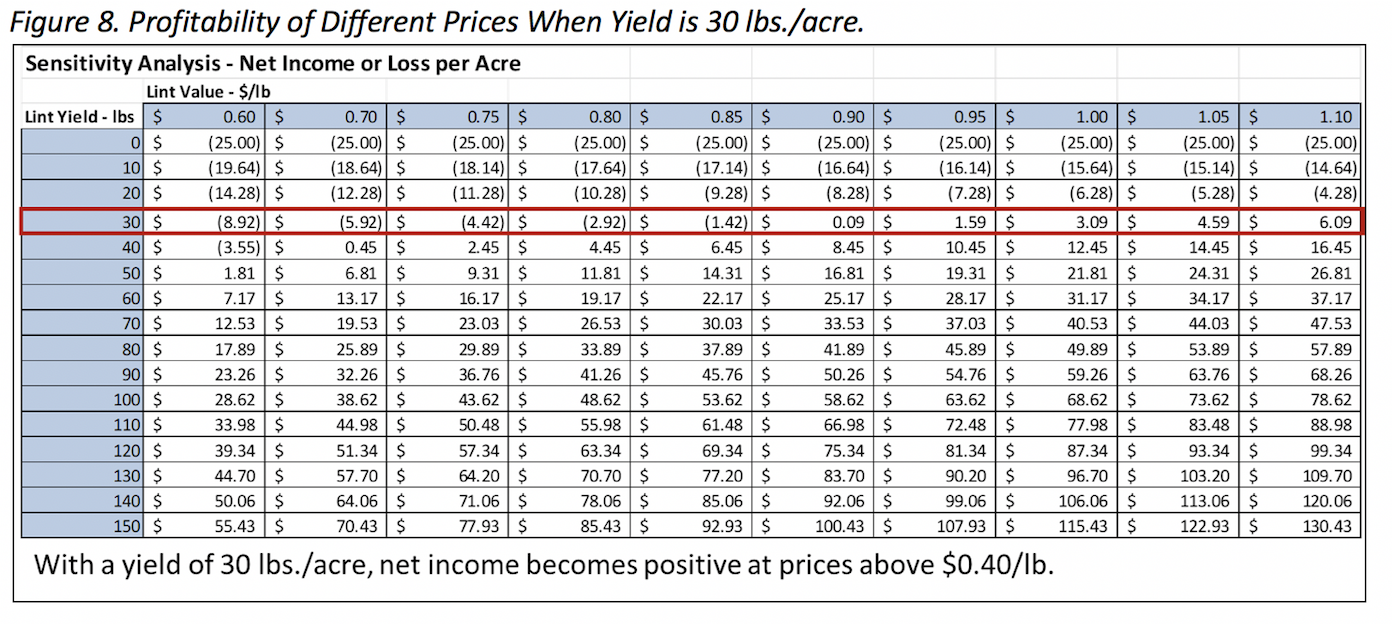
You can use this table to help you evaluate the riskiness of the harvest/don’t harvest decision. If the budget calculates a net income from harvest that is close to $0, then you might need to consider how likely you are to realize a lower-than-expected price or yield that makes harvesting unprofitable.
Some Final Thoughts
As you use this tool, keep the following two things in mind. First, be realistic about the quality of the cotton you harvest from low-yielding fields and the price you can expect to receive for this cotton. If the cotton in these fields is of low quality, you will most likely receive a discount on the price when you sell it. Make sure to account for that price discount as you use this tool. Second, remember that this budget only accounts for the cash costs associated with harvest. Your time and effort have value and, once you account for that value, you may find that harvesting low-yielding fields is not worth your time, even if this tool predicts a positive net income.