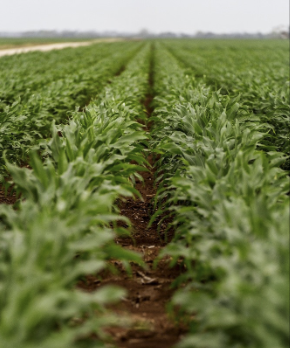
Farms and crops in Burleson County on April 28, 2021. (Laura McKenzie/Texas A&M AgriLife Marketing and Communications)
When traditional crop margins become compressed, it is natural for producers to explore alternative cropping opportunities. Specialty crops, niche markets, and emerging commodities often generate excitement because of their potential to increase revenue and diversify farm income.
However, before committing acreage to a new enterprise, producers should carefully evaluate both the opportunities and risks associated with alternative crops.
Why Producers Consider Alternative Crops
Alternative crops can provide several potential benefits:
- Diversification of farm income
- Improved crop rotation options
- Access to niche markets
- Reduced dependence on traditional commodity prices
- Opportunities to meet evolving consumer demand
While these benefits may be attractive, successful adoption requires more than simply planting a different crop.
Start with the Market
One of the most important questions to ask is simple:
Who will buy the crop?
Unlike traditional crops such as cotton, corn, wheat, or sorghum, many alternative crops are sold into smaller, less developed markets. These markets may have limited buyers and processing capacity, making marketing a much greater challenge.
Before planting, producers should identify:
- Available buyers
- Contract requirements
- Delivery specifications
- Transportation costs
- Market demand trends
A profitable crop means little if there is no reliable market for the final product.
Understand Contract Risks
Many specialty crops rely heavily on production contracts rather than traditional cash markets.
Producers should carefully review contract terms and understand:
- Pricing mechanisms
- Delivery obligations
- Quality standards
- Payment timelines
- Buyer financial stability
A contract is only valuable if the buyer can fulfill its obligations.
Evaluate Infrastructure and Logistics
Some crops require specialized handling, storage, transportation, or processing facilities.
Questions to consider include:
- Is processing available nearby?
- Are transportation costs reasonable?
- Does existing equipment work for the new crop?
- Will additional investments be necessary?
Infrastructure limitations can significantly reduce profitability.
Assess Production Challenges
Alternative crops often come with a learning curve. Limited local experience may create uncertainty regarding:
- Yield expectations
- Pest management
- Weed control
- Fertility requirements
- Harvest timing
Producers should take advantage of Extension resources, research data, and conversations with experienced growers before making significant investments.
Conduct a Thorough Financial Analysis
Perhaps the most important step is evaluating the economics of the enterprise.
Developing a realistic enterprise budget can help answer critical questions:
- What are the expected production costs?
- What yield is required to break even?
- What happens if prices decline?
- How sensitive are profits to weather-related yield reductions?
Scenario analysis can reveal risks that may not be apparent when considering only optimistic projections.
Learning from Past Experiences
Agriculture has seen several promising alternative crops generate excitement before markets became oversupplied. Rapid acreage expansion can quickly outpace demand, resulting in declining prices and profitability.
The lesson is not to avoid alternative crops altogether, but rather to approach new opportunities with careful planning and realistic expectations.
Looking Ahead
Alternative crops can be an effective component of a broader farm management strategy. They may provide opportunities for diversification, improved rotations, and access to specialized markets. Success, however, typically depends on thorough market research, sound financial planning, and a clear understanding of production risks.
Bottom Line: Alternative crops can offer new opportunities, but profitability depends on much more than a high projected price. Before making the switch, take time to evaluate markets, contracts, infrastructure, production requirements, and financial risks to ensure the opportunity is truly a good fit for your operation.
Reference Document: Surviving the Economic Downturn: 2026 Update
https://acrobat.adobe.com/id/urn:aaid:sc:VA6C2:3d2567f4-0d35-4fe1-a367-21453fdcd295