Can your business pay its bills and other financial obligations this year? Or will borrowing more put your business at risk of bankruptcy? Your ability to answer these questions accurately is an important part of managing your business for long-term success. In today’s blog, we’ll review information from a farm’s business records to help you make financially responsible borrowing decisions.

The Information You Will Need
Today we’re discussing liquidity and solvency, which I’ll define shortly. All the information you need to evaluate solvency comes from your business’s balance sheet.
Your balance sheet is a financial statement that provides you with the following information:
- The dollar value of your business’s assets, or what the business owns
- The dollar value of your business’s liabilities, or what the business owes
- The dollar value of your business’s equity, or what’s left over for you after all the business’s debts are paid
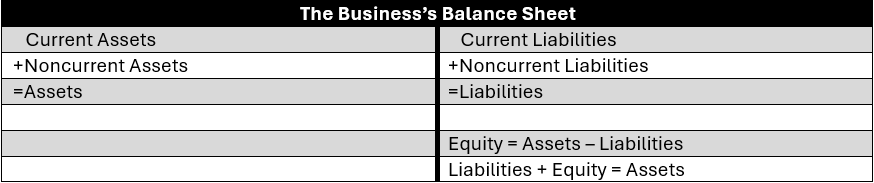
The balance sheet is based on the equation Assets = Liabilities + Equity. As a business’s liabilities increase relative to its assets, business equity must decrease. As liabilities decrease relative to assets, equity increases.
Going a little deeper, you can classify assets and liabilities as current or noncurrent. Current assets include cash and other resources that will generate cash for a business within the next year. Noncurrent assets are resources and investments a business plans to hold or use for more than a year. Current liabilities are obligations the business must pay within the next year. Finally, noncurrent liabilities are obligations due in future years. Table 1 shows how a balance sheet organizes this information. You can use this information to evaluate two elements of financial condition: liquidity and solvency.
Understanding Liquidity
Liquidity focuses on the current portion of the balance sheet and measures how easily your business can generate cash to pay bills and meet other financial obligations. The higher a business’s current assets are relative to its liabilities, the more liquid it is.
Two common measures of liquidity are working capital and the current ratio. A business’s working capital is the difference between its current assets and current liabilities. A business’s current ratio is its current assets divided by its current liabilities.
Working Capital = Current Assets – Current Liabilities
Current Ratio = Current Assets ÷ Current Liabilities
In farm financial management, the commonly accepted standard for a healthy current ratio is 2.0. In other words, a farm should aim for its current assets to be twice the value of its current liabilities. A farm is considered at risk when its current ratio is 1.3 or less. If its current ratio is less than 1, the farm is illiquid and cannot meet all its short-term obligations. Table 2 summarizes these rules of thumb.

Understanding Solvency
Solvency assesses the value of assets and liabilities across the entire balance sheet and reflects your ability to pay all your debts if you sold your business today. Like liquidity, the more a business’s assets exceed its liabilities, the more likely it is to remain solvent.
There are three ratios you can calculate to evaluate your business’s solvency, but we’ll only focus on two here. The first of these is the Debt-to-Asset ratio, which compares the value of the liabilities listed on your balance sheet to the value of your assets:
Debt-to-Asset Ratio = Liabilities ÷ Assets
The second important ratio is the Debt-to-Equity ratio, which compares the value of the liabilities listed on your balance sheet to the value of your business’ equity:
Debt-to-Equity Ratio = Liabilities ÷ Equity
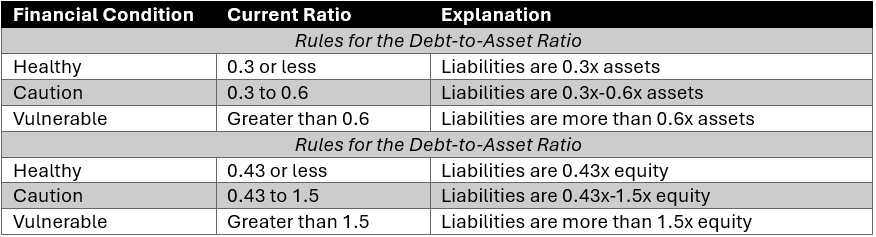
In general, a farm in healthy financial condition will have a debt-to-asset ratio below 0.3 and a debt-to-equity ratio below 0.43. A farm’s financial condition is at risk of bankruptcy if its debt-to-asset ratio exceeds 0.60 and its debt-to-equity ratio exceeds 1.5. Table 3 summarizes the rules of thumb for evaluating a farm’s solvency.