U.S. Peanut Outlook Brief: October 2026
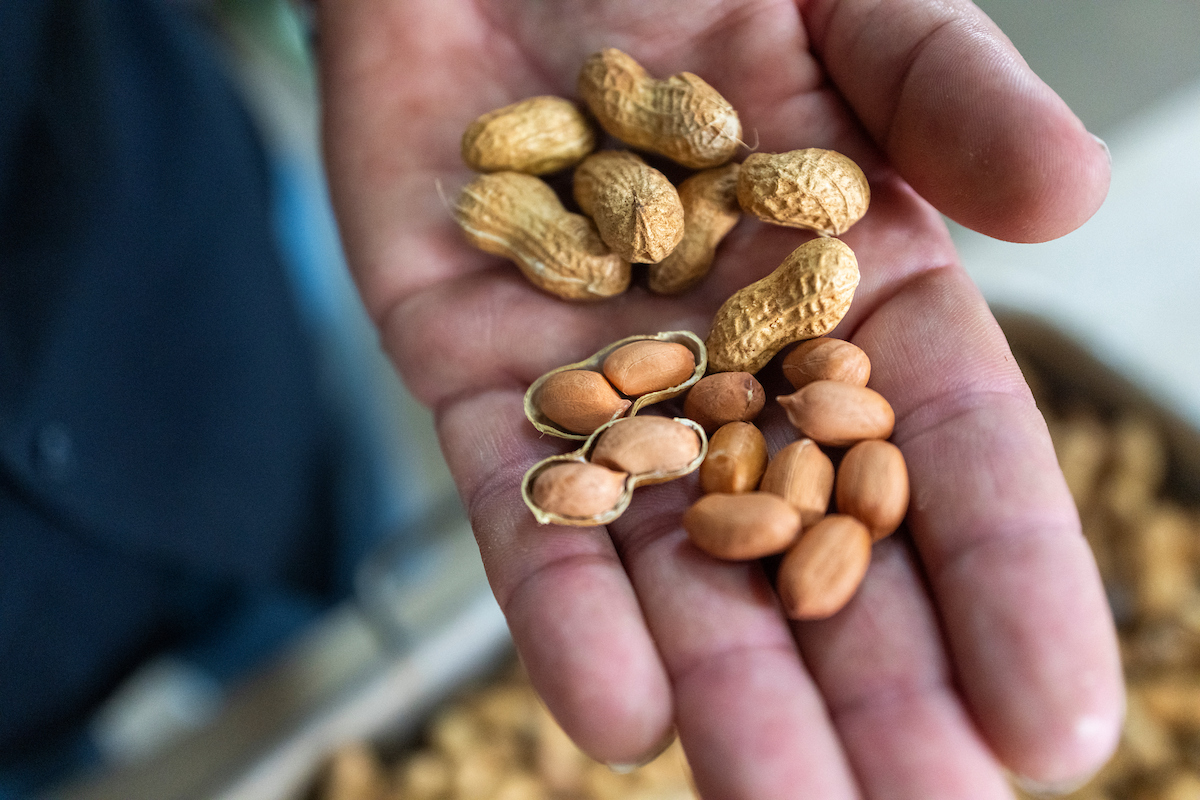
Peanuts on Friday, Mar 06, 2026, in Stephenville, Texas. (Michael Miller/Texas A&M AgriLife)
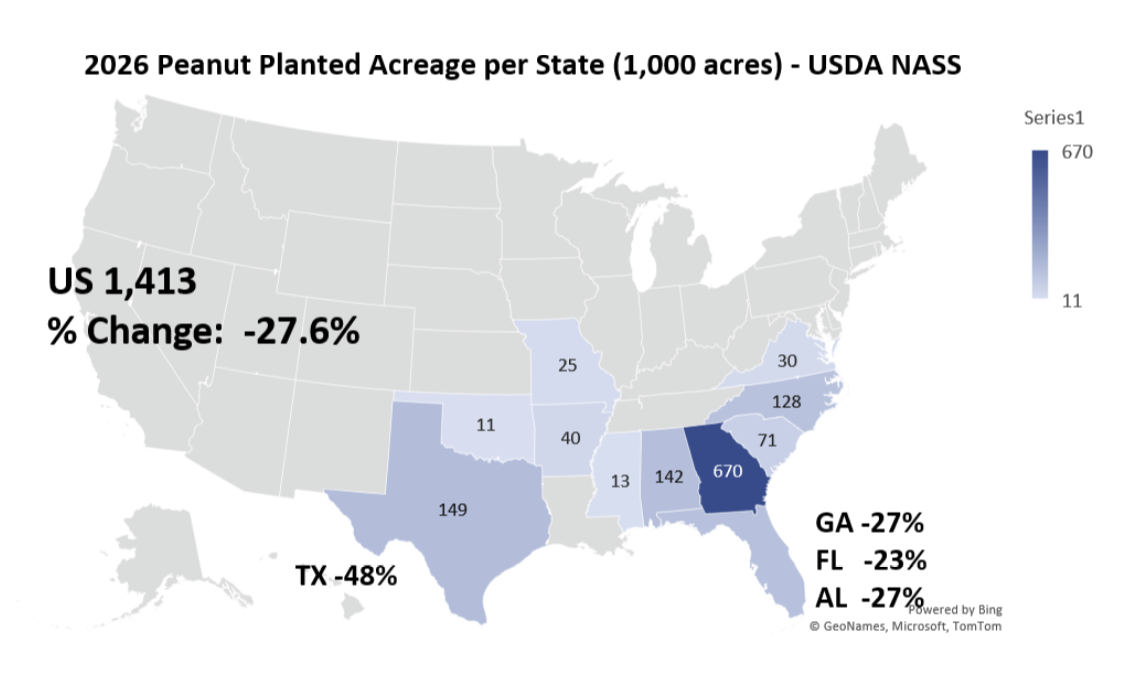
The U.S. peanut industry enters the 2026/27 marketing year in a period of adjustment. Following an 8.4% increase in planted acreage during 2025/26 and one of the largest peanut crops in recent history, growers responded to lower prices and growing inventories by sharply reducing plantings. U.S. peanut acreage declined approximately 28% in 2026 to about 1.4 million acres, with all major producing states reporting significant reductions. Texas experienced one of the largest declines, with planted acreage falling to approximately 145,000 acres amid weak market conditions and drought concerns.
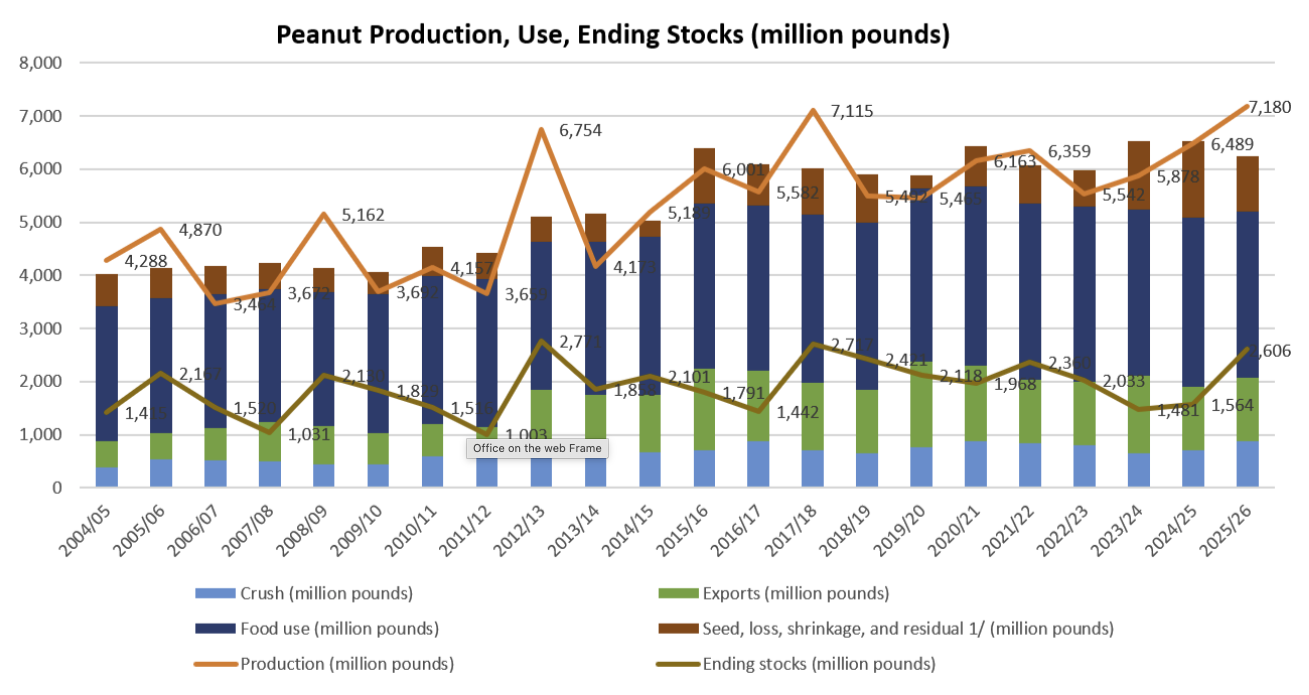
The acreage reduction reflects the large supplies generated during 2025/26. U.S. peanut production increased from 6.49 billion pounds in 2024/25 to an estimated 7.18 billion pounds in 2025/26, resulting in projected ending stocks of approximately 2.6 billion pounds, compared to 1.56 billion pounds the previous year. These inventories are among the highest of the last decade and continue to weigh on peanut prices and contract offers.
Domestic food demand remains the cornerstone of the peanut market. Food use is projected at approximately 3.12 billion pounds in 2025/26, only slightly below the previous year. Peanut butter continues to account for the largest share of consumption, followed by snack peanuts, peanut candy, and in-shell products. While total domestic use remains historically strong, growth has slowed, and per-capita consumption has slipped to approximately 6.9 pounds per person. Nevertheless, peanuts continue to benefit from strong consumer acceptance due to their affordability, nutritional value, and versatility.
Export demand remains another critical source of support. U.S. peanut exports are estimated at approximately 1.2 billion pounds for 2025/26, essentially unchanged from the previous season. Although exports remain below record levels achieved in some years, international demand continues to absorb a substantial share of production and provides an important market outlet as the industry works through large inventories.
In addition to food and export demand, peanut crushing is expected to strengthen. Crush demand is projected to reach approximately 875 million pounds in 2025/26, one of the highest levels on record. Higher crush utilization helps offset some of the supply pressure created by large crops and contributes to maintaining balance in the overall peanut market.
Market prices have weakened as supplies expanded. The U.S. Marketing Year Average (MYA) peanut price is projected at approximately $480 per ton for 2025/26, down from $520 per ton in 2024/25 and well below the highs recorded in 2022/23 and 2023/24. Lower prices have triggered significantly larger Price Loss Coverage (PLC) payments, with the estimated payment rate increasing to $158 per ton in 2025/26. These payments are expected to provide important support to producer incomes until market conditions improve. Also, the Reference Price and the Loan Rate increased to $630/ton and $390/ton, respectively, in 2025/2026.
Key U.S. Peanut Market Indicators
| Indicator | 2024/25 | 2025/26 |
| Production (billion lbs.) | 6.49 | 7.18 |
| Food Use (billion lbs.) | 3.17 | 3.12 |
| Exports (billion lbs.) | 1.19 | 1.20 |
| Ending Stocks (billion lbs.) | 1.56 | 2.61 |
| MYA Price ($/ton) | 520 | 480 |
| PLC Payment Rate ($/ton) | 15 | 158 |
Source: USDA ERS, USDA NASS, USDA FSA (2026)
Looking ahead, the peanut sector appears to be undergoing a necessary supply correction. The substantial reduction in acreage across all major producing states should slow production growth and help reduce burdensome inventories during 2026/27, provided yields remain near average. However, large beginning stocks will likely prevent a rapid improvement in prices. Strong domestic demand, stable exports, and increased crushing activity provide a solid foundation for the market, but inventory reduction remains the key factor determining future price recovery. Overall, the outlook is for a gradual transition from an oversupplied market toward a more balanced supply-demand environment, improving longer-term profitability prospects for U.S. peanut producers.
This article was written by Ivan Borja, a guest author on the Ag Economics on the Plains Blog.