
(Laura McKenzie/Texas A&M AgriLife Marketing and Communications)
When we think of cotton, we think primarily of the fiber used in producing clothing, bed sheets, towels, and other textiles. However, cottonseed, a byproduct of cotton production, has a variety of uses that make it valuable as well. In today’s post, we discuss the uses and pricing of cottonseed.
Cottonseed Markets
How is Cottonseed Used?
Cottonseed is a byproduct of the cotton lint production process. As cotton grows, the plant develops bolls, within which new seeds grow. Cotton lint grows from these seeds as the plant matures. At harvest, cotton bolls are separated from the plant and taken to a gin, where the lint is separated from the seed. Cotton lint is then pressed into bales, which are eventually sold to textile mills, while the seed is sold either to oil mills as a source of oil or to livestock and poultry operations as feed.
Cottonseed oil is used in a variety of ways, including as a cooking aid and as an ingredient in various cosmetic products. For more information on the potential benefits of cottonseed oil as a cooking oil, read this post from USDA.
Two byproducts of the crushing process used to produce cottonseed oil are cottonseed hulls, the outer covering of the seed that is removed before crushing, and cottonseed meal, or what’s left over after the oil is extracted from the seed. Both byproducts, along with the whole cottonseed, are useful as feed for livestock. For more on using whole cottonseed in dairy operations, read this article from Cotton Incorporated.
What Determines Cottonseed Prices?
Like any commodity, cottonseed price is primarily determined by market forces of supply and demand. On the supply side, the amount of cottonseed available depends on the cotton produced. Higher levels of cotton production lead to greater availability of cottonseed. All things equal, this will have a bearish impact on cotton seed prices (Figure 1).
Figure 1. Texas cottonseed prices (mkt. year average) and Texas cotton production, 2001-2020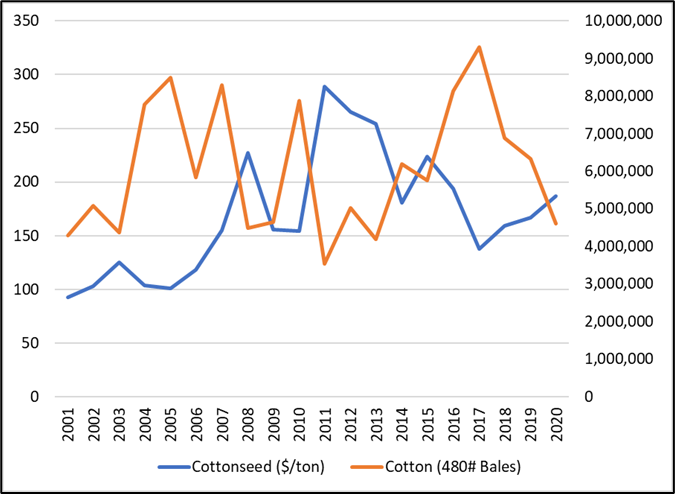 Source: USDA NASS Quick Stats Database
Also important to the price of cottonseed is the price of similar commodities that can act as substitutes for cottonseed and its related products. When the price of cottonseed increases relative to its substitutes, the buyers of cottonseed and its related products can easily shift to using a substitute commodity. For this reason, the price of cottonseed tends to be highly correlated with the price of those substitute commodities.
One such substitute whose price is highly correlated with cottonseed prices is soybeans. Two byproducts of soybean production, soybean oil, and soybean meal, are extremely close substitutes for cottonseed oil and cottonseed meal. Thus, changes in the price of cottonseed tend to reflect changes in the price of soybeans over time (Figure 2).
Figure 2. Texas cottonseed prices (mkt. year average) and Texas soybean prices (mkt. year average), 2001-2020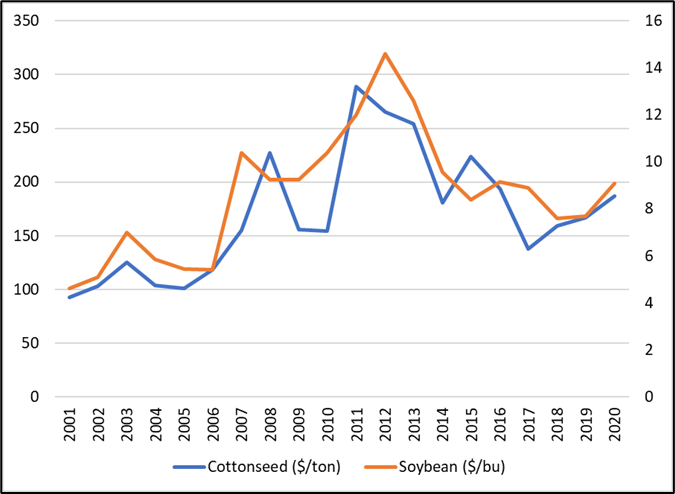 Source: USDA NASS Quick Stats Database