 On July 4, 2025, President Trump signed the One Big Beautiful Bill Act (OBBBA) into law. The law included changes to the Agriculture Risk Coverage (ARC) and Price Loss Coverage (PLC) programs. In this post, we explain what has changed for PLC and how payments under this program might be affected.
Changes to the PLC Program
The Price Loss Coverage (PLC) program is designed to protect producers from severe losses due to extremely low commodity prices. PLC makes payments when a covered commodity’s market year average (MYA) price falls below its statutory reference price. Congress sets a statutory reference price for each covered commodity in law. However, a commodity’s effective reference price can increase if market prices rise sufficiently.

Table 1
OBBBA makes two changes to reference prices. First, it adjusts the calculation of effective reference prices, as explained in Table 1 (above). Second, it raises the statutory reference prices for most covered commodities. Table 2 compares the statutory and effective reference prices for selected crops in the 2018 Farm Bill to those set by OBBBA.
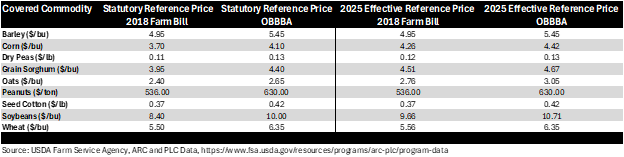
Table 2
Potential Impact on Projected 2025/26 Payments
Table 3 illustrates how OBBBA’s modifications to the PLC program influence the projected payment rates for selected crops. The table provides the expected 2025 MYA price for each commodity, along with the effective reference price and payment rate, as outlined in the 2018 farm bill and OBBBA regulations. For most commodities, the projected payment rates under OBBBA are higher than under the 2018 farm bill rules. In some cases, the difference is significant.
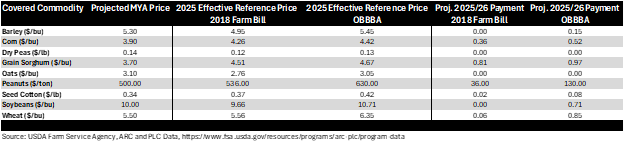
Table 3
One Thing to Keep in Mind: Sometimes Things Change
The information presented here is based on our best reading of the text of the One Big Beautiful Bill Act. We assume that the USDA will implement the changes that OBBBA makes to the PLC program as outlined in the law. However, things can and do change during implementation, and any such changes will affect the payment rates we estimate here. Readers should keep this reality in mind as they consider how the OBBBA’s changes to PLC will affect their operations.