 Economists with the Texas A&M AgriLife Extension Service have been updating the Texas crop and livestock budgets for 2026. In this post, we’ll discuss our expectations for four key costs: fertilizer, chemicals, fuel/energy, and interest rates.
Fertilizer
Figure 1 shows how the national retail price per ton for five major fertilizers has changed since January 2023. For most of 2023 and 2024, fertilizer prices remained stable. However, prices began to rise again in the second half of 2024 and continued to rise throughout 2025. Currently, fertilizer prices are 10-20 percent higher than they were a year ago. Fertilizer prices in 2026 will depend on global trade and policy actions, as well as on supply and demand in both local and global fertilizer markets.
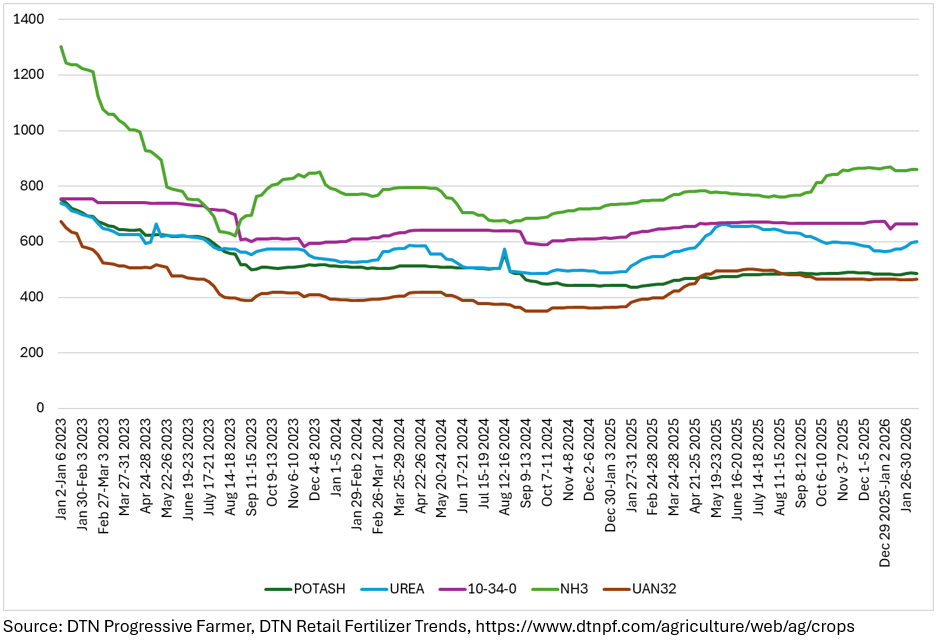
Figure 1. Retail Fertilizer Price Trends, January 2023-January 2026
Fertilizer price increases in 2025 can be partly attributed to trade policy in the United States and China. China restricted urea and phosphate exports early in 2025, limiting supplies and driving prices up. In addition, nitrogen and phosphate imports to the United States were subject to a 10-15% tariff for most of last year. Since then, China has eased its export restrictions, and President Trump signed a modified Executive Order 14527 to suspend tariffs on fertilizer imports. Both policy actions should ease pressure on fertilizer prices in 2026; however, trade policy can change with little notice. Policy actions by the United States, China, or other major fertilizer-producing nations that restrict supplies would drive prices up.
Demand for fertilizer products will also help determine fertilizer prices this year. Figure 2 shows the weekly Urea-Corn price ratio from January 2021 through January 2026, using DTN’s retail price per ton of Urea and the weekly average of the CBOT December corn contract. At the end of January 2026, this ratio was 127.74, meaning a producer would need to produce 127.74 bushels of corn to purchase 1 ton of urea. This is 4 percent higher than the average for the period and about fifteen percent higher than a year ago. In other words, fertilizer will likely be more expensive relative to the crops used to produce it. This may prompt producers to adjust fertilizer application rates, alter crop rotations, or reduce planted acres. The result of these changes is a possible, but unlikely, downward shift in demand and downward pressure on fertilizer prices.

Figure 2. Urea-Corn Price Ratio, January 2023-January 2026
This is all to say that there is a lot of uncertainty around fertilizer prices right now, both globally and locally. There seems to be more potential for upward price pressure from the unknowns than for downward pressure.
Chemicals
Agricultural pesticide and chemical prices have remained stable since September 2023, as shown in the Producer Price Index data (Figure 3). Based on this trend, it seems likely that chemical costs will remain stable this year unless a major market shock occurs.
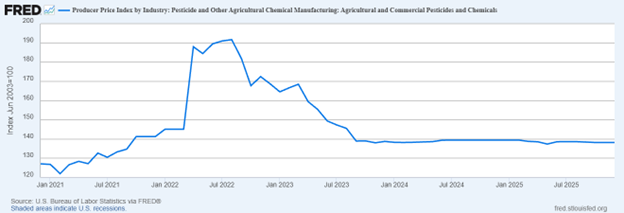
Figure 3. Producer Price Index for Pesticide and Other Agricultural Chemical Manufacturing, 2021-2025
One potential shock to certain ag chemical markets could be last month’s announcement that China intends to end export tax rebates for certain pesticides on April 1, 2026. According to the article we linked to, this move will increase export prices by 9 percent. Whether this affects retail prices this year remains to be seen. It’s likely that ag chemical suppliers will increase their purchases from China to lock in lower prices, which would limit the impact on retail prices in 2026.
Fuel & Energy
On-farm energy expenditures come primarily from three sources: water pumping for irrigation, gasoline, and diesel fuel. The current short-term energy outlook from the U.S. Energy Information Administration indicates that retail gasoline and diesel prices in 2026 will be about $0.20/gallon lower than in 2026. However, natural gas prices are expected to increase. EIA predicts an average Henry Hub spot price of $4.31/MMBtu for natural gas in 2026, up $0.78 from the average 2025 price. According to the EIA, the average residential electricity price will also increase from $0.176/kWh to $0.179/kWh.
What About Interest Rates?
According to the Federal Reserve Bank of Dallas Agricultural Survey, agricultural loan rates in Texas ranged from about 7.5 percent for long-term real estate loans to about 8 percent for short-term operating loans in the fourth quarter of 2025. Agricultural loan rates declined in each quarter of 2025 as the Federal Reserve reduced the federal funds rate.
The Federal Reserve’s Federal Open Markets Committee (FOMC) set the federal funds rate at 4.25-4.50 percent in January 2025 and held it there until August. In September, October, and December, the FOMC announced three quarter-point reductions. As a result, the federal funds rate is currently 3.50-3.75 percent. In their most recent economic projections, FOMC members expect the federal funds rate to fall to 2.9-3.6 percent in 2026. This implies 1-2 rate cuts in 2026; however, how the FOMC will approach interest rates this year remains uncertain.
Jerome Powell’s current term as chair of the Federal Reserve ends on May 15, 2026, and President Trump has nominated Kevin Warsh to succeed Mr. Powell. Historically, Mr. Warsh’s policy views have favored higher interest rates. However, more recently, he has argued for lower interest rates. With a new chair who favors lower rates, there is a small chance the FOMC will implement a larger rate cut than its current projections indicate.
Tips for Managing Costs
It looks like 2026 will be another year of high costs relative to commodity prices and tight margins. For this reason, we encourage producers to make every effort to manage their input use to keep costs as low as possible. I offer these suggestions for the year:
- Communicate your needs with your suppliers. Make sure your suppliers understand your needs, so they manage their inventory effectively, and you avoid the local supply shortages I mentioned earlier.
- Research the quality of any input you plan to use before you purchase it. One of the most important decisions you will make is the seed variety you plant. Make sure you choose a variety that is right for your soil and production system.
- Consider the impact of your decisions on profitability, not yield. If boosting yield costs more than the market value of the extra production, you lose money. If reducing costs means you lose more in revenue than you save, you lose money. Make sure that cost increases lead to larger revenue increases. Make sure cost savings don’t result in larger revenue losses.