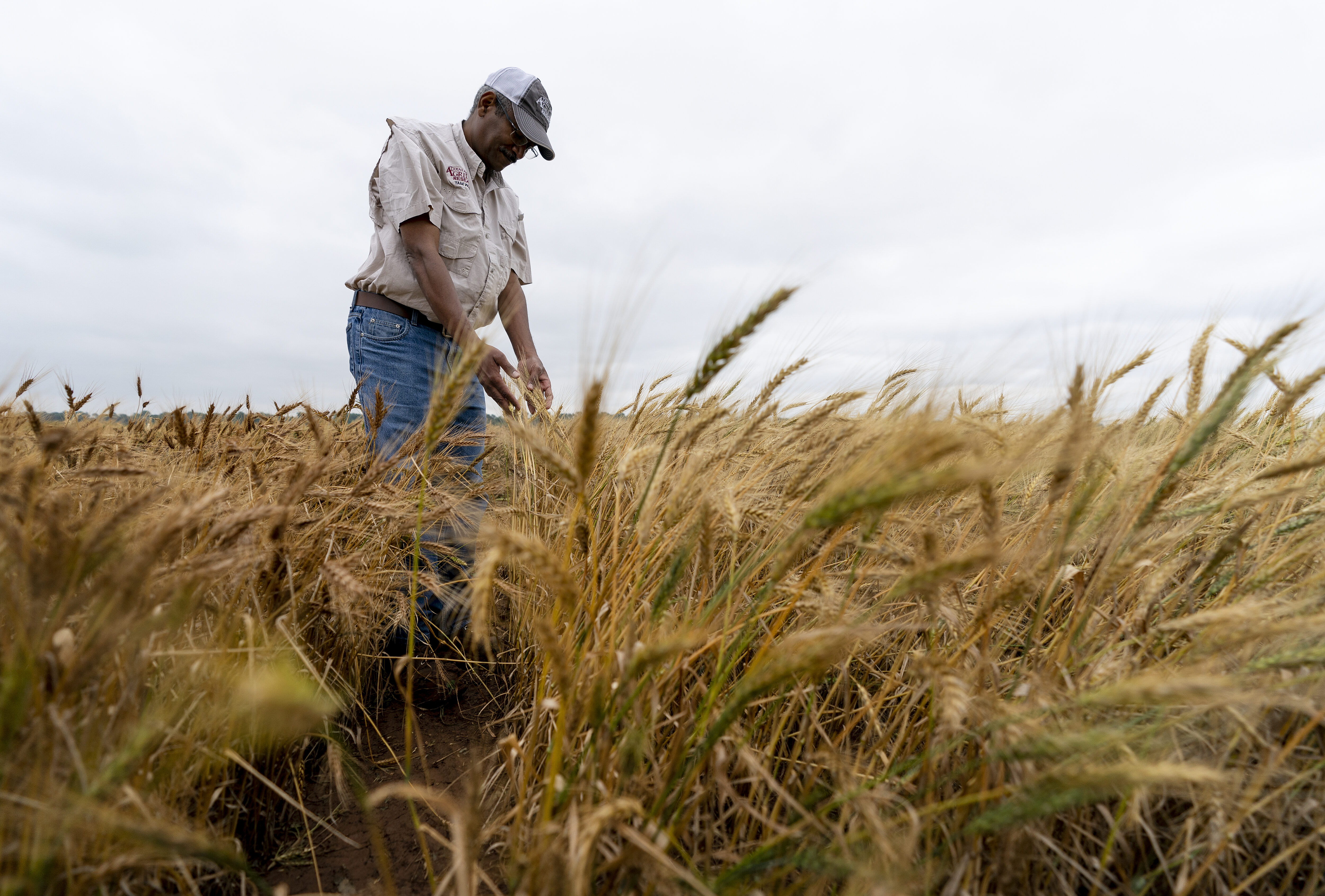
Wheat on May 12, 2021, in Burleson County. (Laura McKenzie/Texas A&M AgriLife Marketing and Communications)
With cash wheat prices below breakeven and challenging weather in many counties, farmers must make difficult decisions to maximize crop returns. Alternative uses for wheat, such as grazing or baling, may offer better profitability depending on the availability of your equipment and infrastructure.
Given this year’s drier conditions and continued low wheat prices, it is essential to evaluate your options. Comparing wheat for grain, grazing, and hay will help identify the most financially viable strategy under current market and production conditions.
Evaluating your options
The Wheat and Small Grains Decision Aid helps farmers decide whether using wheat for grain, grazing, or baling is most beneficial. To make an informed decision, compare the relative prices of grazing, wheat hay, and grain, expected yields, production costs, crop rotation options, available equipment, and insurance coverage. This analysis assumes custom-hired equipment, so if you own equipment, adjust your comparison accordingly.
Wheat Alternatives
This year, in which every alternative shows negative results, the hay option continues to offer higher profits under similar production conditions (see Table 1). To estimate potential hay production, we assume grain yield is 40% of total biomass. For example, a wheat yield of 40 bushels per acre equals about 2.9 tons per hectare of biomass. We estimate harvesting and baling 76% of this biomass, resulting in approximately 2.1 tons per acre (see Table 2) (Wheat Hay vs. Grain: A Comparison of Economic Opportunities, Reagan Noland, Bill Thompson, and Clark Neely). Accurate yield estimates are essential for comparing these options.
In this example, baling hay is more favorable due to lower wheat grain prices, assuming wheat hay prices of $120 per ton or $60 per bale. These results depend on your wheat bale prices (see Table 1) and may differ if you own your harvesting or baling equipment.
The grazing option is also more favorable if there was early grazing, and there is sufficient water, adequate forage, and enough livestock to maximize beef production.
Grazing offers a more favorable economic outlook than grain, provided you have adequate water, fencing, forage, and livestock, and can begin grazing early. The breakeven price for wheat harvesting is $6.80 per bushel, which exceeds the estimated future harvest price for this area (see Table 1). The breakeven grazing price is $0.87 per pound, above the assumed price of $0.65 per pound in this example.
Table 1. Wheat Alternatives

The decision aid allows you to compare alternatives from both economic (see Table 1) and financial perspectives. Analyzing cash flow helps determine which option is more advantageous, especially if you own your combine or hay baling equipment.
You can also use this information to identify the hay sale price needed to match wheat grain profit margins or to determine the appropriate grazing price. The Decision Aid uses your data and costs to calculate breakeven prices for hay and grazing (see Graphs 1 and 2).
Graph 1. Breakeven Hay Prices.
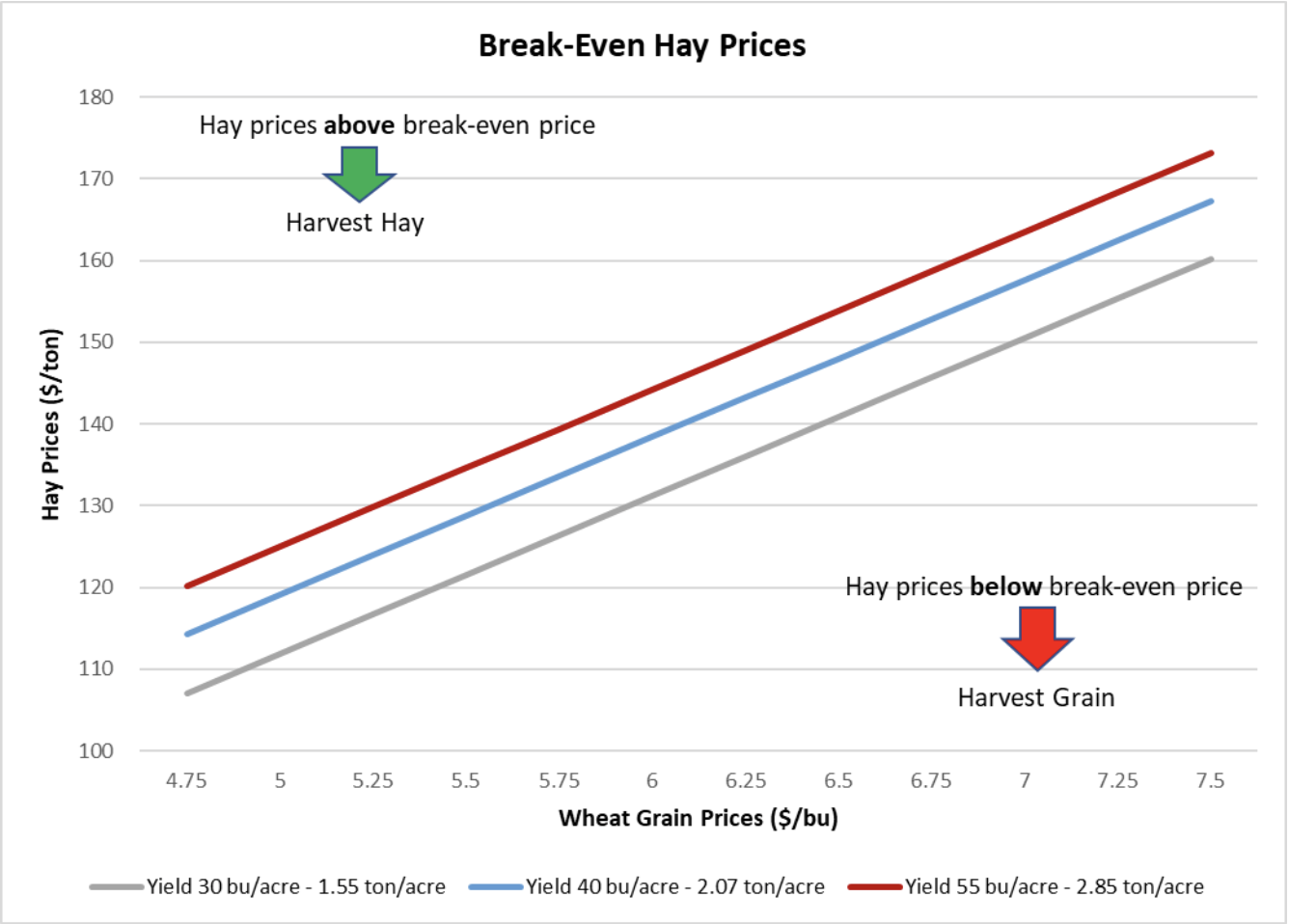
Consider baling wheat if you can sell hay above the breakeven price, given current wheat prices and expected yields. For example, with a yield of 40 bushels per acre at $5 per bushel, baling is preferable only if the net price per ton of hay exceeds $119, assuming 76% of the estimated biomass, or 2.07 tons per acre.
Graph 2. Breakeven Grazing Prices.
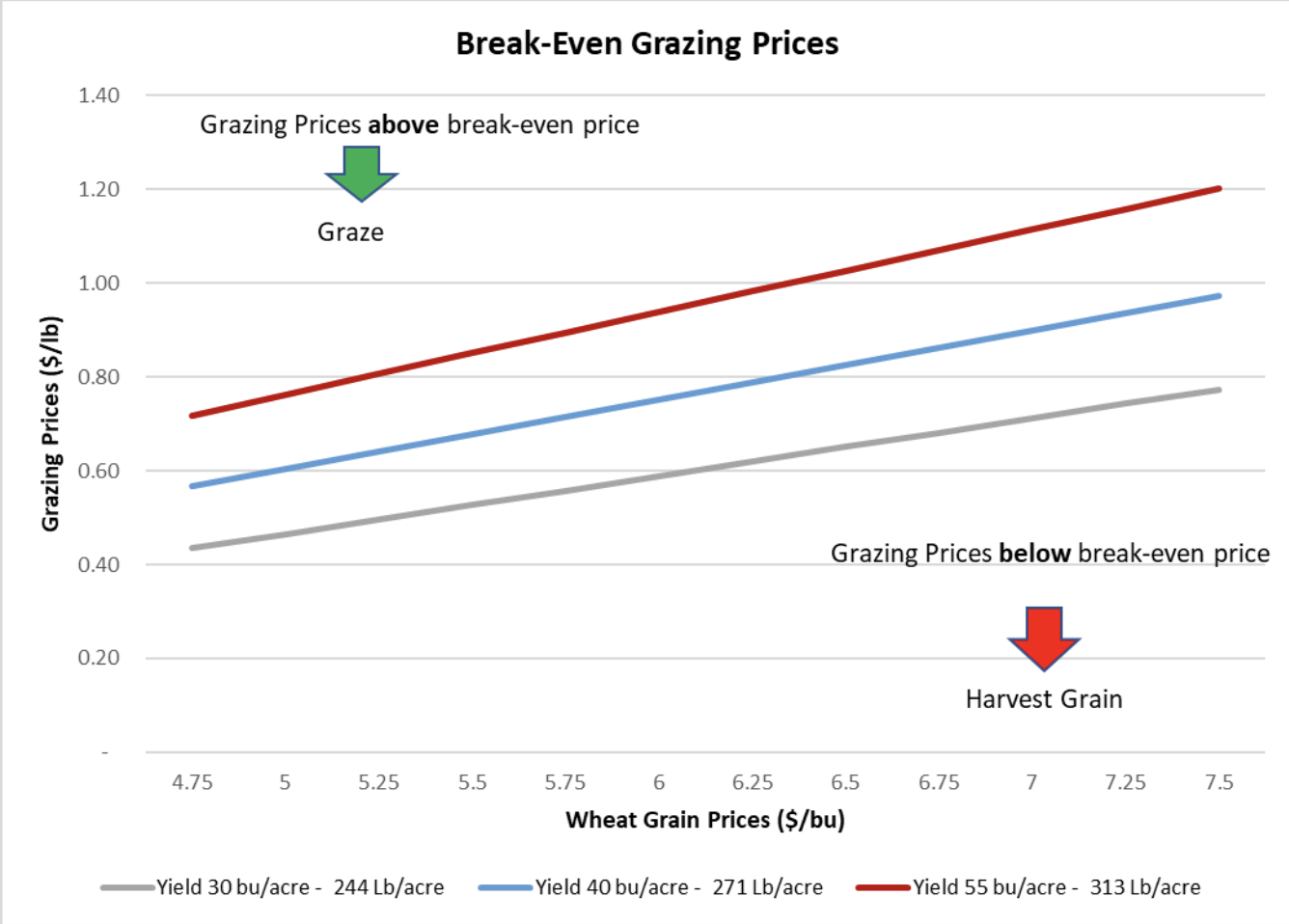
Similarly, with a yield of 40 bushels per acre at $5 per bushel, grazing is only advisable if the grazing price exceeds $0.60 per pound of gain.
Making the Best Decision for Your Farm
With Texas wheat prices low, alternatives such as grazing or hay production may offer better financial outcomes. The Wheat and Small Grain Decision Aid is designed to help farmers evaluate these options. Using your own data on yields, prices, and costs is essential for effective analysis. The examples provided reflect current conditions and expectations. If you need assistance using the decision aid, please let us know.